A Different Calling

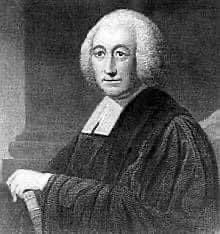
Today the church honors the person considered to be the founder of the Lutheran Church in America, Henry Melchior Muhlenberg, Missionary to United States.

Born in the early 18th Century, Henry was the seventh of nine children raised in Hannover, Germany. He started his professional life as a school master after graduating from studying at Gottingen and Halle, but soon felt a different stirring.

The Lutheran presence in America was scattered and disorganized. Three disparate congregations in Pennsylvania (Philadelphia, New Hanover, and New Providence) sent a joint delegation to London and Halle in search of a pastor who would unite the Lutherans together in the colonies.

Muhlenberg was chosen and sent in 1742. On his way he spent some time in London to learn about America, and while there adopted a new clerical garment that would be used by Lutherans in the colonies.

Henry arrived in Fall of 1742 and gained the trust of both the German-speaking and Swedish-speaking clergy…no small feat! Muhlenberg struggled mightily to unite the many churches that were so ethnic-specific. He traveled incessantly, wrote constantly, preached in German, Dutch, in English, and became known for his powerful voice.

He established the first Lutheran synod in America, the Ministerium of Pennsylvania, in August of 1748. The delegates met together and ratified a modern liturgy that remained the only authorized American Lutheran liturgy for forty years, and is still sometimes revived for use to this day and can be found in all the Lutheran hymnals up through the Lutheran Book of Worship (1978). Muhlenberg had a dream of “one church, one book,” and he didn’t mean the Bible…that was already done…he meant a liturgy book.

Lutherans in this frontier land struggled with authority issues as it moved from a state-supported church in Europe to congregational-led communities in the colonies. Muhlenberg worked mightily with churches on both stewardship and education, two practices that could use a little reviving today. He even wrote a model congregational constitution, never needed in Europe, that helped to organize the disorganized faithful.

Muhlenberg was in favor of a distinct church in America, noting that local practices must hold hands with local customs. Despite this belief, he was quite pietistic, and had a low tolerance for chicanery or shenanigans from clergy or laity.

Muhlenberg and his children were leaders in American public life as well. His son John Peter dramatically left the parish to serve in the Revolution, becoming a brigadier general under George Washington. Another son, Frederick (also a pastor), became a member of the Continental Congress and the first Speaker of the House of Representatives…much to his father’s disappointment. Muhlenberg believed he would have made a much better pastor and should have remained in the parish.

Another son, Henry Ernst was both a pastor and the president of Franklin College where he excelled as an administrator and a botanist.

Where did he find the time?

And Muhlenberg’s great grandson? He became an Episcopal priest who is honored on April 8th. Maybe that’s why Lutherans and Episcopalians in America love one another so much…

Henry Melchior Muhlenberg died in Pennsylvania on October 7th, 1787. You’ll find his remains under a monument where, inscribed in Latin, is this simple phrase, “Who and what he was future ages will know without a stone.”

Muhlenberg is a reminder for me, and for the church, that sometimes you can get a different calling in life (he and all of his children and a couple of vocations under the belts), and that listening carefully to that still, small voice can enable one to do much for the world.

-historical pieces from Pfatteicher’s _New Book of Festivals & Commemorations

On the Autumnal Equinox

On the Autumnal Equinox, my mind is brought back to those ancient Celts who knew the Earth was not just alive, but provided us with secrets on how to live.

Balance, Beloved, is more than hard to find…it is also hard to keep. The Earth only finds it twice a year, and is only able to keep it for 24 hours at a time.

But when it does, everything changes!

At the Vernal Equinox the world springs forth with color and newness.

And today? Well, Camus said that Autumn is a “second spring,” where “every leaf is a flower” beginning to blaze.

For the Celts, with over half of the fields cleared by now, it was time to take stock of the harvest, both within the barn of the heart and the barn outback. They would prepare for winter, using what the year so far has given to plot the next phase of life.

Blessed Equinox! Lean into the balance a bit, and learn how to live.

Sermon Post: On the Keys

I’m preaching this Sunday again, and here’s the words that are coming out of my mouth:

“But here’s the thing, Beloved: I wonder if sometimes we’ve lost the key that Christ handed to St. Peter that day, ya know?

In this grand moment, at the pinnacle of both commerce, power, and life-giving water, Jesus asks the disciples who they think he is.

And they give various answers: a prophet from the past, a prophet of the present…

But Peter says, “You’re the promised one of old.”

The promised one of old.

The promised one who would shed light on the shadows, who would bring comfort to the grieving, who would convince the wealthy that the coins in their pocket belonged to the poor, and remind the poor that they are somebody, by God.

The promised of old who forgives sins, has a short memory of wrongs, loves the unloveable, and who would die to have us think or believe otherwise. Even die on a cross.

The Messiah.

And I don’t know if Peter knew what he was saying or, perhaps like me in most of my moments, stumbled onto a truth he couldn’t quite grasp, but in that moment Jesus hands him the keys to the car and says, “Carry on my wayward son…” as the band Kansas would say.

And carry on he did. And he would be a wayward son, as it were. In one breath calling him the Messiah, and in another denying he knew him. In one breath receiving the Holy Spirit at Pentecost, and in another being wishy-washy over who could be called a Christian as the early church began.

Peter held the keys to the kingdom, but sometimes lost them.

Beloved: we hold the keys to the kingdom, but sometimes lose them.

We lose them when we fret so much about money that we lose sight of mission.

We lose them when we worry so much about who is not here than we do about who has shown up.

We lose them when we worry too much about who shouldn’t be let in to the graceful kingdom of God than we worry about who we excluding who is loved, by God.

By God.

We lose the keys to the kingdom all the time. And in this post pandemic world, as you’re waiting for your next pastor, I want to say to you: the keys of the kingdom of God are yours! Do not lose them!

It’s about mission, not budgets.

It’s about whose here, not who isn’t.

It’s about all-encompassing love, not gate-keeping.

The keys are here…and even if sometimes we lose them, you know, they can be found!

They can be found.

So what if you lose them?

Well, let me tell you.

Our nanny said, “I’ve lost the key.”  And I said, “No worries, I can go and make a copy.”

And you know where the copy is made?  Well, for our home key, it’s probably made at Ace Hardware or Lowes, you know?

But for us, for the faithful, for the Beloved community of which you’re a part of, the copy of the key of the kingdom is made here: at this table.

This table where everyone is invited forward, and no one leaves without something: some bread, some wine, the body and blood of Christ, or at least a blessing.”

Sermon Post: There’s Something About Mary…

I preached today or Churchwide Chapel for the Feast of Mary, Mother of Our Lord.

Feel free to take a read if you’re interested:

“If Mary reminds me of anything, she reminds me that even God’s entrance into the world started with fear and doubt and trembling and humility and uncertainty.

The one who would cast the mighty down from their thrones first sat in a highchair.  The one who would lift up the humble of heart was birthed by a visionary young woman the world only saw as humble, but who knew in her being that she was called.

There’s just something about Mary…”

Replay.

“I just keep re-living my mistakes,” he said, face down.

“You mean, you keep making the same mistakes?” his friend asked.

“Not really,” he said. “I mean that I just can’t forget them.”

It was clearer now.

“Remember,” his friend said slowly, “that time you defied the odds and got that recognition for a job well done? It was just like, last year, right?”

He looked up. “Yes,” he said nodding.

“How about you replay that record. You haven’t heard it in a while.” And his friend sat next to him and together they remembered the things worth remembering.

The Great Disappearing Act

Today the church celebrates one of our calendar-contingent feast days: The Feast of the Ascension.

Or, in German, Himmelfahrt (which is much more fun to say).

In Norwegian it’s Himmelfartsdag (even more fun to say).

But, I digress…

The Feast of the Ascension follows the Biblical pattern of 40, and finds itself a square 40 days after Easter. That Biblical pattern of 40 is meant to be a touchstone for those who pay attention.

40 days and 40 nights of the floating ark.
40 years of wandering for Israel.
40 days of temptation in the desert for Jesus.

This is not coincidence, Beloved, but rather a repeating tracer by Biblical writers to say, in a concise way, that 40 is “when you’re at your wit’s end” and you can’t take anymore.

When it comes to the Ascension, though, it’s flipped. The Biblical account notes that Jesus appeared to the disciples, and a few random folx, for 40 days and then exited stage left. It’s kind of like the Divine has “had enough.”

Why?

Because if Jesus had stuck around, the disciples never would have. We love to get attached to things and then depend on them for the hard lifting, right?

If Jesus had stuck around, the church would never learn to lean on one another (I mean…they’re still struggling to do that 2000 years later, right?).

Just like birds are kicking the chicks out of the nest in these May days, saying, “You’re made for this!” the Ascension is a way to explain that Jesus isn’t showing up in the same way anymore.

So you, Beloved, have to.

In fact: you’re made for this.

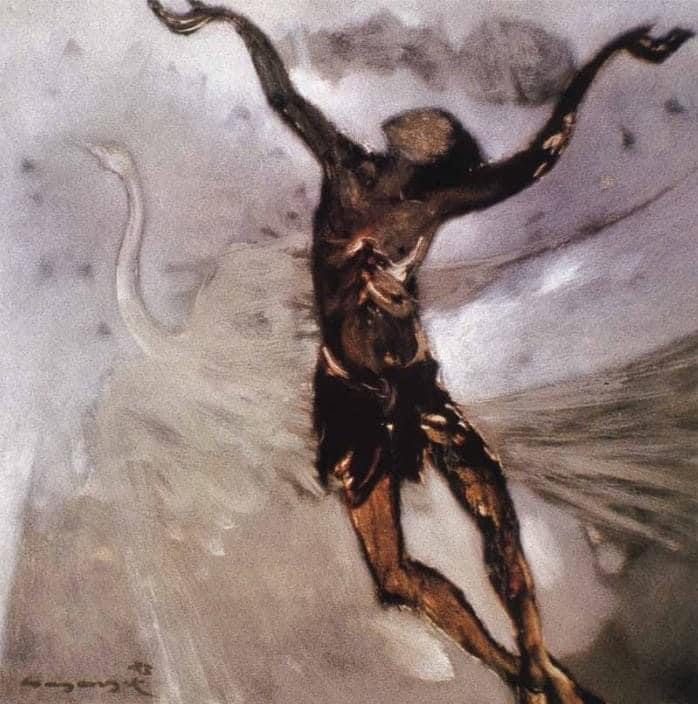
-art by Bagong Kussudiardja (Indonesian, 1928–2004), Ascension, 1983

The Blue Jay

The Blue Jay

My boys will look
at a Blue jay
and turn to the coloring page
and, choosing the yellow crayon,
go to town on the bird before them.

They call it a “blue jay,”
but it is canary yellow.

And instead of saying, “that’s wrong,”
which is my instinct,
my training by a world
that thinks in boxes…
(like damned auto-correct for the
creative heart)

I’m now just jealous.

Of that kind of insight.

The kind of insight that can see
what is
and riff on it like a jazz player.

The kind of insight that can make
a new world
using bits and pieces
of this one.

A Book Review: _The Beauty of Motherhood_

Spoiler alert: I’m not a mother.

But I am a parent, a father even, and in picking up the new book The Beauty of Motherhood by Kimberly Knowle-Zeller and Erin Strybis found echoes of my own experience in these pages.

Organized in a similar fashion as To Bless the Space Between Us by another deep-thinking writer after my own heart, John O’Donohue, The Beauty of Motherhood provides reflections, prayers, and practices that correspond to that age-old question by the pensive writer of Ecclesiastes, “What time is it?”

As any parent knows, each stage of development in those early years is also a stage of development for the parent walking with that child. This book surrounds the stages of “infancy,” “toddlerhood,” and “childhood” with words that bless, console, and encourage moms and mothering figures, bringing intention and attention to the movements of the heart.

I always balk when people tell young parents to “savor every moment,” because honestly you’re usually too tired, confused, or even annoyed to enjoy one moment, let alone every one. This work provides some scaffolding to that sentiment, though, easing the pressure that phrase can cause. A parent need not savor every moment in real time, but with the help of these authors can bring memories and moments that may have slipped away, giving them new life through these reflections.

A special part of this work, and one that is all too familiar to so many but rarely talked about, are the parts where the anxiety and heartache surrounding “waiting for motherhood” is given voice.

Motherhood is a mixed bag. These authors know this well and are attentive to the prismic emotions that comes with it.

The Beauty of Motherhood is a book that, while geared toward those first years of being a mama, could certainly help one awaken meaning at any stage of mommy-ing. My own boys have long since abandoned calling their mom “mommy” (a sad milestone of its own!), and rarely call me daddy anymore. But having something that notes that threshold makes a difference to these parenting hearts, even if for a few paragraphs.

This is the perfect gifts for moms and moms-to-be, and I would contend makes a great gift for grandmothers, too, especially as they watch their children live into parenting in their own way.

Trying to encapsulate the distinctive reflections in this book in a succinct post is difficult, so maybe I’ll let the author’s words do their own speaking here at the end.

When talking about exploring nature with their young son Jack, one mom is brought to a fallen tree trunk where green moss is growing tenderly on bark, “a burst of color amid a muted landscape.”

“What’s this, Mommy?” the young Jack asks.

“It’s beautiful,” the mom replies. (p. 120)

And that, Beloved, is kind of what it feels like at the best of times to be a parent, a mommy (and a daddy).

It’s beautiful.

And it is.

This daddy saw himself in the beauty of motherhood here.

On Dreams

“It’s just like I told you,” she said. “I feel like I’m behind in everything. I’m not where I thought I’d be at this age, at this stage, at this point in my life.”

“I see,” he nodded. “Well, sometimes dreams aren’t realized not because you did something wrong, but because the dream was just that: a figment of your imagination.”

“But it feels like I messed up. Like others are realizing their dreams, and I’m deficient.” She put her head down.

“The great thing about dreams,” he said, “is they’re new every night. Dream a new dream. That other one has grown stale. You’re not the same person who dreamed it long ago. You’ve changed.”

She sighed.

“It’s ok to dream a new dream,” he said, as he put his arm around her. “The important thing is to keep dreaming.”

Sermon Post: Wild Things

“Preached at the Evangelical Lutheran Church of the Epiphany this last weekend. Went in with one sermon, but ended up doing this one…

Our ancient mothers and fathers conceived of God as being a bit wild.  Why do you think the angels always open with the words, “Fear not!”? We’ve domesticated God, equating God with Santa Clause, the giver of gifts and tally-taker of who is on the nice and naughty list.  But God’s encounter with Moses was not the red of a flannel suit and rosy cheeks, but a bush on wild-fire, defying physics and tantalizing the imagination.

We’ve domesticated Jesus, pretending he votes our values (or we vote his), putting him in stark white robes so that he looks like the pastor we’ve always dreamed of (with considerably more hair).  But perhaps Jesus is more John the Baptist than John Smith.

We’ve domesticated the Holy Spirit, relegating her to a peaceful dove who gently alights upon shoulders and inspires beautiful paintings.  But maybe the Holy Spirit is more gadfly than dove, aggravating more often than alighting.  For this example, I appreciate my Celtic ancestry.  They referred to the Holy Spirit as “Ah Gaedh-Glas” or “The Wild Goose,” sending the Celts on a wild goose chase, literally, as they sought out the Spirit to inform their lives.

And if God is wild, then the kingdom of God is wild.”