

Rituals for Surviving Shelter-in-Place

many-candles1Religion, as a whole, knows something very human about us: we desire ritual.

This is true even if you don’t find yourself religious, and even if you find yourself a-religious.

We thrive off of ways to mark the days and the seasons of the Earth, as well as the particular seasons of our lives.

Rituals are a way of reminding humans not only what time it is, but also this deep truth: nothing lasts forever.  Not the good, and not the bad.

Nothing lasts forever.

Our ancestors used to, in the fallow months, take the wheels from their carts, haul them inside, and adorn them with candles.  Every day they’d light a candle, adding to growing, glowing wax, marking the time until work could begin again.  This pre-Christian practice was eventually seized by the church, and this eventually turned into our Advent wreaths that light the path toward Christmas.

Likewise, in Lent, humans have found ways to mark the time before the abundance of Spring.  These practices usually involved some sort of abstinence as a way of drawing attention to the longing deep within us for new life, for newness, for freshness and freedom.

For those of us now stuck at home during this pandemic, the likes of which we haven’t seen in over a Century, a way to survive it with our souls intact might involve this sort of patient practice…especially as we have a habit of losing our patience, and so must cultivate new habits.

One habit a family might adopt would be to find eight candles.  They can be votives to be replaced in individual holders, or eight candles of more substantial measure, able to last through the weeks without changing.

Name the candles, one for each week.  They can be named for a virtue that you hope to practice in a particular week as we wait for the first wave of this pandemic to pass.  Or they might be named for longing or hope that is embedded in your heart in these days.  A sarcastic practitioner may even name them after a cruse word…which, to be honest, is sometimes cathartic, too!  Perhaps each candle has a couple of names, depending on the mood, and depending on the need.

A possible cadence for a Christian family might be:

Perseverance (March 23-March 29)
Conviction (March 30-April 4)
Remembrance (April 5 [Holy Week]-April 11)
New Life Hope (April 12 [Easter]-April 18)
Love of Neighbor (April 19-April 25)
Love of Self (April 26-May 2)
Devotion (May 3-May 9)
Celebration (May 10-Pentecost)

And each week, light a candle in the morning before breakfast, and at night during dinner, or just after.  And as you light it, remind yourself that the growing fire indicates the approaching abatement of this liminal time.

You can accompany each week with a particular reading to hold in front of you.  A possible schedule of readings for the above candles might be:

Week 1: 1 Peter 5:8-10

Week 2: Psalm 69:13-15

Week 3: The Passion from the Gospel of John

Week 4: The Resurrection from the Gospel of John

Week 5: John 20:19-29

Week 6: John 21:1-14

Week 7: Isaiah 43:1-3

Week 8: Acts 2:1-11

For a less traditional grouping of readings, especially for those who may not find their home in the Christian community, or even a church at all, the candles could retain their same theme (as I think they’re universal human themes), but the readings might look something like this:

Week 1: “be easy: take your time. you are coming home. to yourself.” -Nayyirah Waheed, _Nejma_

Week 2: “‘Change and decay–in all around I see,’ we cheerfully sang in my days as a choirboy. Another stanza should have taught us this lesson: it is not only beauty and life that disappear in the cycle of time. Pain too passes, along with heartbreak, fear, and sickness. In a world doomed to fragility, death itself shall someday die.” -Robert Griffin, _In the Kingdom of the Lonely God_

Week 3: “My dear children, perhaps you will not understand what I’m going to say to you now, for I often speak very incomprehensibly, but, I’m sure, you will remember that there’s nothing higher, stronger, more wholesome, and more useful in life than some good memory, especially when it goes back to the days of your childhood, to the days of your life at home. You are told a lot about your education, but some beautiful, sacred memory, preserved since childhood, is perhaps the best education of all.  If a person carries many such memories into life with them, they are saved for the rest of their days. Even if only one good memory is left in our hearts, it may also be the instrument of our salvation one day.” -Fyodor Dostoyevsky, _The Brothers Karamazov_

Week 4: “Oh me! Oh life! of the questions of these recurring,
Of the endless trains of the faithless, of cities fill’d with the foolish,
Of myself forever reproaching myself, (for who more foolish than I, and who more faithless?)
Of eyes that vainly crave the light, of the objects mean, of the struggle ever renew’d,
Of the poor results of all, of the plodding and sordid crowds I see around me,
Of the empty and useless years of the rest, with the rest me intertwined,
The question, O me! so sad, recurring—What good amid these, O me, O life?
                                       Answer.
That you are here—that life exists and identity,
That the powerful play goes on, and you may contribute a verse.” -Walt Whitman, _Leaves of Grass_

Week 5: “To love is good; love being difficult. For one human being to love another; that is perhaps the most difficult of all our tasks, the ultimate, the last test and proof, the work for which all other work is but preparation.” -Rainer Maria Rilke, _Letters to a Young Poet_

Week 6: “Neal: You’re no saint. You got a free cab, you got a free room and someone who will listen to your boring stories. I mean, didn’t you notice on the plane when you started talking, eventually I started reading the vomit bag? Didn’t that give you some sort of clue, like hey, maybe this guy is not enjoying it? You know, everything is not an anecdote. You have to discriminate. You choose things that, that are funny or mildly amusing or interesting. You’re a miracle. Your stories have none of that! They’re not even amusing accidentally. Honey, I’d like you to meet Del Griffith. He’s got some amusing anecdotes for ya. Oh, and here’s a gun so you can blow your brains out. You’ll thank me for it. I-I could tolerate any, any insurance seminar, for days. I could sit there and listen to them go on and on with a big smile on my face. They’d say, “How can ya stand it?” And I’d say, “‘Cause I’ve been with Del Griffith. I can take anything.” You know what they’d say? They’d say, “I know what you mean. The shower curtain ring guy.” It’s like going on a date with a Chatty Cathy doll. I expect you have a little string on your chest. You know, that I pull out and have to snap back. Except that I wouldn’t pull it out and snap it back, you would. And by the way, you know, when, when you’re telling these little stories, here’s a good idea. Have a point. It makes it so much more interesting for the listener!

Del: You wanna hurt me? Go right ahead if it makes you feel any better. I’m an easy target. Yeah, you’re right. I talk too much. I also listen too much. I could be a cold-hearted cynic like you, but I don’t like to hurt people’s feelings. Well, you think what you want about me. I’m not changing. I like me. My wife likes me. My customers like me. ‘Cause I’m the real article. What you see is what you get.” -from “Planes, Trains, and Automobiles”

Week 7: “Listen to the MUSTN’TS, child,

Listen to the DON’TS

Listen to the SHOULDN’TS

The IMPOSSIBLES, the WON’TS

Listen to the NEVER HAVES

Then listen close to me—

Anything can happen, child,

ANYTHING can be.” -Shel Silverstein, “Listen to the Mustn’ts” from _Where the Sidewalk Ends_

Week 8: “We, this people, on a small and lonely planet
Traveling through casual space
Past aloof stars, across the way of indifferent suns
To a destination where all signs tell us
It is possible and imperative that we learn
A brave and startling truth

And when we come to it
To the day of peacemaking
When we release our fingers
From fists of hostility
And allow the pure air to cool our palms

When we come to it
When the curtain falls on the minstrel show of hate
And faces sooted with scorn are scrubbed clean
When battlefields and coliseum
No longer rake our unique and particular sons and daughters
Up with the bruised and bloody grass
To lie in identical plots in foreign soil

When the rapacious storming of the churches
The screaming racket in the temples have ceased
When the pennants are waving gaily
When the banners of the world tremble
Stoutly in the good, clean breeze

When we come to it
When we let the rifles fall from our shoulders
And children dress their dolls in flags of truce
When land mines of death have been removed
And the aged can walk into evenings of peace
When religious ritual is not perfumed
By the incense of burning flesh
And childhood dreams are not kicked awake
By nightmares of abuse

When we come to it
Then we will confess that not the Pyramids
With their stones set in mysterious perfection
Nor the Gardens of Babylon
Hanging as eternal beauty
In our collective memory
Not the Grand Canyon
Kindled into delicious color
By Western sunsets

Nor the Danube, flowing its blue soul into Europe
Not the sacred peak of Mount Fuji
Stretching to the Rising Sun
Neither Father Amazon nor Mother Mississippi who, without favor,
Nurture all creatures in the depths and on the shores
These are not the only wonders of the world

When we come to it
We, this people, on this minuscule and kithless globe
Who reach daily for the bomb, the blade and the dagger
Yet who petition in the dark for tokens of peace
We, this people on this mote of matter
In whose mouths abide cankerous words
Which challenge our very existence
Yet out of those same mouths
Come songs of such exquisite sweetness
That the heart falters in its labor
And the body is quieted into awe

We, this people, on this small and drifting planet
Whose hands can strike with such abandon
That in a twinkling, life is sapped from the living
Yet those same hands can touch with such healing, irresistible tenderness
That the haughty neck is happy to bow
And the proud back is glad to bend
Out of such chaos, of such contradiction
We learn that we are neither devils nor divines

When we come to it
We, this people, on this wayward, floating body
Created on this earth, of this earth
Have the power to fashion for this earth
A climate where every man and every woman
Can live freely without sanctimonious piety
Without crippling fear

When we come to it
We must confess that we are the possible
We are the miraculous, the true wonder of this world
That is when, and only when
We come to it.” -Maya Angelou, “A Brave and Startling Truth”

Of course, the imaginative practitioner could incorporate all of these readings, and add to them as desired.

Mark the days, Beloved.  They may not fly, but at least they won’t crawl.


Channeling the Best Parts of the Greatest Generation

5988555_coronavirus-thumb-img-COVID-01Covid-19 is set to put most everything on hold in the United States, as it is already doing in China, Italy, South Korea, and Norway.
Early on in this cycle, as news started trickling out about the virus and its spread, I was a scoffer.  “We’re overreacting,” I said to my partner.  “This is just crazy.”

And then the deaths started in the United States.  And confirmed cases started rising not by tens, but by hundreds, in a week.

“I’m youngish and healthy,” I thought.  “I’ll be fine.”

Which is a natural thought…but was only looking out for me.  I’m not at risk, but I still have a role to play here.  And so do you.

The tide is coming, and we have a choice as a nation: implement severe caution now in the short-term, or clean up from a deadly disaster in the long-term.  The stakes are pretty clear at this point.

The problem is that the last generation to really tighten their belts and do the hard work of social sacrifice was the Greatest Generation, and most of them have passed on.  Through rubber shortages and food rationing, to the social distancing that was necessitated during the Spanish flu and polio years (they were children then, but certainly felt the sting), that generation understood what it meant to sacrifice for the greater good, and that’s just never really been asked of the United States since, thank God.

Even the draft in Vietnam, while certainly difficult and earth-shaking for many, did not bring the United States to its knees in the way we’re slowly being brought to a stop now.

We’ve been here before in World Wars and epidemics of the past, but for most of us, we’ve never been here before.

And we need to embrace the moment to show that we can do it, and that we understand the risks involved.

In this time we are being called to sacrifice for our neighbors; we’re all being drafted into this, and we must answer the call, hopefully for only a short while.

But if it’s longer, so be it.  We can do this, together.

At its best, Christianity is a religion that mandates (not just encourages, but mandates) that adherents look out first and foremost for “the least of these.”  In this moment, those people are not only the ones who are at most risk of catching and dying from this virus, but also children who will go without food because schools are canceled, families who will scramble to find childcare as that is canceled, workers who rely on mass gathering for their wages, and small businesses with small margins who will see a huge reduction in traffic.

So, what to do?  Here are just some ideas…

-Consider take-out from your favorite place, or buy a gift-certificate to use after the crisis.

-Check on elderly neighbors and offer to go shopping for them for staples (note: toilet paper is a staple, but no one needs a million rolls to get us through this…Covid-19 does not cause diarrhea).

-Give a lump-sum donation to your local food bank, now, to get them over the hump.

-If you go to a church, give your regular offering even if worship is suspended.  Mail in the check, or give online.

-If you are in charge of large gatherings, put them on hold for a few weeks.

-Support local artists who live gig to gig with a Patreon donation or a gift in honor of their creative work.

-If you have predictable income, maybe give a gift to someone who is losing wages because they don’t have paid sick-leave or have been furloughed without pay (which may happen).

-Stay home as much as possible.  Seriously.  And if you do go out, stay away from others as much as possible.

-Offer gift-cards or even meals (as long as no one in your family is sick) to families with nurses, EMTs, police officers, or fire personnel.

-Wash your hands.  A lot. Not just for you, but for others.

-Offer your home to people for whom home isn’t a safe place.  As long as we’re symptom free, small gatherings are not bad.

-Talk on the phone. A lot. Especially to people who may feel extra lonely during these days of social isolation.

We can do this.  Let’s channel the best parts of the Greatest Generation and all do our share (not just fair share, but even extreme share) to make this a footnote in the annals of history.

If You Want a More “Christian” Nation, Elect the Lapsed Jewish Guy

So, here’s the irony: if you want a more “Christian” nation, at least in practice, Bernie Sanders is your candidate.

Hands down.

Full disclosure: I care nothing about having a more “Christian” nation. I think the very idea is actually probably blasphemous…Jesus was into justice for the oppressed and freedom for the captives, not for setting up governments.

But so many say they want this…but, as Jesus says, they know not what they do.

I read a terrible article in the Christian Post (insert your own quotation marks there) about why Christians should vote for Trump and it was all drivel. Anti-intellectual, history-ignoring, nonsense. Going on and on about conservative judges and anti-abortion rhetoric.

Fun-fact: the early church was against infanticide, which was saving babies abandoned after they were born. Today that looks a lot like a social safety net, not anti-medical procedure bills.

Know your history.

So much of “Christian” these days is about belief, and so little about practice, the whole thing has been confused. Many atheists are more Christian in practice than many (most?) regular church-goers who have been “born again” by saying some prayer…

The truth is, though, that if the United States wanted to mirror the early church, they would do these things:

-support the poorest amongst them through shared finances.

-absorb the debts of those within their circle.

– pass out healthcare like it’s going out of style (Jesus was a provider of free healthcare in the ancient world if you trust the Scriptures)

-welcome the stranger

-provide food for everyone, whether they’re at the table or absent.

-use the common good to support (gasp) the commoners.

In the most ancient accounts of the first church, the Book or Acts and the Didache, you find all of the above. Literally. It’s all there.

If you want a more “Christian” nation, vote for the Jewish guy. And if not him, probably the gay guy, or the women from Massachusetts or Minnesota.

They have more in common, at least in ideology and practice, than the current occupant.

Oh, and here’s a secret: Capitalism is not Christian. In fact, it’s anti-Christ in many and various ways…and it amazes me that Christians don’t get this, by and large. Have you read about Jesus?

The Jesus of personal responsibility is a myth. Jesus was about communal responsibility.

We’ve largely forgotten Christian history. We think Constantine is Christ. Or Paul is Christ.

But those first Christians? They knew something about practice: it trumps (word chosen on purpose) belief.

Constantine used the cross to force power on people. Jesus used the cross to break the powerful. The early Christians new this, and practiced it.

We’ve largely forgotten it.

Want a Christian nation (in practice, at least)?

…well, you have some candidates…

The Problem with Pulpits Today

lead_720_405<BTW: all of these quotes are paraphrases, not verbatim, and cobbled together from a few like emails>

“We personally like you,” the email said, “but we leave church services more frustrated than anything, and so we’d rather just stay home.”

It was sent after I offered an email saying that I hadn’t seen them in a while, and after hearing bits and pieces of them “being unhappy.”

I mean, it’s OK, people get unhappy with their pastors sometimes.  That’s part of the deal of leadership.

But why were they frustrated?

Because they heard political undertones in my preaching.  Which is strange to me, because I meant them to be political overtones…

Not partisan, mind you.  Partisan tells you what party to vote for; I don’t care what party you affiliate with, if any.  And although I might struggle with your vote, I’m not going to tell you who to vote for…I struggle with my vote, too.  I wasn’t partisan in my preaching.  I am not, to this day, partisan in my preaching.

But political?  Well, yes.  That was there.  Because the Gospel is political.

The Gospel is about God and people, and people in community are political. So if you’re upset, blame the politician, not the pastor…I didn’t make those laws. I didn’t say those de-humanizing things.

Because this was all going on during the so-called “Muslim ban” (which nations are being added to as I write this).  The ban continues.  You forgot about it?  Huh.  Guess who hasn’t: Lutheran Immigration and Refugee Services, as they try to fight this ban tooth and nail.

And this was all going on as talk of wall construction continued to be shouted about, even as children were being separated at the border, and some dying.  You forgot about it?  Guess who hasn’t: the families affected by this mean-spirited legislation, perpetrated under administrations of both major parties.

And this was all going on as the nastiest, meanest, overtly racist rhetoric (remember Charlottesville?) was being spewed from our nation’s top office.  You forgot about it?  No…who could forget white yuppies with tiki-torches marching without masks through the streets of a Southern city, newly emboldened in their racism because the fish rots from the head.

And if you are a pastor in those waters, and you’re not talking about any that, shame on you.

Seriously.

Do you think Isaiah wanted to say the things he said about the powers that held sway at his time?  No.  But he had to.

Do you think Amos wanted to call from the fringes of society to point to the underclass and the rural poor, showing how they suffered under the foot of the powerful?

No…but he had to.

Do you think Jesus wanted to point out the hypocrisy of the Pharisees, call his local ruler a “fox” (or, a “sly liar”), or run toward the danger of Jerusalem rather than live safely, quietly, in Galilee?

No, but he had to.  You have to, pastor.

“Never trust a pastor who tells you how to vote,” the email went on to say, “or a politician who tells you how to pray.”

I think it was an attempt at levity, but all I could do was scratch my head and wonder what was happening in our society.  I’ve heard many politicians, especially recently, tell people how to pray (just Google “prayer in schools” legislation recently brought up in the courts. Again.).

Remember the age of women’s suffrage.  Remember the era of Civil Rights (did we ever leave that era?).  Remember, pastor, and speak.

Pulpits cannot be partisan.  And pastors have a responsibility to bring people along as much as possible when it comes to difficult and divisive issues, listening and leaning in.

You can be partisan on your bumper with that bumper sticker, but not on your stole.  The stole is reserved for God’s mark, alone.

But pastors, remember also, in our baptismal rite, have a responsibility to “work for peace and justice” throughout all the world, as do all baptized persons.  And part of that work is calling out oppression and danger, especially when it is aimed at those who are already disenfranchised.

The email was right: no pastor should tell someone what party to vote for. I never did and never will from the Office.

But the pastor must tell people the truth: votes have consequences, some you may not like, some that go against the ideals of a God who is love.

And if that’s the case, preach. From the Office, from the pulpit, preach.

That’s the problem with pulpits today: people will leave over them. And that’s OK.

It’s sad, but it’s a sign of our times, and you have to preach anyway.

Hi. I’m Pro-Life but Not Anti-Choice

1-1578136179258Hi.

I’m a father of two, and I consider myself pro-life, even though I’m not anti-choice.

And actually, I view access to safe, legal, and rare abortion as part of women’s healthcare…which is about life.  So I see this all as being very consistent.

What I don’t see as consistent is the idea that being “pro-life” strictly means being “anti-choice.”  That’s not pro-life at all.  That’s pro-fetus.  That’s different.

See, I’m pro-life because I not only trust environmental science and scientists when they tell us the Earth is warming at an alarming rate, I try to do things and support legislation that will slow, if not reverse, that tide.

I’m pro-life because I’m pro universal healthcare.  If we had universal healthcare, you know what?  There would be fewer abortions.  I’m almost certain there would.  Universal healthcare is pro all life.

I’m pro-life because I’m pro public education.  In fact, I’d love more of my tax dollars to head that way.  An educated public is in my best interest, and yours, even if you don’t have any children.  I want my baristas reading Kant, knowing long division, and well-versed in politics.  You should, too.  It makes for a better society.

I’m pro-life because I’m for a social safety net that helps those who are stuck in cycles of poverty and oppression.  I’m pro-life because I’m pro breaking those cycles at every turn. The biggest farce of the traditional so-called “pro-life” movement is their abandonment of those already born in deference for the fetus.  If you force people to have babies, you should be willing to support those children to adulthood.

I’m pro-life because I’m against the death penalty, in all cases.  You might see a contradiction there between not being against abortions but being against the death penalty, but here’s the thing: I know that the person on death row is a living, breathing, human.  It’s unquestionable.  I do not know that a fetus is…none of us do.  But we do know a living, breathing, post-birth person is, regardless of what they’ve done.

I’m pro-life because I’m anti-war.  I’d love to designate the majority of my tax dollars to education and public safety, and give as little as possible to public defense.  Not because I do not enjoy the merits of a free and well-protected society, and not because I do not respect our people in uniform…I certainly do.  But because I believe we have over-compensated in that arena since the days of Eisenhower, and have left our children and our homeless and our hungry and our lonely to get the scraps of our social love.

And what’s more: those who do fight in our endless wars, which are well funded, in too many ways become homeless and hungry and lonely and sick when they return from war.  We fund them while they’re fighting, and abandon them while they’re mentally and physically and emotionally dying. This is duplicitous on our part, and we can do better.

I’m pro-life because I’m pro-immigration.  I don’t believe in open borders, but I certainly don’t believe in walls, either.  And I don’t believe in family separation, no matter if a Democrat does it, or a Republican enforces it.  Anyone who claims to be “pro-life” but wants to build a wall is playing a game of semantics and lying to themselves.  They are not pro-life; they are pro their “way of life.”  That is very, very different.

I’m pro-life because I’m pro female healthcare.  Women can choose what happens to their bodies.  So few abortions happen because a child “isn’t wanted.”  So many happen because a fetus isn’t viable, or there are other risk factors involved, and though I cannot imagine ever counseling someone to end a pregnancy, I do not think it is my right to tell them they have to continue it. You just walk with them, give them the best information available, and support them.

The choice is too personal, and too difficult, to legislate in the negative, so we must protect the legislation of the positive, of choice.

We need a re-definition of pro-life in this nation, and I say this as thousands gather in the “pro-life” march at this moment.  Our popular definition is far too narrow.

Because here’s the thing: I don’t like that abortions happen, but I understand why they do. I don’t think anyone likes that they happen. I don’t think anyone is “pro-abortion.” I cannot, as a man, relate to having to make the choice, but I can empathize for sure. It’s always tough, always sad, always personal, and, as a medical procedure, should always be legal.

Because sometimes difficult things happen in life, which means difficult choices have to be wrestled with.  And the only way to safely wrestle with them is…well…this way.

It’s about safety and healthcare in the end. It is.

You cannot “protect” the fetus in the womb and abandon it the moment the umbilical cord is cut.  That’s not protection at all.  That’s forced abandonment. That’s pro-fetus.

I think you can be pro-life but not anti-choice.

In fact, I would say that’s the most consistent way to be.

The Particular Anxiety of the Local Congregation

let-it-goCommunities have anxiety.  All of them do.

Work communities hold anxiety, especially when rumors of acquisitions, layoffs, and resignations begin to swirl.  This may be what Jesus was referring to when he said that you will hear “wars and rumors of wars.”  Maybe it wasn’t literal wars he was referring to, but the weird wars we play on an uncertain future when given the chance.

Family communities hold anxiety, too.  This usually presents itself in grudges, passive-aggressive phone calls, or over-communication between parties.  You know, so Edna doesn’t bring too much egg salad again to the picnic because no one really likes it, anyway.  And, do you think Brian will bring his boyfriend?  Because grandma can’t handle that yet…

The local congregation, too, holds anxiety, but in my experience, they do it in these really strange, yet predictable, ways.

Way One: the rumor mill.  It starts churning in the parking lot after church.  Or in the Fellowship Hall (really, shouldn’t we call these gossip halls?) during coffee hour.  Or in whispers during the offering after spying that thing in the announcements that you really don’t care for.

Notice how, in this particular way, no one actually goes to the pastor.  Instead, the pastor will hear about these “wars and rumors of wars” being fought in the shadows, and will say the predictable, “Tell them to come talk to me if they have an issue.”  And they have to say this because no one will give up the name of the person with anxiety.  Their name is “some people.”  As in, “some people are talking…”

Pro-tip: If you’re not ready to reveal who “some people” are, or usually, is (mostly always singular), don’t bother saying anything at all.

Way two: the late-night email.  Pastor’s inboxes are these strange depositories for so many people’s anxieties.  And I can’t tell you how many anxious, terse, or even just plain nasty emails, usually emboldened by rumor or fact-less fret, were sent after midnight.  It’s just there, staring at you, the minute you check it the next morning.

The inbox is where we hold a lot of our anxiety, transferring it there for safe keeping.  More often than not, I’d just delete it.  Because they didn’t need the anxiety, and had put it in my inbox.  And guess what?  I didn’t need it either, so the delete folder got it.

Way three: the anonymous note.  In what world do we think these are helpful?  Can we just all agree to put our name on our issues?  Please?  Trust me, you will feel better if you put your name on it.  Why?  Because then the pastor can actually talk to you about it.

But if you don’t want to put your name on it, do yourself a favor and write it out…and then throw it away.  Because that’s where your pastor will put it: in the literal trashcan. Or, at least, they should.  It’s what I coach them to do.

Way four: the grand withholding of funds.  “Until this is changed,” it was said, “I’m not giving another dime.”

This particular tactic isn’t just harmful to the church, by the way, but I truly believe it’s harmful to the giver.  If I agreed with every. single. thing. a place who got my benevolence did, enacted, or invested in, I’d probably never give any of it away.  Which, ironically, is what so many protestants do, as we’re known for giving only around .46% of our income away.

Notice that decimal point.

Leveraging your generosity to get your way on a pet project is probably the definition of bullying, especially for an organization that runs off of generosity.

Times of change and transition are always touchy, no matter our context.  We are animals who say we like adventure, but love to anchor ourselves in routine.  Deviation is not something humans do very well.  Evolutionarily, deviation meant danger…our lizard brains take over and our anxiety can get the best of us.

So what shall we do with our anxiety?  Name it.  Call it out.  Voice our concerns honestly with those who can actually address them.

And then see what happens.

Let them drift down the river of life.

Because our anxieties are just preoccupations with the future that prevent us from being present, and prevent us from being our best-selves.

One of the reasons I always deleted those late-night emails I received was because I knew that the person sending them was not in their right mind…because no one in their right mind sends those off.  And I wanted them to be their best-selves.  None of us need a paper trail of our most anxious moments.

But why bother to name these anxieties anyway?

Because they destroy communities.  They erode trust using half-truths and misinformation.

And they infect a congregation like a virus.  This is how congregations get sick.

The best medicine when you hear of “wars and rumors of wars” is to name the war, name the rumor, offer it up as a sacrifice to both God and anyone who can do something about it, and then, as Elsa would say:

let it go.

The Problem of the Circles

three_circlesSince I left parish ministry, I’ve had many people inquire as to the “real reason.”

Well, when I find out the whole story, I’ll tell you…

There isn’t just one, but rather many. And they’re not good or bad or anything.

They just, well, are.

A new call.  A nudge away.  A pull away.  A new mission.  I mean, all sorts of things.

But after serving in parishes for ten years, I do know a thing or two about what kills professional church workers emotionally, psychologically, and physically.  Parish ministry is, as the saying goes, “death by a thousand duck bites.”  I still, to this day, have a post-traumatic stress relationship with my phone.  When it rings, I react negatively.  Even after six months out of the parish I can’t help but wonder who died, who’s pissed, who’s in crisis, or who needs my attention.

Parish pastors aren’t, of course, the only professionals who have this relationship with their phones.  Chaplains, medical doctors, undertakers, and all sorts of on-call professionals know that dread.

But I’m not writing about that today, actually.  I’m writing about a more acute issue, one that leads to burn-out more quickly than the phone, and most any other, I’d suggest.  I’ve named it, “The Problem of the Circles,” and it literally caused me more dread in my years in the parish than most any other problem.

So, here it goes, some truth:

You have circles you run in.  Everyone does. And they overlap somewhat.

Somewhat.

One is your professional circle, or where you do your work.  It’s how you make your money, how you earn the means to eek out your small existence in this corner of the universe.

Another is your family circle, both biological and chosen.  In this circle you form relationships that sustain you and keep you.

A third is your voluntary circle.  For some this takes the form of hobbies, and for others it takes the form of charity or philanthropic work.  In some lives, those two are combined.

These three circles make up our existence and friend-base, even though not everyone has all of them.  In fact, most of the people I’ve counseled over the years are lacking one of those circles.

They’re stuck in their work, and have neglected their family or hobbies.  Or they only have their family, and have no meaningful vocation or philanthropic outlet.

Or they have a meaningful service opportunity, but work sucks and their family is non-existent.

That’s a problem, of course.  And it can be a problem for pastors, as it can be fore everyone.  In fact, I want you to stop and consider what your three circles are right now.  What do you have?

Ok, moving on…

All of these circles will overlap a bit.

But actually, I think pastors have a unique problem when it comes to the circles.

See, most people have three distinct circles: work, family, and hobbies/philanthropy are separate. They overlap, but aren’t the same. They’re different. Comprised of different people and different foci.

But for a pastor, the circles are all one and the same, or at least, that’s the expectation.  I was expected to pull my work, include my family (and pull my friends), and spend my philanthropic time all in the same circle.

If I didn’t show up for a community event at church, did it even really matter?  The pastor wasn’t there, does it count?  Why wasn’t I there?

And if the pastor isn’t at every social engagement, don’t they really care?  Couldn’t they be bothered to show their support?

Pastors are often expected to pull their work, their friends, and their leisure-time from the same sphere, and it’s just often too much.  Because if M-F is for work, Saturday is for social gatherings (that “chosen” family), and Sunday is for philanthropy, when is the time the pastor gets away?

Away to cultivate a new circle?

And not just a vacation…because vacations won’t do it.  Vacations are where you get away from all circles.  We all need a vacation; certainly.  But even week-to-week, we all need time away.

Away to form other relationships.

I can’t tell you the number of times over the last 10 years I received flack because I didn’t volunteer with this pet cause or that pet cause run by various parishes.  If I gave my time to every pet cause, guess what cause would lose out?

My family. Because it would have been, just about, every night and every weekend. Oh, and why isn’t the pastor’s family here?

In that case, my work and my philanthropy became the same circle.

Or sometimes my hobby of writing would catch flack because, well, why wasn’t I working?!

When do you think I do most of my writing? Here’s a hint: it’s usually after 5pm, and often after midnight.

But when you’re on-call all the time, when is time off?

Here’s the thing: everyone needs three circles.  At least three.

A fourth might be a friend group even outside of all of that (usually that rolls into the hobby/philanthropic circle, but can sometimes be a stand-alone group).

But everyone needs at least three circles.  And you need to be free to have them, no matter your profession.  You need to have them so you don’t become co-dependent on any one of them.

And think that’s not a real thing?  How many parents can’t stop over-parenting, even after their kids are grown?  How many professionals never really give it up, even when they’re technically “retired?”

Too many.  We become co-dependent so easily…

So, Beloved, how are you doing with your circles?

Yeah…it can be a problem.

Cultivate them.  You need them. And let others have them.

Why I Don’t Think the Magi Actually Happened, but Still Believe it’s True

2063106617_46d2b0d693_b

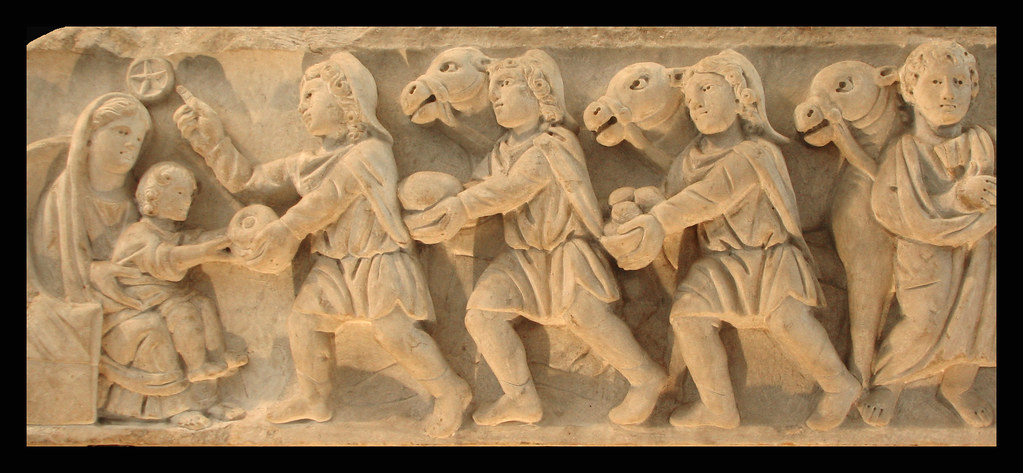
A 4th Century Carving of the Adoration of the Magi. Note that fifth person hanging around…and how Jesus is older. In Matthew this happened a few years after the birth.

The Gospel of Matthew has an agenda: it wants you to trust that the Jesus it speaks of is the same Messiah spoken of in the Hebrew Scriptures.

The writer (we call them “Matthew” but have no reason to believe a person named “Matthew” actually wrote it) is not unbiased.

The writer is not objective.

The writer is not very original, either.  Want to read an original writer?  The Gospel of Mark and the Gospel of John are super original.  Matthew cobbles his Gospel together from a few places.

We know that the writer used the Gospel of Mark, and some other sources, in the writing of this Gospel.  The writer quotes Mark directly in some parts, and goes off writing on their own in other parts.  Some of these non-Markan passages are also found in the Gospel of Luke.

And some, well, aren’t found anywhere else.

Like the story of the Magi.

BTW, I’m going to refer to the writer as Matthew and “he” from now on, but know that the only definitive reason we call it “Matthew” is because someone in the ancient world named it that, probably so that it would get wide readership.  Booklets that were attributed to Apostles got wide readership (which is why you don’t see the letters of Clement I and Clement II [which are faithful and wonderful and should be in scripture!], and instead find the scurrilous book of James included in the canon).

Here’s the thing, though.  If you understand Matthew’s point, you can see how the Magi play into Matthew’s working theology.  And through that lens you get the meaning behind the Magi.

And that’s the important part.

What’s not important? Whether it happened or not.  In fact, that’s the truth about a lot of ancient tales and sacred scripture.  It doesn’t matter if it happened; it happens all the time!  It doesn’t matter if it happened; it’s true!

That kind of lens is, I think, one of the things missing from the faith in these post-enlightenment days.  We want things to be fact, equating fact with truth.  But fact is not always true, and true things sometime never actually happened.

I can go on in another blog about that, but back to the issue at hand…

If Matthew wants you to see that the Jesus he writes about is the same Jesus, he’s going to go to great lengths to get you to understand it.

And so one of the things that Matthew is going to do is make sure that you see that the arrival of the Messiah in the world will have a global impact.  Kings, Magi, will literally bow down before him.

They have to.  It says so in Isaiah 60:3 and Psalm 68:29 and Psalm 72:10…and other places.

And Matthew is very concerned that you see that the Hebrew prophecies come true in the life of Jesus.

See?  That’s why Luke doesn’t include it: it’s not important for Luke to prove that to you.  He has other biases.  And that’s why Mark doesn’t include it: Mark doesn’t care about that, either.

And John?  He’s a lone-ranger on this sort of thing.  It’s a miracle that Gospel even made it into the canon (especially because Jesus dies on a Thursday in John).

The Magi prove Matthew’s point: the prophecies of old come to fruition in Jesus, and so kings, Magi, have to bow down to him, especially since Herod (we know) won’t.

But even though I don’t think it happened, I still think it’s true.  Why?

Because the Jesus story has had a global impact.  And that star that the  Magi followed inspired a whole generation of cosmic exploration by Christian scientists who furthered astronomy more than most know.  And the beautiful foreshadowing that happens in Matthew, by design I think, leads you to understand the nature of Jesus: gold for kingship, frankincense echoing the sacrificial gifts of the old temple, and myrrh because he will die (it was kind of like giving Jesus a coffin).

And what’s more, Matthew makes this wonderful political statement with the story of the Magi!

If Herod, the puppet king (who was ruthless, but historically not a terrible ruler), wouldn’t bow down before Jesus, these kings would.  And when Herod tells the Magi to return to him and tell him where Jesus is, they catch wind in a dream (dreams are important to Matthew because they’re important in the Hebrew scriptures [think Jacob, Joseph, and Samuel]) that they shouldn’t, and the Magi disobey.

The point?  When your rulers tell you to do something that your conscience won’t allow, you disobey, by God.  Literally: by God.

There are all sorts of true nuggets in this story!

And here’s the thing: your pastors probably know this.  But we don’t talk about it. Instead we spend time trying to find out how the Magi traveled and where they came from and what their names were (I love that part of lore, actually…it’s fun and true, even if it’s not fact).

And all of that is, in the end, like trying to describe how a number smells.  You can go round and round and get nowhere because, well, numbers don’t smell.  The story isn’t told because it happened…don’t get wrapped up in that!

In all of that we miss the points, I think.

Because the story of the Magi is important for Matthew, and is so true in so many ways.

But did it happen?

Well, it happens all the time.

It happens when people lay down their power and agendas in deference to God. It happens when people disobey their leaders because they’ve been asked to do in moral things, and choose the path of peace instead.

It happens all the time.

An Advent Playlist

CompilationAdvent is necessary.

Even for those who don’t buy into the metaphysics of this season, the need to practice states of being is supremely human.  We need to practice repentance, so that when we truly need to repent we know how to do it.  We need to practice joy, so that when we really need to be joyful, we know how to do it.  We need to practice zeal, so that when the moment to be zealous comes, we’ll get into the mode quickly.  Lent, Christmas, and Pentecost, respectively, help us do these things.

And do them well.

Advent, Beloved, is the season where we practice waiting.  It’s so human.  Because we’re all waiting for something.

For birth. For death. For a new job. For the other shoe to drop. For guests to come over. For love to find us. For illness to abate. For a heart to mend.

We wait, and Advent helps us do it well.  Through the themes of light and shadows, unexpected opportunities, a mixed-bag of saint days, and the onset of the Solstice, Advent helps us to train our bodies into a posture of waiting, so that when it happens, we’ll know how to do it with more patience, less anxiety, more expectation, and a sober heart and mind.

To accompany this waiting, I’ve taken on the discipline of finding Advent music to dot the days.  I promised I’d throw out all the music I’ve compiled, and so here is this year’s list.  Some of these are new additions, and some are long-standing, tried and true pieces that have waited with me many times.

But, to capstone your waiting on this Christmas Eve, I give it to you.

Merry Christmas. The wait is over…for now.

Shine by Collective Soul

Dreams by The Cranberries is a good addition.

Dreams dot the Advent/Christmas landscape. Joseph is told of Mary’s pregnancy in a dream (in the Gospel of Matthew), and the Magi are warned in a dream not to return to Herod (also in Matthew).

Do yourself a favor and add Joshua Radin’s Winter.

Enya’s Stars and Midnight Blue is a good choice.

An unconventional (and, perhaps, unpopular?) choice would be Bette Midler’s From a Distance.

Yeah, I know, but go with me on this for a second.

If Christmas is radical incarnation and embodiment, then the Advent days of preparation are one where we watch for someone who is coming from far off. So if, as Midler says, “God is watching us from a distance,” at Christmas God begins interacting with us from closer proximity…no longer at a distance.

Advent is the time when we prepare for the one coming “from a distance.”

This, and the themes of peace in the lyrics, make it an appropriate Advent song, if not a good one.

Josh Ritter’s Where the Night Goes. You won’t be disappointed.

His themes of “homecoming” and “memories” fits nicely with the Advent themes of “housewarming.”

Your Advent playlist should include The Christmas Song by Dave Matthews and Tim Reynolds.

CCR’s Put a Candle in the Window has long been my Advent go-to.  The themes of traveling, homecoming, and light make it a perfect choice.

Gordon Lightfoot’s Song for a Winter’s Night is the original of this oft-recorded song, and the best in my opinion.  Lightfoot’s voice adds the brooding tone to this beauty.

Cue Brandi Carlile’s A Promise to Keep up next.  Advent is about waiting for promises to be kept, after all.

Joni Mitchell’s River is another oft-recorded song that, again, is best in the original.

Advent has a haunting theme behind all the waiting and all the watching. In ancient days they used to tell ghost stories around the fire at night in these winter months. A good addition to your playlist for the season would be this one by the artist Sting, Hounds of Winter.

To Be With You by Sara Groves is perhaps the most Christmas-y of the Advent tunes I’ve chosen, but the lyrics paint such a pretty picture of the gathered family that it deserves a slot.

Lumineer’s Stubborn Love is great for an Advent playlist.  God shows a stubborn love in the themes of this season.

This year may, indeed, be better than the last…so Counting Crows’ A Long December should be on the list.

To add some funk to your Advent playlist, throw Jamiroquai’s Starchild on there and give it a spin.

And then look up the lyrics and you’ll see why it fits.

Toward the end of December, after the “Ember Days” of the middle of the month, when you’re sure the light will give out, the church starts naming the historic names of The Messiah to make the promise a sort of daily mantra.

On December 17th it begins with O Wisdom. Wisdom is the muse of creation…an inspiring force to change the world.

An Advent song that encompasses this theme might be: You’re the Inspiration by Chicago

On the occasion of O Adonai (My Lord), the 18th of December, a good addition would be the beautiful and enigmatic My Sweet Lord by George Harrison.

On the O Antiphon where we honor O Root of Jesse (Radix Jesse), December 19th, try Iron and Wine’s Tree By the River.

It’s about memories and roots deeply planted that, though long dead, still live on…

On December 20th when we remember the Key of David, Take a listen to the Mumford and Sons song Winter Winds.

On December 21st the O Antiphon is “O Dayspring.”

An unconventional, but lyrically fascinating, offering would be Soundgarden’s Black Hole Sun.

Seriously, listen to the lyrics. It fits your Advent playlist.

The O Antiphon for the 22nd is O King of Glory.

A good addition to your Advent playlist today would be The Hand Song by Nickel Creek.

A song about love and sacrifice and scars: the marks of a king according to the Messiah account.

Throw on Dear Evan Hansen’s You Will Be Found as the song for the 23rd’s O Antiphon: O Emmanuel.

God with us.

You will be found.

And finally, for Christmas Eve, do yourself a favor and throw on this song by Tracy Chapman which, I think, is a modern rendition of the Magnificat: Talkin’ Bout a Revolution.

“Yes, finally the tables are starting to turn…”

Enjoy, Beloved.

A “Come to Jesus” Regarding Christmas…

d7249a77afefe94f1751ecefb384c820

Wonder what they’re celebrating? Hint: it isn’t Jesus’ birthday…because, well, timeline.

So, full disclosure: I was going to title this post “Jesus is Not the Reason for the Season,” but that was deemed too provocative…

Growing up we’d sometimes have a “come to Jesus” meeting amongst the family.  It was a moment to speak some honest truths that were hard to swallow.  It was never a moment to degrade or deride, but rather to just say some honest things that set the ground for going forward.

And I think, Beloved, that maybe we need to have a “come to Jesus” about Christmas.

And I think maybe we need to have this conversation because, well, I’m noticing some strident things coming from certain circles about Christmas, the nativity, and the whole season that are really just, well, inaccurate.

And, I think, probably a bit harmful in the long run.

Because here’s the thing: while your Christmas might be about Jesus…he is the reason for your season, and maybe my season…we have to be honest about the fact that it certainly didn’t start that way.

Humans, since we’ve been recording these types of things, have always celebrated some sort of festival of light at the solstice.  It’s a need within us for reassurance that shadows will not last forever.

We’re, when we’re honest, scared of the night.

And so our ancient mothers and fathers who lived in the north, when the ground became too hard to plow, took a wheel off of their cart, brought it inside, decorated it with greenery and candles, and lit one every night, trying to coax the sun back from its hiding place.

This became, over time, our Advent wreath.  It became a Christian symbol, but it didn’t start that way.  And it’s OK that it didn’t!  I think it’s better that it didn’t…because it makes it all so much more universal.

And that yule log that will adorn your Christmas table is a pagan symbol of the huge burning logs that were lit on the solstice, the shortest day, to last through the shadows.  It’s got holly and ivy on it, the masculine (prickly holly) and the feminine (flowing ivy) to weave together our humanity into the rhythm of the world’s seasons.

And that tree in your living room was a stolen tradition from pagans who used to decorate the trees, making them beautiful (and, sadly, Martin Luther did not first put candles on them, as the legend goes) to counter the cold, frozen days of winter.  Fertility reminders were important in the fallow days, after all.  The sun would come back. The earth would give crops again. Humans would continue to thrive.  The evergreen incorporated all of this symbolism and more.

Early Christians took these fertility symbols and started using them to tell Biblical stories, by the way.

That Christmas tree didn’t stand near the nativity in the beginning, but for early Christians it stood for, well, the beginning!  They’d replay Adam and Eve plays using those evergreen trees, hiding apples in the branches to retell Genesis 1 and 2.

It’s OK that we didn’t invent it, Beloved.  Let’s not pretend we did.

But now for the piece that gets me the most emails, and some recent “unfollows” on social media: the birth narratives in the Gospels.

Here’s the truth:

Mark, it looks like, thought Jesus was born in Nazareth.  He didn’t care much about where he was born, or at least care enough to write about it, so in Mark, Jesus comes wandering out of Nazareth.

John, likewise, doesn’t care where Jesus was born, but just about who Jesus is.  His birth narrative is cosmic, and John 1 is a retelling of Genesis 1 with Christ at the center.  It’s beautiful, poetic, and has a point.

Matthew and Luke are the ones who tell nativity stories.  And why?  Well, if you read them you’ll find out.

Matthew needs you to know that the Jesus of the Gospels (of the Gospel of Mark, specifically) is the same Messiah told about in the Hebrew scriptures.  So he goes to great lengths, jumping over many hurdles, to make sure that the Jesus you read about in Matthew harkens back to the depictions of the Messiah found in bits and pieces throughout the Hebrew texts.

He puts him in Bethlehem because that fulfills the prophecy. (Micah 5:2)

Joseph, his father, is a dreamer, which is intended to echo that Joseph-the-dreamer in Genesis.  In dreams he learns of Jesus’ birth.  In dreams he learns to flee to Egypt when Herod goes on his rampage, which should remind you, by the way, of Pharaoh trying to kill all the newborns in Egypt, with Moses, that other messianic figure in Genesis, surviving.

Do you see?  Matthew is replaying the story for a new generation of the faithful.

And Egypt is important because ancient prophecy noted that, “out of Egypt will come (God’s) son…” (Hosea 11:1)  So Matthew had to get them there.  This all worked out nicely.

Luke, too, places Jesus in Bethlehem, much for the same reason.  But unlike Matthew, Luke has the issue of getting them to Bethlehem, because his Gospel opens the scene with them in Nazareth…probably because Mark starts there.

So the Holy Family is from Nazareth.  But how to get them to Bethlehem?  Ah, yes, we’ll have a census happen, which will connect them to Bethlehem and the ancient prophecy.

Except that, in extra-Biblical records we can’t find any census happening around that time.  There is one that happens later, it turns out.  And I guess it’s possible that the whole timeline is wrong…but that’s not the point, friend.

I’ll repeat that: the timeline is not the point.  Literalism is not the point for these birth narratives.  The point is painting a Divine picture for you.

So Luke gets them to Bethlehem, and Jesus was born.

And all of those other questions on whether he was born in a “stable” or a “cave” or even the first floor of a house are interesting and fun ponderings but ultimately don’t matter.

Because it only really happens that way in Luke, and…yeah, I’m going to say it…probably didn’t happen that way at all.

Because that’s not the point.

For Luke the point comes a moment after the birth: with the angels and the shepherds.  Luke, the Gospel that pays the most attention to the marginalized and the disenfranchised, has the birth of the Messiah being made known not to kings in palaces or the rich elite, but to the shepherds, who weren’t even allowed to testify in the courts of the day because they were considered lying scoundrels.

This is lovely symmetry with the end of Mark’s Gospel where the only people who see the resurrection of Jesus are the women who…wait for it…weren’t even allowed to testify in the courts of the day.

So between Mark and Luke you see that the most important book ends of Jesus’ life and ministry are seen only by people who no one should believe.

And that, Beloved, is the point: Luke wants to reinforce the idea that the poor, the marginalized, and the one you least expect is the one God bestows grace upon grace toward.

Now, why bother saying any of this?

I love nativity scenes.  I have many of them.  I have an icon of the nativity right in front of me at the moment, actually.  It’s beautiful and meaningful and truthful in so many ways.

But it’s not fact.  It didn’t happen that way.

And it doesn’t have to have happened that way.  Because that’s not the point.

Matthew’s point is not that literal Magi traveled across continents to visit Jesus, but rather that God’s entrance into our space and time had a global impact.  And those gifts?  They were not real gifts, but symbols of his life, death, and resurrection.  Gold, for the treasure that he was.  Frankincense, for the offering to humanity that he would become.  Myrrh, because he’s going to die…and that’s what you wrap people in when they die.

These are not actual gifts they gave, but rather symbolized the gift the Christ is.

And Luke’s point is not that an actual stable, or even actual angels, appeared on the scene, but rather that the people you didn’t expect would be the ones to play a pivotal role in the life, death, and resurrection of the Messiah.

People like you.

And, back to the season at hand…

None of this would have happened in December, anyway.  You don’t put sheep out to pasture in December, Beloved.  You do that in June.  So even if Luke was trying to relate reality, we’re way off on our seasons in this era.

No, our date for the Nativity of Christ is another stolen piece that we took from those non-Christians who were dancing around bonfires at the solstice.  They were already celebrating, so the church changed it from the “festival of the undying sun” to the “nativity of the undying son.”

And it wasn’t even a major holiday for ancient Christians!  Pentecost and Easter were the two big festivals for the first church.  That first church would probably be appalled and confused as to why we’re bothering with this December holiday, anyway.  Maybe, if we want to keep tradition, we should abandon Christmas altogether as a Christian holiday and re-ignite a passion for Pentecost (see what I did there?).

And you know what?

Most pastors know this stuff…at least if they’ve had an education that moved past Biblical proof-texting or a glorified Sunday School (and let’s be honest: too much that passes for “seminary education” these days is a glorified Sunday School).

We know this stuff, but we don’t talk about it because, I think, we’re afraid of being caught up in culture wars.  Or we don’t want to deal with the emails that come from speaking truth into a season that has so many tendrils upon our hearts.  Or we don’t have the time, honestly, because it’s already so busy…

But here’s my larger point with all this: Jesus can be the reason for your season.  That’s awesome, and meaningful, and beautiful.

But let’s not pretend that Jesus was always the reason for celebrating at this time of year.

Christianity took the season and made it something for themselves, which we’re wont to do, and that’s OK.

And that argument on whether Jesus was born in a cave, a stable, a house, an RV?  Don’t spend too much time thinking about it all, because that’s not the point.

And this is why I think it’s harmful not to share some of this info with the church: you might miss the forest for the trees.  You might miss the point of it all.

The point is that God’s advent on the scene shook everything from floor to rafter (Matthew), that God would invite the least-of-these into the center of the Divine drama (Luke), that the baptism of Jesus would be his second birth into ministry (Mark), and that the Christ is woven into all creation (John).

The rest, as we say in the South, is just lipstick and rouge, ya’ll.

And I get that this all might be an inconvenient truth.  But in this season of beauty and wonder and awe, it’s OK to lift up scenes and stories that have so much embellishment!

In other words, the stories are true, even if they’re not factual.

And it’s only inconvenient if you need them to be factual to see their truth.