Today we have two conflicting remembrances which, when held side-by-side, should humble both the church and all of humanity: The Feast of the Transfiguration and the Bombing of Hiroshima.
Of course everyone who is familiar with the ramp-up to Lent in the church will note that we celebrate the Transfiguration of Our Lord on the Sunday before Lent. This is most certainly true.
But that is a Sunday observation, not a feast day.
Today is the proper feast day of that event where Peter, James, and John followed Jesus up to the mountaintop and witnessed him standing between Moses and Elijah, between the Law and the Prophets of old, bridging the gap between what was and what will be. In a blaze of light Jesus has his identity shine forth.
That ancient blaze of light stands in stark contrast to the blaze of light where, from the height of a mountaintop in 1945 the first atomic bomb to be used on humans was dropped onto Hiroshima. In that particular blaze we have, I fear, humanity’s identity as people addicted to weapons and war shining forth.
A tragedy.
In the first instance we have a glorious blast of transfiguration. In the second, a blast of incineration. The innocents of Hiroshima were disfigured, not transfigured.
However we might take a historical look at the impact of that bomb on the wider war (Did it stop the war? Was it an evil that was outweighed by the ending of a long conflict?), the particular impact of that bomb was horrific.
Continues to be horrific.
And certainly the use of that bomb opened Pandora’s small box of a legion of future potential horrors which we are constantly trying to hold at bay, standing between what was and what we fear might be.
The church, when it eats at the food trough of Nationalism, would do well to hold these two side-by-side and remember that the hunger for war and dominance is abated not by indulgence but by repentance.
The Feast of the Transfiguration revealed the Christ as a saving actor in human history. The remembrance of the bombing of Hiroshima reminds me, and should all of us, that we are terrible at saving ourselves.
-commemoration notes from Claiborne and Wilson-Hartgrove’s Common Prayer: A Liturgy for Ordinary Radicals
Today I would lobby hard that the church remember a voice who spoke for so many in America: Toni Morrison, Author and Activist.
Born Chloe Ardelia Wofford in Lorain, Ohio in 1931, She learned the horrors of racism at an early age when, as her parents couldn’t afford the rent, the landlord of their home lit it on fire while they were still inside. This trauma, along with the generational trauma in her family, would help inform her life’s work.
At the age of 12 Chloe was baptize in the Catholic church and took the saint name Anthony as her baptismal name. This got shortened to Toni, and that’s how we know her today. She was inspired by Austen and Tolstoy in her writing, but also by the legends and ghost stories of her family lore. An imaginative young Toni started to tell tales and weave wonderful stories together early on.
Toni attended Howard University, and then went on to teach English in Texas as a newly married woman and mom. The marriage did not last, but in 1965 Morrison’s career took a big jump as she became the first black senior editor at Random House in New York City. From there she used her position to elevate black authors. At the age of 39 Morrison joined the ranks of those she edited, publishing her first book The Bluest Eye. The year was 1970, and this first book would go on to become required reading for so many of us.
Morrison would go on to publish many more books and plays, and in 1987 published her most celebrated work, Beloved, a story about an enslaved Black woman, Margaret Garner.
To call it a masterpiece is to undersell it.
Toni would turn Beloved into a trilogy, finishing the series ten years after the first publication. The first book in the series would go on to become a movie, and Morrison’s place amongst great American authors would be secured, and from 1989 until her retirement in 2006 Morrison held a chair at Princeton University in Humanities. In 2017 Princeton dedicated Morrison Hall in her honor.
As a political activist, Morrison was not known for staying quiet in the face of racism and abuse. At the deaths of Eric Garner and Michael Brown, Toni spoke loudly and clearly for justice and told of a system that still targeted black and brown bodies.
Toni Morrison died on this day in 2019 at the age of 88 from complications of Pneumonia. She lives on, though, in the stories, plays, and inspired minds she leaves behind.
Toni Morrison is a reminder for me, and should be for everyone, that telling truthful stories, even if they’re fiction, can shape a nation.
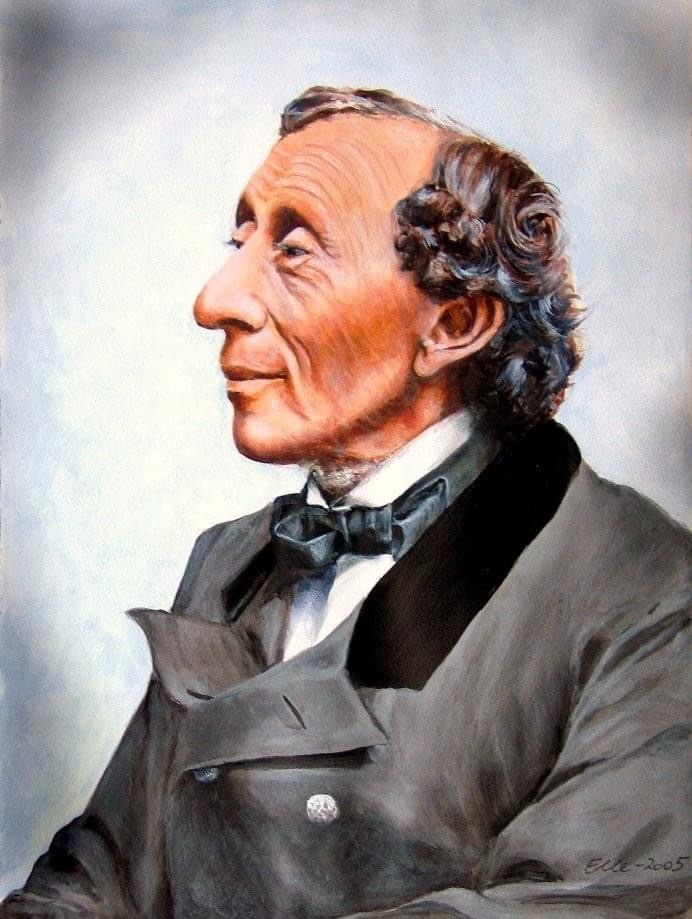
Today I would lobby hard that the church remember a premier storyteller who has had arguably as much cultural influence as the parables of Jesus: Hans Christian Anderson, Poet, Teller of Tales, and Social Influencer.
Hans was born in the early 19th Century in Odense, Denmark to an illiterate mother and a father who only had a basic elementary education. It is absolutely improbable that he would end up being a literary force, and yet, here we are.
Hans was originally sent to a school for the poor, and there was taught the basics of reading, writing, and arithmetic. At home, however, his father fueled his imagination by giving him Arabian Nights. After his father died, he began apprenticing as a weaver and a tailor, and then eventually went to Copenhagen to seek his fortune as an actor, a path most New York waiters and LA baristas can tell you about.
A director at the Royal Danish Theater took notice of young Hans and sent him on to further education on the Royal dime. Note: a teacher invested in him and encouraged him in his craft…we owe teachers so much, especially because they are often the first line of encouragement for young artists.
Let those with ears to hear, hear.
Unfortunately Hans often had a tough time in school, sometimes because people didn’t believe in him, and sometimes because he was just of a more morose nature and was taken advantage of by others. One of his earliest fairy tales, “The Tallow Candle,” spoke of an unappreciated wax taper, perhaps a glimpse into his own being.
Obviously these obstacles did not stop Hans from excelling at his craft, and slowly and surely through poems, travel diaries, novels, and plays, he made a considerable name for himself, particularly because his tales had direct moral overtones, often ones that echoed some of the Biblical stories he grew up with.
Interestingly enough, however, Hans had a difficult time with religion, and he wrestled with the church. One of his most famous encounters was with fellow wrestler Saint Soren Kierkegaard, who described Hans as kind of a brooding fellow. Perhaps some of this brooding came from his other big wrestling match in life, his sexuality. In many of his letters, and even in some of his tales, he speaks of a loneliness and longing for a love that was unattainable and taboo.
Your heart can’t help but break for him in this way.
He still continued to work and write, shaping the world around him through the most amazing thing that humans have produced: stories. In his old age the Danish government had started to pay him a yearly stipend simply because he breathed. He was that treasured as a person. From “The Little Mermaid,” “The Emperor’s New Clothes,” and “The Snowman,” Anderson’s tales continue to tingle the imagination and cause our hearts to stir.
At the age of 67 Hans woke up one morning with a start and fell out of bed, severely injuring himself past the point of recovery. His injury caused him to be thoroughly examined, and in the aftermath they found signs of liver cancer.
He died on this day in 1875.
Hans Christian Anderson is a reminder for me, and should be for the whole church, that stories are truly the things that pluck at the human heart and cause us to move and be moved. Indeed, stories are our best gift to humanity, Beloved.
Today the church remembers one who taught the first Apostles: Gamaliel the Elder, Rabbi, Leader of the Sanhedrin, and Instructor of St. Paul.
It might seem unusual for a Hebrew scholar and Pharisee to be honored as a saint of the church. That is, of course, until you remember that most all of the early church were Hebrew in the beginning, and Jesus himself was a Pharisee (of the scholars who studied Mosiac Law and trusted in a resurrection from the dead).
Rabbi Gamaliel hailed from a long line of scholars, including the celebrated Rabbi Hillel who we believe taught Jesus, or at least informed his thinking (some of Christ’s most memorable lines about the Law were riffs on Hillel). Rabbi Gamaliel shows up in the Acts of the Apostles in the 5th Chapter and is mentioned in the 22nd Chapter as St. Paul’s Hebrew teacher. It is Gamaliel who convinces the rest of the Sanhedrin to stop killing the followers of Jesus, and the scholars followed his advice (though they still didn’t tolerate preaching Christ crucified).
Rabbi Gamaliel is believed to have become a Jewish-Christian, though a secretive one, and lore has it that he was baptized with his son by Sts. Peter and John, together. Lore also maintains that it is Gamaliel who carefully buried the body of St. Stephen, the first martyr of the faith, and even buried another secret disciple of Christ’s, Nicodemus.
Much of Gamaliel’s conversion narrative is conjecture and lore. What is certain, though, is that he shielded the Apostles from being killed, was apparently tolerant of other belief systems, and taught a young Paul in the Mosaic Law.
For this reason Gamaliel is yet another reminder for me, and should be for the whole church, that the faith of the church has always, and will always be, heavily influenced by those outside of the faith. You’d think this would make us a very hospitable and tolerant people, especially to those of other belief systems.
You’d think.
-historical bits gleaned from Acts and publicly accessed resources.
Today the church remembers a Russian saint who made Ivan the Terrible terribly ashamed: Saint Basil the Blessed, Erstwhile Fool, Shoplifter, and Prophet.
Saint Basil was born in 1468 to Russian indentured servants, unable to move past their economic station. He apprenticed as a cobbler, an at 16 headed to Moscow to live his life. Once in Moscow he encountered many who were poor and destitute, and took it upon himself to ask for alms for them as a favor, as often they were too proud or too ashamed to ask themselves.
His service to the poor went a step further as he began to shoplift from local wealthy merchants, passing on the goods to those who were in need. To shame those who refused to help those on the margins, Saint Basil eventually swore off clothes and went naked or in rags around the city, wrapped in chains as a symbol of both the economic burdens of a serfdom system, as well as a symbol of the antipathy of those with means to the plight of the poor. He never took a permanent home, but lived as a wandering prophet.
This, as you can imagine, didn’t sit well with the Jones’s.
As he wandered, Saint Basil would give mini sermons warning of misfortunes coming to those who turned their backs on the poor and marginalized, gaining a wide audience. One such audience member was the tsar, Ivan the Terrible. The story goes that one Lenten day Saint Basil offered the tsar a piece of meat, which Ivan rejected in his Lenten austerity. Saint Basil then retorted, “Then why do you drink the blood of humans?!” an indictment of Ivan’s cruel and horrible treatment of innocent people.
Saint Basil the Blessed died on this day sometime in the mid 1550’s (no one is really sure of the year), having lived quite a long life for his era. He was sometimes called Basil the Fool for his eccentricities, but sometimes to get a point across you have to make a scene, ya know?
Saint Basil the Blessed is a reminder for me, and should be for the whole church, that the call of Christ is to alert the Jones’s of the world the plight of those on the margins. It is not a call to appease the Jones’s so they’ll keep showing up in the pews and giving their offering.
Let those with ears to hear, hear.
-historical bits gleaned from public sources as well as Claiborne and Wilson-Hartgrove’s Common Prayer: A Liturgy for Ordinary Radicals
-icon written by Br. Robert Lentz and can be purchased at Trinitystores.com
A day late, but always on time for a funeral, on August 1st the church remembered a saint who gets scant, but memorable, mention in the Scriptures: Saint Joseph of Arimathea, Secret Disciple and Finder of Graves.
Saint Joseph is memorable in the Jesus stories largely for his dissent collar. As a member of the Sanhedrin (the council of the synagogue in Jerusalem), the writer of Luke notes that he “did not agree” to the council’s plan to bring Jesus to Pilate as a blasphemer. The writer of John calls him a “secret disciple,” and it is he who goes to Pilate after the crucifixion to ask for the body, and lays Jesus in a grave that was unused.
The reason Saint Joseph is so important is because, well, he gets his name mentioned. In the ancient world you wouldn’t write about somebody unless that somebody was a body that other people would recognize and know. It’s thought that perhaps Saint Joseph of Arimathea was an important part of that early church, and the writers of the Gospels thought it important to include him. It’s also worth noting that he shows up in Luke and John, two Gospels written far apart from one another, without any indication that John (the one written later) used Luke as a guide. This gives us an idea that stories about Joseph of Arimathea were circulating in that ancient church.
That’s a little trip down theological nerdom, but it’s kinda neat.
Legends about Saint Joseph of Arimathea started growing and by the fourth century his fame was widespread. Some of these lager-than-life stories claimed that Joseph was the uncle of Jesus, was a tin smith, and had brought Jesus to the tin mines of Cornwall when Jesus was a young boy. Others said that Saint Joseph was sent by Saint Philip (post-resurrection) to be a missionary in Britain. On that journey it was said that Saint Joseph took with him the Holy Grail! At Glastonbury Saint Joseph struck his staff into the earth and from it grew the Glastonbury Thorn (and Glastonbury is still considered one of the holiest “thin places” in Britain), though the whereabouts of the Holy Grail remain a mystery…
This all means, of course, that you can thank the legends of Saint Joseph for the third installment of the Indiana Jones series.
None of these stories have any historical merit except for the idea that we do think that Saint Joseph of Arimathea was a real human who played a real role in the Jesus event.
Saint Joseph is a reminder for me, and should be for all the church, that sometimes a holy dissent is necessary.
-historical notes gleaned from Pfatteicher’s New Book of Festivals & Commemorations
-opinions mine
-icon written by W. Micheal Shirk. Note both the thorn bush and the grail!
Today the church remembers a 15th Century monk who would form one of the most fiery Roman monastic orders: St. Ignatius of Loyola, Founder of the Jesuits (Society of Jesus).
St. Ignatius was born to a Basque family with money and prestige. Because of his high status, he had the privilege (if you want to call it that) of being a page in the court of Ferdinand and Isabella, where he spent his days drinking, enjoying lots of carnal pleasures, and really not giving a damn (in a bad way).
This life eventually landed him in some legal trouble. In order to reform his ways he did what so many young persons do to get a grip on life: he joined the military.
In 1521 St. Ignatius was injured in battle while fighting French forces at Pamplona. A cannon ball struck his knee, causing him to limp the rest of his life. While he lay in recovery, he read the life of Christ and hagiographies about the saints, and in those days of recovery he resolved to devote himself in service to the faith.
It’s worth noting that he also loved to read fiction and knight-centered fantasy tales…just to keep it real, ya know?
He took a year off (as only the wealthy can do), and decided to go on a pilgrimage to Jerusalem and enter University in Barcelona, and then eventually in Paris.
He graduated from University at the age of forty-three, proving you’re never too old to get some schooling under your belt. He gathered around him nine companions and took a trip to Rome, calling themselves the Society of Jesus. They offered their services to Pope Paul III in whatever fashion the Bishop of Rome desired.
All ten were ordained into the priesthood, and the Pope Paul III in time approved the Society of Jesus (the Jesuits as they’re commonly known) who organized themselves in the only way Ignatius knew how: military style, with Ignatius as the first Superior General.
Ignatius died July 31st, 1556, having established Jesuit orders throughout Europe, and sending missionaries to Asia, Africa, and the Americas. The Jesuits became known for their self-discipline, adherence to moderation, and frankly a “take no crap” way of being in the world.
The Jesuits today produce some of the most interesting personalities seen in the popular church. Some are militant social justice warriors, with hearts and minds set on bettering humanity, standing up for the poor, and bucking the patriarchy in order to do so. In other cases, some Jesuits strictly toe the doctrinal line, giving no room for error (they were staunchly against the Reformation). How these two types of personalities (and the many that fall between these two poles) find themselves in the same order might cause you to be puzzled…and rightly so. It’s a paradox.
Yet, in this paradoxical way, Saint Ignatius created an order that mirrored his own human existence: having tasted excesses and the strong arm of the law, he had compassion for those who suffer, all the while feeling the need to have safety-rails on his life in order to know how to “stay on track.”
Saint Ignatius is a reminder for me, and should be for the whole church, that it’s never too late to start a movement. Also: when you find yourself within a movement, you might be standing next to someone who joined for a completely different reason…and you have to become OK with that on some level, Beloved.
-historical bits from Pfatteicher’s New Book of Festivals and Commemorations
Today the church remembers a 19th Century saint who found his holy quest utilizing bills more than belfries: Saint William Wilberforce, Renewer of Society and Abolitionist.
Saint Wilberforce was born into wealth and privilege, and to his credit he leveraged these two rolls of the dice for the betterment of humanity. He was extremely devout, and desired to be a priest, but was convinced that Parliament held more sway than the pulpit.
He entered politics, and for forty-five years he fought within the House of Commons for the abolition of the slave trade. In 1798 he began speaking, campaigning, creating flyers and petitions and bills, tirelessly annoying Parliament with his insistence that moral humans and an ethical society could not coexist with slavery.
In 1806 Wilberforce managed to get a bill passed that prohibited slavery in all the British colonies, but his efforts were not done because while slavery was prohibited in the colonies, it still existed elsewhere throughout the British Empire.
Arguing, calling people to gain their moral backbone, backroom dealing, and appealing to their better angels, Wilberforce and his allies finally, in July of 1833, passed a bill that freed all slaves throughout the empire.
He died three days later.
In the early days of his movement Wilberforce was noted to say, “Let the consequences be what they would…I from this time determined that I would never rest until I had effected (slavery’s) abolition!”
Saint Wilberforce is a reminder for me, and should be for the whole church, that sometimes one person with moral backbone can move an empire.
It’s happened before.
-historical bits from Pfatteicher’s New Book of Festivals & Commemorations as well as Claiborne and Wilson-Hartgrove’s Common Prayer: A Liturgy for Ordinary Radicals
-icon written by Sir Thomas Lawrence and hangs in the National Portrait Gallery, London, United Kingdom
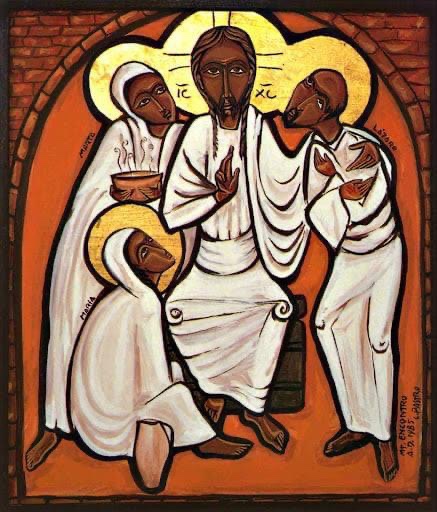
Today the church remembers a little unconventional family of saints: Saint Mary, Saint Martha, and Saint Lazarus of Bethany, Siblings, Hosts, and Friends of Jesus.
Now, new scholarship is suggesting that perhaps Mary and Martha are actually the same person, which is intriguing and amazing and a huge possible find (the ancient texts we have were altered by a redactor, possibly to make John and Luke better match), but because this is all so new, and Martha does appear in Luke, we continue on until we know more…
Appearing in the Gospels of Luke and (maybe?) John in various places, this little family from a little-known town in the ancient world finds themselves on the scene with Jesus in important moments.
St. Mary of Bethany (not to be confused with any of the other Mary’s in the scriptures) is often thought of us a quiet, contemplative soul. It is she who kneels at the foot of Jesus to listen to him when he entered their home. Some say it is she who anoints his feet in the Gospel of John, consecrating him as the paschal lamb. In some places in scriptures the house that this little family lived in was the home of “Simon the Leper,” perhaps indicating that Mary is Simon’s widow. Regardless, Saint Mary of Bethany is remembered as a contemplative, perhaps even a mystic.
St. Martha of Bethany is often unfairly categorized as a busy-body, which is certainly not the truth. In fact, you could argue that out of this little family it is Martha, not Mary, who knows Jesus is Divine. “If you would have been here,” she says in John’s 11th Chapter, “my brother Lazarus would not have died!” While this is not a profession of faith, it is certainly a profession of power. Martha is eminently practical, however, and in some places in scripture it is noted that the house they gather in is hers. Perhaps she was an early donor of the cause, providing money and shelter for this wandering Rabbi?
St. Lazarus of Bethany appears in a few different roles in the scriptures. His name means “God has helped,” and perhaps there are a few characters in the canon who assume that title as kind of a moniker for how Jesus will heal them. When he appears with his sisters in Bethany, however, it is as a dead man brought back to life. Jesus weeps over his dead body, a sign that he was beloved by the Christ. His resurrection story is a prelude to the Easter morning, a little foreshadowing in the Gospel of John.
Devotion for this little family of siblings sprang up in the church, and lore about their life after the Jesus event is legion. Some say they were wanted disciples after the resurrection, and stuck in a leaky boat and set out to sea. From that little dingy the legend says they landed in Cyprus, where Lazarus was made a Bishop of the early church. Some stories say that Lazarus was made Bishop of Marseilles, and martyred under Emperor Domitian (though this might be a situation of mistaken identity as the name Lazarus became popular, and a fifth-century Bishop Lazarus is known to have been head over the church in Aix).
In the Western and Eastern Churches the saint days of this little family have been set in various places. Lazarus is sometimes remembered close to Christmas as one of the “Companions of Christ” on December 17th. Martha was sometimes commemorated alone on this day, keeping Mary to be honored with Mary the wife of Cleopas and Mary the Mother of James on May 25th.
But, in my mind (and Pfatteicher’s who is proposing this new calendar of commemorations) it makes the most sense to keep this little unconventional family together. They are an example of the reality that families come in all shapes and configurations. They are a nod to the idea that women funded and housed the early church. They are testaments of faithfulness in the midst of tragedy and heartache.
It should also not be lost on us that this little family from a no-name town is not dissimilar from most all of our little families who exist with little fanfare. And yet, Jesus loved them dearly…perhaps that might be true of all our families, large or small, yes?
Saint Mary, Saint Martha, and Saint Lazarus of Bethany are a reminder for me, and should be for the whole church, that families of all shapes, sizes, and configurations made up the early church, and that whether we’re mystics like Mary, practical like Martha, or just someone lots of people love like Lazarus, there is a place for us.
-historical notes gleaned from Pfatteicher’s New Book of Festivals & Commemorations
-although I’ve searched high and low for the writer of the icon, I cannot find the artist (though I can see it was written in 1985). Should you find it, let me know! Despite not knowing who wrote it, I decided to keep it because I love the depiction and the simple style that depicts this simple family from Bethany
Today the church remembers a quintessential Lutheran theologian who took seriously Luther’s quip that “singing is praying twice,”: Saint Johann Sebastian Bach, Theologian, Composer, and Musician.
Saint Johann was born in Thuringia in the late 17th Century to a family of musicians. By the age of eighteen he was already a valued composer excelling on many instruments. He started his formal musical career as the organist of New Church at Arnstadt and the parish of St. Blasius in Muhlhausen where he married his wife Maria.
In 1708 he was offered the post as court organist and chamber musician to the Duke of Weimar, and this is where he would gain international fame and began composing chiefly for the organ. In 1714 he became in concertmaster, and held a number of other prominent positions in subsequent years, growing in fame, stature, and ability.
In 1720 his wife Maria died, and in 1721 he would marry Anna Magdalena Wulcken, a famous singer who served as his muse for a number of his most famous pieces.
From 1723 until his death he was the cantor of St. Thomas School and director of music at both St. Thomas and St. Nicholas in Leipzig while also lecturing a the University there. Were you to wander into St. Thomas or St. Nicholas in these days you would have heard most of his inspired compositions for the first time; his music was primarily meant to be played within the local congregation and the worshiping assembly.
Saint Johann saw his calling not primarily to music, but to the Divine inspirer of all sound. He was deeply spiritual, devoutly religious, and his faithfulness produced nearly two hundred cantatas for every Sunday and multiple offerings for High Holy Days.
B Minor Mass, the St. Matthew Passion (first performed at St. Thomas Church on Good Friday in 1729), and Concerto for Two Violins (my favorite) still ring throughout churches, concert halls, and iPhones around the world today.
Bach was the parent of twenty (yes…twenty) children between his two marriages. At his death he was given the title, “The Fifth Evangelist” by Archbishop Nathan Soderblom (see July 12th for his saint day). On the 200th anniversary of his death (1950), his body was moved from the churchyard of St. John’s to the site where he did most of his work, St. Thomas in Leipzig. Many flock to see the site still today.
St. Johann is a reminder for me, and should be for the whole church, that the arts have long been the primary medium of the faith. We must encourage young artists to take up the craft of music, composition, poetry, and choral direction, and we must pay them well for their wonderful work.
They are, after all, primary ministers in this world.
-historical bits gleaned from Pfatteicher’s New Book of Festivals & Commemorations