Today the Church celebrates the Feast of the Epiphany.
This is much more than just a story of Magi visiting the Christ child.
This day is all about awe and wonder. It is about recognizing the cosmic impact that the Divine incarnation has, as even the heavenly bodies testify to the greatness of God through the stars.
It is about the global impact that the embodiment of the Word of God would have, as people from the far corners of the Earth are embraced by God’s holy in-breaking, compelled to seek it out.
It is about Christ’s nature: precious as gold, fragrant as frankincense, and self-giving as the myrrh used to wrap the dead in that final act of love.
The journey of the Magi will be echoed by the journey of those women who walk with spices to the empty tomb on Easter morning.
The symmetry is striking. The whole arc fills you with awe.
In these days between Epiphany and Transfiguration the church will continually ask, “Who is this Jesus?” And with story after story we’ll hear a variety of answers to that question.
But today we just get this one answer: the embodied Word is worth searching for, worth giving things up for, and worth defying the powers of this world for.
The Magi, like Jesus himself, will practice civil disobedience in an effort to keep their conscience intact, by God.
Today the church honors a 17th Century pioneer in equality and human dignity, St. Peter Claver, Jesuit, Servant and Reformer.
St. Claver was born in Spain, became a Jesuit priest, and was sent to Columbia and the mission fields of the new world. There he came under the wing of Fr. Alonso de Sandoval, a fellow Jesuit who was dedicating his life to the well being of the slaves being brought in massive numbers to work the Colombian fields and mines.
St. Claver worked on behalf of the slaves from the minute they were forced from their boats in the inhumane slave trade. Their physical, emotional, and spiritual well-being became his primary concern, and he felt he needed to live among them to serve them, taking a stand with them against the inhumane practices of the powerful.
He argued through the means available to him that slaves, once baptized, should be freed, an argument that seems nonsensical and colonialist to our ears, but which was probably his best means of persuasion at the time. Fellow Christians, he thought, deserved the rights all Christians deserve.
He was known for following up with slaves after their work days in the mines and fields, and faced great hatred and opposition from slave owners and the rich elite who knew his care threatened their control.
St. Claver also found himself in the jails and work camps, often coming alongside those being tortured during the Inquisition. Though Fr. Claver was sympathetic to the Inquisition’s goal, he felt that everyone left imprisoned and alone deserved a friend and advocate. In his work in the hospitals he was known for showing no racial partiality in his care for patients, which to us sounds like “not enough,” but in the 17th Century was “far too much” for the powerful padding their pockets on the backs of cheap human labor.
Often stubborn and difficult to work with, Fr. Claver had many admirers for his guts, but few friends. At the end of his life he became paralyzed and was left in a small room, neglected for four years until his death.
Ironically, in his time of need he was not offered the same care that he had offered others.
St. Claver is often called the “Saint of the Slaves,” not only because he cared so much for them, but also because he argued passionately for their legal rights.
Certainly we can say that he did not do enough. But contextually, he was a unique voice of opposition and action…a combination that was rare in the 17th Century.
He is a reminder to the church, and to me, that words without actions are just noise in a world drowning in a cacophony of noise.
Social media posts and generalized outrage are no strategy for world change, Beloved.
We must find ourselves living in and with our neighbor, advocating with them, not just for them. We must find ourselves utilizing our power to preach both to and against the powerful.
And we don’t do so as some sort of insurance policy, believing that someone will one day do the same for any of us…they may not.
We do so because it’s the right thing to do, by God.
-historical bits from Pfatteicher’s New Book of Festivals & Commemorations
Today is the feast day of a giant of theology and philosophy, Saint Augustine, Teacher.
Fun Fact: Augustine was voted by his classmates, “Most Likely Non-Disciple to Get Lutheran Churches Named After Him.”
Augustine was born in Algeria in 354 to a Christian mother (Monica) and a pagan father. He was a good student, and in his early years practiced Manichaeism, a dualistic religion of Persian origin that was very “in the now” of his day.
He fathered a child early on in his life, and he named him Adeodatus which means “Gift of God.” History is quiet on the kind of father he was, but it’s important to note that this happened because all of this early material would lay the basis for his most famous work, Confessions.
Eventually Augustine ended up in Rome where he taught rhetoric and was wooed into the Catholic faith. There he was catechized under St. Ambrose and was baptized at the Great Vigil of Easter in 387.
Shortly thereafter Augustine returned to North Africa and lived a monastic life with friends. In 391 while visiting Hippo, he was chosen by the small church there to be their pastor.
All indicators point to his reluctance to take up the role, but eventually he was ordained into the priesthood and consecrated Bishop of Hippo, a role he kept for 35 years. He traveled extensively in the ancient world, and wrote volumes while he did so.
His book The City of God contains his reflections on society and the body politic in the aftermath of Rome’s collapse. In it he also defends Christianity and sets forth a vision of an ideal Christian society.
Spoiler alert: it looks nothing like America.
He established a Rule of Life and an order, Augustinian, was begun in his name. Martin Luther would adopt this Rule and this order.
Augustine died after he came down with an intense fever in the year 430. His remains, well, remain in the Church of San Pietro in Pavia, Italy.
Augustine is the model of the “second chance” life. And, quite honestly if you read Confessions, a third and fourth chance, too.
He is one of the most human of the saints because his foibles and misadventures are documented for all to see. He remains a gift to the church, even with all his flaws, and is a constant reminder that contrition and confession enable us to be born again.
And again.
And again.
-historical tidbits from Pfatteicher’s New Book of Festivals & Commemorations
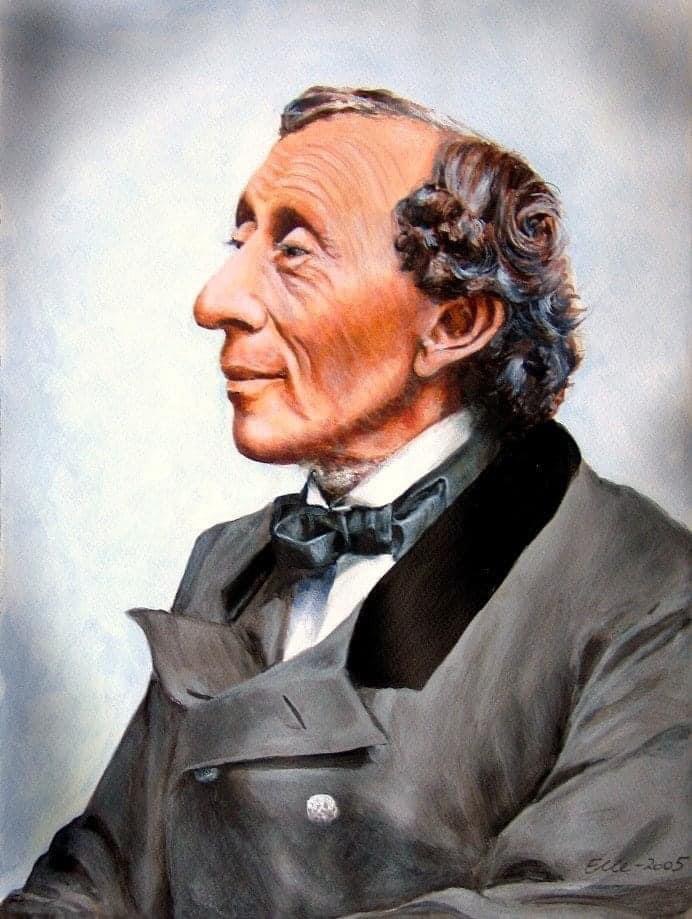
Today I would lobby hard that the church remember a premier storyteller who has had arguably as much cultural influence as the parables of Jesus: Hans Christian Anderson, Poet, Teller of Tales, and Social Influencer.
Hans was born in the early 19th Century in Odense, Denmark to an illiterate mother and a father who only had a basic elementary education. It is absolutely improbable that he would end up being a literary force, and yet, here we are.
Hans was originally sent to a school for the poor, and there was taught the basics of reading, writing, and arithmetic. At home, however, his father fueled his imagination by giving him Arabian Nights. After his father died, he began apprenticing as a weaver and a tailor, and then eventually went to Copenhagen to seek his fortune as an actor, a path most New York waiters and LA baristas can tell you about.
A director at the Royal Danish Theater took notice of young Hans and sent him on to further education on the Royal dime. Note: a teacher invested in him and encouraged him in his craft…we owe teachers so much, especially because they are often the first line of encouragement for young artists.
Let those with ears to hear, hear.
Unfortunately Hans often had a tough time in school, sometimes because people didn’t believe in him, and sometimes because he was just of a more morose nature and was taken advantage of by others. One of his earliest fairy tales, “The Tallow Candle,” spoke of an unappreciated wax taper, perhaps a glimpse into his own being.
Obviously these obstacles did not stop Hans from excelling at his craft, and slowly and surely through poems, travel diaries, novels, and plays, he made a considerable name for himself, particularly because his tales had direct moral overtones, often ones that echoed some of the Biblical stories he grew up with.
Interestingly enough, however, Hans had a difficult time with religion, and he wrestled with the church. One of his most famous encounters was with fellow wrestler Saint Soren Kierkegaard, who described Hans as kind of a brooding fellow. Perhaps some of this brooding came from his other big wrestling match in life, his sexuality. In many of his letters, and even in some of his tales, he speaks of a loneliness and longing for a love that was unattainable and taboo.
Your heart can’t help but break for him in this way.
He still continued to work and write, shaping the world around him through the most amazing thing that humans have produced: stories. In his old age the Danish government had started to pay him a yearly stipend simply because he breathed. He was that treasured as a person. With “The Little Mermaid,” “The Emperor’s New Clothes,” and “The Snowman” and so many others, Anderson’s tales continue to tingle the imagination and cause our hearts to stir.
At the age of 67 Hans woke up one morning with a start and fell out of bed, severely injuring himself past the point of recovery. His injury caused him to be thoroughly examined, and in the aftermath they found signs of liver cancer.
He died on this day in 1875.
Hans Christian Anderson is a reminder for me, and should be for the whole church, that stories are truly the things that pluck at the human heart and cause us to move and be moved. Indeed, stories are our best gift to humanity, Beloved.
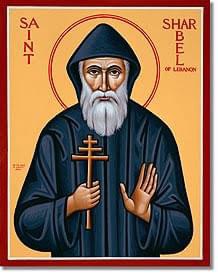
Today the church remembers a saint honored by both Christians and Muslims: Saint Charbel Mahklouf, Hermit and Miracle Worker.
Born in 1828, Youseff Mahklouf was raised in the mountains of Lebanon to a working class family. From an early age he had an affinity for the saints of the faith. When his father died, his mother married a man who would go on to take Holy Orders, becoming one of the rare married Roman priests in the world.
Youseff would seek to follow in his step-father’s holy footsteps.
In 1851 he would go off to seek his monastic vows through the Lebanese Maronite Order, taking on the monastic name Charbel, a nod to the early Christian martyr of the same name. In his pursuit of ordination he became a keen mind, studying philosophy and theology under the names that made the Eastern church full of such wisdom.
Saint Charbel was drawn to the life of the hermit, though, and as soon as he was ordained he sought permission to no longer need anyone’s permission for anything. He spent the next twenty-three years of his life living alone, and died on Christmas Eve in 1898.
Since his death numerous miracles have been attributed to him and, though Lutherans are generally allergic to miracles, it’s worth noting that both Christians and Muslims have reported to feeling his help in times of need. Being raised in the hills of Lebanon at the intersection of these religious traditions, his very being provides a seam that sows the two faiths together in some ways…a seam that we should certainly use when seeking dialogue.
Saint Charbel is a reminder for me, and should be for the whole church, that sometimes we are called to live a solitary life and, in doing so, end up uniting people in ways we didn’t think possible. The trick is, of course, to discern and follow the call…
-information gleaned from Illes’ Daily Magic and public sources
-icon written by the saints over at monesterayicons.com
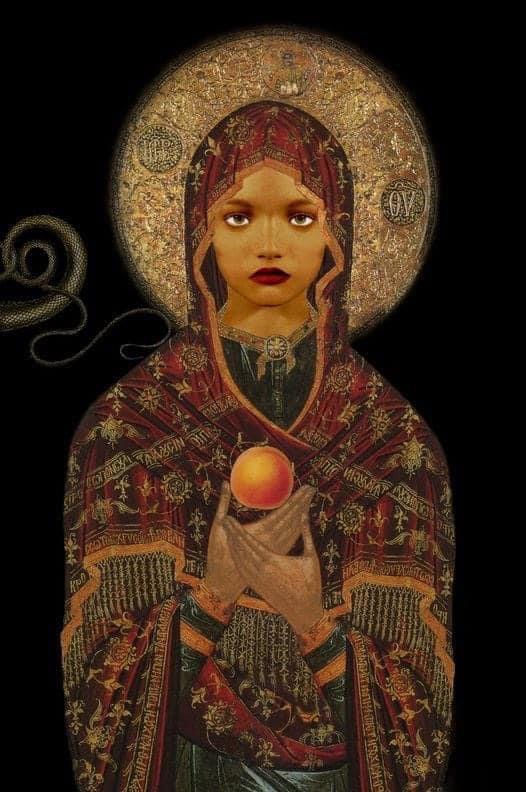
Today the church honors the “apostle to the Apostles,” St. Mary of Magdala, more commonly called Mary Magdalene.
Mary’s role in the stories of Jesus varies, depending on the account being referenced. In Luke she was one of those healed by Jesus during his ministry (apparently 7 demons plagued her). Some traditions have identified her with the “woman of the city” who anointed Jesus’ feet when he reclined in the Pharisees’s home, though there is no scriptural basis for this.
In the Gnostic Gospel of Philip, Mary is the one whom Jesus “loved more than the other disciples,” causing 2000 years of speculation over whether or not they were intimate or just in the “friend zone.”
It’s worth noting that the ancient church was known to type-cast in order to provide biased analysis, especially when it came to marginalized communities. The ever-virginal Mary, Mother of Jesus needed a yang to her yin, and so the perpetually penitent prostitute label was assigned to Mary Magdalene. These two mirrored Mary’s would stand for different paths in life for many a young Christian, and unfortunately these typologies have caused terrible, perhaps irreparable, harm to many of the faith.
This unfair, and unfounded moniker of prostitute doesn’t describe Mary Magdalene, but does describe us: we love such labels, especially ones that accuse and belittle.
I think Mary Magdalene should rather be thought of as “ever-faithful” instead of perpetually penitent. It was she who stuck by Jesus on his hardest day when everyone else fled. And it is she who, in the shadows of the early morning, rose to anoint his body, faithful to the end.
Or maybe we should call her “the first pastor,” because it is she who first told the disciples that Jesus had risen, originally proclaiming that good news formally, with the authority of one who had been visited uniquely by Jesus with the message.
Some recent scholarship suggests that “Mary of Magdala” is less a name assigning her to a place, and rather a formal title, with “Magdala” as a descriptor of what she was to the first church: “the tower.” If this is true, “St. Mary the Tower” gets equal billing with “St. Peter the Rock,” making her a beacon of strength and wisdom.
I quite like that.
If this understanding has been erased or lost to the insecurity of patriarchy, it makes recapturing and re-membering it even more necessary than ever in these days.
Mary Magdalene is a reminder for me, and should be for the church, of two things.
First: histories written by men will feature men and end up denigrating women in some way, either by omission or by commission. This has been true, is presently true, and without a real “come to Jesus” around re-imagining masculinity and the intentional introduction of female voices in the mix, will unfortunately be true in an unchecked future.
Second: a woman was the first pastor. Every pastoral call committee should be reminded of this before looking at any paperwork.
-biographical notes taken from Pfatteicher’s “New Book of Festivals & Commemorations,” opinion portions are solely mine and don’t represent Pfatteicher
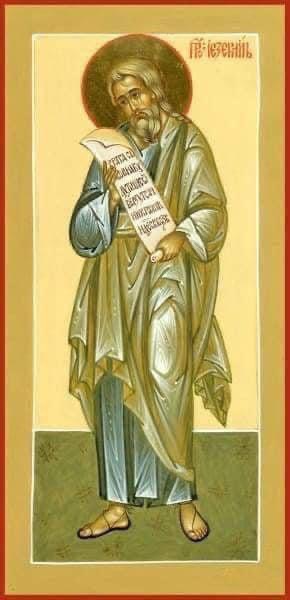
Today the church remembers the Biblical prophet-in-exile: Saint Ezekiel, Critic, Visionary, and Giver of Questionable Advice.
Saint Ezekiel was (probably) born sometime in the early 600’s BCE while King Josiah was instituting the reforms that Judah had hoped would keep them in Divine favor and keep warring armies from continually conquering them.
Spoiler alert: the reforms didn’t work.
He was born into the priestly cast of Israel, and was supposedly a descendant of Joshua himself. Ezekiel, prophet and priest, was married and, because of his high standing in Jewish society, was exiled to Babylon when the Babylonians crushed Jerusalem. The Babylonians were no fools. To prevent an insurrection in their captured lands they would exile the best and the brightest (and those who held the most political sway) to work in Babylon for the king there, benefiting from their wisdom and preventing any influential characters from gathering power around themselves.
Ezekiel was married, and reportedly lived in Tel Abib on the banks of the Chebar river.
In the book of Ezekiel we get a glimpse into his prophecies and encounters with God. Ezekiel was a person who lived off of the visions he had of the Divine, much like Saint Julian of Norwich and Saint John of the Cross, and his mystical visions vacillated between beautiful and horrific. He warned of the coming destruction of the temple in Jerusalem and, for five years, acted out this destruction in a kind of pantomime for all to see.
Other notable illustrations in his visions were the graphic depictions of the angels surrounding the Divine throne (human face, ox, eagle, and lion), and the cryptic fiery “wheels in wheels” which always reminds me of the Johnny Cash song, “Ring of Fire.”
When the prophecy of the destruction of Jerusalem proved true, he became a would-be advisor for those also in exile in Babylon. Notably it was he who told Shadrach, Meshach, and Abednego to refuse to bow down to King Nebuchadnezzar’s golden idol, creating the fun Easter Vigil story popularly known as “Three Men in a Fiery Furnace” because when you don’t do what the King wants, you get thrown in the oven.
You know, that old chestnut…
Surely that was questionable advice, but everything turned out alright.
Ezekiel is held as a model of faith in all three of the Abrahamic traditions, the “People of the Book.” The Eastern Orthodox Church honors him on this day, as do many other communities (including Lutherans).
Ezekiel is a reminder for me, and should be for the whole church, that even when you find yourself as an exile from your home, stay true to your convictions and you’ll find your home is never far away.
-first icon is a typical Russian writing of Ezekiel and can be purchased at orthodoxchristiansupply.com
-second icon is a writing of Ezekiel’s vision of “wheels within wheels” and, though I’ve tried hard for a while to find the writer of the icon, I’ve been unable to locate them. Note that I’m not the writer of either.
Today the church remembers a firebrand of a saint who threw off the shackles of patriarchy every chance she got: Saint Elizabeth Cady Stanton, Speaker, Feminist, and Woman’s Rights Advocate.
Saint Elizabeth was born in Johnstown, New York to strict Presbyterian parents in the first part of the 19th Century. Early into adulthood she married abolitionist Henry Brewster Stanton, and together they had seven children. She organized women across the country to fight for the right to vote, coming alongside other advocates like Sojourner Truth, Harriet Tubman, and Amelia Bloomer.
Together they organized the first Women’s Rights Convention in Seneca Falls, New York in 1848.
She was extremely witty, a brilliant scholar, and a staunch abolitionist. She created the “Declaration of Sentiments,” an expansion of the Declaration of Independence that inserted the word “woman” and “women” throughout the document. Along with advocating for woman’s suffrage and against slavery, she also moved the needle on the right for women to own property and divorce their husbands.
She was a regular church attender, but a sharp critic of Christianity (and religion in general) which makes me think we would probably have been friends.
She died in 1902, never witnessing the 19th Amendment or realizing the right to vote. Nevertheless, she paved the way for that legislation to happen.
Saint Stanton is a reminder for me, and should be for everyone, that sometimes we don’t see the results we labor for, but we must labor on.
-historical bits from Pfatteicher’s New Book of Festivals & Commemorations
-icon written by Fr. Robert Lentz and can be purchased at trinitystores.com
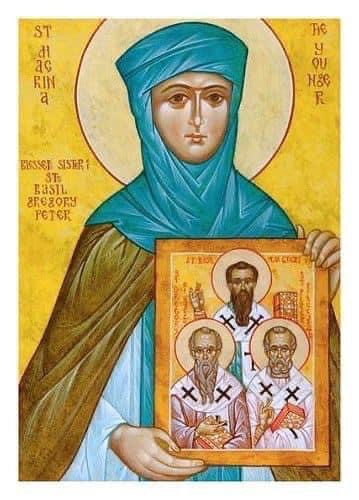
Today the church remembers a 4th Century saint who was often overshadowed by her more famous brothers Greg and Bas (you know them Gregory of Nyssa and Basil the Great, two of the three “Cappadocian Fathers” of the faith): Saint Macrina the Younger, Scholar and Universalist.
Saint Macrina was born in a family already well-steeped in the early Christian movement. She was named after her grandmother, Macrina the Elder, and though her brothers would gain notoriety for their scholarly treatises, they themselves mentioned Macrina as a teacher of faith in their home.
Having been betrothed in an arranged marriage by her father, Macrina never tasted wedded life as her fiancé died before the wedding. She came to see her vows as belonging to Christ alone, and lived an aesthetic and austere life with her mother and a group of women who pledged themselves to communal living. In this community, everyone was equal, whether you were formally a servant or wealthy enough not to owe anyone anything.
It’s one of the early egalitarian communities of the faith, and St. Macrina grew in responsibility as the community grew, taking on what we would call an Abbess role in time.
St. Macrina was also the tutor of her younger brother, Peter of Sebaste who would become a Bishop in the early church. She taught him not only the great philosophical ideas of the time, but also about The Way which was spreading like wildfire in the West and the Near East. In this way, and because she had such a strong influence on Greg and Bas (as I call them), means she was a shaper of the early church, an unseen hand on the needle of the faith.
Known for being a deep thinker, St. Macrina was supposedly a Universalist, and is lifted up by the Universalist Unitarian Church as a great scholar. Her brother, Gregory of Nyssa, composed Dialogue on the Soul and Resurrection in which he records a conversation with Macrina on her death bed (actually, her aestheticism was so great she refused to die in a bed, and chose to die lying on the ground). In that conversation she notes her deep conviction that everyone would be reconciled to God in the end, faithful and pagan alike.
St. Macrina died on this day in 379 AD in Pontus, modern day Turkey.
Saint Macrina is a reminder for me, and should be for the whole church, that the early Christian movement comprised a multiplicity of thoughts and theologies…and still does, despite what the zealots in all corners might want you to think.
-historical bits from open source publications
-icon a classic Byzantine style by unidentified writer where St. Macrina holds an icon of her brothers
The ancient Celts had a strong inclination that the rhythms of nature were echoed in the rhythms of the human body. Winter was for silence and rest, Spring for energy and growth, Summer for blazing work and toil, and Autumn for winding down and letting go.
They understood that living in a way that was in alignment with these rhythms led to a balanced way of being in this world.
At every new moon they also saw that the cycle of life both as continued and began again at the same time, giving support for this idea that time is circular, not linear, and that every moment is both a continuation of a past step and the opportunity for newness.







 Reluctant Xtian