This poem by Maggie Smith keeps running through my head.
“Life is short, though I keep this from my children. Life is short, and I’ve shortened mine in a thousand delicious, ill-advised ways, a thousand deliciously ill-advised ways I’ll keep from my children. The world is at least fifty percent terrible, and that’s a conservative estimate, though I keep this from my children. For every bird there is a stone thrown at a bird. For every loved child, a child broken, bagged, sunk in a lake. Life is short and the world is at least half terrible, and for every kind stranger, there is one who would break you, though I keep this from my children. I am trying to sell them the world. Any decent realtor, walking you through a real shithole, chirps on about good bones: This place could be beautiful, right? You could make this place beautiful.”
The poet Nayyirah Waheed has broken me many times. Her work has, over the course of a few years, served as a meditation many mornings.
Like, this one:
stay soft. it looks beautiful on you. (from her book, Salt.)
One of the things I love about the rhythm of the church year is that it keeps me soft. Nimble. Pliable.
When we get too stuck in our ways, too embedded in our walled-off routines, we become rigid. So much of religion has become rigid in the hands of hard people who have obeyed dogmas not like one takes opportunities, but like one might follow a written recipe that is so complex no chef has mastered it.
Rigidity is brittle. A rigid faith breaks in time.
Advent is, like I say above, an opportunity to practice plasticity in the faith. With so much mystery sewn into the fabric of these short-sunned days, we are encouraged to dream a bit, to wonder and let our hearts wander (perhaps that’s where the old carol got its title?) and become soft again.
To melt, if you will, like you do when you pick up a newborn.
I remember one time taking my newborn son to visit our oldest parishioner. My son, only a few months old, was strapped to my chest in our carrier. The old woman, in her 90’s, asked if she could touch him. I bent myself over as she reached out her hand, and I guided her fingers to his little head (as her eyesight was failing).
I marveled at how both the oldest person I knew, and the youngest, felt the same in my hands: tender skin, soft skin, pliable skin.
It was a moment; eternity reaching out to touch at both ends.
She died not long after that visit…
That encounter made my heart pliable. Soft. It was beautiful.
Like the aged Elizabeth holding her son, perhaps, a story told in these middle days.
What is keeping you soft in these middle days, Beloved?
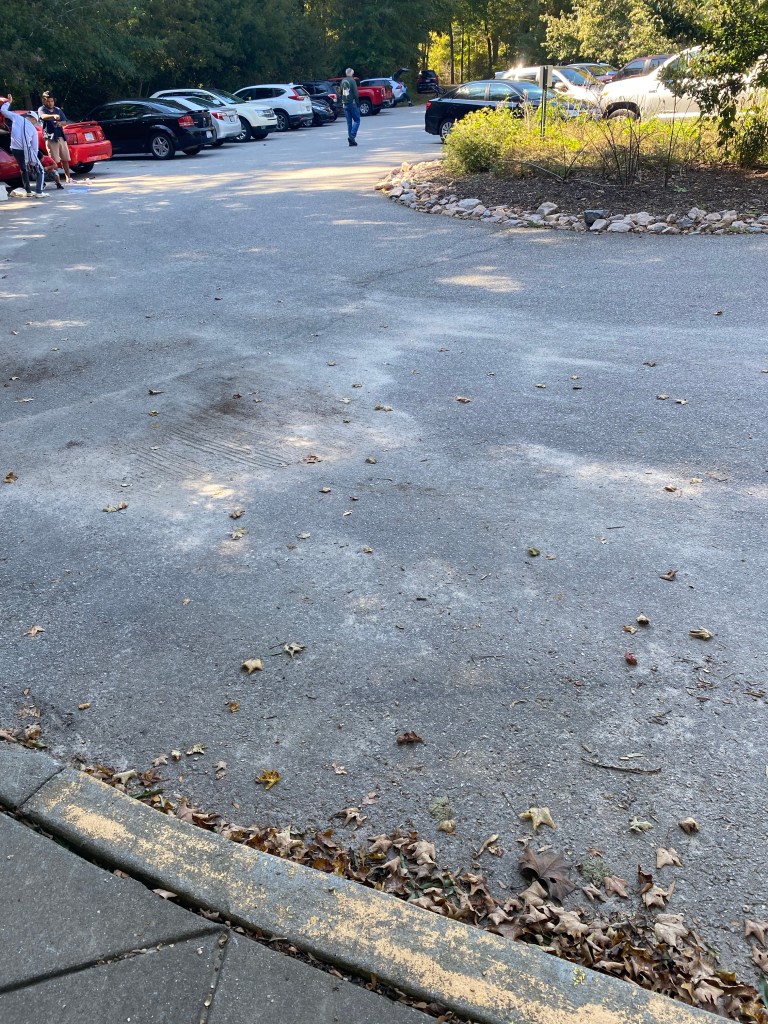
I drove into a Falls River Greenway parking lot. I had 15 miles before me.
In the parking lot was an older white male, standing in the middle of the drive with a gun and holster on his belt, a “patriotic” shirt tightly tucked in.
No badge. No way to tell if they were an officer of some sort.
Because open carry is legal here in NC, I was unsure of what to do, if anything. To add to the concern, a group of young Latinx men were loading up their fishing gear into a nearby truck, and the man was pacing directly in front of them.
I was worried for them. I was worried in general.
Had my boys been with me, we would have left.
I texted Rhonda, just so she would know what was going on if something happened.
Open carry laws cause confusion.
How can we tell if someone is about to shoot up a greenway, or is just “exercising their supposed right to carry a weapon of mass murder?”
I stuck around for a bit, stretched, tied my shoes. The men in the truck left, and though the armed man kept standing there, I went on for 15 miles.
Should I have called the police? Perhaps. Perhaps not. I don’t know.
But a few things now:
-if I see someone carrying a gun, I’m calling the police. Even if it’s “legal,” I think we’re past the point where we can take the chance.
-white men are still the most dangerous gun owners. I get a lot of pushback when I say that, but the statistics, facts, bear it out as true.
-despite all this, I refuse to own a handgun. Even for “protection.” The presence of a gun statistically makes a situation less safe, not safer.
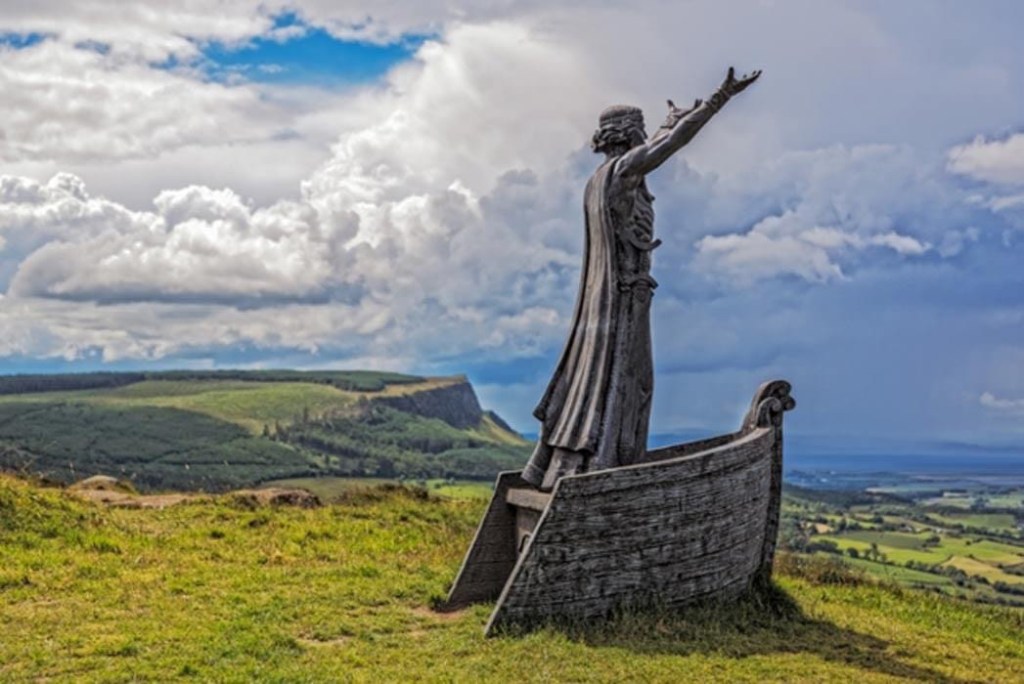
In reading about my ancestors, the ancient Celts, I recently came across the god Manannan mac lir, the Irish god of the sea. They called him, “Ruler of the Land Under Wave” (which I think is a pretty bad-ass title).
For the Celts the sea they spoke of consisted mostly of the Irish Sea and the islands between Ireland and Britain.
It was thought that the Ruler of the Land Under Wave traveled over the water in his chariot called Ocean Sweeper, led by his favorite horse Enbarr (which roughly translates to “Waterfoam”).
Manannan held one of the ancient magical pieces of the world, a great shining cloak that could change color as the sea changed, making him largely invisible for those not paying attention.
On the Isle of Man the ancients would climb a mountain with a bundle of green rushes and pay tribute to him on Midsummer Eve, as they regarded the Ruler of the Land Under Wave as their great protector.
Even now some Irish and Scottish fisherman who hold on to the old ways say a blessing to Manannan before heading out to sea:
“Manannan mac lir (Son of the Sea), who blessed our Island, Bless us and our boat, going out well. Coming in better, with living and dead (fish) in our boat.”
A statue to Manannan mac lir still stands in Gortmore, Magilligan, County Londonderry, Northern Ireland.
“This is terrible” my eldest said has he looked at his report card.
After a pandemic year of virtual learning, we’re all getting used to the rhythm of being back at school, and only time will tell what scars (holy and traumatic) this whole experience will leave on this generation of Covid-kids. My heart is full of pushes and pulls on this topic.
We must lead with grace, Beloved. With ourselves, one another; with teachers, school boards, and administrators.
Too many are not leading with grace.
He was so upset. It ruined his night.
The reality, though, was that he only had lower than average scores in three areas, and we had been told by his teacher that all parents should prepare for lower than average scores in some areas because, well, they’re still working on skills.
Learning takes time, Beloved.
And the thing is: it was a good report card. The elementary school equivalent to A’s and B’s, and he even had an A++ in there, a superior score!
But all he could see were those things that missed the mark.
After some tears and temper tantrums, we talked it out. Missing the mark means he’s still learning. Missing the mark doesn’t mean he’s a bad person, or that he’s less-than, or that he’s a screw-up, or that he’s not smart.
It means he’s in process.
And, in our most honest moments, we’re all in process, Beloved.
There is a spiritual gift in missing the mark. It’s a reminder that perfection is not only not attainable, it’s not ultimately beneficial. Perfect people don’t have anywhere to go or anything to do.
No one’s report card is perfect. The more we embrace this, the better we’ll all become. Because a less than perfect report card leaves room for grace, for growth, for give-and-take. It is a spiritual gift to know you have a less than perfect report card. And I don’t mean that you take that with any shame, or any false humility.
It’s just damn true.
My life is a less than perfect report card, every quarter. As a spouse. As a parent. As an employee. As a child.


 Reluctant Xtian