“You thumbed grit into my furrowed brow, marking me with the sign of mortality, the dust of last year’s palms. The cross you traced seared, smudged skin, and I recalled other ashes etched into my heart by those who loved too little or not at all.” -Elizabeth-Anne Vanek
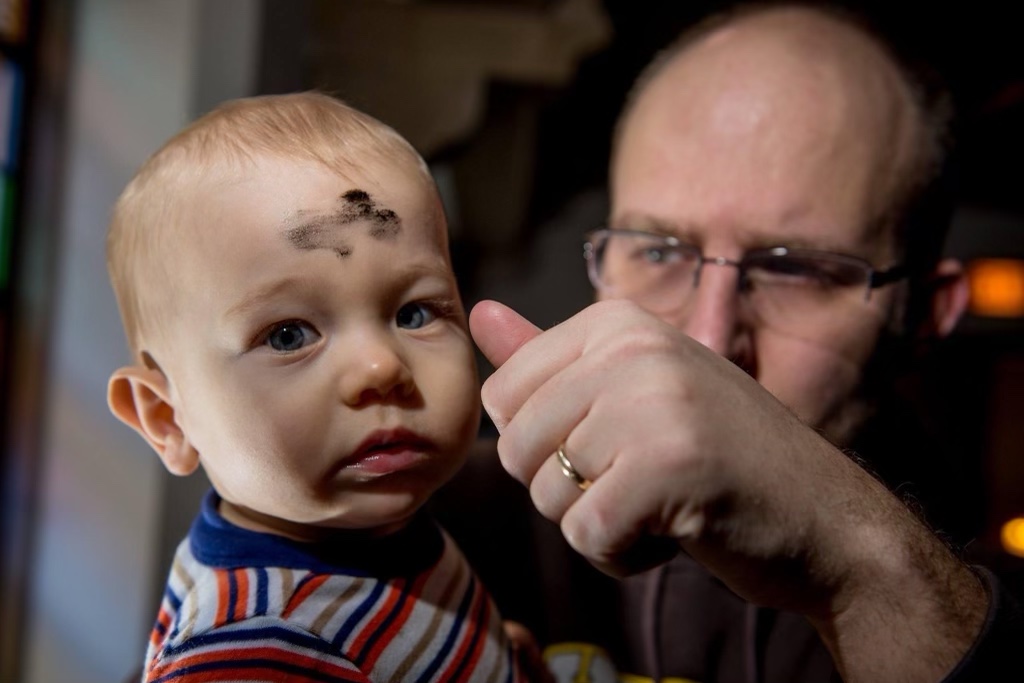
Today the church holds a somber fast traditionally known as Ash Wednesday which dates back to the 11th Century.
In a number of places in the Hebrew scriptures ashes were associated with penance and remorse. The books of Jonah, Amos, and Daniel all note the practice of heaping ashes upon your head as a outward display of how guilt and penitence feel inside.
As the church year begins to ponder the death of the Christ in anticipation for resurrection, a more introspective, prayerful, and yes, honest tone is kept. Ash Wednesday is the start of that long road to Calvary.
While some might consider the practice to be sad or even scary (after all, who likes considering their mortality?!), the wise mystics of all faiths remind us that we must ever keep death before our eyes if we are to truly live.
You cannot outrun mortality, Beloved.
You cannot out-diet, out-exercise, out-supplement, out-buy, or out-smart the quiet, pervasive truth that all creation is indeed, dust at our core (beautiful stardust, to be exact), and we will all one day return to that dust.
There is no out.
And yet, as is true with all paradox, there is a certain amount of freedom that comes with embracing this hard truth. Being Wonder Woman and Superman for too long weighs on us all, and we’re really not meant to fly anyway.
We’re meant to walk, which means we stumble like all walking beings do from time to time. The reality of our imperfection is, too, a gift of grace.
After the church and the empire had joined hands, the rhythm of the church year was overlaid on the rhythm of the ancient celebrations of humans.
Ash Wednesday, the day of penitence, became a massive event; a “full Nineveh moment” in the face of the “holy” church’s Jonah proclamation: “Repent, lest ye be damned!”
Sackcloth. Ashes. Solemnity. That was the prescription. Interestingly enough, the diagnosis was proclaimed by the entity who also claimed to have the cure. Religion tends to do that…
But the people, used to more festive holidays, demanded some revelry before the fast. Intrinsic in our human bones, divorced of any religious pietistic profundity, we all know that a fast is seen best through the lens of a feast, and vice versa. A little bit of denial needs a little bit of indulgence to truly know what you’re missing, right?
And so Carnival was declared, a time to fatten our stomachs, our spirits, and our souls before the sobriety of Lent.
Masks were handed out so that, if you were in hiding for a crime, you could come out of your shelter and join in the fun. A hall pass of sorts. Acts of extreme gluttony are best done anonymously, right? On Carnival, everyone is criminal in some way, everyone is queen and king of their universe for just a bit.
The time for bending a knee will come; for sure. One day all masks fall.
But today is a day for reclining, gesticulation, and for pretending we don’t fear fat and sumptuousness, if only for a bit!
“O Lord, refresh our sensibilities. Give us this day our daily taste. Restore to us soups that spoons will not sink in, and sauces which are never the same twice.
Raise up among us stews with more gravy than we have bread to blot it with, and casseroles that put starch and substance in our limp modernity. Take away our fear of fat, and make us glad of the oil which ran upon Aaron’s beard.
Give us pasta with a hundred fillings, and rice in a thousand variations.
Above all, give us grace to live as true folk–to fast till we come to a refreshed sense of what we have and then to dine gratefully on all that comes to hand.
Drive far from us, O Most Bountiful, all creatures of air and shadows; cast out demons the demons that possess us; deliver us from the fear of calories and the bondage of nutrition; and set us free once more in our own land, where we shall serve thee as thou has blessed us–with the dew of heaven, the fatness of earth, and plenty of corn and wine.
Her song is, “Lift every voice and sing, till Earth and Heaven ring…”
Her song is, “Lift high the cross, the love of Christ proclaim…”
Her song is the Psalm Jesus uttered from the cross. Her song is the cries of anger and desperation and pain on the streets of Memphis, of Minneapolis, of St. Louis, of the girls in Iran, of children in our schools, of the teenage Mary predicting that the world was about to turn.
Is about to turn. About to turn, turn, turn, to every season turn, turn, turn…
Justice is not the Gospel, but the Gospel calls for justice, forgiveness, and a powerless love triumphing over loveless power.
We are all empowered to sing the Gospel song of powerless love triumphing over loveless power that we hear and know and have written on our heads, our tender hands, our hearts as this Jesus is presented to us over and over again in the face of the stranger, in the face in the mirror, in the face of those the world refuses to look in the face…”
I’ve been invited to preach at the chapel service of the ELCA Churchwide offices for Saint Andrew’s Feast Day. If you’re curious what will be proclaimed, here it is:
She came every month with a copy of the mailed newsletter in her hand, marked up with red ink. The office admin answered the door graciously every month, as she had been doing since before I arrived. She took the bloodied copy, said thank you, and put it on her desk, slumping down in her chair.
“Who was that?” I asked. I’d caught a glimpse of the woman out the window, and had never seen them before.
“Oh,” the admin said, “she comes every month to show me all the mistakes in the newsletter. She doesn’t go here anymore, but she used to I guess. She stopped coming because she said it’s too hard for her to get here…”
“But she can get here to critique the newsletter monthly? That makes no sense,” I said, shaking my head.
I looked at the copy. The editorial corrections she was suggesting (demanding?) were from an outdated form of writing, anyway. Her edits weren’t actual edits, just grammatical preferences.
“Why do we allow this?” I asked, honestly. “This is just bad behavior.”
A month went by, and one day I saw the car drive up. The woman stepped out, ink dripped copy in her hand. The admin sighed and got ready to head down to answer the door. “Let’s go together,” I said.
I opened the door before she rang, and she looked at me, surprised. “You must be the new guy,” she said, smirking at me.
“I don’t believe we’ve met,” I said extending my hand. “No, you won’t see me on Sundays. But I know the newsletter has a lot of issues and people care about that sort of thing, so I still edit it for you so, you know, you can see your mistakes.”
She held out the document.
“No thank you,” I said. “We don’t need you to edit it anymore.”
“You know,” she went on, “I used to be an editor for this church’s newsletter…”
“When was that?” I asked.
“I left in 1982,” she said.
“That’s a while ago. Why did you stop?” I asked, genuinely interested.
“I got mad,” she said with a smile, “you know how these things go…”
“I do,” I said, “which is why I’m not interested in letting it go on. You’re welcome here any time. But we won’t be accepting any more of your newsletter edits. Please do not show up here with this kind of thing ever again.”
Her eyes narrowed.
“I bet you have a family, don’t you?” she said with a smirk. “When you go home tonight, you tell your wife that today you met a WOW.”
“A WOW?” I repeated.
“Yes. A Wicked Old Woman,” she said, turning and walking back to her idling sedan.










 Reluctant Xtian