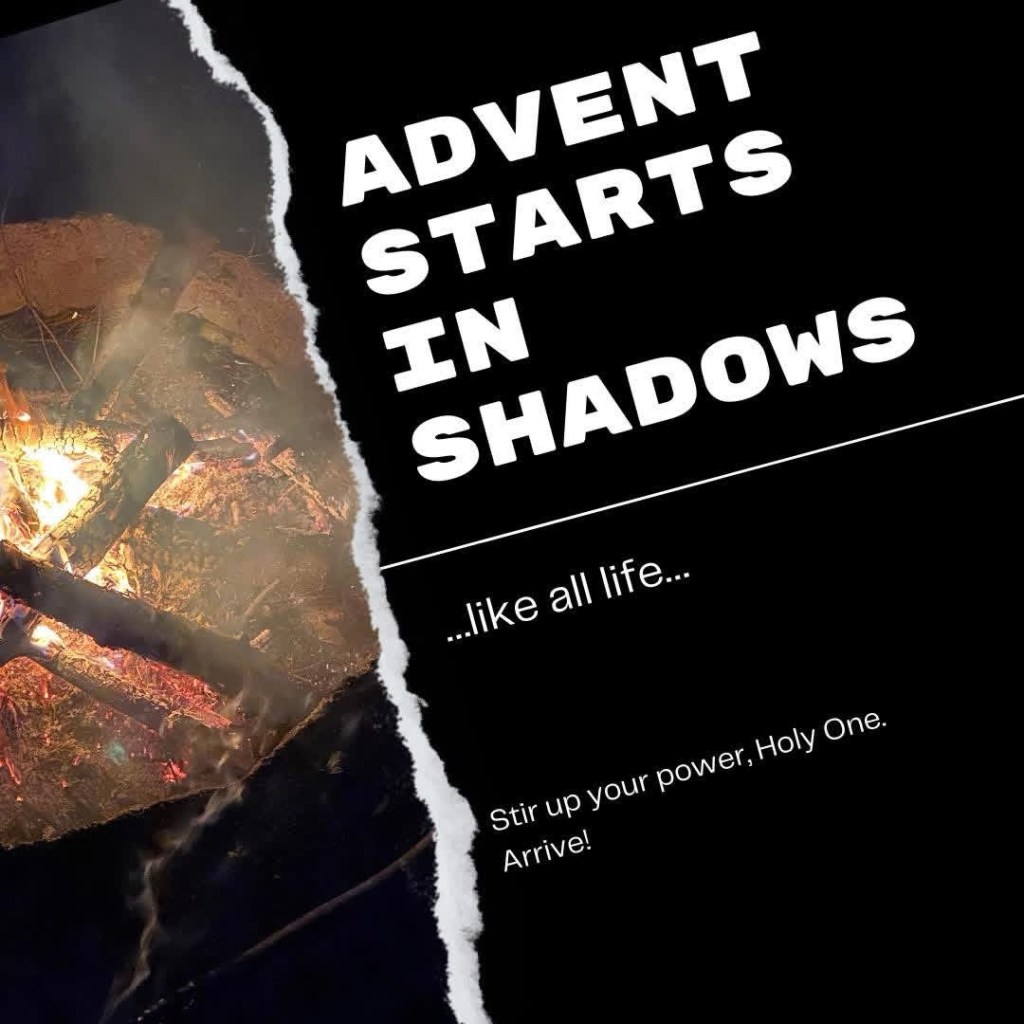
Advent Starts in the Shadows

It’s an odd juxtaposition that happens when the secular and the sacred collide in these early Advent days. So many of us (at least, in America) are rushing to get that tree put up, the most ancient pre-Christian solstice symbol, and haul out the red and green decorations.

Meanwhile, the church is singing a bluer song and calling everything to hush for a bit, like you would when a baby is sleeping nearby.

Both responses to this time of year in this hemisphere are appropriate, of course. The ancient Celts would spend this time cozying up their indoor spaces, knowing they’ll be in the shadow of the fireplace for many hours in the coming months. They’d tie greenery to their door as an air freshener, and they’d make warm clothes, tell stories, and play indoor games. In this way, they’re not unlike all of us in our rush to decorate for the Christmas season.

But they’d do this other thing, too: they’d slow down. Their work would stop for a while, except for those necessary things needed to survive the winter. They’d rest longer, going to bed not long after night fell and waking late with the lazy solstice sun. They’d light candles in the morning and the evening, their new sun stolen from their fireplace outfitted with a huge log that, God willing, would last a good while.

They’d cozy and they’d slow.

The secular world is begging you to cozy at this moment. The sacred world is calling you to slow.

And, honestly, I’m not sure there’s such a thing as “secular” or “sacred.” Holiness pulsates through everything if our heartbeat is in rhythm with the Divine. So perhaps it shouldn’t be so much the “secular is calling you to cozy,” and the “sacred is calling you to slow,” but rather that the tensions pulling and pushing us in this world are felt forcefully in this moment, which is not a surprise.

We’re in a moment of change, evidenced by those last leaves falling to the ground.

Here’s a deep truth that all of these pushes and pulls point to: life begins in the shadows.

I don’t use “darkness” on purpose, by the way. As prophet and poet Nayyirah Waheed wrote in her collection Nejma,

“there is dark
and
there is anti light
these are not the same things”

Language has evolved to the point where we can be careful and choosy with our words (as imperfect as it might be).

Shadows, like that in the Valley of Death that the Psalmist sings of, is a more appropriate description, I think. We’re not talking about a color, we’re talking about an absence of illumination.

All life starts with an absence of illumination.

The Big Bang began with a deep vacuum bereft of light.

The womb which was our first home pulsated with life, but no light.

The seed trying to do what it is meant to do in this moment is buried under the weight of too much earth, and yet it lives.

Life begins in the shadows.

This is why the readings in the church here at the beginning of Advent aren’t of Mary or Joseph or a baby in a manger, but ones of foreboding and nighttime.

The church knows, as does the Earth, as has humanity from ancient days, that life begins in the shadows, so if we’re going to talk about redemption and salvation and resurrection and new life, we have to start here.

There is an 8th Century hymn that often kicks off Advent in many spaces, “Creator of the stars of night.” The Latin version of this text is most beautiful, “Conditor alme siderum…” the chorister sings in simple chant tone.

Sidus, where we get siderum can mean just “stars,” and certainly it does mean that. But in this usage it also means all the cosmic bodies: planets, meteors, stars, galaxies.

The church sings to the creator who filled up the vacuum of space and, like the Mark text, invites us to gaze up at the shadows of space in awe and wonder. In the night times of life we ponder such mysteries. Who hasn’t stayed awake in bed with their mind racing?

The shadows are meant for such pondering, for from such ponderings comes imagination and new life and all sorts of things never before seen, as frightening as those moments can be sometimes.

And, as it is, we’re again plunged into such a night time of life in this Advent season.

Change happens in the shadows. Newness starts in the shadows.

Life starts in the shadows.

So Advent must start in the shadows.

So, Beloved, cozy up and slow a bit. Ponder the mysteries with the ancients.

New life is starting.
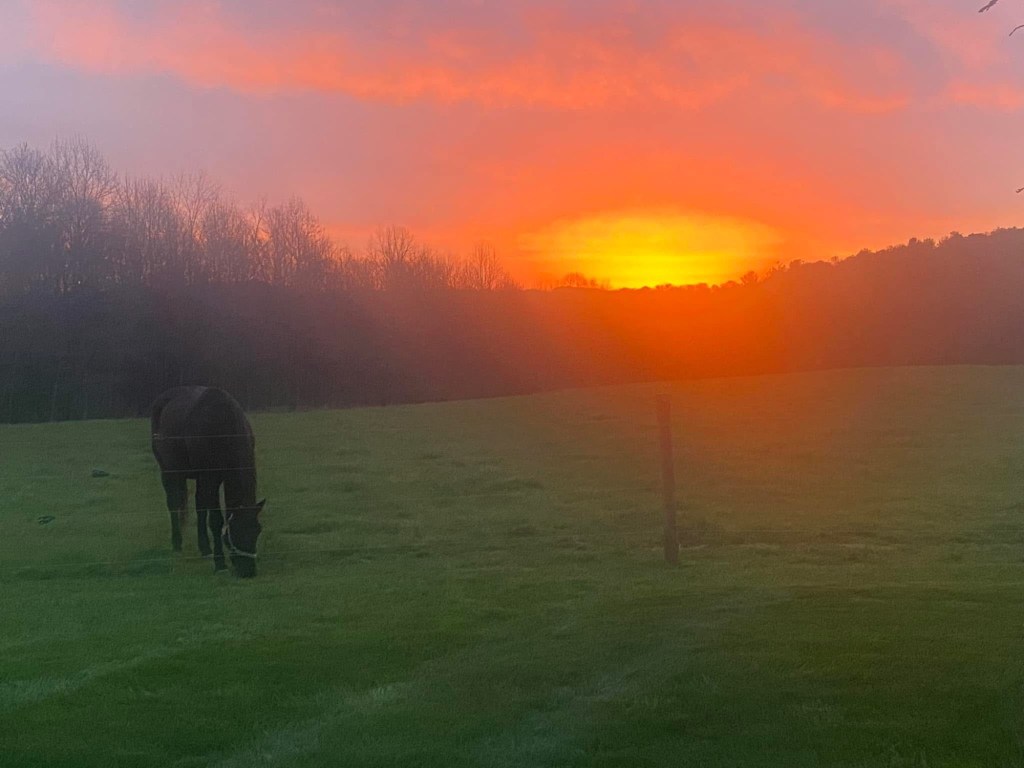
Signs

The Christian Celts (and the pre-Christians Celts, even, celebrating the newly thawed ground and the emergence of Spring) would celebrate Easter week with signs of new life and abundance.

Children would go about looking for nests in trees and underbrush, collecting any eggs they could find. They’d hide them in cubbies in their rooms, or under their houses, and on Easter they’d haul their findings out into the woods and have a pre-dawn breakfast of roasted eggs with the other children of the town.

On Easter Sunday the town would come together, having reserved some of those eggs for cake baking, and they’d present a village cake called a “prioncam cake,” which loosely means “capering cake” or “dancing cake.” It was decorated with woodland animals and a garland of wildflowers.

They’d put the cake in the middle of the gathering, and around it they’d dance and prance to fiddle and pipe. The best dance won the prize, the cake, hence that old saying, “That takes the cake!”

Now, on this Easter, there may still be some eggs, some treasures still hidden to surprise you…

If you’re willing to look.

The Triduum

As we enter Holy Week, a thought on the events to come:

The Triduum, or Great Three Days, is the antidote to an overly saccharine Easter.

Maundy Thursday gathers the disciples, including you, around a shared table where we all get our feet washed and we all share in dipping our bread in the same bowl as Jesus.

Then the sanctuary is stripped, like our souls now feel stripped, as we realize not only what is about to happen, but also that we must stay to bear witness.

On Good Friday we come not to church, but, with everything bare and the lights low, to a darkened tomb. There we encounter the story of that fateful night, a story we know well not only because we’ve heard it every year, but also because we’ve lived it. It’s familiar.

We’ve all been betrayed by our friends, and have all betrayed a friend. We’ve all been falsely accused and accused others without evidence, let alone our unspoken shame knowing our justice system does this, and profits from it all the time.

We’ve all seen power prey on the powerless. This is that story, but instead of the local courtroom it’s the courtroom of the cosmos.

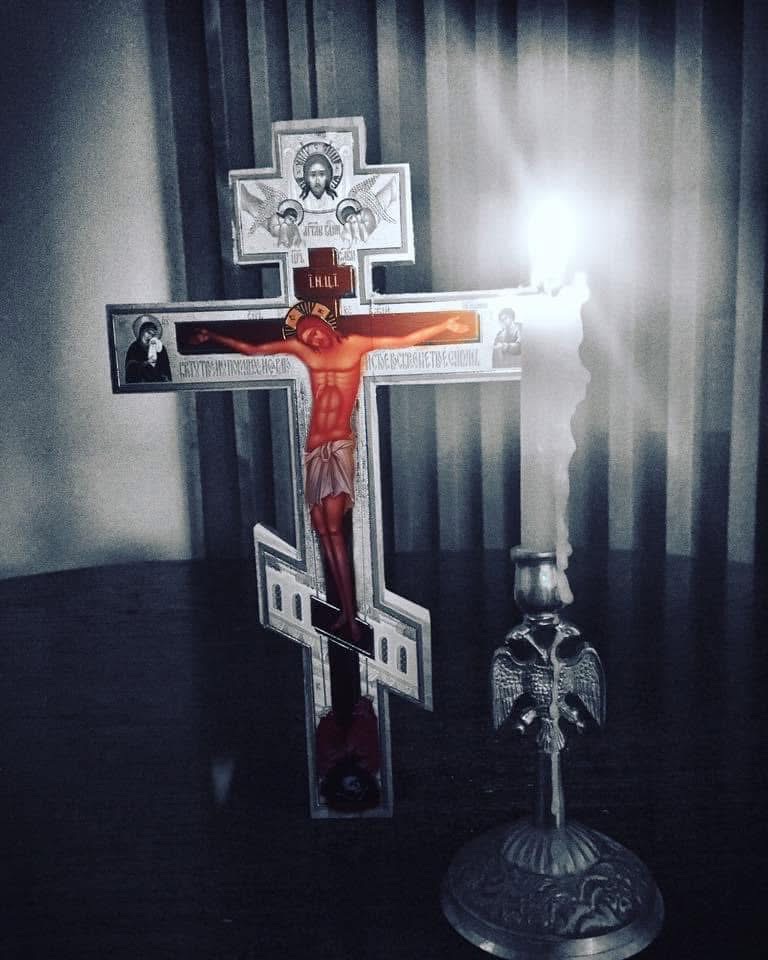
The reproaches are sung where we’re challenged to answer unanswerable questions of eternal proportions, and the service ends with the cross alone left in the room.

We are, in the end, left only with the cross: this twisted tool of torture to which we now cling, hoping that something good can yet come from it.

Sound familiar?

And then we spend the whole next day in the quiet of non-answers. And at dusk we stream back to that tomb, create a new fire to keep our souls warm, and tell campfire stories of salvation to console ourselves.

“Remember that time that God created the world?” we ask around the fire. “And remember when God saved those folks from the fiery furnace?” We retell these stories as a way to spark hope that, as in those impossible moments, God might be able to do something new with this impossible moment. We teach these stories to our babies, even as we reteach it to ourselves.

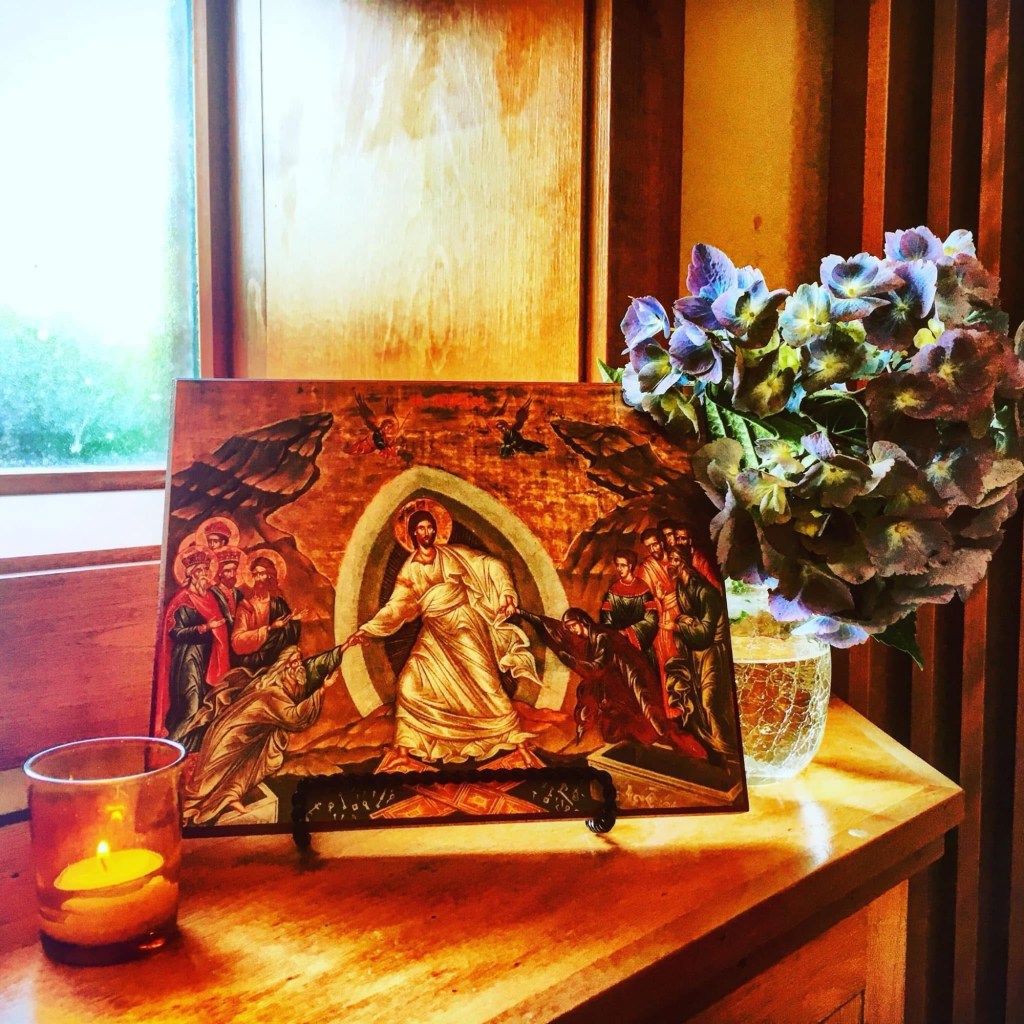
And then before we know it, the tomb has turned into a lush garden, and that tomb that was full of death is suddenly full of life: flowers, water, and yes, living bodies.

Our bodies.

Our bodies who now gather around the body of the risen Christ now seen in bread, wine, water, and the faces around us. And we baptize people who have newly heard all of this. And we sing and dance and party because, yup, resurrection has happened again, by God!

The whole arc has import. Every scene plays a part.

Easter is not a day, it’s a journey

Monday in Holy Week

For the Christian Celts, the Monday (and sometimes Tuesday and Wednesday) of Holy Week was dedicated to cleaning the house and the home (with Holy Thursday dedicated for cleaning the chapel).

After months of inside smoke from the hearth dusting everything with soot, and with the spots above and around the well-used candles getting dingy and oily, Spring cleaning served both practical and spiritual purposes. Spring was a time of renewal, and so it made sense to renew the home from the dinge of winter.

But, as importantly, Spring cleaning mirrored the inward housecleaning of the Lenten days. With Easter almost upon them. the last few corners of the soul were tended, swept, and exposed to the light for purification.

On Palms

Today the church commemorates the Palm Sunday processional in many parishes across the globe. This moveable commemoration is the beginning of the end of the new beginning for Christians who observe the liturgical calendar.

Bishop Theodulph of Orleans penned the hymn my heart is singing on this Palm Sunday morning, “All Glory, Laud, and Honor.”

It truly is one of my favorites, made more sacred by the fact that we really only sing it once a year.

He is said to have written it from his prison tower, thrown there by King Louis the Debonair, son of Charlemagne.

The story goes that the Bishop wrote this hymn and, in the year 821 as the Emperor passed by on Palm Sunday heading to Mass at the cathedral, he sang it loudly over the passing procession from his stone entombment. The emperor, taken with the song, released the good Bishop.

Truly the rocks themselves will shout for justice.

-painting by Polly Castor

On Emotion Not Facts

In college I wrote for the paper.

My readers mostly hated me. And by “readers” I mean editors. Apparently they wanted facts. I was more into emotion. Drive. Haikus in unconventional meter.

Also, I was into religion. Not faith, but religion. Picking it apart like you might a multi-layered salad. Or a trifle.

But not a tasty trifle. Rather, like one of those ham and cottage cheese trifles that that one lady brought to every Lutheran potluck because her husband liked it.

That was a thing, by the way. A lady at my childhood church made a ham and lemon jello mould for every potluck that was left untouched by everyone in that church basement except for her husband.

That’s love, I think. Or maybe it’s not. Maybe it’s laziness. But, regardless, I didn’t care about facts as much as I cared about why the hell she’d make that jello mould every potluck even though it was avoided by everyone like a copperhead at a petting zoo.

My editors hated that about me.

Background on Carnival and Ash Wednesday

After the church and the empire had joined hands, the rhythm of the church year was overlaid on the rhythm of the ancient celebrations of humans.

Ash Wednesday, the day of penitence, became a massive event; a “full Nineveh moment” in the face of the “holy” church’s Jonah proclamation: “Repent, lest ye be damned!”

Sackcloth. Ashes. Solemnity. That was the prescription. Interestingly enough, the diagnosis was proclaimed by the entity who also claimed to have the cure. Religion tends to do that…

But the people, used to more festive holidays, demanded some revelry before the fast. Intrinsic in our human bones, divorced of any religious pietistic profundity, we all know that a fast is seen best through the lens of a feast, and vice versa. A little bit of denial needs a little bit of indulgence to truly know what you’re missing, right?

And so Carnival was declared, a time to fatten our stomachs, our spirits, and our souls before the sobriety of Lent.

Masks were handed out so that, if you were in hiding for a crime, you could come out of your shelter and join in the fun. A hall pass of sorts. Acts of extreme gluttony are best done anonymously, right? On Carnival, everyone is criminal in some way, everyone is queen and king of their universe for just a bit.

Carnival was a day for reclining, gesticulation, and for pretending we don’t fear fat and sumptuousness, if only for a minute.

And then comes today.

Ash Wednesday.

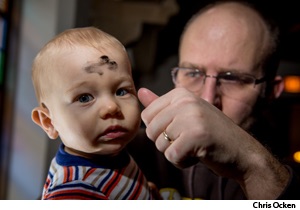
Ash Wednesday is for remembering that time for bending a knee to mortality will come; for sure.

One day all masks fall.

Mortality

Today the church also holds a somber fast traditionally known as Ash Wednesday which dates back to the 11th Century.

In a number of places in the Hebrew scriptures ashes were associated with penance and remorse. The books of Jonah, Amos, and Daniel all note the practice of heaping ashes upon your head as an outward display of how guilt and penitence feel inside.

As the church year begins to ponder the death of the Christ in anticipation for resurrection, a more introspective, prayerful, and yes, honest tone is kept. Ash Wednesday is the start of that long road to Calvary.

While some might consider the practice to be sad or even scary (after all, who likes considering their mortality?!), the wise mystics of all faiths remind us that we must ever keep death before our eyes if we are to truly live.

You cannot outrun mortality, Beloved.

You cannot out-diet, out-exercise, out-supplement, out-buy, or out-smart the quiet, pervasive truth that all creation is indeed, dust at our core (beautiful stardust, to be exact), and we will all one day return to that dust.

There is no out.

And yet, as is true with all paradox, there is a certain amount of freedom that comes with embracing this hard truth. Being Wonder Woman and Superman for too long weighs on us all, and we’re really not meant to fly anyway.

We’re meant to walk, which means we stumble like all walking beings do from time to time. The reality of our imperfection is, too, a gift of grace.

Plus, God loves things made out of dust.

Today we remember that.