For the ancient Celts, December was a month where they celebrated light being born from winter’s long shadows.
They believed that, on the solstice, the sun would jump up and retreat back down for just a moment, seemingly staying in roughly the same place, signaling that it would once again keep it’s promise to bless the people with its presence the next year.
Every year they believed the sun was born again.
They’d honor this birth with days and days of celebration, usually around twelve, and they would perform ritual acts of welcome including dancing, drama, music, games of feat, and above all, lighting fires that they thought would help the newly-born, fledgling sun gain strength. The “yule log” was both for heat and for fueling the sun back into its summer glory.
Also, interesting tidbit: “yule” is probably where we get the word “jolly” from in English.
Even after Christianity had overlaid its own festival onto the celebrations of Ireland and Scotland, the pagan roots shone (and shine!) through. The Scandinavian settlements of the area had dyed the yule practices in the proverbial wool of the people.
It’s an odd juxtaposition that happens when the secular and the sacred collide in these early Advent days. So many of us (at least, in America) are rushing to get that tree put up, the most ancient pre-Christian solstice symbol, and haul out the red and green decorations.
Meanwhile, the church is singing a bluer song and calling everything to hush for a bit, like you would when a baby is sleeping nearby.
Both responses to this time of year in this hemisphere are appropriate, of course. The ancient Celts would spend this time cozying up their indoor spaces, knowing they’ll be in the shadow of the fireplace for many hours in the coming months. They’d tie greenery to their door as an air freshener, and they’d make warm clothes, tell stories, and play indoor games. In this way, they’re not unlike all of us in our rush to decorate for the Christmas season.
But they’d do this other thing, too: they’d slow down. Their work would stop for a while, except for those necessary things needed to survive the winter. They’d rest longer, going to bed not long after night fell and waking late with the lazy solstice sun. They’d light candles in the morning and the evening, their new sun stolen from their fireplace outfitted with a huge log that, God willing, would last a good while.
They’d cozy and they’d slow.
The secular world is begging you to cozy at this moment. The sacred world is calling you to slow.
And, honestly, I’m not sure there’s such a thing as “secular” or “sacred.” Holiness pulsates through everything if our heartbeat is in rhythm with the Divine. So perhaps it shouldn’t be so much the “secular is calling you to cozy,” and the “sacred is calling you to slow,” but rather that the tensions pulling and pushing us in this world are felt forcefully in this moment, which is not a surprise.
We’re in a moment of change, evidenced by those last leaves falling to the ground.
Here’s a deep truth that all of these pushes and pulls point to: life begins in the shadows.
I don’t use “darkness” on purpose, by the way. As prophet and poet Nayyirah Waheed wrote in her collection Nejma,
“there is dark and there is anti light these are not the same things”
Language has evolved to the point where we can be careful and choosy with our words (as imperfect as it might be).
Shadows, like that in the Valley of Death that the Psalmist sings of, is a more appropriate description, I think. We’re not talking about a color, we’re talking about an absence of illumination.
All life starts with an absence of illumination.
The Big Bang began with a deep vacuum bereft of light.
The womb which was our first home pulsated with life, but no light.
The seed trying to do what it is meant to do in this moment is buried under the weight of too much earth, and yet it lives.
Life begins in the shadows.
This is why the readings in the church here at the beginning of Advent aren’t of Mary or Joseph or a baby in a manger, but ones of foreboding and nighttime.
The church knows, as does the Earth, as has humanity from ancient days, that life begins in the shadows, so if we’re going to talk about redemption and salvation and resurrection and new life, we have to start here.
There is an 8th Century hymn that often kicks off Advent in many spaces, “Creator of the stars of night.” The Latin version of this text is most beautiful, “Conditor alme siderum…” the chorister sings in simple chant tone.
Sidus, where we get siderum can mean just “stars,” and certainly it does mean that. But in this usage it also means all the cosmic bodies: planets, meteors, stars, galaxies.
The church sings to the creator who filled up the vacuum of space and, like the Mark text, invites us to gaze up at the shadows of space in awe and wonder. In the night times of life we ponder such mysteries. Who hasn’t stayed awake in bed with their mind racing?
The shadows are meant for such pondering, for from such ponderings comes imagination and new life and all sorts of things never before seen, as frightening as those moments can be sometimes.
And, as it is, we’re again plunged into such a night time of life in this Advent season.
Change happens in the shadows. Newness starts in the shadows.
Life starts in the shadows.
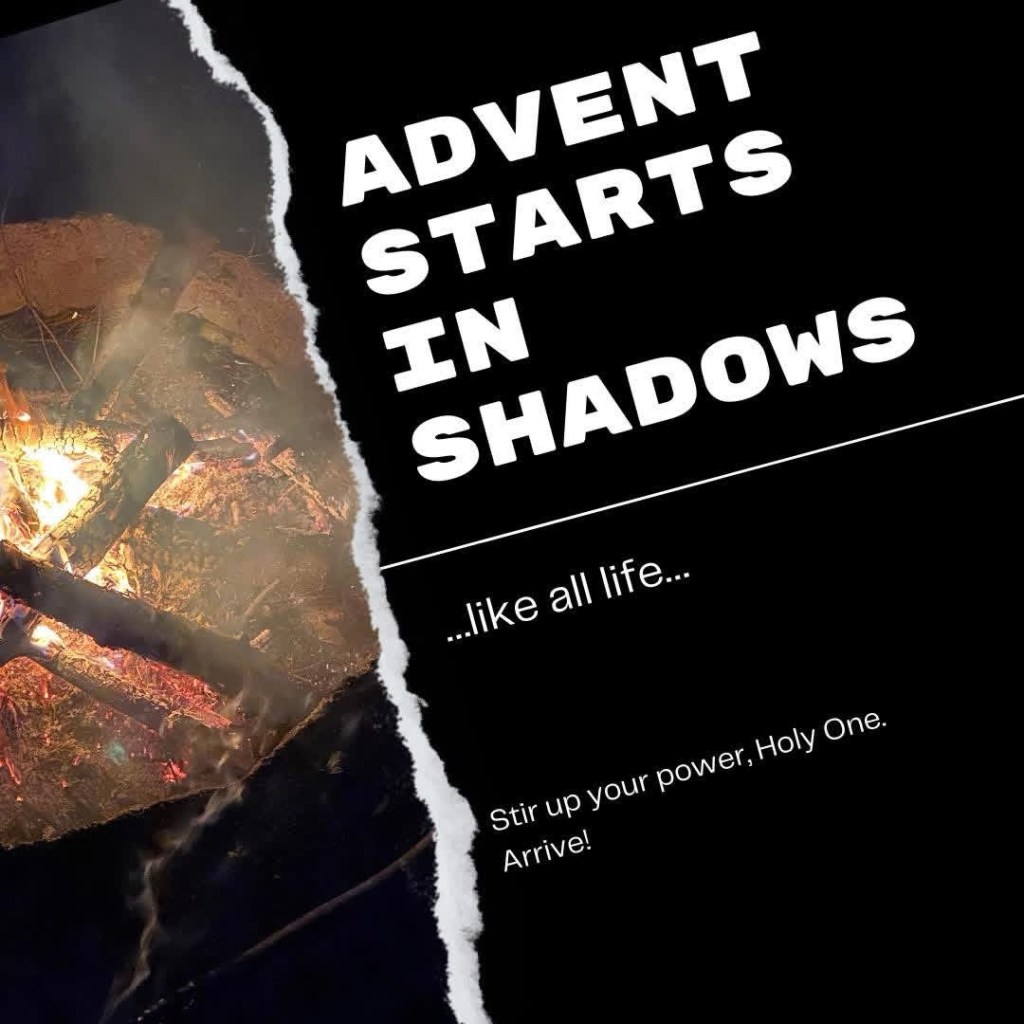
So Advent must start in the shadows.
So, Beloved, cozy up and slow a bit. Ponder the mysteries with the ancients.
“A world without weapons, without McMansions in sprawling suburbs, without mountains of unnecessary packaging, without giant mechanized monofarms, without energy-hogging big-box stores, without electronic billboards, without endless piles of throw-away junk, without the overconsumption of consumer goods no one really needs is not an impoverished world.
I disagree with those environmentalists who say we are going to have to make do with less. In fact, we are going to make do with more: more beauty, more community, more fulfillment, more art, more music, and material objects that are fewer in number but superior in utility and aesthetics. . . “
Tonight as we enter the midway of the month, I’m remembering that in November the ancient Celts found themselves under the Reed Moon.
Each month has a moon, usually named after a tree, corresponding to the attribute that the month brought to the wheel of the year. Now, while reeds are not technically “trees,” November was illumined by the reed moon because reeds, when wound together, created tough blankets that would be used for both floor and roof, for both basket and rope.
They are tough as trees when braided.
Reeds were emblematic of how November was a weaving of worlds, ushered in by Samhain and All Saints, the ancestors and the babies creating a tapestry of existence that was most clearly felt as the shadows lengthened and the hearth blazed. For the ancient Celts life existed far into the past and far into the future, and the cycle of life was always rolling. Reeds reminded them of this: woven together to be one whole, and when wind blew over the open reed they believed they could hear the howling voices of the ancestors calling to them from the other side of the veil.
These, of course, became wind chimes and porch pipes.
The Reed Moon inspires us, with its long night-shine life, to remember those who have gone before, the ache in our bones a reminder of their unseen, but ever-felt, presence.
The ancient Celts found October to rest under the Ivy Moon. Now half past the month, the harvest is pretty much done and everything is starting to wear its nakedness.
But they called this Autumn moon Ivy Moon because ivy has a difficult time dying, and can live on even after the host plant has died. Ivy, for them, was a reminder that everything goes on in some form or fashion: life, death, rebirth.
It’s the way of things.
Ivy is strong, evergreen, resilient. Though the Earth is wearing their nakedness in these days, Ivy reminds us that the wheel is turning, not dying. It is spinning, not stopping.
Everything has an origin story. Even a few of them mixed together.
For the ancient Celts, Samhain was full of fire rituals intended to both purify land and scare off any trickster faeries and protect the farm from curses.
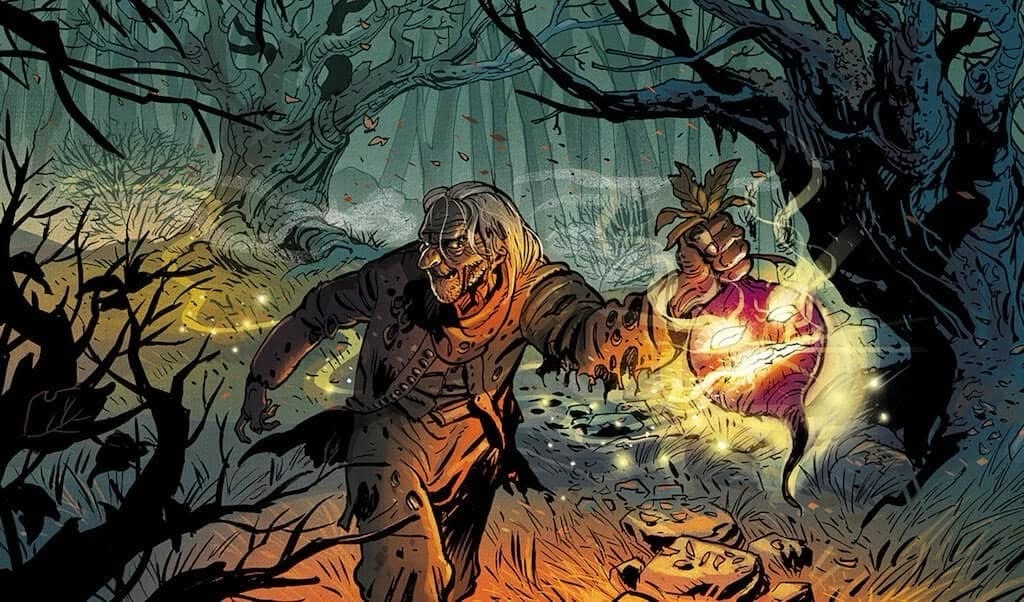
If you went out into the night on Samhain you’d tie a carved turnip on a string, aglow with a piece of charcoal inside. These glowing faces, called Jack-o’-lanterns referred to an old Christian tale about a blacksmith named Old Jack (sometimes called Stingy Jack) who, because he was so evil, was barred from both heaven and hell.
Instead his purgation was to roam the back roads on Hallowe’en night with nothing but a turnip lamp to light his shadowy way.
When Samhain was brought to the so-called New World (spoiler alert: not “new” at all), pumpkins were much more common than turnips, and so Irish settlers used those for lanterns instead.
The ancient Celts had a strong inclination that the rhythms of nature were echoed in the rhythms of the human body. Winter was for silence and rest, Spring for energy and growth, Summer for blazing work and toil, and Autumn for winding down and letting go.
They understood that living in a way that was in alignment with these rhythms led to a balanced way of being in this world.
At every new moon they also saw that the cycle of life both as continued and began again at the same time, giving support for this idea that time is circular, not linear, and that every moment is both a continuation of a past step and the opportunity for newness.
On the Summer Solstice the ancient Celts would give thanks for our star.
They’d build fires on the tops of the hills, believing these fires would further fuel the sun. They’d bring their babies close to the fire as a blessing, and they’d dance and sing and daring couples would hold hands and leap over the flame for good luck.
Midsummer was a day of indulgence with shared feasts and partying and plays and dramatic re-enactments of all kinds. As the sun indulged the Earth on this day, so the people took the minute here as summer was half gone (summer on the Celtic wheel is May-July) to bask in the House of Light, as they called the summer fields and hills.
Tonight is a very appropriate night to light a bonfire, enjoy some food outside, and give thanks for our star without which none of us could live.
 Reluctant Xtian