
Unknown's avatar

About Timothy Brown

A pastor. A writer. A dreamer. Occasionally a beer brewer.

Preaching: On Misquotes and Mistletoe

Curious what I’m preaching tomorrow?

Here’s Advent 2

An excerpt:

“The writer of the Gospel of Matthew loves a good quote, especially from the Hebrew scriptures. In fact by my arm-chair counting, Matthew will quote the Hebrew scriptures or use an allusion to them over 70 times in his retelling of the life, death, and resurrection of Jesus.  He’s big on connecting the story of Jesus to the Hebrew scriptures, and today he attempts to quote the prophet Isaiah.

‘Attempt,’ I say, because he actually misquotes Isaiah…

Matthew has Isaiah saying, ‘A voice cries out in the wilderness: prepare the way of the Lord!’

See, in Isaiah’s 40th chapter the prophet doesn’t write that.  Instead, the prophet writes:

‘A voice cries out, ‘In the wilderness, prepare the way of the Lord!’

You might not think this matters much, and perhaps it doesn’t for the text…it fits so well, right?  Matthew wants John the Baptizer (I refuse to just give him to the Baptists) to be the voice we think of crawling out of the wilderness with his PETA-offending clothes and unusual diet telling us to prepare the way of the Lord.

And that’s all well and good, except Beloved.

Well.

Sometimes I think we’re the ones who find ourselves in the wilderness of life, no?

Sometimes I think we’re the ones who find ourselves in the wilderness of church life coming out of a pandemic and the pews are a little emptier than before.

Sometimes we’re the ones who find ourselves in the wilderness of a bed that is empty on one side where it used to be filled.

Or the wilderness of an empty-nester house.

Or the wilderness of a lifeless job, a lifeless marriage, an unwanted singleness, a confused state in between all of those things.

Or perhaps some are in the wilderness time of regret for things done and things left undone, as our Rite of Confession says.  The things that weigh on our hearts can sometimes keep us lost in the wilderness of guilt and anxiety, and John the Baptizer speaks clearly to that kind of wilderness today…

And we may think that these sorts of things are some sort of mistakes in our life, a misquote perhaps, or that something we’ve done or not done have made us a misquote in this world, where something is not quite what it should be because it all just doesn’t feel right, and we’re coming up on the holidays and, well, it just might not feel quite right this year.

We may think we’re the mistake, misquote of existence, by God.

And here is John the Baptizer, Beloved, breaking into that noise to remind us that whether we’re in the wilderness or not, it is in the wilderness where the paths of God are made.”

Yule Tidings

For the ancient Celts, December was a month where they celebrated light being born from winter’s long shadows.

They believed that, on the solstice, the sun would jump up and retreat back down for just a moment, seemingly staying in roughly the same place, signaling that it would once again keep it’s promise to bless the people with its presence the next year.

Every year they believed the sun was born again.

They’d honor this birth with days and days of celebration, usually around twelve, and they would perform ritual acts of welcome including dancing, drama, music, games of feat, and above all, lighting fires that they thought would help the newly-born, fledgling sun gain strength. The “yule log” was both for heat and for fueling the sun back into its summer glory.

Also, interesting tidbit: “yule” is probably where we get the word “jolly” from in English.

Even after Christianity had overlaid its own festival onto the celebrations of Ireland and Scotland, the pagan roots shone (and shine!) through. The Scandinavian settlements of the area had dyed the yule practices in the proverbial wool of the people.

The Holy Martyrs of El Salvador

Today the church remembers the Martyrs of El Salvador.

Ita Ford, Maura Clarke, Jean Donovan, and Dorothy Kazel were Catholic Missionaries, Ursuline, and Maryknoll Sisters murdered in 1980 for their outspoken defense of the plight of the powerless and poor. Accompanying the people there, they were irritating the powers of the day with their theology of liberation and hope.

These four sisters were murdered on this day in the same year that Archbishop Romero was murdered, though he was killed in March.

Instead of recounting the details of their lives, I’ll just share a bit from a letter Sister Clarke wrote to her companion, Katie, just before she was murdered:

“There are so many deaths everywhere that it is incredible.

The ‘death squadron’ strikes in so many poor homes. A family of seven, including three small children, was machine-gunned to death in a nearby town just last week. It is a daily thing–bodies everywhere, many decomposing or attacked by animals because no one can touch them until they are seen by a coroner. It is an atmosphere of death.

I don’t know what tomorrow will bring…Write to me soon. Know that I love you and pray for you daily. Keep us in your heart and prayers, especially the poor forsaken people.”

The days surrounding Christmas are filled with Feast Days, some beautiful (like St. Nicholas), and some tragic like today. This is because the Divine entered into the world not as we would like it to be, but as it is: beautiful and tragic.

These martyrs today are a reminder to me, and should be for the church, that the first victims of any sort of violence are the poor and vulnerable.

If you need confirmation of that, just ask any medical professional who they treated most for COVID-19.

Those with means, good insurance, fewer health conditions (that are easily and often exacerbated by poverty!), and who can take off work to get treatment without fear of losing their job largely recovered.

Those without, did not.

It is a different kind of violence, a more negligent kind on the part of the powers of the world, but it is violence none-the-less.

Let those with ears to hear, hear.

“When People Leave Your Church Over Politics”: A Note for Pastors

“I once heard you should never vote for a politician who tells you how to pray, and you should never listen to a pastor who tells you how to vote,” their parting email said.

The family would be leaving the church because I was “too liberal,” even though I had never told anyone how to vote, from the pulpit or otherwise. I mentioned this fact, by the way, and he said, “Yes, but we can tell what you think about it and how you’d wish we would vote…”

That’s a big assumption.

No goodbye in the office. No farewell. Just an email with no subject line.

It hurts when people leave your church over politics. It still stings me, even now, to think on that family and a number of others.

It feels like a failure of some sort, like you couldn’t keep people together.

By the way, the translation of the above phrase actually should be, “you couldn’t keep people happy,” which is absolutely true. A pastor’s call is not to keep people happy, anyway, despite what the people will tell you…

It hurts when people leave because they see you have a bumper sticker for a different candidate than they prefer (this actually happened, btw).

It hurts when people leave because you were just trying to keep them safe with masks and social distancing and they wanted to “trust Jesus” rather than “trust the science,” pitting Jesus against science in a way that I think would make Jesus himself scratch his ancient head.

It hurts when people leave because you talk about tending the poor and needy and they hear “socialist!” instead of hearing Isaiah, Amos, Micah, Jesus, and Paul.

It hurts when people leave because you say “Black Lives Matter,” because it’s just true and Jesus was a person of color and all they hear is the filtered funnel of the media.

It hurts when people leave because you mentioned the existential threat of gun violence in that one sermon because, honestly, it is an existential threat that is killing our babies (and if mental health is such an issue…which is certainly is…suicide alone is enough reason not to keep a gun in the house!), and all they heard was that you think all guns are terrible.

The honest truth is that it hurts like hell. Even if you know that they won’t be upset all the time anymore, and even if you know that this kind of a break is coming, and even if you know that you won’t have to sweat when opening your email inbox on Monday because they’re perturbed by something they heard or thought they heard or pretended to hear on Sunday, it hurts.

Even when you see it coming from a mile away, it hurts.

No two-ways about it.

And you know what? It hurts even more when you see them at the grocery store around town, or see their social media posts about how happy they are at their new church where the pastor “never talks about politics” (translation: doesn’t talk about political things I disagree with). It hurts even more when they still hang out with the people who stayed and you see them at parties, but you don’t talk to them, or feel like you can, because no matter what the truth about their leaving is, it feels like it’s because of you.

You.

And it is at this point where you might expect I’d say something like, “They’re better off,” or “You don’t need them,” or “Shake the dust from your feet and move on,” or “But look at all the new people joining!” or “It’s not you, it’s them.”

But I’m not going to, because I can’t.

While all of those platitudes might be true, none of it heals the other deep truth that it. just. hurts.

In this Advent season I clutch perpetual hope tightly, hanging on as if my life depends on it (which it probably does). But I do wonder if pastoring in these hyper-partisan times is perhaps the hardest in recent history, and I’m not sure where hope plays into that in the immediate moment.

Even so, pastor, I hope the pain recedes in time.

And I hope those people, even in my life, are happy how they find themselves.

And I hope that one day political partisanship won’t split the pews and the pulpits.

I hope.

Patron Saint of Mid-Life Crisis

As we enter into December, the church remembers one I call the “Patron Saint of Mid-Life Crisis,” St. Nicholas Ferrar, 17th Century Deacon and Community Builder.

Nicholas was born in London in 1593 and educated at the prestigious Clare Hall in Cambridge. He would eventually become a Cambridge Fellow and, after traveling the European continent for a while, became a member of Parliament and a trustee in the Virginia Company. His political and financial stars shown brightly!

And then he decided it wasn’t the life he wanted to lead.

In 1625 he gave it all up and settled at a small house at Little Gidding in Huntingdonshire. He was soon ordained a Deacon and founded an Anglican community which was basically comprised of his immediate family and the families of his in-laws.

From 1626 to 1646 they restored a dilapidated church, held Masses for the community, established a school to teach the local children, and took on the task of caring for the health-care needs of the neighborhood.

They held weekly vespers and daily prayer, and he invited his community to practice intentional fasting, meditation, and spiritual story-telling and writing, composing a number of books illustrating the Christian life.

This little community was visited by English authorities and nobility and used as a place of prayer, blessing, and restoration.

St. Ferrar died in 1637 and the community was eventually destroyed by the Puritans who called it a “Protestant nunnery.” Most of the stories and books composed there were burned, and the chapel was once again put to ruin (though it was rebuilt in the 1800’s).

You might recognize “Little Gidding” as the title of the last of Eliot’s “Four Quartets,” one of the great religious poems of the Twentieth Century.

St. Ferrar is a reminder to me, and should be to everyone inside and outside the church, that it is absolutely Ok to stop doing things you are good at and seek a new path, no matter your stage in life.

The idea that everyone is called to do one thing, and one thing only, is a romantic fallacy. You can switch gears, by God.

-historical pieces from Pfatteicher’s New Book of Festivals & Commemorations

Forgotten Sibling

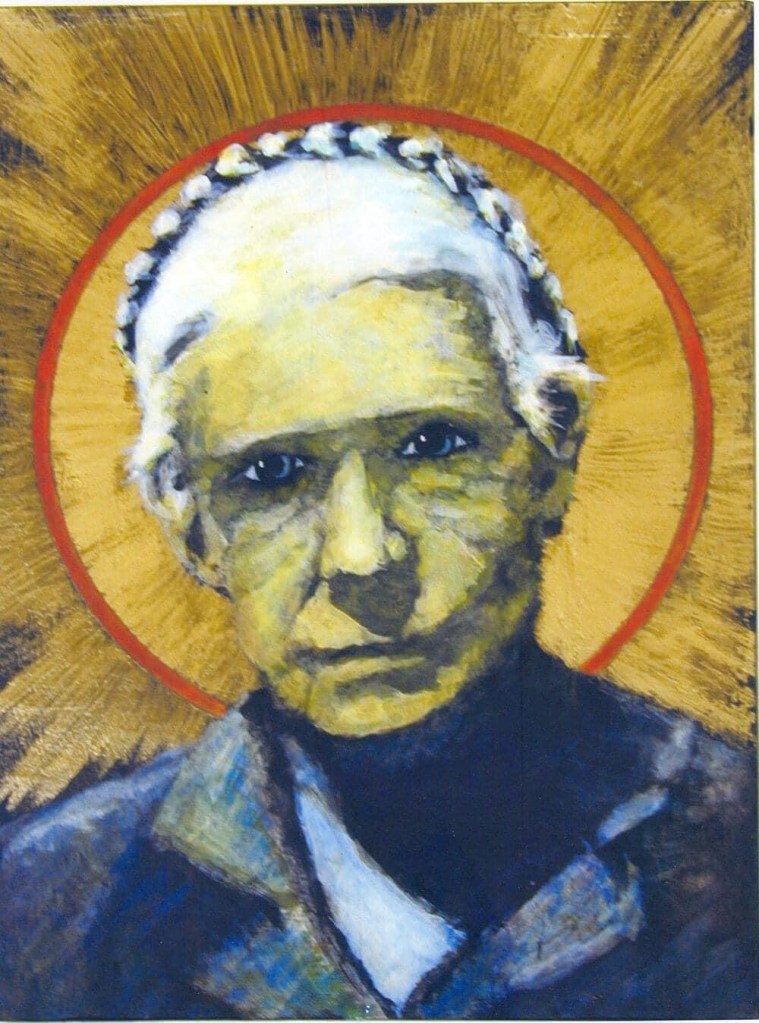
Today, November 30th, the church honors an often overshadowed apostle, Saint Andrew. He’s usually called “brother of Peter,” and rarely seen without that qualifier, making him, in essence, known to the world only in relation to his brother…which many people can probably identify with.

St. Andrew is the patron saint of sea-people, but also the informal saint of all who stand in the shadow of someone else.

He is the saint for the B-side of the record, the underdog sibling, the cobbler and the cooper who are no longer appreciated in their crafts.

Lore notes him dying in Greece, crucified because he refused to make sacrifice to the local gods and kept talking about Jesus.

And though he stood in the shadow of his brother his whole life, Andrew gets a place of prominence in the end: his feast day is the official marker for the start of Advent because the First Sunday of Advent every year is the Sunday that falls closest to St. Andrew’s day.

-icon written by Sister Nadine of the Sisters of St. Andrew in London, GB

Stuck in the System

We are captive to systems. Systems prevent us from critiquing consumerism or looking at our own prejudices with any sort of honesty.

Those angered over Thanksgiving, Black Friday, and Cyber Monday shopping seem elitist and judgmental. It must be nice to sit back and have the pleasure of a day off to tell others they aren’t spending it correctly.

Likewise, those excited by the chase of a good deal reinforce an economic system that acknowledges, through “deals,” underhanded pricing and an addiction to excess. It must be nice to narrow our scope so much to ignore the real impact of our dollars.

So we cannot critique without seeming elitist (and being elitist), and we cannot enjoy the marketplace because it woos us into needing more at the expense of others.

We cannot talk about it well because the system has confused our language to the point that all we hear are attacks.

Seems like a nice alternative is to just point out that fact, pray for our addictions to elitism and consumerism, and have some coffee where I’ll both consume and critique…and stand where we all do: stuck in the system.

On Simple Living

Today, as we begin our Advent journey in 2022, the church honors Dorothy Day, Friend of the Poor and Antagonizer of the Privileged.

Born in Brooklyn just before the turn of the 20th Century, Dorothy worked for radical newspapers in her early years, mixing with the bohemian crowds of Greenwich Village.

She found herself living with a man she loved, and became pregnant in 1926. It was during this time that she experienced a life-changing conversion to the faith, and she made her home in Roman Catholicism.

She struggled to marry her internal passion for the Christ with her outer conviction to work for social justice. In 1933 she collaborated with fellow gadfly, Peter Maurin, to found the Catholic Worker Movement. Living simply and intentionally, this pseudo-monastic community took a vow to live collectively for the betterment of the poor and the outcast.

They set up hospitality houses in the city, collective living units in agricultural plots of land, and convened clarity councils to make decisions. They aimed to “create a new society within the shell of the old.”

St. Dorothy died in 1980. There is a story about her funeral that, as her casket was being carried through the street to the sanctuary for the funeral Mass, a person with severe mental illness pressed in on the crowd gathered around the procession. They made their way to the casket, and opened it, peering down upon Dorothy. The whole crowd stood and let it happen, knowing that it was precisely this human Dorothy had come to give her life to, and was ministering to them one more time.

St. Dorothy Day is a reminder for me, and should be for the whole church, that simple living is a calling for some, but not all. Poverty should be a choice, by God, and not the result of unfair economic, social, or political circumstances. The church is called to lift those trapped in poverty and to invite those with much to embrace a simpler life for the sake of their neighbor.

-historical bits from Claiborne and Wilson-Hartgrove’s Common Prayer: A Liturgy for Ordinary Radicals

-icon written by Dan Smith

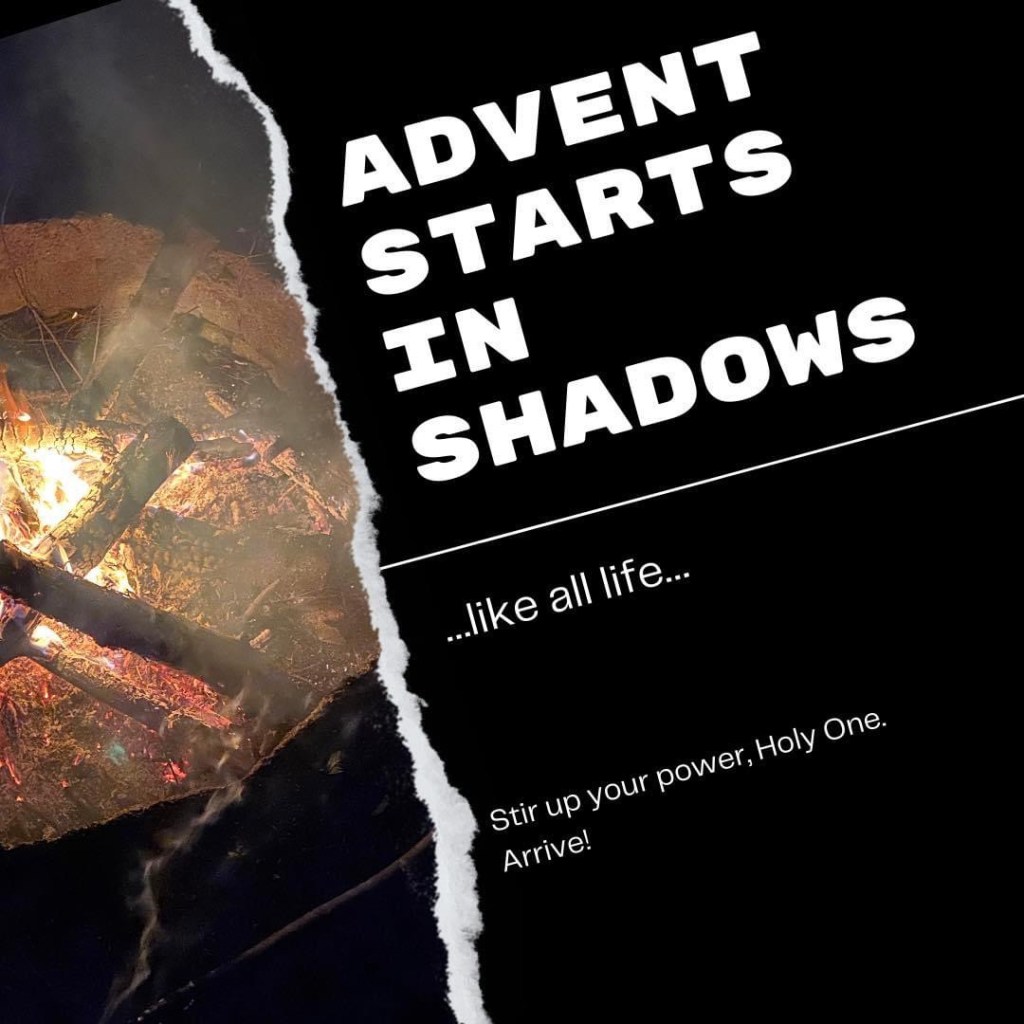
Advent Starts in the Shadows

Lent is a spiritual housecleaning.

Advent? Advent is a spiritual housewarming.

We cozy up our homes, and our hearts, like a young one knitting something in a rocker late into the night, expecting something, someone, any day now.

Any day.

But it starts at night, and in the early morn. As the sun hides in these days and the shadows stick around longer, those who follow the church year ponder beginnings and endings by candle light, slowly adding to their number as the waiting intensifies.

Advent starts in the shadows because most of our waiting happens in the shadows, both literal and figurative, as we wrestle with difficult questions.

What does it mean to be another year older and missing those who have gone before?

What does it mean to wonder when we’ll see our last year?

What does it mean to wait for something new to happen…wondering if it will ever happen at all?

What does it mean to practice joy instead of happiness, peace instead of uneasy stalemates, hope instead of certainty?

What does it mean to be open to something new while missing what was?

This is the way of Advent. These are the angst days of joyful wrestling, prayerful pondering, and hopeful expectancy tinged with a good bit of refining doubt.

Christmas crooners croon away, and that’s all we’ll and good, but the true warbling in these days are the wonderful wonderings we wonder with Mary, pondering what newness lies ahead, and inside of us, this year. We cozy up our beings to welcome it.

Advent starts in the shadows of our “hopes and fears of all the years,” as the carol goes.

A beautiful, amazing, ponderful time. Embrace it.