“Sometimes writing sits in you like a wild animal. Maybe you see its eyes. Maybe you don’t see it at all, but the hair on the back of your neck knows it is there where the deepest shadows lie. Often the shadows lie about what’s hiding in them.
The panther that has stalked you since you were a child is old now. No longer wild, and tired of guarding the treasure you yourself left behind– blind and deaf, she will give it all to you if you just let her go.
But how are you to know whether the fox on the hill in the cemetery carries your mother’s name or is the same fox you saw crossing your back yard in the snow
unless you put your pen to paper and use it to release the animal that hides in the shadow of your hand.”
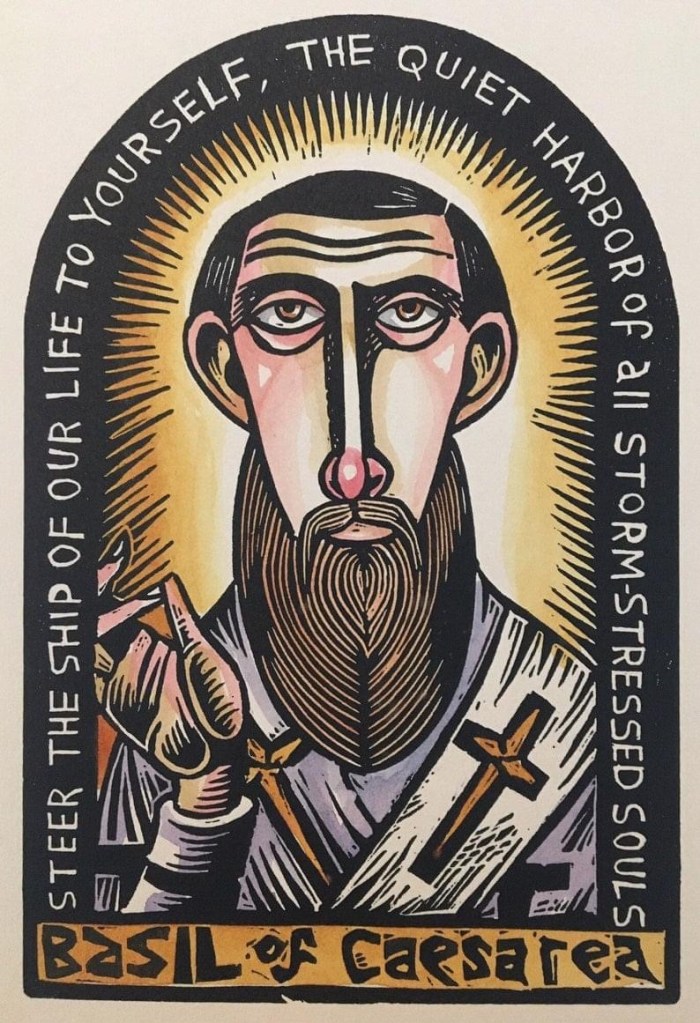
Today the church remembers a chatty 4th Century saint who, despite his best efforts, was terrible at living alone: St. Basil the Great, Bishop and Patron Saint of Extroverts.
St. Basil was born into a wealthy Greek family around the year 330AD. He was raised by his grandmother and pious parents, was well educated, and was influenced in early adulthood by a charismatic Bishop of the church, Eustathius of Sebaste. This influence compelled him to be baptized and spurred a spiritual awaking.
Feeling a call to the ministry, he left his practice of law and education to go where the monastics roam. Traveling to Palestine, Egypt, and Syria, studying the ascetics and the monastic life, he mindfully distributed his wealth to the poor and tried his hand at living the life of a hermit.
He was terrible at it.
He missed talking to people, and found his brain to be a poor conversationalist.
So, he decided to gather around himself a group of like-minded people, thereby effectively creating the first intentional monastic community of the church. His writings and reflections of this time became formative for Eastern Monasticism, and he’s generally thought of as the founder of the first monastic settlement.
As his stature and practice grew, and as his writings were circulated, St. Basil became a respected theologian and practitioner of the faith. He attended the Council of Nicaea and was a strong voice for Orthodoxy.
In 362AD St. Basil was ordained a Deacon in the church, and then a presbyter as his influence grew. He joined with St. Gregory in full-throated repudiation of Arianism (an ancient heresy), and eventually became the administrator of the Diocese of Caesarea.
In 370AD he succeeded Eusebius as Bishop of Caesarea. Though he had some bad blood with a few neighboring priests and bishops (if you think we have theological squabbles today, read some of the stuff coming out of the 4th Century church!), St. Basil was also known to see the best in people, even his opponents. He was also exceedingly generous with his money (he barely kept any) and his time, known for being on the front lines of the local soup kitchen in times of famine.
St. Basil’s writings, especially those regarding care for the poor and the sick, continue to confront Christians today. He did not mince words.
My favorite Basil line has him writing in a pastoral missal, “The shoes left unworn and rotting in your closet are meant for those without shoes, as is the food in your pantry and the unused coat.” And he was known for living this out, not just preaching about it.
The date of his death is unknown, probably sometime in the late 4th Century of liver disease and poor health probably brought on by leading an extremely ascetic lifestyle, but his memory lives on.
St. Basil the Great (as he is now known) is a reminder for me, and should be for the whole church, that proximity is primary. You must be around the people you serve to know them, and you must engage with others, even if you disagree with them.
Today, as most of the world celebrates New Year’s Day, the church officially honors an odd festival (which was created in opposition to the New Year’s Day revelries): The Holy Name of Jesus.
To understand why we have this feast day at all you have to go back, way back, to when there were differing calendars, and therefore differing ideas of when a new year actually begins.
For much of secular recorded history, the new year began on March 1st (or at least in March) with the ushering in of meteorological Spring (note: this is not astronomical Spring, but rather just the date when Spring starts to show off in many places). The names of the later months of our current calendar, September, October, November, and December still harken back to this reality, as September is the seventh month (Sept), and October the eighth (Oct), etc. if you start the year in March.
If you care nothing else about this festival or this day, the above is a feather in your cap for 2022. Bet you learned something new.
There was, at the same time, a persistent thought that January 1st marked the beginning of the year, as it honored the god Janus who looked forward and backward and immediately followed the Winter Solstice.
When Julius Caesar reorganized the calendar for Rome, he made it the beginning of the year, and it made sense because the Roman Senate convened in January. The first day of that month became the official “Saturnalia” celebration day, though the weeks prior and weeks after were included in the festivities.
This date as the start of the new year began to spread throughout the centuries, and eventually landed in England and the American colonies who were late adopters to the idea (it took them until 1752).
But, as the Church was birthed in Rome and the Saturnalia festivities were in full swing with drunken parties and dancing and theater tournaments, influential clergy (like Augustine), though they would have rather have had no part in marking the day at all, decided that worship and fasting would be good practices to keep the Christians from the pagan celebrations.
This practice, btw, is still held in some parishes on New Year’s Eve until the wee hours of New Year’s Day, and is called “Night Watch.”
So the church, feeling it needed to keep Christians from getting too boozy and too happy around the pagan feast, went with a more Biblical understanding of the day. Using Christmas Day as a marker (which, again, was reluctantly placed on the calendar…Christmas wasn’t a thing for Christians in that early church) they saw that eight days later would be the circumcision and name-day of Jesus, and they decided, “Yup! That’s what we’ll call it.”
And so, this feast day was born as a reaction to the outside world and a coopting of other feasts at the time. In this way the church showed great ingenuity, in my opinion. After all, people don’t like it when you take things away from them, for whatever reason, so they’d much rather you add or shift things for them.
The above is interesting, but for those of us who are more interested in seeing these holy/holidays differently rather than understanding them as purely a reaction to the outside world (which makes me not want to honor them at all, to be honest!), I present to you this idea:
The Feast of the Holy Name of Jesus presents for the church, and for all of us, an opportunity to honor the importance of names for humans.
I remember one time as a young, smart-mouthed kid, that at a Cuban restaurant in Hialeah, Florida, I forgot to note something that I wanted to order and said, “Get Jose back here! I forgot something.”
My grandfather looked at me with a mixture of anger and disappointment and said, “Tim, that is not his name. He is proud of his name. You cannot change it without his permission, and you need to respect it.”
I was obviously (and rightfully!) put in my place. Indeed it was not his name, and I was making a terrible, racist joke that attempted to take that away from him.
Names are important.
This is why it is, in fact, racist to not learn how to pronounce the names of people of color (this tactic has long been used as a way to degrade people). This was recently seen in a prominent Georgia Senate election a few years ago.
It is racist to deny people job interviews because they have names that are not “traditional” or are specifically ethnic.
Names are given in love, usually in honor, and mean something.
This is also why when our trans brothers and sisters offer to the world a name that best fits them, we need to honor it.
This day is a reminder for me, and can be for the church, that names matter, by God.
-historical bits from Pfatteicher’s New Book of Festivals & Commemorations -icon of Our Lady of Czestochowa -editorials by me
Tonight the church honors not a saint, but an event: Watch Night, remembering the Emancipation Proclaimation of 1863.
Traditions surrounding a “night of watching” on New Year’s Eve can be found in Moravian and Methodist American history through the 1800’s. The practice may have begun almost a century earlier in Bohemian regions of Europe, however, as families marked endings and beginnings.
In America these vigils were taken as an opportunity to reflect on the past year and make resolutions for the coming one. Often held in churches and surrounded by prayer and music, these gatherings usually started in the evening and lasted past midnight.
In 1863, however, the tradition took on new life and a new focus in America as slaves in formerly Confederate States gathered in churches, homes, and rooms in the waning hours of 1862 awaiting President Lincoln’s signature on the Emancipation Proclaimation to take effect.
Watch Night continues to be an annual gathering, especially in communities of color, as a way to both remember what has happened and gather strength for continuing to work for the freedoms still to come. 2020 and 2021 have been stark reminders that the Emancipation Proclaimation was not, and has never been, enough in the struggle for all in this country to live in peace and enjoy prosperity. Indeed, that first proclamation didn’t “free all slaves” in the United States…that would take acts of individual legislation in many border states and territories over time.
We need to remember that racism and prejudice still influence our civic and religious lives, Beloved.
Watch Night is an invitation for us all to reflect and resolve to partner together to do more.
Today the church remembers a 7th Century defender of those on the margins: Saint Egwin of Evesham, Friend of Widows and orphans.
Saint Egwin was the descendant of royalty in his day, a relative of Mercian queens and kings. He was born in Worcester (look to your fridge for the appropriate pronunciation of that term) and was elevated to Bishop after 693 A.D.
As a bishop, though, he came into conflict with those he was given charge over. He was a fierce defender of widows and orphans, believing the scriptures paid special attention to those forgotten by humanity, and sought monetary aid for them from the populace. His strict understanding of these things, along with clergy piety, created some resentment amongst the Brits. They sought to vacate his bishopric.
He took a pilgrimage to seek vindication from the Pope himself and, in piety he thought fitting for the journey, was said to shackle himself and throw the key into the River Avon. He’d make the journey in chains.
In the Alps his company came upon extreme thirst without a fresh water source. Some in his troupe turned mockingly to the pious bishop, entreating him to ask for a water source as Moses did in the wilderness. Still, others in his company trusted in him and encouraged the prayers. It is said that he prostrated himself and, at his bequest, a gushing river came forth giving nourishment for his people.
A suspicious but fun tale.
As he reached the zenith of his pilgrimage, praying at the Tomb of the Apostles in Rome, it is said that one of his servants brought him a key contained in the belly of a fish caught in the Tiber River. That key, it is said, unlocked the bishop’s chains, ensuring the Pope would grant his request to stay in his holy see.
Upon his return to England he founded Evasham Abbey, dedicating it to Mary, the Mother of our Lord. It is said that he died on this day in 717.
Saint Egwin is a reminder for me, and should be for the whole church, that sometimes the pastors most loved before they take their role become those who are despised by folks who think they should act differently…
But the call won’t allow them to act differently.
Let those with ears to hear, hear.
-historical bits from common sources
-icon found in St. Lawrence church in Evesham, England, by Geoffrey Webb in 1943.
Today the church remembers not one person, but rather a family: The Holy Family, Vessels of Divine Communion.
Typical depictions of the Holy Family usually include Joseph, Mary, and the infant Jesus. We understand through scriptural accounts as well as the conventions of the day, that Jesus had siblings as well, which should not be forgotten.
It should also not be assumed that the Holy Family is somehow a prescription for how nuclear families should look. It is, instead, descriptive of the times…and even then, not so much, as Mary’s pregnancy out of wedlock certainly chaffed against the societal norms of the day.
But even with these qualifiers, the Holy Family as a unit is instructive for the kind of love that people can, and should, share within the family (biological or chosen). Joseph, the step-father of Jesus, is tenderly concerned when he cannot find his son on their pilgrimage, and is, by all accounts, kind and stalwart with Mary, keeping their engagement despite the pregnancy surprise.
Mary is a wise and protecting mother, accompanying Jesus on his travels, and sticking with him until the very end, even the cross. Truly, Beloveds, we are not meant to bury our babies, and yet she does so, not shying away from the heartache.
And though we don’t get much of a glimpse of the child Jesus, we find him appropriately rebelling against his parents, kindly watching out for his mother, and including his brother in his ministry.
Certainly it was not an idyllic family. No flesh-and-blood family, chosen or biological, is idyllic (despite what social media might portray). There were even a few arguments recorded (John 2, Matthew 12, Mark 3) that showed not everything was “Leave It to Beaver.”
And yet, they loved one another through it all.
This is why they are lifted up today: not because they were perfect, but because they loved one another in and through the imperfections.
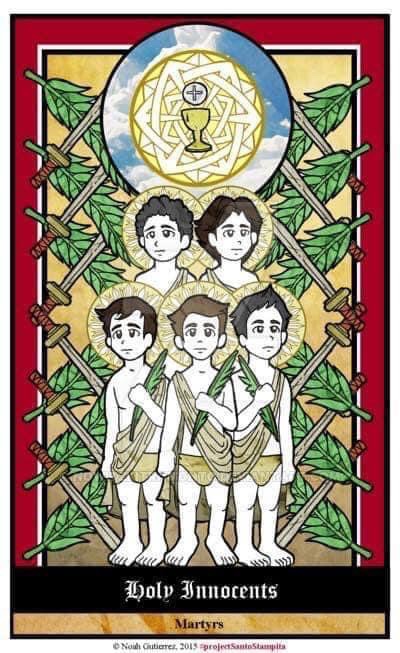
Today the church remembers the slaughter of the Holy Innocents, the children King Herod killed when searching in fear for the Christ child.
We sing of this in the carol “Lully Lullay,” which is meant to mimic the lullaby the mothers of Bethlehem sang to their children to keep them quiet as soldiers searched for them.
“Herod the king, in his raging…”
This still happens today. Children are still our most vulnerable population, especially when the powerful become fearful.
Children are the first to die in times of famine and disease, when food and medicine are hoarded by the powerful.
Children are still the first to die in the wars their parents wage.
Children are the first to feel it when social services are cut by the powerful.
Children are the first to feel it when we pass laws of convenience instead of laws of conviction.
Remember our Holy Innocents today: -The children of Uvalde, Texas, Oxford, Michigan, of Newtown, of Columbine, of every situation where we fail to act to protect them and instead protect guns -The children of Ukraine, Yemen, Iran, Syria, Afghanistan, and all places torn by perpetual war. -The children of the rural poor. -The children of the urban homeless. -The children of undocumented immigrants, especially those used as political pawns in recent days -The children born addicted. -The children who fall into addiction because their futures are bleak. -The children who have every privilege but are not loved. -The children who are greatly loved but have no privilege and suffer in a world of status games. -The children of Papua New Guinea tortured for being accused of witchcraft. -The children sold into slavery around the world for the powerful to abuse. -The children who are left without parents or grandparents in this pandemic because we are selfish.
On December 27th the church remembers St. John, the only apostle said to have died of natural causes.
St. John played a prominent role in the Gospels, and some believe he is even depicted in the Gospel of John as the “Beloved Disciple” (though, I would contend that the Beloved Disciple in that Gospel is actually the one reading the Gospel…but more on that in a different piece of writing).
After the Ascension, John traveled far and wide as an evangelist. He is said to have ended up in Ephesus, where he died of advanced age. Lore has it that in his last years faithful congregants would carry him into the church at Ephesus where he’d bless the gathered people saying, “Love one another, my little children,” a theme of the Epistles of John.
It’s an appropriate day to have a glass of wine or grape juice. Legend has it that John was challenged to drink a cup of poisoned wine, and as he held the cup, he blessed it, and the poison became a snake and slithered out, rendering it harmless. This is why John is sometimes depicted as holding a snake in a chalice.
These saint days following Christmas highlight the “Comites Christi,” or “Companions of Christ.”
St. Stephen died tragically, St. John supposedly died peacefully, and tomorrow the Holy Innocents of Bethlehem who died tragically are meant to highlight how Christ entered a world full of blessing and brokenness, sadness and joy.
God’s incarnation did not solve the problems of humanity, but showed that humanity is worth saving, by God…even broken as it is.
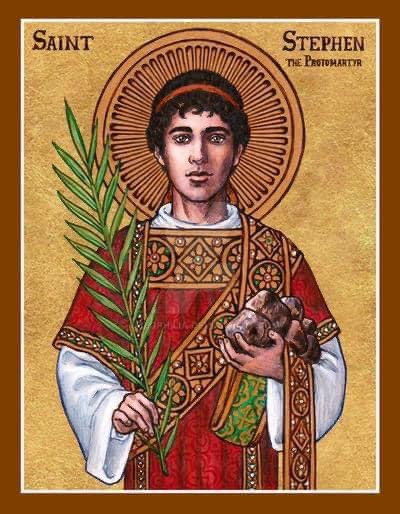
Today the church remembers St. Stephen, Deacon and Proto-Martyr.
It may seem odd to place the feast day of a martyr so close to The Nativity, but the reality is that Jesus came into a world of violence, no matter how loudly you sing “Silent Night.”
The pairing of the birth of the Messiah with the first martyr was intentional: Christ’s arrival is meant to redeem and reform our violent ways…but we’re not there yet.
St. Stephen appears in the Acts of the Apostles as a follower of Jesus whose defining characteristic is love. Even as he was being stoned to death, he prayed for his persecutors. We don’t know anything else about this disciple who apparently led a short, but noteworthy, life.
St. Stephen is joined by two other feast days directly on the heels of The Nativity: the Holy Innocents and St. John. All three will form a few days of peaks and valleys as the 12 Days of Christmastide play out. St. Stephen and the Holy Innocents will remind the us of the tragic nature of our world. St. John, the only Apostle said to have died of natural causes, will remind us that not everything is bad. This back-and-forth swing of the feasts of the church provide a rhythm that calls us to both work for justice, as not everything is well, and thank God for life and creation, because not everything is bad.
By the way, you sing of St. Stephen every year in the Christmas Carol “Good King Wenceslas” who, if you recall, “looked out on the Feast of Stephen, when the snow lay round about, clean and crisp and even…”
St. Stephen is a reminder for me, and should be for the whole church, that love is powerful, and it’s what we cling to and are held by in this life.







 Reluctant Xtian