Unknown's avatar

About Timothy Brown

A pastor. A writer. A dreamer. Occasionally a beer brewer.

Speak with Conviction

Today the church honors another saint who doesn’t get a lot of attention, but deserves it, St. Birgitta of Sweden.

Birgitta was born into a family of status. Her father was the chief judge in the province of Upland, Sweden in the 14th Century. As a child she began having dreams and visions of Jesus and Mary, which started her mystical journey.

Due to her proximity to the powerful in Sweden, she was appointed the lady-in-waiting to the queen of Sweden, Blanche of Namur. There she became known for having fantastical visions, and for being a staunch opponent of underhanded behavior from the nobles of the land.

She was not known for keeping her opinion to herself.

After her son died too young, she went on a pilgrimage, walking the Santiago de Compostella in Spain, accompanied by her husband. On the trip back, her husband (his name was Ulf…a great name) became seriously ill, and he died just a few years later, never fully recovering.

After the death of both her young son and her husband, Birgitta’s life became more akin to the prophets as her visions and dreams intensified. She devoted her time to helping the poor and oppressed, the underclass in Sweden, and later also in Rome.

She openly criticized the kings and popes and tried to make peace between warring factions of the church and the world.

Acting on one of her visions, in 1351 she founded the Order of the Holy Savior, also known as the Birgittines, centered on a monestary in Vadstena, Sweden.

The order was mixed-gender, comprised of both monks and nuns, but governed by an abbess.

In 1371 Birgitta embarked on one final journey, this time to see the Holy Land. The trip was cut short by a shipwreck and the death of one of her other children who went with her. She died in Rome, and her body was returned to Vadstena, where it is still buried.

Today her legacy lives on in the Society of St. Birgitta, a community of both clergy and laity within the Church of Sweden who follow a modified Rule of life inspired by her memory. Her dreams and visions are recorded in the book “Revelations” which is still read by mystics today.

Birgitta is a reminder for me of the power that putting our dreams into action can have, and that we are called to speak with conviction when the powers of the world conspire against the weak.

-historical notes gleaned from Pfatteicher’s “New Book of Festivals & Commemorations”

St. Mary the Tower

Today the church honors the “apostle to the Apostles,” St. Mary of Magdala, more commonly called Mary Magdalene.

Mary’s role in the stories of Jesus varies, depending on the account being referenced. In Luke she was one of those healed by Jesus during his ministry (apparently 7 demons plagued her). Some traditions have identified her with the “woman of the city” who anointed Jesus’ feet when he reclined in the Pharisees’s home, though there is no scriptural basis for this.

In the Gnostic Gospel of Philip, Mary is the one whom Jesus “loved more than the other disciples,” causing 2000 years of speculation over whether or not they were intimate or just in the “friend zone.”

It’s worth noting that the ancient church was known to type-cast in order to provide biased analysis, especially when it came to marginalized communities. The ever-virginal Mary, Mother of Jesus needed a yang to her yin, and so the perpetually penitent prostitute label was assigned to Mary Magdalene. These two mirrored Mary’s would stand for different paths in life for many a young Christian, and unfortunately these typologies have caused terrible, perhaps irreparable, harm to many of the faith.

This unfair, and unfounded moniker of prostitute doesn’t describe Mary Magdalene, but does describe us: we love such labels, especially ones that accuse and belittle.

I think Mary Magdalene should rather be thought of as “ever-faithful” instead of perpetually penitent. It was she who stuck by Jesus on his hardest day when everyone else fled. And it is she who, in the shadows of the early morning, rose to anoint his body, faithful to the end.

Or maybe we should call her “the first pastor,” because it is she who first told the disciples that Jesus had risen, originally proclaiming that good news formally, with the authority of one who had been visited uniquely by Jesus with the message.

Some recent scholarship suggests that “Mary of Magdala” is less a name assigning her to a place, and rather a formal title, with “Magdala” as a descriptor of what she was to the first church: “the tower.” Of this is true, “St. Mary the Tower” gets equal billing with “St. Peter the Rock,” making her a beacon of strength and wisdom.

I quite like that.

If this understanding has been erased or lost to the insecurity of patriarchy, it makes recapturing and re-membering it even more necessary.

Mary Magdalene is a reminder for me, and should be for the church, of two things.

First: histories written by men will feature men and end up denigrating women in some way, either by omission or by commission. This has been true, is presently true, and without a real “come to Jesus” around re-imagining masculinity and the intentional introduction of female voices in the mix, will unfortunately be true in an unchecked future.

Second: a woman was the first pastor. Every pastoral call committee should be reminded of this before looking at any paperwork.

-biographical notes taken from Pfatteicher’s “New Book of Festivals & Commemorations,” opinion portions are solely mine and don’t represent Pfatteicher

-icon written by Ulla Karttunen

Questionable Advice

Today the church remembers the Biblical prophet-in-exile: Saint Ezekiel, Critic, Visionary, and Giver of Questionable Advice.

Saint Ezekiel was (probably) born sometime in the early 600’s BCE while King Josiah was instituting the reforms that Judah had hoped would keep them in Divine favor and keep warring armies from continually conquering them.

Spoiler alert: the reforms didn’t work.

He was born into the priestly cast of Israel, and was supposedly a descendant of Joshua himself. Ezekiel, prophet and priest, was married and, because of his high standing in Jewish society, was exiled to Babylon when the Babylonians crushed Jerusalem. The Babylonians were no fools. To prevent an insurrection in their captured lands they would exile the best and the brightest (and those who held the most political sway) to work in Babylon for the king there, benefiting from their wisdom and preventing any influential characters from gathering power around themselves.

Ezekiel was married, and reportedly lived in Tel Abib on the banks of the Chebar river.

In the book of Ezekiel we get a glimpse into his prophecies and encounters with God. Ezekiel was a person who lived off of the visions he had of the Divine, much like Saint Julian of Norwich and Saint John of the Cross, and his mystical visions vacillated between beautiful and horrific. He warned of the coming destruction of the temple in Jerusalem and, for five years, acted out this destruction in a kind of pantomime for all to see.

Other notable illustrations in his visions were the graphic depictions of the angels surrounding the Divine throne (human face, ox, eagle, and lion), and the cryptic fiery “wheels in wheels” which always reminds me of the Johnny Cash song, “Ring of Fire.”

When the prophecy of the destruction of Jerusalem proved true, he became a would-be advisor for those also in exile in Babylon. Notably it was he who told Shadrach, Meshach, and Abednego to refuse to bow down to King Nebuchadnezzar’s golden idol, creating the fun Easter Vigil story popularly known as “Three Men in a Fiery Furnace” because when you don’t do what the King wants, you get thrown in the oven.

You know, that old chestnut…

Surely that was questionable advice, but everything turned out alright.

Ezekiel is held as a model of faith in all three of the Abrahamic traditions, the “People of the Book.” The Eastern Orthodox Church honors him on this day, as do many other communities (including Lutherans).

Ezekiel is a reminder for me, and should be for the whole church, that even when you find yourself as an exile from your home, stay true to your convictions and you’ll find your home is never far away.

-first icon is a typical Russian writing of Ezekiel and can be purchased at orthodoxchristiansupply.com

-second icon is a writing of Ezekiel’s vision of “wheels within wheels” and, though I’ve tried hard for a while to find the writer of the icon, I’ve been unable to locate them. Note that I’m not the writer of either.

The Universalist

Today the church remembers a 4th Century saint who was often overshadowed by her more famous brothers Greg and Bas (you know them Gregory of Nyssa and Basil the Great, two of the three “Cappadocian Fathers” of the faith): Saint Macrina the Younger, Scholar and Universalist.

Saint Macrina was born in a family already well-steeped in the early Christian movement. She was named after her grandmother, Macrina the Elder, and though her brothers would gain notoriety for their scholarly treatises, they themselves mentioned Macrina as a teacher of faith in their home.

Having been betrothed in an arranged marriage by her father, Macrina never tasted wedded life as her fiancé died before the wedding. She came to see her vows as belonging to Christ alone, and lived an aesthetic and austere life with her mother and a group of women who pledged themselves to communal living. In this community, everyone was equal, whether you were formally a servant or wealthy enough not to owe anyone anything.

It’s one of the early egalitarian communities of the faith, and St. Macrina grew in responsibility as the community grew, taking on what we would call an Abbess role in time.

St. Macrina was also the tutor of her younger brother, Peter of Sebaste who would become a Bishop in the early church. She taught him not only the great philosophical ideas of the time, but also about The Way which was spreading like wildfire in the West and the Near East. In this way, and because she had such a strong influence on Greg and Bas (as I call them), means she was a shaper of the early church, an unseen hand on the needle of the faith.

Known for being a deep thinker, St. Macrina was supposedly a Universalist, and is lifted up by the Universalist Unitarian Church as a great scholar. Her brother, Gregory of Nyssa, composed Dialogue on the Soul and Resurrection in which he records a conversation with Macrina on her death bed (actually, her aestheticism was so great she refused to die in a bed, and chose to die lying on the ground). In that conversation she notes her deep conviction that everyone would be reconciled to God in the end, faithful and pagan alike.

St. Macrina died on this day in 379 AD in Pontus, modern day Turkey.

Saint Macrina is a reminder for me, and should be for the whole church, that the early Christian movement comprised a multiplicity of thoughts and theologies…and still does, despite what the zealots in all corners might want you to think.

-historical bits from open source publications

-icon a classic Byzantine style by unidentified writer where St. Macrina holds an icon of her brothers

Saint Olga

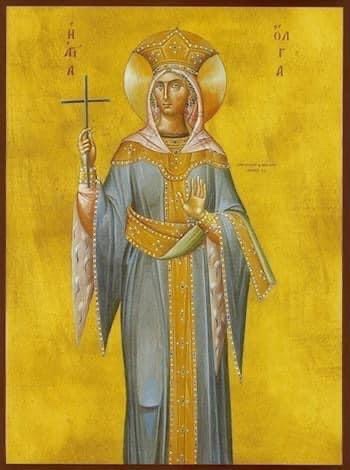
Today the church remembers one who is considered to be the first Christian ruler of Russia: Olga, Princess of Kiev, Confessor and Ruler.

Saint Olga is the grandmother of the first “official” ruler of Russia who confessed the faith. Her grandson Vladimir gets the “official” title because of patriarchy, but in actuality Olga was the first official Christian to rule the nation.

Born in the late 9th Century, Olga married Prince Igor and, after his death in the year 945 A.D., officially ruled in his stead until her son came of age.

She was known for being courageous, “sticking it to the man,” instituting reforms that her husband was unable to carry out regarding financial and administrative changes, and had been an early convert to the faith through the Scandinavian missionaries who traveled down the river system from the East.

In the year 957 A.D. Olga visited Constantinople and some say that is where she was officially baptized, though others claim that she had long been an adherent to the faith. Regardless, her personal faith did not indicate a change of heart for her country, and her son who came to rule after her was not a confessor.

Olga is remembered in Eastern Orthodoxy as the “Blessed Princess Olga,” and is honored in the Ukrainian and Russian branches of the church. She is remembered as being witty and brave. The story goes that when she went to be baptized in Constantinople, the Emperor saw her beauty and asked her to marry him. She replied, “First I must be baptized,” and then followed it up with, “and I need a Godfather. Will you be mine?”

The Emperor agreed and, following her baptism, returned to the invitation of marriage. The bright Princess replied, “We are now family through baptism, and never has a father married a daughter, even amongst the heathens!”

Knowing he had been outsmarted, he gave Olga his blessing to return to Russia with the faith.

She died in the year 969 of old age.

Saint Olga is a reminder for me, and should be for all the church, that too often the female saints amongst us don’t really get their due because, well, patriarchy is hard to eradicate and we must always keep in mind the author of histories and, well, read between the lines.

Let those with ears to hear, hear.

-historical notes gleaned from Pfatteicher’s New Book of Festivals & Commemorations

You’ll Accompany Me

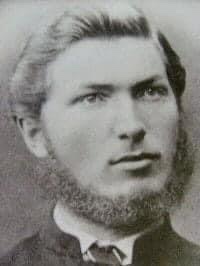
Today the church recognizes a peasant from Bavaria who would influence both an entire continent and an island nation, Johannes Flierl, Missionary to Australia and Papua New Guinea.

Born in humble beginnings in 1858, Flierl was ordained a pastor in Bavaria and started his mission work in the interior of Australia with the native aboriginal persons there. Roughly eight years later, he boarded a boat and hopped across the Torres Strait, landing in Finschafen, Papua New Guinea, the capital of the German colony of Kaiser-Wilhelmsland.

Flierl was the first Lutheran missionary on the island. He established a mission near Simbang, but didn’t baptize any locals until 14 years later.

Flierl is remembered not only for his mission work, but most importantly as a champion for the locals in their fight for rights against government oppression. A seminary in Finschafen was established in his name in 1957, ten years after his death.

Flierl’s mission would eventually become the Evangelical Lutheran Church of Papua New Guinea which, along with the Batak Church in Indonesia, is the largest of all Lutheran mission churches.

Flierl is notable for a few reasons, not the least of which is his innovative chin hair. It does my heart good to hear of a 19th Century missionary who was fighting for the rights of the people they were sent to walk with, not just trying to bludgeon them with a religion they didn’t ask to be exposed to.

The ELCA’s model for missions is one of accompaniment, and though it is unclear how closely Flierl’s work embodied that same spirit, I see glimmers of hope in his story that he may have practiced some of that mindset in his missions.

-historical notes gleaned from Pfatteicher’s “New Book of Festivals & Commemorations”

It Shall Not Be Moved

As the sun rises, it’s worth noting that the church honors a 20th Century saint on this day who worked hard to unify the quarreling factions of the body: Saint Nathan Soderblom, Archbishop of Uppsala, Unifier of the Church.

St. Nathan was born in Sweden at the end of the 19th Century to a family helmed by a pietistic pastor father. He was ordained a minister in the Church of Sweden in 1893, and served as chaplain to the Swedish legation in Paris until 1901. While in Paris he studied comparative religion, and his mind and heart was expanded.

Upon receiving his doctorate he taught History of Religion at Uppsala while also lecturing in Leipzig. He was known for being highly intellectual, highly liturgical, and highly progressive in his theology.

Despite opposition from more conservative pastors, he was elected the Archbishop of Uppsala and Primate of the Church of Sweden. In his leadership and his writing he sough what he called “evangelical catholicity,” encouraging different factions of the church to work together for the social good.

You might remember a similar agreement between St. Peter and St. Paul…

Through his leadership and efforts the predecessor bodies that would eventually become the World Council of Churches began to form and do their work.

During World War I he vehemently sought the freedom of prisoners of war and refugees, arguing for peace on behalf of the people. In 1930 he won the Nobel Prize for peace.

He died on this date in 1931.

St. Nathan Soderblom is a reminder for me, and should be for the whole church, that education not only expands the head, but also expands the heart, and a church that can agree to serve the poor is like a tree standing by the water.

It shall not be moved.

Now, if only it could agree to that…

-historical notes from Pfatteicher’s New Book of Festivals & Commemorations

-icon written by Tobias Stanislas Haller BSG

Patron Saint of Beer

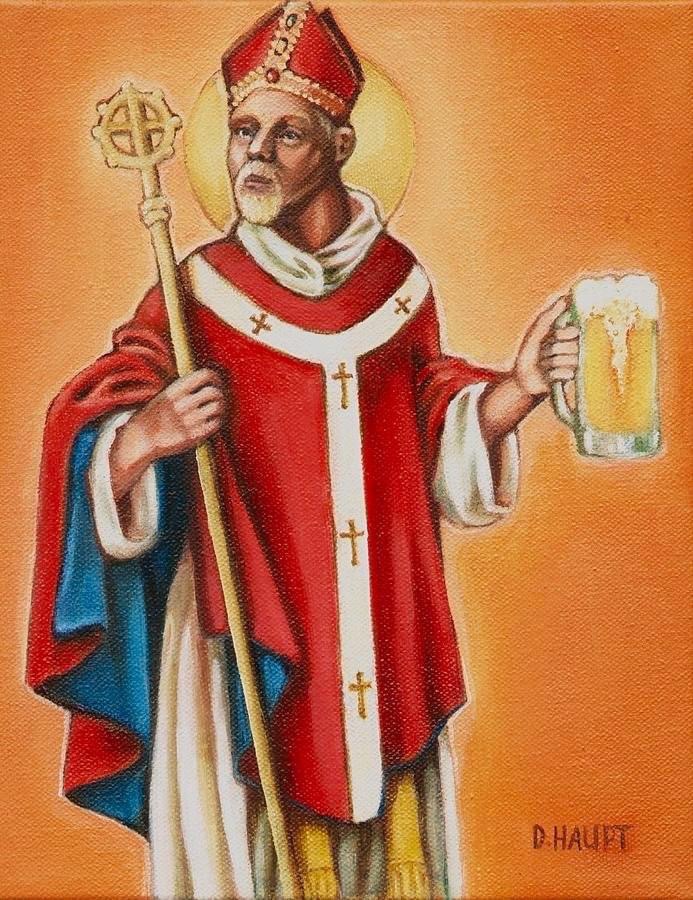
Today is the saint day of a patron who is near and dear to my craft-beer loving heart: Saint Arnold, Beer Brewer and Savior of Humanity.

So, here’s the thing about St. Arnold: he is an unlikely saint, as most are, but not because he did things wrong, but because he did them correctly.

He started his career in life as a soldier near modern day Brussels, but ended up at a monastery in France, learning beer brewing from the brothers. He rose to become the Abbot of Medard’s Abbey, though he tried to flee from the responsibility. Lore has it that he ran from the cloister and wolf chased him, hunted him down, and convinced him to go back and serve the vocation.

That’s a fun call story if I’ve ever heard one…

Instead of being OK serving this monastery in France, he chose to found his own in Oudenberg, and there began brewing beer in force. The people of Oudenberg were being plagued by infested water, probably from human waste dumped too close to the local water source, and encouraging them to drink the beer rather than the water actually saved lives.

Plus, this beer was low gravity, giving them the ability to do their work well while also staying alive. A plus in my book.

This blessed saint is still honored in Brussels on the “day of beer,” as a reminder that sometimes when the local water source is contaminated, some boiling (and hops) will be the cure.

Saint Arnold is for me, and should be for the whole church, that no topic is as simple as “good or bad,” and sometimes science in the kitchen can lead to health in the streets.

On Listening to the Young

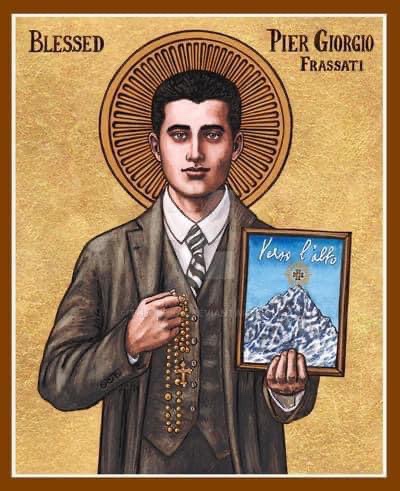
Today the church remembers a saint who fought hard to move the needle of justice, especially for his poor neighbors in Turin Italy: Pier Giorgio Frassati, Social Reformer and Activist.

Saint Pier was born in 1901 to an agnostic father and artistic mother. His father would go on to serve in the Italian government, and his mother would go on to produce artwork that would be bought by royalty. Saint Pier, though, had his eyes set on adventure and advocacy.

As a young boy a mother and shoeless son came begging at the Frassti household. Pier answered the door and, so moved by the sight, gave the young boy the shoes off of his own feet. One night he witnessed a beggar come to his door intoxicated, and was horrified when his father sent him away with nothing. Sobbing Saint Pier ran to his mother who wrapped some food in a napkin for him, and sent him out into the night to find the hungry man.

For as big of a heart Saint Pier had, he also had a wonderful sense of humor. He would play practical jokes on his family and friends, and earned the name “Terror” for his wisecracks.

Though he was a smart boy, he was only an average student, and rather than find his home inside books, he found it inside the organizations working for justice. Especially dear to his heart was the anti-fascism work going on in the day, and those causes seeking to bridge the inequality gap. He spoke out against the regime of Mussolini, and was arrested for protesting alongside the Young Catholic Workers Congress.

“Charity is not enough,” he was known to say, “we must have social reform!”

His friends called him a “saint with a cigar,” as he marched, wrote (riffing off of Thomas Aquinas and St. Catherine of Siena), and spoke out against injustice.

In his leisure time he was an avid athlete, boating and mountaineering with his friends.

On one such boat trip in 1925 Saint Pier started to complain of a back ache. Returning home he was met with the death of his grandmother. Not wanting to add to the grief, he kept his pain largely to himself, though it grew in the following days.

Within a week Saint Pier found himself unable to rise from his bed, stricken at the age of 24 with Polio. He died in the arms of his mother, saying with his last breath, “May I breathe forth my soul in peace to you…”

Saint Pier is not a well-known saint, but is one who reminds me, and should remind the whole church, that moving the needle on social inequality often begins in the compassionate hearts of the young.

Which means we should listen to the young, as uncomfortable as that might make us.

-historical bits gleaned from 365 Saints by Koenig-Bricker

-icon written by Theophilia of Deviant Art (deviantart.com)

The House or Light

As we break into July I’m reminded that the ancient Celts always felt that they had two homes: the “inside house,” and the “outside house.”

In the winter months the hearth became their sun, and the family gathered around it to live well.

But from May-November, they didn’t need the false sun of the hearth, and their world (literally) revolved around the burning star that provides us life and light. The “outside house” was all creation, every living thing not within four walls.

They called this “outside home” the “house of light.”

In July they would sit in the house of light, outside, to learn: how to grow, how to use the light offered you free of charge, how to rise early, and how to retire as the sun retired.

We’d do well in these days to find ways to imagine our lives being between two houses, I think…and being able to learn what is taught in July.