Unknown's avatar

About Timothy Brown

A pastor. A writer. A dreamer. Occasionally a beer brewer.

On the Deacons

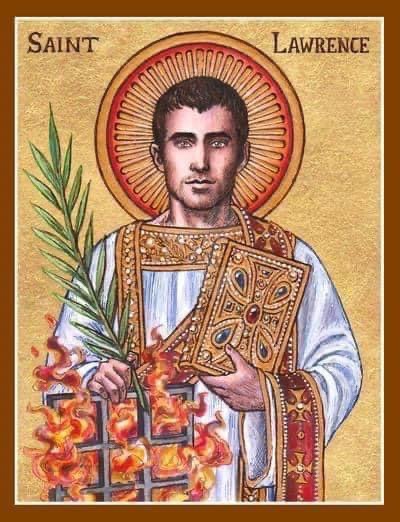
Today the church honors a 3rd Century Deacon, St. Lawrence of Rome.

Lawrence was the chief of the seven deacons of Rome, charged with distributing the wealth and food of the Church to the poor.

In 257 Emperor Valerian began a massive campaign of persecution against the Church. All properties of the Church were confiscated, and worship was forbidden. Pope Sixtus II, who had just been the Bishop of Rome for a year, was apprehended in a cemetery along with his seven deacons as they were celebrating the liturgy, and all but Lawrence were beheaded and buried there.

Lawrence was left alive because, as the head Deacon, he knew where the Church had hidden the store of charitable gifts and treasures. He was tortured for three days, and then martyred on the 10th of August.

Lore around Lawrence’s martyrdom is legion, and though the topic is tragic and terrible, the stories of this witty Deacon are amusing all the same.

When told to go gather up the treasures of the Church, Lawrence ran from the cemetery and assembled a great number of paupers, orphans, widows, and the maimed, assembled them at the palace, and said, “Here is the treasure of the Church!”

Tradition claims Lawrence was sentenced to a long and painful death for his stunt, and as he was being tortured over a fire said, “I’m done on this side. Turn me over!”

It is not an accident that so much lore surrounds Lawrence’s execution. For Rome to execute a Roman citizen in such a way was shocking to the early church. Even citizenship couldn’t save them! The stories provided insight and relief in the shadow of such brutality.

Less Lawrence himself, but more-so the stories about him are a reminder to me, and should be to the church, that humor is a spiritual gift, and that while the world searches after gold, the Church should be finding ways to distribute it to those it is taken from.

-historical notes from Pfatteicher’s “New Book of Festivals & Commemorations”

-icon written by Theophilia at deviantart.com

On Good Work

Today the church remembers an obscure German philosopher turned nun: Saint Teresa Benedicta of the Cross, Genius, Scholar, and Holocaust Victim.

Born 1891, Edith Stein came into the world to a Jewish family in what is now modern day Poland. Though her family was observant in most every way, Edith abandoned any belief in God by her early teens…a story many families can relate to, no? In the shadow of World War I Edith went to nursing school and then became fascinated with the theme of empathy and the human response to hurt, fear, and pain. At the age of 23 she received her doctorate, using the exploration of empathy as her thesis.

Fascinating, no?

During her college years she began exploring the life of St. Teresa of Avila and, falling in love with that passion and faith, was baptized in 1922. She had originally wanted to enter monastic life then, but instead went on to teach at a Catholic University.

In 1933 when proof of “unaltered European heritage” became a criteria for civil service, Edith was forced out of her teaching position due to her Jewish lineage. Seeing this an opportunity to do what her heart was telling her to do, she became a postulate at the Discalced Carmelite monastery in Cologne and, on the Feast of St. Teresa of Avila in 1934 received the habit as a novice in the order, taking on the name of her spiritual mentor, Teresa Benedicta a Cruces. In 1938 she completed her vows.

Because the persecution of the Jewish people, and anyone of Jewish heritage, became seen as a central theme of the Nazi Regime, Saint Teresa and her sister Rosa, also a convert, were sent to Echt in Netherlands to hopefully go undetected by the Gestapo. In 1942, however, the Dutch Bishops’ Conference published a letter read in all Dutch churches that condemned the Nazi treatment of the Jewish people, and in retaliation the Gestapo made a concerted effort to round up all Jewish converts to Catholicism.

St. Teresa and Rosa were sent to Auschwitz on August 7th, 1942.

St. Teresa had been preparing her body and mind for a concentration camp for some time, periodically starving herself and sleeping without sheets in the cold. Her preparation, however, was in vain.

On this day, August 9th, after surviving the deportation to Auschwitz, St. Teresa Benedicta of the Cross and so many others were killed in a gas chamber.

St. Teresa was formally sainted by Pope John Paul II in 1988, and is considered one of six patron saints of Europe. Her name and memory graces more than a few European museums, and her life’s story has been dramatized as a play here in America.

Still, the most remarkable thing about St. Teresa Benedicta of the Cross, at least to me, is how she knew she wasn’t going to survive the war, and yet continued on with her work.

St. Teresa Benedicta of the Cross is a reminder for me, and should be for the whole church, that sometimes we continue on with our good work even if we know it won’t last forever.

Indeed, perhaps because we do this, it finds a way to last past death, no?

Perhaps it was empathy that allowed her to do so…and might allow us to as well.​

Let those with ears to hear, hear.

-historical bits from publicly accessible information

-icon written by Jenn Norton

On Wooing

Today the church remembers St. Dominic, Priest and Friar.

This 13th Century contemporary of St. Francis would blaze a similar path through the church and the world as his animal-loving brother, taking action against the corruption and laxity he observed in the religious halls of power through a call to renewed living, teaching, and love.

Wealth had, in his estimation, jeopardized the church and its ability to speak truthfully and honestly in the world. He was also alarmed at the number of Christians subscribing to the belief that Jesus only existed in spirit, and therefore was never incarnate. This belief encouraged the faithful to see all matter as inherently evil, denying the goodness of creation.

In response he organized a movement of poor, itinerant preachers who took quite seriously Jesus’ words in Matthew 10. These women and men (Dominic also started an order of nuns along with his male devotees) went throughout the world preaching and teaching, extolling the beauty and wonder of creation and incarnation, combating the heresy through conversation, sermons, and faithful living.

Meanwhile, the Pope began a crusade of fear-mongering and violence to tamp out those viewed as heretics, padding his coffers as he did so.

These opposing approaches to the same issue presents a clear ideological divergence that, unfortunately, still presents itself today in the world. Will issues be tackled through force, “law and order,” and intimidation? Or will leaders raise up more leaders to pave paths of peace in the midst of confusion?

Dominic’s order was eventually blessed by Pope Honorious III in 1216, and is officially known as the Order of Friars Preachers (hence why Dominicans have “O.P.” following their name in official documents, “Order of Preachers”). You’ll know a Dominican because they wear a black robe over a white tunic, which got them their other name, “Black Friars.”

Dominicans are known for being cerebral and pious, and the best known product from this order is probably St. Thomas Aquinas.

As I noted above, Dominic is a reminder for the church, and the world, that power cannot be overcome by more power, in the end. There is always someone more powerful, Beloved…or one who will become more powerful.

Power must be outsmarted not by dominating through the muscles of the arm, but by being wooed through the muscle that is the heart.

-historical bits gleaned from Pfatteicher’s “New Book of Festivals & Commemorations”

On Exploration

Today I would encourage the church to remember one who, though not a Christian, helped shape a culture and nation: Rabindranath Tagore, Poet, Author, and Activist.

Before we do a brief little glimpse at Tagore, I think it’s worth noting why I think the church should remember those even outside their own flock. If we are to imagine that the stream of time includes many ripples, some of those ripples will be from rocks we’ve thrown in, and yet others will be from rocks on other banks that bump into our own ripples, creating new patterns.

Tagore is one such social ripple maker (and his poetry graces my bookshelf), and so like Gandhi and Gamaliel, he’s worth lifting up!

Born in the second half of the 19th Century, Tagore is Bengali by birth, and his legacy is held by both Bangladesh and India as culturally significant. He was born into a high class, and though his mother desired that he become a barrister (and, indeed, he was sent to England to study for it), his heart was that of a poet. From the age of eight he was writing poetry, and even published his first book of poems under a pseudonym at the age of sixteen.

As you can imagine when a poet is trying to study law, he didn’t stay long in school. He returned to Bengal without a degree, and began publishing poems, short stories, and novels. While in England he became enthralled with Shakespeare, and the complex characters he encountered there shaped his own writing.

In 1912 Tagore gained international fame, though it followed on personal tragedy. His wife, two of his children, and his father all died in a relatively short period of time in the years prior, and in the midst of this heartache he translated one of his famous poetry books, Gitanjali, into English. W.B. Yeats and Ezra Pound took notice, and he won the Nobel Prize in Literature in 1913. He was also offered Knighthood for his work, but renounced it in 1919 in reaction to the massacre of Bengali people at the hands of British forces.

Tagore saw that Indian independence was a moral movement, though he resisted any strong nationalism, seeing that as an inherently dangerous idea. In his view nationalism would cut India off from other countries, making them an island unto themselves, which would make them insular.

Those with ears to hear, hear.

Even though he stood with Gandhi in the movement for Indian independence, he and Gandhi disagreed on the tactics by which to achieve that independence, often feeling that Gandhi was too radical, and the poor locals on the ground felt the forceful fist of those actions.

Along with social activism, Tagore helped to create alternative schools, encouraging alternative ways of learning for the local children. He spoke out against the caste system, and lobbied that all castes get access to the temples and cultural gems that India offered.

As Tagore aged he became less and less enamored with religion as a system, and saw the divisions it caused as doing more harm than good. He also began to more intentionally explore science, and began to weave his stories into the scientific community through essays and fanciful scientific biographies in the 1930’s.

In 1937 Tagore fell comatose, and remained in that way for many years, briefly recovering some abilities, and then failing again in 1940. He died on this day in 1941.

Tagore had his fingers in all creative works: from drama, to poetry, to novels and stories, to hymn writing and paintings. Tagore felt like exploration was part of a human’s calling in life, and he dared to fulfill it.

Rabindranath Tagore is a reminder for me, and should be for everyone, that exploration is part of humanity’s calling in life.

So go create, by God!

-historical bits from publicly accessible sources

-icon is Tagore’s own self-portrait

Transfiguration vs Incineration

Today we have two conflicting remembrances which, when held side-by-side, should humble both the church and all of humanity: The Feast of the Transfiguration and the Bombing of Hiroshima.

Of course everyone who is familiar with the ramp-up to Lent in the church will note that we celebrate the Transfiguration of Our Lord on the Sunday before Lent. This is most certainly true.

But that is a Sunday observation, not a feast day.

Today is the proper feast day of that event where Peter, James, and John followed Jesus up to the mountaintop and witnessed him standing between Moses and Elijah, between the Law and the Prophets of old, bridging the gap between what was and what will be. In a blaze of light Jesus has his identity shine forth.

That ancient blaze of light stands in stark contrast to the blaze of light where, from the height of a mountaintop in 1945 the first atomic bomb to be used on humans was dropped onto Hiroshima. In that particular blaze we have, I fear, humanity’s identity as people addicted to weapons and war shining forth.

A tragedy.

In the first instance we have a glorious blast of transfiguration. In the second, a blast of incineration. The innocents of Hiroshima were disfigured, not transfigured.

However we might take a historical look at the impact of that bomb on the wider war (Did it stop the war? Was it an evil that was outweighed by the ending of a long conflict?), the particular impact of that bomb was horrific.

Continues to be horrific.

And certainly the use of that bomb opened Pandora’s small box of a legion of future potential horrors which we are constantly trying to hold at bay, standing between what was and what we fear might be.

The church, when it eats at the food trough of Nationalism, would do well to hold these two side-by-side and remember that the hunger for war and dominance is abated not by indulgence but by repentance.

The Feast of the Transfiguration revealed the Christ as a saving actor in human history. The remembrance of the bombing of Hiroshima reminds me, and should all of us, that we are terrible at saving ourselves.

-commemoration notes from Claiborne and Wilson-Hartgrove’s Common Prayer: A Liturgy for Ordinary Radicals

-commentary by me

-icon of Transfiguration by Lewis Bowman

Truth-Full Fiction

Today I would lobby hard that the church remember a voice who spoke for so many in America: Toni Morrison, Author and Activist.

Born Chloe Ardelia Wofford in Lorain, Ohio in 1931, She learned the horrors of racism at an early age when, as her parents couldn’t afford the rent, the landlord of their home lit it on fire while they were still inside. This trauma, along with the generational trauma in her family, would help inform her life’s work.

At the age of 12 Chloe was baptize in the Catholic church and took the saint name Anthony as her baptismal name. This got shortened to Toni, and that’s how we know her today. She was inspired by Austen and Tolstoy in her writing, but also by the legends and ghost stories of her family lore. An imaginative young Toni started to tell tales and weave wonderful stories together early on.

Toni attended Howard University, and then went on to teach English in Texas as a newly married woman and mom. The marriage did not last, but in 1965 Morrison’s career took a big jump as she became the first black senior editor at Random House in New York City. From there she used her position to elevate black authors. At the age of 39 Morrison joined the ranks of those she edited, publishing her first book The Bluest Eye. The year was 1970, and this first book would go on to become required reading for so many of us.

Morrison would go on to publish many more books and plays, and in 1987 published her most celebrated work, Beloved, a story about an enslaved Black woman, Margaret Garner.

To call it a masterpiece is to undersell it.

Toni would turn Beloved into a trilogy, finishing the series ten years after the first publication. The first book in the series would go on to become a movie, and Morrison’s place amongst great American authors would be secured, and from 1989 until her retirement in 2006 Morrison held a chair at Princeton University in Humanities. In 2017 Princeton dedicated Morrison Hall in her honor.

As a political activist, Morrison was not known for staying quiet in the face of racism and abuse. At the deaths of Eric Garner and Michael Brown, Toni spoke loudly and clearly for justice and told of a system that still targeted black and brown bodies.

Toni Morrison died on this day in 2019 at the age of 88 from complications of Pneumonia. She lives on, though, in the stories, plays, and inspired minds she leaves behind.

Toni Morrison is a reminder for me, and should be for everyone, that telling truthful stories, even if they’re fiction, can shape a nation.

It has before

-historical bits from public sources

-image painted by Nannette Harris

Teller of Tales

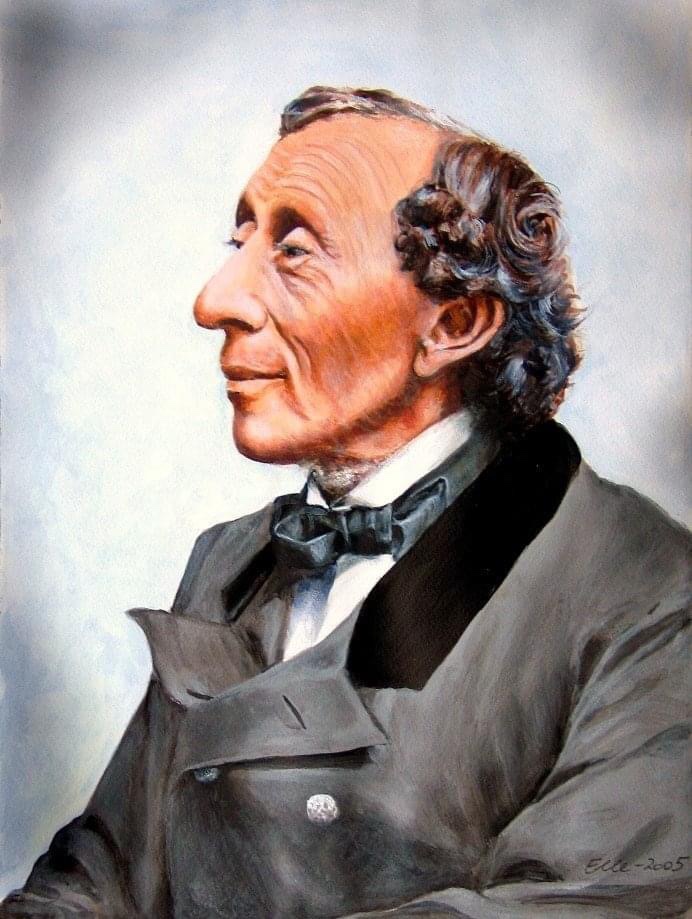
Today I would lobby hard that the church remember a premier storyteller who has had arguably as much cultural influence as the parables of Jesus: Hans Christian Anderson, Poet, Teller of Tales, and Social Influencer.

Hans was born in the early 19th Century in Odense, Denmark to an illiterate mother and a father who only had a basic elementary education. It is absolutely improbable that he would end up being a literary force, and yet, here we are.

Hans was originally sent to a school for the poor, and there was taught the basics of reading, writing, and arithmetic. At home, however, his father fueled his imagination by giving him Arabian Nights. After his father died, he began apprenticing as a weaver and a tailor, and then eventually went to Copenhagen to seek his fortune as an actor, a path most New York waiters and LA baristas can tell you about.

A director at the Royal Danish Theater took notice of young Hans and sent him on to further education on the Royal dime. Note: a teacher invested in him and encouraged him in his craft…we owe teachers so much, especially because they are often the first line of encouragement for young artists.

Let those with ears to hear, hear.

Unfortunately Hans often had a tough time in school, sometimes because people didn’t believe in him, and sometimes because he was just of a more morose nature and was taken advantage of by others. One of his earliest fairy tales, “The Tallow Candle,” spoke of an unappreciated wax taper, perhaps a glimpse into his own being.

Obviously these obstacles did not stop Hans from excelling at his craft, and slowly and surely through poems, travel diaries, novels, and plays, he made a considerable name for himself, particularly because his tales had direct moral overtones, often ones that echoed some of the Biblical stories he grew up with.

Interestingly enough, however, Hans had a difficult time with religion, and he wrestled with the church. One of his most famous encounters was with fellow wrestler Saint Soren Kierkegaard, who described Hans as kind of a brooding fellow. Perhaps some of this brooding came from his other big wrestling match in life, his sexuality. In many of his letters, and even in some of his tales, he speaks of a loneliness and longing for a love that was unattainable and taboo.

Your heart can’t help but break for him in this way.

He still continued to work and write, shaping the world around him through the most amazing thing that humans have produced: stories. In his old age the Danish government had started to pay him a yearly stipend simply because he breathed. He was that treasured as a person. With “The Little Mermaid,” “The Emperor’s New Clothes,” and “The Snowman” and so many others, Anderson’s tales continue to tingle the imagination and cause our hearts to stir.

At the age of 67 Hans woke up one morning with a start and fell out of bed, severely injuring himself past the point of recovery. His injury caused him to be thoroughly examined, and in the aftermath they found signs of liver cancer.

He died on this day in 1875.

Hans Christian Anderson is a reminder for me, and should be for the whole church, that stories are truly the things that pluck at the human heart and cause us to move and be moved. Indeed, stories are our best gift to humanity, Beloved.

-historical bits from public sources

-picture painted by Elle, 2005

Some More on August…

On one of these early August days, I’m reminded that now is the midpoint for the “Summer half of the year” for the ancient Celts, that time between May and November in their (and our) calendar wheel.

For the Winter midpoint of the year the Celts have the festival of Imbolc, or what we in the States call “Groundhogs Day.” It’s a feminine festival, with Imbolc meaning “still in the womb” (and, coincidentally they looked to burrowed animals in those ancient Celtic religions as nature’s alarm clock to wake from winter). For the summer, and specifically August 1st and the days just after, the Celts had “Lughnasadh (loo-nuh-suh)” in honor of Lugh, an ancient deity akin to Rome’s Mercury. I’m not sure their’s a modern American equivalent, except for maybe our flexible notion of “summer vacation.” The idea is similar.

Lugh, the ancient deity, was known as a “jack of all trades, master of none,” and the time is seen as more of a masculine festival in Celtic tradition. He was called a physician, a mystic, a smith, a trickster, and a bard. He did a bit of everything, and so the festival gives a bit of a nod to everything. Just as Imbolc marked the time when the world was emerging from the womb and celebrated was around the hearth, Lugh is an outdoor celebration that marks the days of “last hurrah” and a descent into the harvest, the colder times, the “beginning of the end” as we might say.

To honor the festival they’d reap the first ears of wheat, oats, and barley, and dig the first potatoes. They’d wean the young lambs so that the mothers would mate in order to continue the cycle in the expectant spring. First plump fruits would be picked from the gardens, and it was understood in all of this that the Earth was keeping its harvest promise.

They’d settle bets and business deals, race horses, and everyone would compete in team games for the “glory of today,” because the hard harvest work was about to begin in haste and the night was slowly taking over the sun’s brilliance.

This rhythm and pull between the womb of creation and the “last hurrah” before an ending is still our rhythm, both as humans in society, and as embodied beings.

The Teacher

Today the church remembers one who taught the first Apostles: Gamaliel the Elder, Rabbi, Leader of the Sanhedrin, and Instructor of St. Paul.

It might seem unusual for a Hebrew scholar and Pharisee to be honored as a saint of the church. That is, of course, until you remember that most all of the early church were Hebrew in the beginning, and Jesus himself was a Pharisee (of the scholars who studied Mosiac Law and trusted in a resurrection from the dead).

Rabbi Gamaliel hailed from a long line of scholars, including the celebrated Rabbi Hillel who we believe taught Jesus, or at least informed his thinking (some of Christ’s most memorable lines about the Law were riffs on Hillel). Rabbi Gamaliel shows up in the Acts of the Apostles in the 5th Chapter and is mentioned in the 22nd Chapter as St. Paul’s Hebrew teacher. It is Gamaliel who convinces the rest of the Sanhedrin to stop killing the followers of Jesus, and the scholars followed his advice (though they still didn’t tolerate preaching Christ crucified).

Rabbi Gamaliel is believed to have become a Jewish-Christian, though a secretive one, and lore has it that he was baptized with his son by Sts. Peter and John, together. Lore also maintains that it is Gamaliel who carefully buried the body of St. Stephen, the first martyr of the faith, and even buried another secret disciple of Christ’s, Nicodemus.

Much of Gamaliel’s conversion narrative is conjecture and lore. What is certain, though, is that he shielded the Apostles from being killed, was apparently tolerant of other belief systems, and taught a young Paul in the Mosaic Law.

For this reason Gamaliel is yet another reminder for me, and should be for the whole church, that the faith of the church has always, and will always be, heavily influenced by those outside of the faith. You’d think this would make us a very hospitable and tolerant people, especially to those of other belief systems.

You’d think.

-historical bits gleaned from Acts and publicly accessed resources.

On Not Keeping Up with the Jones’s

Today the church remembers a Russian saint who made Ivan the Terrible terribly ashamed: Saint Basil the Blessed, Erstwhile Fool, Shoplifter, and Prophet.

Saint Basil was born in 1468 to Russian indentured servants, unable to move past their economic station. He apprenticed as a cobbler, an at 16 headed to Moscow to live his life. Once in Moscow he encountered many who were poor and destitute, and took it upon himself to ask for alms for them as a favor, as often they were too proud or too ashamed to ask themselves.

His service to the poor went a step further as he began to shoplift from local wealthy merchants, passing on the goods to those who were in need. To shame those who refused to help those on the margins, Saint Basil eventually swore off clothes and went naked or in rags around the city, wrapped in chains as a symbol of both the economic burdens of a serfdom system, as well as a symbol of the antipathy of those with means to the plight of the poor. He never took a permanent home, but lived as a wandering prophet.

This, as you can imagine, didn’t sit well with the Jones’s.

As he wandered, Saint Basil would give mini sermons warning of misfortunes coming to those who turned their backs on the poor and marginalized, gaining a wide audience. One such audience member was the tsar, Ivan the Terrible. The story goes that one Lenten day Saint Basil offered the tsar a piece of meat, which Ivan rejected in his Lenten austerity. Saint Basil then retorted, “Then why do you drink the blood of humans?!” an indictment of Ivan’s cruel and horrible treatment of innocent people.

Saint Basil the Blessed died on this day sometime in the mid 1550’s (no one is really sure of the year), having lived quite a long life for his era. He was sometimes called Basil the Fool for his eccentricities, but sometimes to get a point across you have to make a scene, ya know?

Saint Basil the Blessed is a reminder for me, and should be for the whole church, that the call of Christ is to alert the Jones’s of the world to the plight of those on the margins. It is not a call to appease the Jones’s so they’ll keep showing up in the pews and giving their offering.

Let those with ears to hear, hear.

-historical bits gleaned from public sources as well as Claiborne and Wilson-Hartgrove’s Common Prayer: A Liturgy for Ordinary Radicals

-icon written by Br. Robert Lentz and can be purchased at Trinitystores.com