
Unknown's avatar

About Timothy Brown

A pastor. A writer. A dreamer. Occasionally a beer brewer.

A Good Boy

Today is a strange day in the feasting life of the church because in some pockets of the community, specifically Celtic and French pockets, a saint is not honored, but rather an animal considered saintly: Guinefort the Hound, Protector of Children and Martyr.

The story of Guinefort is one that can be found in many different cultures. In Celtic lore his name is Gelert. In east India he’s not a dog at all, but rather a mongoose (a modern adaptation is the much beloved children’s cartoon, “Riki, Tiki, Tavi”). But though the names, and sometimes animal species, changes in across cultures, the story is largely the same: a faithful pet saves the family newborn from a deadly viper.

The testimony surrounding Guinefort the Greyhound comes from a Dominican monk, Stephen of Bourbon, from the 13th Century. In his relating a hunter left his French cottage to bring back breakfast, and upon returning finds the nursery room a complete wreck, and his faithful hound meeting him with a bloody snout. Assuming the worst, the hunter dispatches of the dog, only to find the young child unharmed under an overturned bassinette, with a dead viper nearby.

The faithful Guinefort had not destroyed the child, but had destroyed the viper.

In their elation over their child and guilt over the mistaken identity, they buried the hound and made an altar of rocks there to always remember him.

In France the altar became a pilgrimage site of sorts for the townspeople, and Guinefort became a revered “saint” in their eyes, with them calling upon him to protect their children in their work and play.

This veneration of a dog obviously rubbed the church the wrong way, and many attempts have been made in the centuries since to tamp down this sort of animal reverence (the Celts had been doing it forever, though, and some habits die hard!). Try as they may, Guinfort’s memory, story, and yes, saintliness remains to this day in many pockets of the world. The tale is a reminder for us not to be too hasty with our assumptions and to give those we know and love the benefit of the doubt.

It’s also interesting to see how the fear of snakes has a through-line throughout human history. Truly our evolutionary-driven fear of what is sneaky, silently, and venomous is common across cultures. Instead of making us more interested in learning the differences between different kinds of snakes, though, this has usually just encouraged us to kill all snakes regardless of their bite.

Which is too bad.

Regardless, it is clear that Guinefort is a very good boy.

Guinefort is a reminder to me, and should be for the whole church, that no matter what you want the people to believe or do, or whatever you want them to stop believing and refrain from doing, people will do what they do because sometimes tradition is stronger than belief for humans.

It just is.

-historical bits from common sources
Sermon Post: Do You Know…?

I’m preaching at a nearby church this Sunday as a guest preacher. Here’s the sermon I’ll give if you’re interested…

An exceprt:

“Do you know…” is the phrase that sticks out to me today, that phrase that the disciples say to Jesus after he tells those gathered around him that what comes out of their mouths is sharper than most any sword.  “Do you know…” rings in my head and it may partly be because it’s so often repeated in my house. 

My son Finn, all of 10 years old, loves facts.  Random facts. Facts that take up mighty precious space in my brain the minute he says them to me, and get lodged in there, displacing other, more important things that I continually forget.

Facts like most people cannot lick their elbow.

Facts like alligators can’t stick out their tongues.

Facts like horses sleep while standing, though they can also sleep laying down, so never assume a horse is dead.

Facts like sloths can hold their breath longer than dolphins, and that ladybugs normally have seven spots, and that mosquitos are attracted to the color blue…

After this morning, should you take nothing from the sermon, most of you will remember that last one I bet.

“Do you know…” is a forceful way to start a sentence because it’s less of a question and more of a statement that says, well, I’m about to impart some knowledge on you whether you like it or not, knowledge that will likely take up space in your brain rent free.

And maybe that’s the other reason why this small, short line sticks out to me in this very generous reading from Matthew’s Gospel, maybe it’s because people have sometimes said this to me much the same way that the disciples are saying it to Jesus.

“Do you know you made people angry today with what you said?” I heard that one after a good number of sermons, Beloved.  Might even hear it today. Who knows.

“Do you know so-and-so is saying such-and-such about you?”

“Do you know how disappointed I am in you?”

My gut response to these kinds of “Do you know…” statements is something like, “And do you know that I don’t care?!”

But I do care.

I do care, and I know I care because these kind of “Do you know…” statements, much like those useless facts, also takes up precious space in my crowded brain and I hear them more loudly than I do other statements like, “Do you know how nice you are? Do you know how loved you are? Do you know you’re a precious child of God above all the other things people call you?”

Seeker of Relics

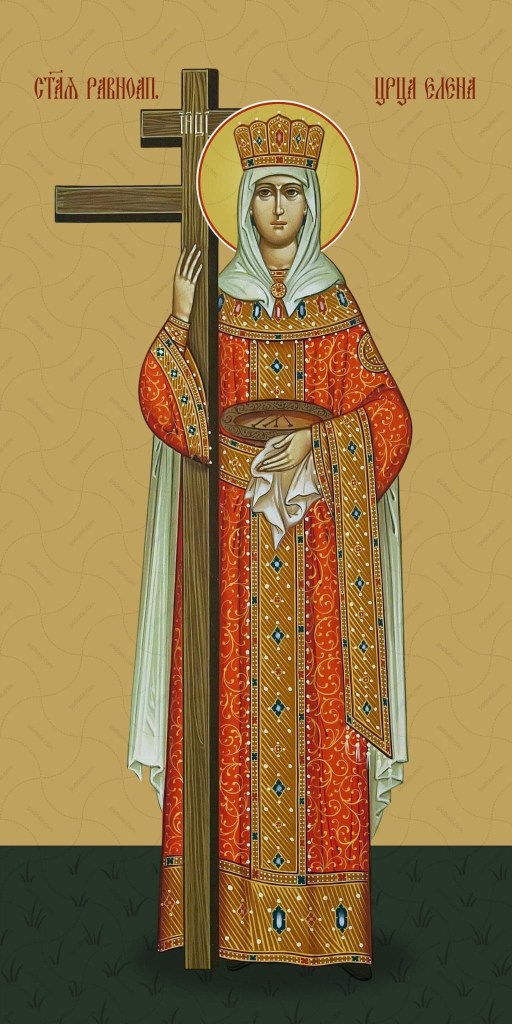
Today the church remembers a saint who went on a search for lore and said she found what she was looking for: Saint Helena, Mother of Emperor Constantine and Seeker of Relics.

Saint Helena’s childhood is a bit of a mystery. She was probably born in the Roman empire to a poorer family, though this is unconfirmed. She somehow found herself wedded to power, however, in the form of Constantius Chlorus who would become co-regent of the Western portion of the Roman empire. They had a son in the late part of the 3rd Century and named him Constantine.

Not one to pass up a political power play, Constantius divorced Helena and married Theodora, the step-daughter of the then Emperor (Maximinianus Herculius), making him next in line.

Constantius died in 308, and Constantine took the throne. As he ascended those steps, he brought his dear mother along with him, making her one of the “in crowd” again. Constantine ordered the empire to revere his mother as much, if not more, than he himself did, and under his influence Helena slowly converted to Christianity.

Now that she was the Empress of the land once again (Augusta Imperatrix was her official title), a newly revitalized Saint Helena undertook Indiana Jones-like quests to explore the life of Jesus on foot. Constantine charged her with finding any relics that she could relating back to the life of Jesus.

In her search for relics, Saint Helena built churches on the “sites” where she believed Jesus did important things like, oh, get birthed and ascend into heaven. These churches are still there in Jerusalem, including the one on Golgotha. Emperor Hadrian had built a temple to Venus on the site, and Saint Helena ordered it to be demolished. Lore has it that in the excavation they found three crosses, the middle being the cross of Christ.

Saint Helena supposedly recovered the nails used in the crucifixion, parts of the rope that bound Jesus, parts of his tunic, and parts of what is called “the true cross.” She took these back to Rome with her, and you can see all of these supposed relics still, the pieces of the cross being held at the Basilica of the Holy Cross in Jerusalem.

Now, of course, this is all very fantastical, right? Truly is unbelievable…and yet some do.

One of the issues is that the search for the historical Jesus will always come up lacking. No amount of splinters or threads of yarn can patch together what is actually being sought in that journey: verification.

Faith can’t be verified.

One of the gifts that Saint Helena did do was provide the world with beautiful things. The churches she started at these “holy sites” are truly remarkable, even if they may built on wishes and hopes.

Sometimes that’s all we have.

Saint Helena is a reminder for me, and should be for the whole church, that even though we seek out verification regarding the matters of the faith, we won’t find them. But, seek we still do, and as we do it I hope we make some beautiful things along the way…

-historical bits from public sources

-icon is traditional Russian style

Sermon Post: There’s Something About Mary…

I preached today or Churchwide Chapel for the Feast of Mary, Mother of Our Lord.

Feel free to take a read if you’re interested:

“If Mary reminds me of anything, she reminds me that even God’s entrance into the world started with fear and doubt and trembling and humility and uncertainty.

The one who would cast the mighty down from their thrones first sat in a highchair.  The one who would lift up the humble of heart was birthed by a visionary young woman the world only saw as humble, but who knew in her being that she was called.

There’s just something about Mary…”

Crossroads

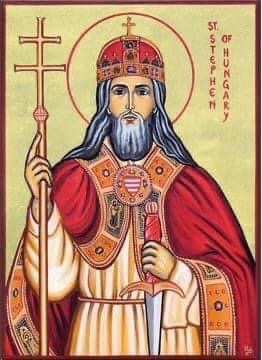
Today the church remembers a saint with an interesting, if sordid, legacy: Saint Stephen of Hungary, King and Confessor.

Saint Stephen was born into royalty in the second half of the 900’s, and was baptized with his father when he was just five years old. He ascended to his father’s title of Duke and, having brought the people of Hungary together and brought order to the area, he was given a crown by Pope Sylvester II and was crowned the first king of Hungary on Christmas Day, 1001 A.D.

This crown given to him proved a bit controversial. It disappeared in the 1200’s and a replacement crown, with a skewed cross, was manufactured and made its way to the United States at the end of World War II in 1945. In 1978 the crown was returned to Hungary after Communism in the country collapsed.

Ok, back to Saint Stephen…

So, Saint Stephen was at a crossroads as a king. Would he follow the Eastern Church whose prestige was waning and in-fighting causing it to be quarrelsome? Or would he go with Rome and methodically create a theo-imperial system of rule?

Having one foot in both camps, he eventually went with Rome and adopted the Western church as the rite of Hungary’s Christian expression. He was aggressive in his conversion tactics, however, and that aggression was met with aggression by the pagan inhabitants of his kingdom who really didn’t like to be forced to do, or believe, anything.

In the end Saint Stephen’s efforts would be hampered by his own family, as the infighting of his relatives over who would succeed him put a stain on his legacy, and the Hungarian expression of the church. His son Emeric, being cultivated for the crown, died in a hunting accident in 1031, and Saint Stephen himself fell into ill health in his last years.

All the same Saint Stephen is honored in Hungary as the first king and is remembered fondly in Hungary to this day.

Saint Stephen is a reminder for me, and should be for the whole church, that crowns are heavy. Sometimes you just have to do your best and let history decide.

-historical notes from Pfatteicher’s New Book of Festivals & Commemorations

About Mary

Today the church celebrates the life and work of probably the most influential saint, St. Mary, God-Bearer and Apostle.

Mary appears in fits and spurts throughout the different Gospels, getting the most ink spilled on her in the Gospel of Luke. This is not surprising, of course, as Luke has a heart for the ministry of women and people on the margins. Mary falls into both categories, Beloved.

Mary is so relatable.

She is a teen mother, pregnant out of wedlock, which put her at odds with societal norms.

She is a revolutionary, singing the Magnificat in the face of world powers destined to conspire against her and her family.

She is an immigrant parent, willing to do what it takes to keep her family alive, fleeing in the night to Egypt when Bethlehem was unsafe.

She is a proud parent, standing with her son through his peaks and valleys of life, urging people to listen to him when they are reluctant.

She is a worried parent, sometimes urging her boy to stay quiet in the face of opposition because she didn’t want to find him dead on the streets.

She is a grieving mother, not turning away even as her son was wrongly put on death row, dying in the hands of fearful power brokers.

While many revere Mary because she was Jesus’ mother, I revere her because she is me. She is my mother. She is the radical I aspire to emulate, and the parent I long to be.

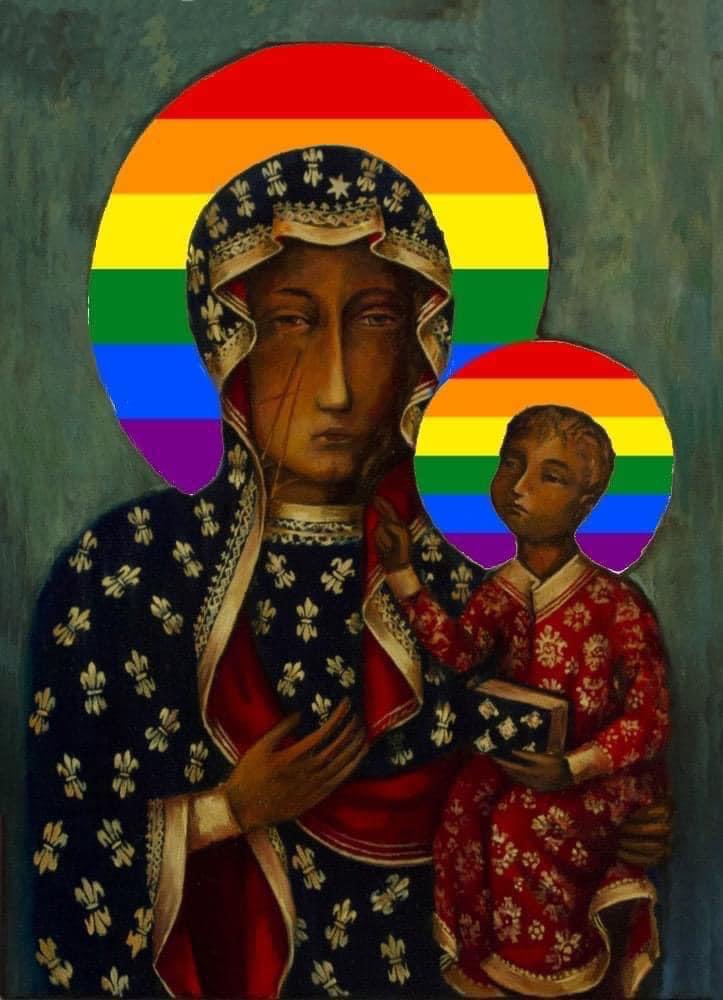
(Artwork by Polish artist and LGBTQ activist in Częstochowa. A radical in the footsteps of Mary, he’s been widely persecuted for this icon.)

On Self-Giving Love

Today the church remembers a contemporary saint whose life was one of self-giving love: Saint Maximilian Mary Kolbe, Priest, Martyr, and Defender of the Defenseless.

Born in the last years of the 19th Century in Lodz, Poland, Raymond Kolbe joined a Franciscan order in his early teens, taking the names Maximilian and Mary, a testament to his devotion to Christ’s mother.

Saint Max (as I like to call him) left his Russian-ruled stretch of Poland to study in Rome, was ordained there, and taught church history for a time. Mission and evangelism caught his attention, and he began a movement to create friaries and publications for the propagation of Roman Catholicism throughout the world. His friaries in Poland, Japan, and India housed hundreds of Franciscans in the early 20th Century.

When Nazi Germany invaded Poland in 1939, Saint Max’s friary in Warsaw took in thousands of Polish citizens and fifteen hundred Jews, providing sanctuary from the occupying forces. Because he sheltered those being demonized, and because his publications encouraged people to be faithful to the church, not to Nazi nationalism, Saint Max was taken to Auschwitz with four of his fellow friars, and the friary was permanently closed.

At Auschwitz Saint Max continued to be a priest: hearing confessions and celebrating the Mass with contraband bread and wine.

In July of 1941 a prisoner from Kolbe’s bunk escaped and, as punishment, ten prisoners from the same bunk were selected for death as a deterrent to such action. One of the men, Sergeant Francis Gajowniczek, was married with a family on the outside. Having served Sergeant Francis communion for years, Saint Max knew this about him and offered up his life in exchange for his fellow prisoner.

The guards allowed it, as Sergeant Francis was young and strong and by now Saint Max was elderly and weaker.

The ten prisoners were thrown in isolation to die slow deaths by starvation. After two weeks the guards checked on the men, and only Saint Max and one other were still alive. Not waiting for nature to take its course, Saint Max was injected with carbolic acid on this day in 1941.

Saint Max is a reminder to me, and should be for the whole church, that when the powers want to force you to turn your back on your fellow humans, no matter their creed, you disobey…even if it costs you your life.

Let those with ears to hear, hear.

You can visit a shrine dedicated to this saint in Libertyville, IL called “Marytown.” There you’ll learn more about his life, his theological genius, and yes, his defiant death.

-historical bits taken from Pfatteicher’s New Book of Festivals & Commemorations

-icon is available for purchase at monasteryicons.com

On Nursing

Today the church honors a yet timely saint, Florence Nightingale, nurse and caretaker of humanity.

Born to wealthy parents, Florence was named for the Italian city in which she was birthed, though her parents formally lived in estates in Derbyshire and London. She was a quick study, and grew to know more than a few languages by the time she was twenty.

Unsatisfied with the kept and proper life, Florence said she heard God telling her to “complete her life’s mission,” though she couldn’t rightly determine what that specific mission was.

Her schooling made her an acknowledged expert on public health (and it appears that people listened to her!), and she became keenly interested in the Kaiserwerth Motherhouse of Deaconesses. She soon entered the school for training as a nurse, and in 1853 became the superintendent of the Institution for the Care of Sick Gentlewomen (brevity was not their strong suit when it came to naming organizations in those days).

Nightingale was dissatisfied with the hospital, however, and when the Crimean war broke out, she and 38 fellow nurses left for Turkey to lend their aid. There they found shocking conditions and misogynist doctors who treated them poorly. But as the war progressed, the pressing need of so many wounded forced the hands of the powers that be, and Miss Nightingale and her fellow nurses worked long and hard to tend to the injured.

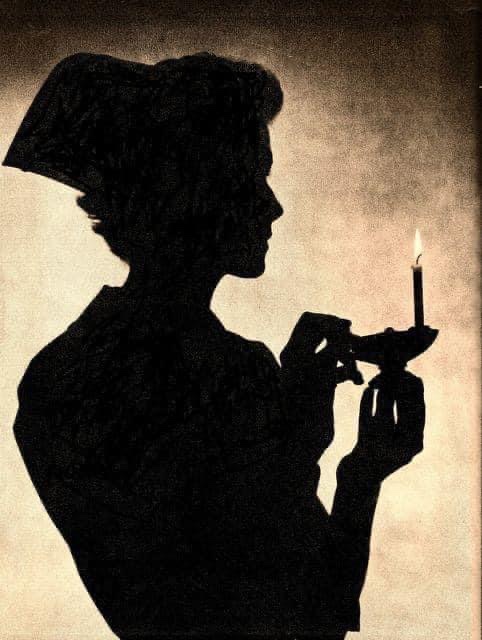
From this scene came the iconic “lady with the lamp” depiction.

She eventually would rise in rank to become the superintendent of the Female Nursing Establishment of the Military Hospitals of the British Army in 1856, and she wouldn’t leave Turkey until the very last patient left for England.

She was the last one in the field.

She worked against the political powers of the day to greatly improve the health and living conditions of the soldiers she worked so hard to heal.

Florence herself would eventually fall ill to chronic brucellosis, but even from her sickbed continued to advise and counsel nurses and doctors through letters and consultations. In 1860 she established the Nightingale School for Nurses at St. Thomas Hospital, and soon shifted her focus to changing the terrible conditions in the many workhouses in Britain.

In 1907 she was awarded the Order of Merit, the first woman to be given such distinction, and died in 1910 at the age of 90. Her grave marker simply states, “F.N. Born 1820. Died 1910.”

St. Florence Nightingale is a reminder to me that a life curved outward, rather than inward, can continually and forcefully change the situation of many in the world when consistently applied, especially in the face of the many “isms” of this world. The powers will pull out all the stops to thwart the efforts of those who would lift up the vulnerable in the world.

In these past few years of global pandemic, with so many nurses staying on the job until their last patient is sent home, she is not just worth remembering, but worth honoring and emulating.

One way to honor such a legacy is by following the advice of medical officials.

Let those with ears to hear, hear.

-historical bits gleaned from Pfatteicher’s New Book of Festivals & Commemorations

Blessed are the Odd

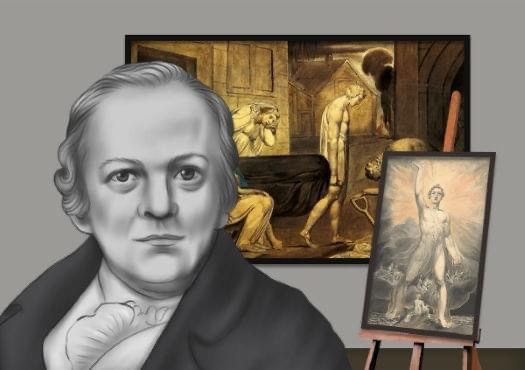
Today I would lobby that the church remember a visionary who, though largely dismissed while he was alive, is widely regarded as a brilliant artist whose body of work continues to influence humanity today: Saint William Blake, Poet, Painter, and Bucker of Organized Religion.

Blake was born in the middle of the 18th Century in London. He attended school just long enough to learn how to read and put pen to paper, and was then homeschooled by his mother with the Bible being used as a primary text. Because he was seen as a stubborn child, his parents decided to send him to a special school at the age of ten to do what he loved: drawing classes. There he practiced his art while reading whatever his heart desired, and it was at this early age that he started to pen his first poems.

Blake’s family were known as English dissenters, having rejected the state church of England, though they still considered themselves Protestant. Though he didn’t participate in any formal religion, his work put him in close proximity to communities of faith, and he claimed to have experienced mystical visions and dreams, even from an early age.

You could say he was “spiritual but not religious.”

As a young man he apprenticed as a printmaker, and then enrolled at the Royal Academy, studying art and becoming a vocal (if not radical) critic of most everything he deemed as conventional. As you can imagine, the contrarian streak did not exactly make him popular, though he did make a few notable and similarly radical friends at the Academy (like George Cumberland).

Blake had difficulty in all sorts of relationships, it would seem. His first proposal was a flop and, upon explaining that flop to a young woman, Catherine Boucher, he inquired if, after hearing his sob story she might be interested in marrying him.

She agreed.

Catherine was largely illiterate at the time of their marriage, but Blake would go on to teach her how to read, write, and engrave, making her perhaps his most valuable aid throughout his artistic career.

Blake would go on to form a printshop which would also double as a gathering place for a variety of intellectual dissidents, from radical theologians to early feminists to supporters of the French and American revolutions. His engravings, etchings, and even his own pen would espouse these radical notions in vibrant ways, as his art put in practice his politics and theological penchants.

In short: he wasn’t an artist “for hire.” His work reflected his thoughts.

Blake would live his whole adult life married to Catherine, though his own thoughts on marriage, chastity, and sexuality were varied and unconventional. He saw much of state-sanctioned marriage as particularly harmful to women (inhibiting their freedom), and his thoughts and those of many in his corner may have been a glimpse of the 19th and 20th Century “free love” movements.

Blake would work for a variety of poets illustrating their words, publish and present a wide variety of critiques of artists and intellectual thought, and in his last year of life began on the ambitious journey to illustrate Dante’s Divine Comedy, dying while still working on it on this day in 1827. Of all of his artistic pieces, those depicting glimpses of the stories of scripture and those from Divine Comedy are probably most well-known, and most striking.

William Blake’s legacy is varied and lasting. His radical politics inspired John Tavener, Bob Dylan and Jim Morrison. His radical stories moved modern day authors like Philip Pullman. His radical images sparked the imagination of Hollywood directors (“The Red Dragon”) as well as holy people across generations. His detailed and, at the time of his life, wild analysis of human nature is a precursor to Jung and Freud.

Blake lives on.

Perhaps my favorite quote from him is this little ditty:

“To see the world in a grain of sand,
and to see heaven in a wildflower,
Hold infinity in the palm of your hand,
and eternity in an hour.”-from “Auguries of Innocence”

Because he was so radical, so odd, he was deemed “mad” by many in his day. But he is a reminder for me, and should be for the whole church, that, well…

Blessed are the odd, for from their imagination we glimpse the infinite capacity of God.

-information gleaned from publicly accessible resources

-opinions mine

When Words and Action Hold Hands

Today the Church honors one of my favorite saints, Saint Clare of Assisi. She is the unsung spiritual companion of St. Francis (who gets much more airtime because humans love animals), but deserves as much, if not more, press.

St. Clare was born to a noble family, and in an era where women had limited power, had the gumption and guts to turn down not one, but two marriage proposals.

In her late teens she heard St. Francis preach a sermon during Lent, and soon after ran away from home to join him in a life of poverty. Francis commended her to the care of Benedictine nuns at Bastia, and though her family pleaded with her to come home, she eventually convinced both her sister, and later her widowed mother, to join her instead.

Clare and Francis collaborated together on a new “rule of life” for a monastic community, and after obtaining Pope Innocent III’s blessing, established the “Poor Clares” who would live solely on the generosity of others, never possessing anything.

Though St. Clare was intent on living in a post-ownership society, she also understood that savage piety could produce a backhanded vanity. “We are not made of brass,” she said once to an overzealous sister, reminding the order that poverty was a gift, not a quest or competition. Human bodies can handle only so much deprivation.

St. Clare led her community for forty years, becoming seriously ill a number of times. Yet, she outlived her best friend and spiritual soul-mate, St. Francis, by twenty-seven years. Her order lives on today.

St. Clare is a reminder for me of a couple truths:

First, the spotlight unfairly falls on men in history. Clare was inspired by Francis, but more fully lived into his ideal vision of a monastic life than he ever did. She is the shining example that what he preached was a good way to live.

Second, piety can be just as competitive as gluttony in the hands of the overzealous. Martyrdom complexes are as sinful as extravagance. Clare’s call was to humility, not destitution.

Finally, never underestimate the ability to move someone when words and actions hold hands. Clare looked not only to the sermon Francis preached, but to the sermon he embodied, and was motivated to do something life-changing.

-historical bits from Pfatteicher’s New Book of Festivals & Commemorations