Unknown's avatar

About Timothy Brown

A pastor. A writer. A dreamer. Occasionally a beer brewer.

Saint of Doubt

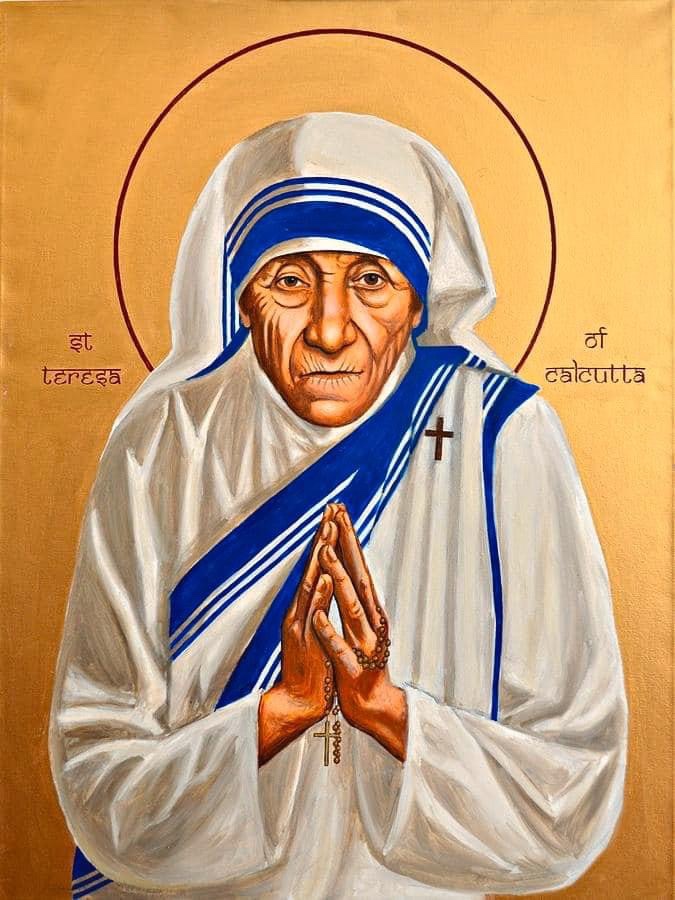
Today the church also remembers a woman who had a small frame but was a giant in the life of so many around the world: Saint Mother Teresa, Servant, Renewer of Society, and Woman full of Existential Doubt.

Born Gonxha Agnes Bjoaxhiu in Skopje, Albania in the year 1910, this slight saint was raised in the faith by her mother, as her father died when she was just eight. In September of 1928 Gonxha left home intending to become a missionary and entered the Institute of the Blessed Virgin Mary in Ireland. Being only eighteen at the time, she changed her name to Sister Mary Teresa after St. Therese of Lisieux, and prepared to head to India that December.

In January of 1929 Saint Teresa arrived in Calcutta and began her formal ministry with the people she would eventually identify with. In 1937 she made her final vows and was given the title “Mother,” an homage to not only her status within the ecclesial body of the church, but also as a testament to her outlook: tender, heart-felt, and courageously fierce when it came to the care of her people.

It is no exaggeration to say that many of us were the children of Mother Teresa.

On September 10th (it’s really amazing how many of the events of her life happened in September until we realize that this month is really a month of transitions in all creation) in the year 1946 she received a nudge from the Holy Spirit that a religious community should be formed in Calcutta, dedicated to serving the lowest caste of the societal system there.

In August of 1948 she officially received permission to found the Missionaries of Charity, with their white a blue bordered garb as a tell-tale sign of their work.

By 1950 her movement to serve the poorest of the poor in the world had spread from Calcutta to Venezuela, Rome, Tanzanie, and eventually to every continent throughout the known world. She truly inspired a movement that can be called world-changing.

In 1979 she was honored with the Nobel Prize for Peace and gained larger international fame. What is less-known about Saint Teresa, our common Mother, is that she was plagued by doubt and existential questions. Even as she gained fame as a woman of faith her private life was one of wrestling with the God she professed and the destitute poverty she witnessed. Only after her death did we all realize the deep struggle she faced daily to profess a God of love when so many in the world went without.

In this way, she truly is the Mother of so many of us.

In 1997, having served Calcutta for so many years, Mother Teresa died. She was given a state funeral in India and buried in the motherhouse there at the Sisters of Charity. She remains both an inspiration and an honest participant in both the service that Christ calls us to and the questions surrounding the idea of a benevolent God when there is so much hurt and pain and sorrow in the world.

Saint Mother Teresa is a reminder for me, and should be for the whole church, that no amount of faith can shield us from the honest questions that come when we’re in proximity of those who go without in this world.

Honestly, anyone without questions has not examined their faith…and this saint is a reminder of that.

Let those with ears to hear, hear.

-historical bits gleaned from Pfatteicher’s New Book of Festivals & Commemorations

-icon written by Brian Nicholas Tsai

Saint Jimmy of the Buffett’s

Last night we lost Saint Jimmy of the Buffett’s, a tropical bard who embodied chill for a world needing instructions on how to do it, all the while using his business savvy and heart to create a legacy of ongoing chill that will outlive him.

I was introduced to Saint Jimmy early in my life. Some called him a novelty, some a joke, but to me he presented the quintessential ideal of someone enjoying their life’s calling to the fullest. I immediately found a kindred soul: he loved to make people happy and sought out different ways to do it through all the senses.

His love for bar food and boat drinks led to an empire of eateries.

His love for people of all ages led to retirement communities that encourage chill in the third act of life.

His love for human connection was found in a touring schedule that would make artists half his age fatigued in half the time, drawing thousands and thousands of Parrot Heads who saw following him on tour as an honor that bonded vagabonds and misfits and CEOs and school teachers together, all needing a break for a few hours, everyone letting their hair down (even if you didn’t have any).

His love for the written word led to books upon books, both for adults and children, to be published, all highlighting the sand and the surf and the hoisted sail.

And his love for music? Well, Saint Jimmy was not an amazing composer, but he was a prolific one. And he knew something that so few people do: how to tell a good, complete story in song.

In “The Captain and the Kid” we learned about his grandfather’s struggle to retire from sea life. In “Son of A Son of A Sailor” we learned about his life’s ambition to be on the waves forever like his grandfather, and in “A Pirate Looks at 40” we heard him struggle with the fact that he’ll never live that kind of life because, by chance, he was born “200 years too late…an over 40 victim of fate.” Even in his little-known tune “Mailbox Money” we got a glimpse of his life, hearing how his residuals just appeared in his mailbox in the morning and even how, when in his island life the postal service was spotty, he’d take up the helm delivering the mail by boat to his neighbors.

Though I find toe-tapping fun in his hits “Fins” and “Cheeseburger in Paradise,” I’ve always been drawn to his sentimental tunes offerings like “Barefoot Children in the Rain,” and “Take Another Road.”

After Hurricane Katrina wiped out large swaths of New Orleans and lower Mississippi, he wrote a song to ease their hearts, donating the proceeds of the album to their recovery. In the song he sang,

“I bought a cheap watch from a crazy man,
Floating down Canal.
It doesn’t use numbers or moving hands,
It always just says ‘now.’
Now you may be thinking that I was had,
But this watch is never wrong.
And if I have trouble the warranty says,
‘Breathe in, breathe out, move on.’”

I cannot tell you, Beloved, how many times those lyrics have saved my life.

Saint Jimmy sought the good life and accidentally stumbled upon a meaningful one. Saint Jimmy sought the ocean, but instead brought happiness to oceans of humanity through community-building tunes.

Saint Jimmy found his way into the ears and hearts of so many who just needed a license to chill, and he wrote the order for them to do so without hesitation. I had the joy of hearing him for the first time just a few years ago, even as I own just about every one of his albums on vinyl.

He was a serious businessman who peddled in amusement as his currency, and we were grateful to join in that commercial exchange, finding privilege on both sides of that transaction.

It is fitting that he died on the cusp of Autumn, having led a Summer existence.

And, at least for me, I find it fitting that I read of his death this morning looking at the waves of the Atlantic, his home he introduced me to and invited me to see as my own.

Sail on, Jimmy.

Here’s the view from my balcony, and I have to imagine that this morning, well, yours is the same one.

Martyrs

Today the church honors often overlooked saints, but ones close to my heart, The Martyrs of Papua New Guinea.

I know…you’ve never heard of them, which is too bad.

They’re relatively recent additions to the calendar of commemorations, added in the late 70’s.

When the Axis Powers invaded New Guinea in 1942, a number of the European missionaries on the island nation had already been called back to their countries of origin.

The Anglican Bishop of New Guinea, Philip Strong, challenged his clergy to remain with the people. Eight missionaries and two Papuan laymen were betrayed to the Axis Powers and martyred in August of 1942 for their defiance and insubordination.

In 1948 the Martyrs Memorial School was opened in Sangara as a living memorial to these brave souls. The school continues today and can be found in Agenahambo.

Often included in this memorial day are the 15 Lutheran, 24 Methodist, and 168 Roman Catholic Missionaries in Papua New Guinea, New Britain, and the Solomon Islands who died during the WW II.

-historical pieces gleaned from Pfatteicher’s New Book of Festivals & Commemorations

Welcome, September

For the ancient Celts, September marked the mid-point of their Autumn life. In these blazing days that might sound strange to our ears (it hardly feels like Autumn to most of us), but on the wheel of the year this quarter is earmarked for “harvest.” Their wheel, their internal rhythm even (and ours!) has the mid-month of every season as the transitional one:

February-Mar-April-Spring
May-June-July-Summer
August-Sep-Oct-Autumn
Nov-Dec-Jan-Winter

That middle month is the one of transitions with the equinox or the solstice of the season lying in its belly.

September is a season of invention and harvest. The crops are pulled in fully in this month. The fireplace starts to roar at night not only around dinner time, but longer into the evening as cool air sweeps through the house and the canning and drying and preserving that needs to happen for the coming Winter gets underway.

The fire in the hearth is mirrored by the fire starting to show up in the leaves now gloried on their way to death, and the drying fields calming themselves, preparing for new birth next year.

Toward the end of this month, to honor the final bit of the harvest, dried pieces of wheat and barley would be woven into a crown and hung on doors and windows, or worn on the heads of children.

The whole town would come together as the last sheaf was brought in and they’d have a large feast where the last sheaf of the field was woven and decorated. They’d toast the sheaf, saying “Here’s to the one that helped us with the harvest!” Then they’d take the decorated sheaf and hang it in a place of prominence.

This is where we get our modern day “autumn wreaths” that adorn our own doors and fill up your local Michael’s or Kohl’s in the “home decor” section. Today we see these as pretty and festive. For the ancient Celts they were a sign of thanksgiving and triumph, as the harvest gods had once again provided.

Welcome, September, the month of transitions. We thank you once again for the harvest.

On Genuine Love

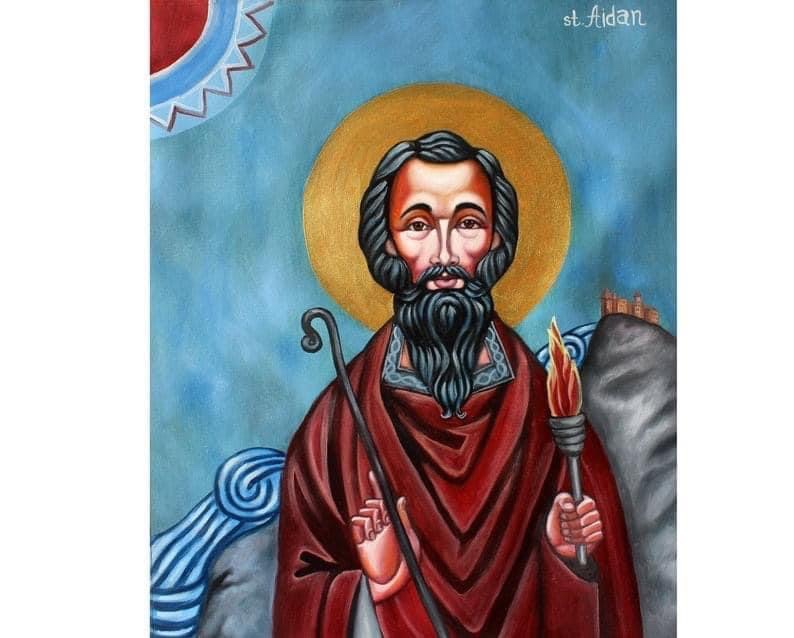
Today the church remembers a wonderful 7th Century Celtic Saint, Saint Aidan, Friendly Bishop and Quiet Firebrand.

In St. Aidan’s day the British Isles were considered to be mostly Christianized, but the stubborn island of Ireland was proving to be a difficult people to convert. As keepers of an older way, the Irish were amenable to many parts of Roman Catholicism except for the whole “obedience” thing.

Nevertheless, at the turn of the 7th Century the church decided to try its hand again at bringing the faith to the Irish. The little monastery founded by St. Columba on Iona housed a number of native Irish monks, and rather than send British or Roman missionaries to the Irish people, it was deemed wise to send Irish monks to serve them and share the Gospel.

This was smart.

St. Aidan had been quite critical of the methods previously used by Roman missionaries toward his people, and though his name means “little fiery one” in Gaelic, he entered the mission field with humility and a genuine love for the Northumbrians, of whom he was now appointed as Bishop.

In the way that the Celts were known for doing, he melded the ancient rituals and beliefs of the Celts with Christianity to create a more wholistic way of practicing the faith. He chose the island of Lindisfarne as the perfect place to build a cathedral, and from these emerald-hued hills began meeting with towns people across Ireland, taking a keen interest in their lives and gently ingratiating himself to them.

Aidan thought conversion happened best by wooing, not warring with words. He was relentlessly friendly, and founded a number of schools and hospitals to serve the children of Ireland. He was particularly concerned for orphans and those trapped in slavery. In fact, he bought the freedom of many slaves, using church offerings to pay off those who held them captive.

St. Aidan died on one of his many missionary endeavors, having fallen ill visiting his beloved people. The legend goes that on August 31st in 651, he stopped, took a breather leaning against the wall of the local church in Bamburgh, and simply fell over.

St. Aidan is a reminder to me, and should be for the whole church, that for any message to be heard, genuine love must first be shown.

-icon written by Anatoli
-historical bits gleaned from various sources, including Koenig-Bricker’s 365 Saints

The Giant

Today is the feast day of a giant of theology and philosophy, Saint Augustine, Teacher.

Fun Fact: Augustine was voted by his classmates, “Most Likely Non-Disciple to Get Lutheran Churches Named After Him.”

Augustine was born in Algeria in 354 to a Christian mother (Monica) and a pagan father. He was a good student, and in his early years practiced Manichaeism, a dualistic religion of Persian origin that was very “in the now” of his day.

He fathered a child early on in his life, and he named him Adeodatus which means “Gift of God.” History is quiet on the kind of father he was, but it’s important to note that this happened because all of this early material would lay the basis for his most famous work, Confessions.

Eventually Augustine ended up in Rome where he taught rhetoric and was wooed into the Catholic faith. There he was catechized under St. Ambrose and was baptized at the Great Vigil of Easter in 387.

Shortly thereafter Augustine returned to North Africa and lived a monastic life with friends. In 391 while visiting Hippo, he was chosen by the small church there to be their pastor.

All indicators point to his reluctance to take up the role, but eventually he was ordained into the priesthood and consecrated Bishop of Hippo, a role he kept for 35 years. He traveled extensively in the ancient world, and wrote volumes while he did so.

His book The City of God contains his reflections on society and the body politic in the aftermath of Rome’s collapse. In it he also defends Christianity and sets forth a vision of an ideal Christian society.

Spoiler alert: it looks nothing like America.

He established a Rule of Life and an order, Augustinian, was begun in his name. Martin Luther would adopt this Rule and this order.

Augustine died after he came down with an intense fever in the year 430. His remains, well, remain in the Church of San Pietro in Pavia, Italy.

Augustine is the model of the “second chance” life. And, quite honestly if you read Confessions, a third and fourth chance, too.

He is one of the most human of the saints because his foibles and misadventures are documented for all to see. He remains a gift to the church, even with all his flaws, and is a constant reminder that contrition and confession enable us to be born again.

And again.

And again.

-historical tidbits from Pfatteicher’s New Book of Festivals & Commemorations

Sermon Post: On the Keys

I’m preaching this Sunday again, and here’s the words that are coming out of my mouth:

“But here’s the thing, Beloved: I wonder if sometimes we’ve lost the key that Christ handed to St. Peter that day, ya know?

In this grand moment, at the pinnacle of both commerce, power, and life-giving water, Jesus asks the disciples who they think he is.

And they give various answers: a prophet from the past, a prophet of the present…

But Peter says, “You’re the promised one of old.”

The promised one of old.

The promised one who would shed light on the shadows, who would bring comfort to the grieving, who would convince the wealthy that the coins in their pocket belonged to the poor, and remind the poor that they are somebody, by God.

The promised of old who forgives sins, has a short memory of wrongs, loves the unloveable, and who would die to have us think or believe otherwise. Even die on a cross.

The Messiah.

And I don’t know if Peter knew what he was saying or, perhaps like me in most of my moments, stumbled onto a truth he couldn’t quite grasp, but in that moment Jesus hands him the keys to the car and says, “Carry on my wayward son…” as the band Kansas would say.

And carry on he did. And he would be a wayward son, as it were. In one breath calling him the Messiah, and in another denying he knew him. In one breath receiving the Holy Spirit at Pentecost, and in another being wishy-washy over who could be called a Christian as the early church began.

Peter held the keys to the kingdom, but sometimes lost them.

Beloved: we hold the keys to the kingdom, but sometimes lose them.

We lose them when we fret so much about money that we lose sight of mission.

We lose them when we worry so much about who is not here than we do about who has shown up.

We lose them when we worry too much about who shouldn’t be let in to the graceful kingdom of God than we worry about who we excluding who is loved, by God.

By God.

We lose the keys to the kingdom all the time. And in this post pandemic world, as you’re waiting for your next pastor, I want to say to you: the keys of the kingdom of God are yours! Do not lose them!

It’s about mission, not budgets.

It’s about whose here, not who isn’t.

It’s about all-encompassing love, not gate-keeping.

The keys are here…and even if sometimes we lose them, you know, they can be found!

They can be found.

So what if you lose them?

Well, let me tell you.

Our nanny said, “I’ve lost the key.”  And I said, “No worries, I can go and make a copy.”

And you know where the copy is made?  Well, for our home key, it’s probably made at Ace Hardware or Lowes, you know?

But for us, for the faithful, for the Beloved community of which you’re a part of, the copy of the key of the kingdom is made here: at this table.

This table where everyone is invited forward, and no one leaves without something: some bread, some wine, the body and blood of Christ, or at least a blessing.”

Loveable, Kind, and Doting

Today the church honors Saint Louis, the 13th Century King of France (not “The Gateway to the West”).

Now, before you ask, this is Louis the IX, not that other famous Louis of ill-repute.

In fact, Louis the IX was of quite upstanding repute, despite his involvement in the Crusades. Crowned at the age of 12, this young king expressed that he’d rather have joined a cloister than been royalty. He was loveable, a kind husband, and a doting father.

He also had a heightened sense of piety, often wearing shoes without soles as a sort of perpetual penance.

Oh, and he also would not allow cursing in his presence, which automatically makes me admire him and also makes me quite sure we would have never been friends.

St. Louis attended worship religiously (get it?), and was quite generous with his money, both publicly and privately.

In leading one of the Crusades in 1250 he was taken prisoner, and returned to France six years later. After mobilizing another army, he sailed again for North Africa in 1270 and, after much difficulty, died of dysentery in Tunis with a very “Oregon Trail” sort of ending. He’s buried in the basilica of St. Denis near Paris.

In iconography he’s often depicted with a crown of thorns, both because it was one of the relics he worked hard in his life to recover, and also as an homage to the humble way in which he conducted himself.

St. Louis is a reminder to me, and to the church, that power does not always corrupt and crush the human soul. Indeed, if we all are remembered as “loveable, kind, and doting,” well, we’ve done alright, right?

-historical bits from Pfatteicher’s _New Book of Festivals & Commemorations, and the icon is by “Theophilia” of deviantart.com

Anybody

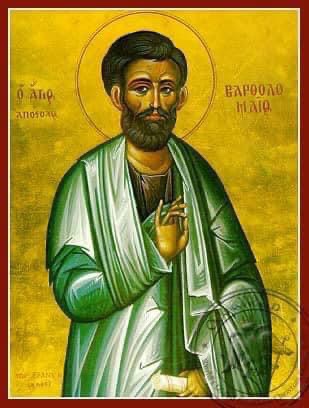
Today the church honors a saint wrapped in mystery: St. Bartholomew, Apostle, perpetual Somebody/Anybody.

Bartholomew makes an appearance as one of Jesus’ 12 disciples in Matthew, Mark, and Luke, and reprises the role in the book of Acts.
His name is not even really a name as much as a description: he is the “son of Ptolemy” (except in Matthew where he’s called Simon Bar-jonah).

Bartholomew may, therefore, have another personal, intimate name that we have no knowledge of. In Matthew, Mark, and Luke he is associated with the disciple Philip, but in the Gospel of John the disciple Philip is yoked with a disciple named Nathanael. Could Bart actually be named Nate?

Maybe.

There are several traditions that map the two names together, and separately, though as early as the 9th Century the two names were often considered one and the same.

Lore has it that Bartholomew wrote a Gospel account, which is now lost to history. Some reports have him preaching in Asia Minor, Persia, and India, where he supposedly left a copy of the Gospel of Matthew written in Hebrew for the people to have and keep, a copy which was reportedly found at the end of the 2nd Century by a wandering missionary.

Most accounts have him ending his ministry (or, rather, having it ended for him) off the Caspian coast where he was grotesquely martyred (“flayed” according to the stories, which is why he’s often depicted with a knife, or even holding his own skin). He secured his place in the pantheon of saints by being included in the Sistine Chapel mural near Christ at the last judgment.

The Coptic church has a different tradition about this saint, though, one that has him preaching in Upper Egypt and North Africa, where he met his martyrdom by being cast into the sea.

Something I’ve come to love about this mysterious and secretive saint is the fact that they are relatable to many in our world who labor under an identity that they don’t quite jive with.

I’m thinking of the trans and non-binary youth I’ve walked with who struggle with what to call themselves. Often flayed in public opinion because they can’t quite put words around their own being, they struggle to find voice in a world of assumed norms.

I’m thinking of the people who are known less for who they are as people, and more for who they are in relation to other, more popular people. The eclipsed sibling. The child who never quite lives up to their parent. The quiet spouse. The one who was in a position directly before or after the beloved person who held that same position in a church, a public office, or even a family.

History is confused about this saint, and never really waited around for clarity.

Bartholomew/Nathanael is seen but not known. They are acknowledged but not really understood. They are talked about, but the details are confused and fuzzy because no one took the time to explore them, and they were never really given the chance to explain.

In this way Saint Bartholomew, this Saint Nobody/Somebody, is the patron saint of so, so many in this world…

-historical bits sifted from Pfatteicher’s New Book of Festivals & Commemorations

-icon written by Vranos Nik and can be purchased at oramaworld.com.

They Want to Give

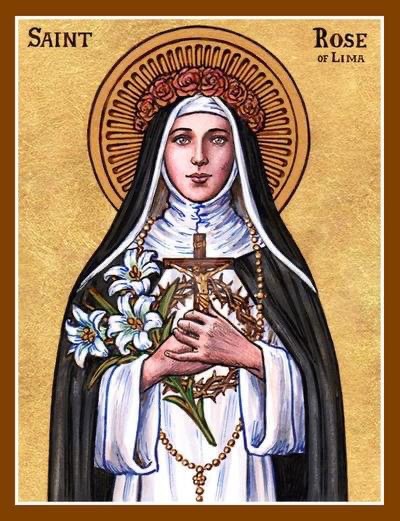
Today the church remembers the first official canonized saint of the Americas: Saint Rosa of Lima, Eccentric, Vegetarian, and Caretaker of the Sick.

Born Isabel Flores de Olivia, Saint Rosa’s name came from one of her nannies who claimed to have had a vision where Isabel’s little face bloomed into a rose. They started calling her Rosie and, well, as many childhood nicknames do, it stuck. Her family was wealthy for one born in the late 16th Century in a far flung colony, and she had many siblings. When she was Confirmed in 1597 she officially took the name Rosa as her new name, and then her real work began.

Rosa was strong-willed. It seemed whatever someone else wanted her to do, she did the opposite. Suitors started to admire her beauty, so she cut her hair and rubbed spices on her face to make it break out. She started to fast three times a week, despite her wealthy family wanting her to have a full figure. She took a vow of virginity, despite her parents wanting her to marry.

She was her own woman, and knew what she wanted out of life: to give herself away.

In the quiet hours of the night she would go and find sick people on the streets, bringing them back to her room to care for them. She refused to eat meat noting that it caused harm, and instead had a crown of silver created with spikes on the inside for her to wear, mirroring the crown of thorns. She took the sacrament daily, and only slept two hours a night, devoting the rest of her time to prayer and service. She sold flowers and embroidered pieces of art (she is also the Patron Saint of Embroidery!) to help her family survive, but gave most of the monies away to the poor.

Eventually her behavior caused her to shy away from the larger world, and she functionally became a recluse.

Despite her eccentricities, her parents never allowed her to join a religious order, though she desperately wanted this for her life. Instead she took what is known as “tertiary vows,” living the life of a monastic without the formal orders, following the way of Saint Dominic in seclusion.

She was known to have visions and dream dreams, and in fits and spurts would relate these to the church.

Saint Rosa of Lima died at the age of 31 on this day in 1617. She is the Patron Saint of Lima, and her likeness can still be found on their currency. Despite her reclusiveness, she was well known, respected, and loved, especially because she was known for giving of herself and her wealth for those who had nothing. At her funeral everyone, and I mean everyone who was anyone, attended to give homage to her self-giving love.

Saint Rosa is a reminder for me, and should be for the whole church, that sometimes people know what they want out of this life from an early age and, despite the stereotypes, young people want to give of themselves for others.

And we can let that happen, by God.

-historical bits from public sources

-icon written by Theophilia