Unknown's avatar

About Timothy Brown

A pastor. A writer. A dreamer. Occasionally a beer brewer.

How You Live

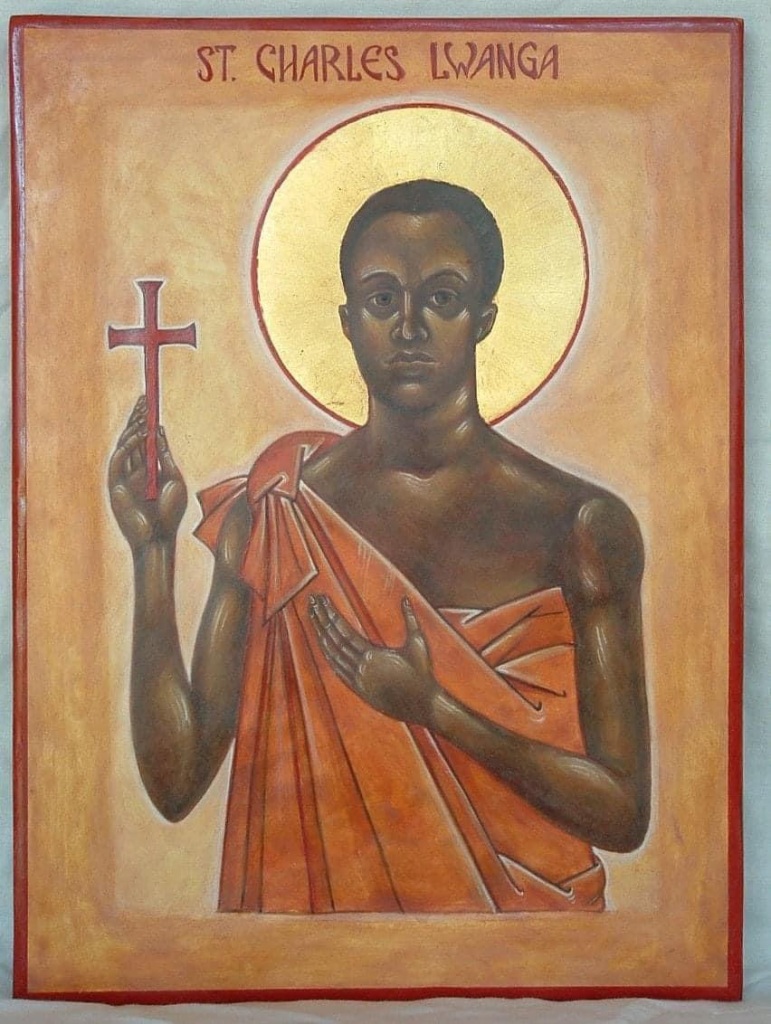
Today the church remembers a horrible 19th Century massacre as it honors St. Charles Lwanga and the Martyrs of Uganda.

In the late 1870’s Christian missionaries came to Uganda, both Catholic and Protestant, to plant churches and spread the Gospel.

Full disclosure: I have very mixed feelings about missionary work, especially the kind that was practiced in that time and place (and still practiced in many corners of Christianity). The accompaniment model I can support, and do support. I do not support the “I have something you need/white savior” model, which is far too often the model still used.

But I digress.

Regardless of how they came to the faith, these thirty-two martyrs were offered up as a “burnt offering” at Namugongo, many of them pages in the court of King Mwanga of Buganda. Many of the men were actually just boys, no more than thirteen years old. Their crime?

They refused to renounce the faith.

Charles Lwanga was seen as their leader, and encouraged them to stand fast to their convictions.

After this massacre, the killings continued as persecution spread throughout the land as King Mwanga attempted to exterminate Christianity. Unfortunately for the king, the stories about these brave martyrs emboldened others to not only stand firm in their faith, but even led some to adopt the faith because they were so inspired.

The conviction of these martyrs helped other Ugandans to understand that Christianity was/is truly African, and not a white religion…which totally makes sense because Christianity started with a man of color (even though much of the church keeps trying to pretend that’s not true).

Led by the example of these martyrs, Christianity started to spread like wildfire throughout Uganda. There was nothing the king could do.

The Martyrs of Uganda, led by Saint Lwanga, are a reminder for me, and should be for the whole church, that sometimes your life and how you live it is the best testimony.

-historical bits from Pfatteicher’s New Book of Festivals & Commemorations

-commentary mine

-icon of Saint Charles Lwanga written by Fr. Kevin Estabrook
Life of the Mind

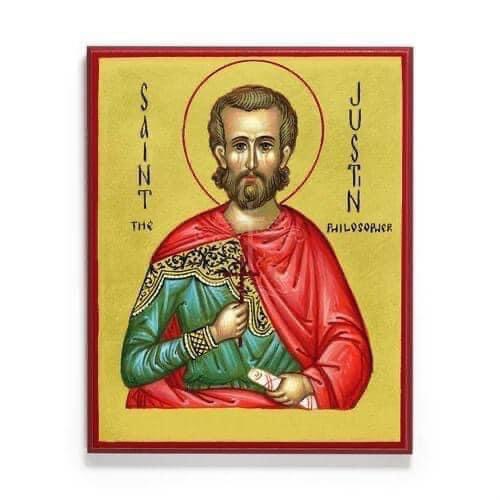
Today the church remembers one of its most influential early thinkers: St. Justin, Martyr, Apologist, and Philosopher.

As the early church began to expand and grow, the Second Century proved to be a difficult time period for those trying to be honest about following the faith in a world hostile to non-conformity.

St. Justin, probably the most influential public Christian figure of his day, was born to pagan Greek parents in Samaria around the year 100 A.D. He sought out the best thinkers of the time in his honest pursuit of philosophy and to understand religion, and while studying in Ephesus stumbled upon the stories of Christian martyrs. He was amazed that people would die for their faith, noting that “no one believes in Socrates to the point of dying for what he taught…” (though, truthfully, the Inquisition would turn this notion on its head, right?).

As the story goes, he came upon an elder Christian by the seashore who explained to him the prophets of the Hebrew Scriptures, and then and there he decided to become a Christian.

St. Justin taught the faith in Ephesus for a while, and eventually made his way to Rome where he made two famous defenses of Christianity: once to emperor Antoninus Pius, and once to the assembled Roman Senate.

He became embroiled in a series of debates with the Cynic philosopher Crescens, and though St. Justin provided honest and tight philosophical defenses, it went…well…predictably for him.

When push came to shove, St. Justin refused to make burnt sacrifices to the emperor, and for that he and some of his students were killed.

His Apologies still remains a sound defense of the faith and an early glimpse at what ancient Christians believed and practiced. St. Justin was also keen to make sure that Christianity didn’t ignore the Hebrew Scriptures (which some strains are wont to do), and kept the faith rooted in the prophecies of old.

Most importantly (at least, for me), St. Justin didn’t see Christianity as a foil for Platonism or as incompatible with deep philosophy. Rather, he saw it as both complementary and, in some ways, a culmination of the life of the mind.

St. Justin a reminder to me, and should be for the whole church, that the faith doesn’t mean a rejection of the life of the mind.

-historical bits from Pfatteicher’s _New Book of Festivals & Commemorations)

-Icon written by the saints at Legacy Icons (legacyicons.com)

We’re Visiting

Today is another sacred day: The Visitation, where Mary, “great with child” visited her elderly relative, Elizabeth, also miraculously pregnant.

Together they noted their hope and expectation that their children would change the world.

This hope and expectation is felt by every parent, I think.

I hope.

But on this convergence of holy days and extraordinary days, where a beautiful visitation is met with the reality that many parents fear for their babies when they go off to school, we must call to mind this hope and expectation again.

I hope that my boys will know and fight for the truth that Black Lives Matter. I hope that they will never fall victim to unmitigated gun culture, and will never get used to the sight of hand guns and machine guns carried in public and will stay away when they see them.

I hope that my children, and the children of those I love, will honor the lives of those who have died because of our addiction to violence.

I hope that my children, and indeed my own self, who give our lives to public service will never abuse that service.

And I hope that we will one day mourn our dead the way some mourn the loss of our supposed “rights” and economic structures.

That has yet to happen. That has yet to happen.

Beloved: we are all just visiting this life. Let us do all the good we can, while we can.

The Young are Powerful

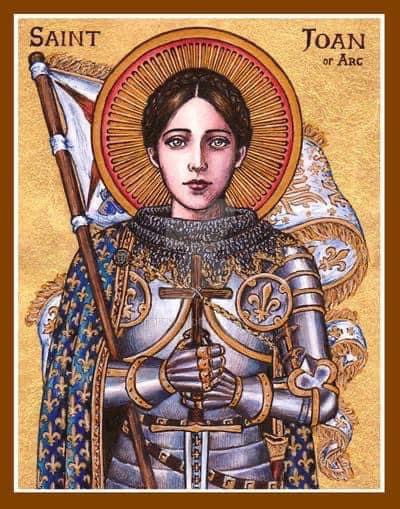
Today the church remembers a young teen with a calling: Saint Joan of Arc, Fierce Warrior and Visionary.

Saint Joan was born in Northern France to a peasant family in 1412, when Britain controlled most of France.

In 1428 Saint Joan traveled to Vaucouleurs to see would-be King Charles. She was rejected twice from his audience, but the third time is the charm. She revealed that she had received a vision from Saint Michael and Saint Margaret to fight for France’s independence.

At 17 years of age she entered the war to great prestige, and upon her arrival at the battle of Orleans, the city’s siege ended within days. She went on to fight valiantly and bravely in a series of other campaigns and in 1453 The Hundred Years War was ended in a French victory, (though some cities remained under British control) with French morale bolstered by stories of the young warrior.

King Charles was coronated with Saint Joan by his side.

Joan continued her campaign for a unified France, she joined an assault on occupied Paris. The attempt failed and Joan was wounded.

In 1430 Joan assembled an army of volunteers to continue fighting for France, and she was captured by Burgundians. In captivity a pro-English bishop put her on heresy trials and, once convicted, she was burned at the stake on this day in 1431 at the age of 19.

About a decade after her death her trial was overturned by Pope Callixtus III, and she is now considered a national symbol for the French people. And though she was only officially canonized in 1920, she has long been venerated by the faithful seeking an inspiring story of a young person’s ability to influence global events.

Saint Joan of Arc is a reminder for me, and should be for the whole church, that the young are powerful and should be given the opportunity to act on it.

Let those with ears to hear, hear.

-historical bits taken from public sources

-icon written by Theophilia

Luther of the Slavs

Today the church honors 17th Century hymn writer and “Luther of the Slavs,” Juraj Tranovsky.

Tranovsky is heralded as the creator of Slovak hymnody. He studied at Wittenburg in 1607, and became a wandering educator, taking posts throughout Bohemia and Moravia.

Tranovsky was ordained in 1616, but soon toleration for Lutheranism in Bohemia came to an end, and he was imprisoned in 1624. The next year a plague came upon the world, and the following famine killed three of his children and caused the scattering of half of his congregation.

He was eventually called to a church in Liptov, Slovakia, and served there until his death in 1636 after a long illness. He was 46 years old.

He was a lover of poetry and a composer of many hymns, composing them in both Czech and Latin. His hymnal, the Cithara Sanctorum (Lyre of the Saints) appeared in 1636, and is the basis of Slovak Lutheran Hymnody to this day.

It is often forgotten that the Slovak tradition within Lutheranism continues even today, and has offered a great wealth of hymns, doctrinal distillations, and translations of important documents to the Lutheran movement throughout the ages.

We still sing, in the ELCA, one of his hymns to this day, ELW 602, “Your Heart, O God, is Grieved.”

With this lingering pandemic, and in the shadow of the killings in Uvalde and Buffalo and the massacres still happening, the words of the first stanza speak something to me today.

“O God, Father in heaven, have mercy upon us. Your heart, O God, is grieved, we know, by every evil, every woe; upon your cross your forsaken Son our death is laid, and peace is won.”

-historical notes from Pfatteicher’s “New Book of Festivals & Commemorations”

Formulas vs Awe

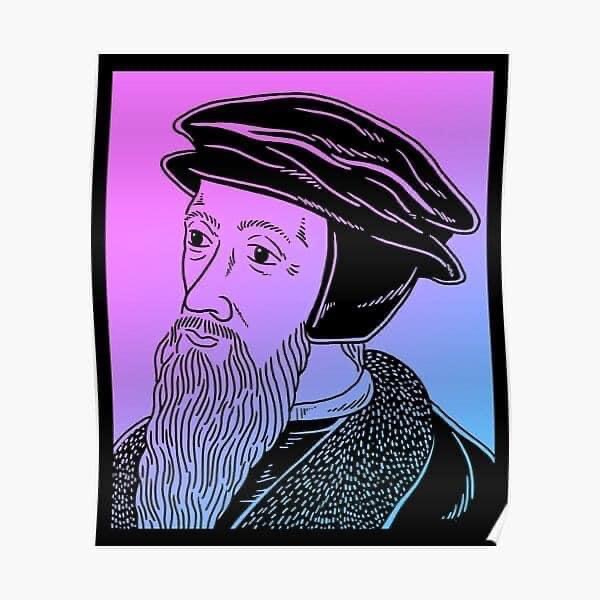
Today the church remembers a theologian who was probably a little too smart for his own (and our) good: Saint John Calvin, Renewer and Reformer.

Calvin was a serious child, and would grow up to be a very serious adult. He had a logical mind, and was not prone to swings of emotion (like Luther), but rather relied on formulas to make sense of the world, for better or for worse. He was well read, and devoured Augustine and books on grammar and rhetoric. At the age of 19 he had already earned a masters degree.

Calvin studied law at first, like many who would go on to serve the church (looking at you Luther), and as his father had recently been excommunicated over some legal issues, Calvin’s love of theology stayed strong but his relationship with the church was frayed.

After his father died, Calvin officially broke with the Roman church and joined the Reformation movement in 1533. He left France, settled in Basel, and began publishing theological works in earnest. Institutes of Christian Religion was put in print in March of 1536, and he eventually found himself in Geneva, organizing the Reformation movement there. He developed a theocratic organizational schematic for the church there, but was eventually invited to leave Geneva when his formulaic approach came into conflict with the popular Zwinglian practices adopted by many of the patrons of the city.

Calvin found himself under the care of another famous player in the Reformation, Martin Bucer, and stayed in Strasbourg for a time. There he married Idelette de Bure and had a son, adding to her two children from a previous marriage. Idelette died 1549, and Calvin cared for his new, young family as a widower.

Geneva came calling again when a pro-Calvin faction of Protestantism took political power. Calvin once again returned to that city, and under the new constitution developed the four-fold ministries of the Calvinist church: pastors, teachers, elders, and deacons.

Calvin continued on in Geneva, often taking in religious dissidents from other places in Europe, and died on this day in 1564. He was a powerful preacher and prolific writer, and his strict and unbending theological ideas remain in place today (though some of them bend a bit these days).

St. Calvin is a mixed bag for me. Though he certainly pushed theological thought and hastened the needed reformation of the church, his ideas could be extreme and simplistic in their rigidity, especially around election and atonement. He didn’t leave much space for beauty and mystery, and uber-Calvinist strains of Christianity often lead the way in bulldozing other ideas that fall outside of familiar doctrinal formulas.

That all being said, he is a reminder for me, and should be for the whole church, that while we do need some formulas for understanding metaphysics, art and beauty can’t be trampled in the process or else we lose our ability to stand in awe at the ineffable.

-historical bits gleaned from Pfatteicher’s New Book of Festivals & Commemorations

-icon written by dinosareforever and can be purchased at redbubble(dot)com.

-commentary mine

Confounding It Is

Today the Church celebrates one of our moveable, and most confounding, Feast Days: The Feast of the Holy Trinity.

Here’s the thing about the Holy Trinity: it is a mystery to be held, not a problem to be solved…so we should stop trying to solve it, already.

At its best this doctrine, and this Feast Day (which has been celebrated on this Sunday after Pentecost since at least the 10th Century), honors the ineffable nature of the Divine. Using ancient numerology and a mystic mindset, it acknowledges that some things are unknowable, always spinning, and that this can be comforting for a humanity that longs to peg everything down.

A God who cannot be pegged down is endlessly possible.

At its worst this doctrine has become a (primarily masculine) box that explains in ways that don’t make any sense who God is and how Jesus and God are related, and then throws in a bird (or are they all the same and not related at all? See what happens when you think about it too much?!).

The Trinity is a Divine whirlwind of creativity and love.

The Trinity is a thought that is foundational to all other thoughts.

The Trinity is mother of all, the stream in which time is caught up, the hovering mist that covers existence.

And it is also none of this.

The Holy Trinity is a reminder for me, and should be for the whole church, that any effort to peg the Divine down is a fool’s errand (thank God).

-Icon is Crow Trinity written by Fr. John Giuliani

For the Vegetarians

Attention Vegetarians! Today’s saint is for you!

Today the church remembers a goofball saint whose brilliance was often wrapped in a joke: St. Philip Neri, Jokester, Vegetarian, and Confessor of the Church.

St. Philip Neri was born in a post-Renaissance world ripe with schism. The Reformation began while he was an infant, and the church landscape was changing rapidly in his formative years.

As he entered his late teens he abandoned dreams of going into business, and instead moved to Rome to study Theology and Philosophy, diving deeply into the spiritual life. The waters he found there, though, were not to his liking, and though he enjoyed his studies he decided not to become ordained at that time.

Instead, St. Philip became what most of the church is: an invested layperson with a keen spiritual life.

St. Philip’s problem, though, was that everyone liked him, and his popularity was making it harder and harder for him to turn down ordination. This was especially true as the Council of Trent in the mid-1500’s was starting to re-imagine what the Roman church would look like (and people wanted St. Philip Neri to be a part of that shaping).

St. Philip was eventually ordained and became what too few pastors were (and, maybe, are?): an outstanding preacher and confessor. He used image and metaphor and allusion to tie together disparate parts of the faith into lovely and meaningful sermons.

And, he was funny!

His two favorite books were the New Testament and a joke book. Seriously.

He founded The Oratory, a group of priests living together, that included amongst their rituals of Mass, prayer, and fasting, times to “just chat” and compose hymns and speeches together. While this looked suspicious to many in the church, it was eventually accepted as a movement that embodied the ideals of the faith.

St. Philip Neri was also known as a lover of animals, and is often depicted in icon form holding his pet dog, a Maltese. He was an advocate for vegetarianism, and would often free captured birds he found in the market or on the street…and then the birds tended to follow him around. He went so far in his defense of all living things, that he wouldn’t even swat away flies, but constantly left the windows open so that they could escape.

St. Philip Neri died on this day in 1595 while he was hearing Confessions. He was quickly beatified, and is still held in high regard across the church catholic for his keen intellect and his gaiety.

As an example of his fun nature, he one time told a woman with a propensity for gossip that, as penance, she had to throw a bag of feathers in the air and pick up every one. She protested, saying it would be impossible. “Ah,” St. Philip said, “you see, that’s exactly what it’s like with gossip. Once you let those words out, you cannot gather them back in!”

St. Philip Neri is a reminder to me, and should be for the whole church, that we don’t have to take ourselves too seriously. After all, it’s just life, folks…

-historical bits gleaned from Knoenig-Bricker’s 365 Saints

-icon written by Br Robert Lentz and can be purchased at Trinitystores.com

On Being Venerable

Today the Church remembers an 8th Century Saint who lived an uneventful life (which is what makes him interesting): St. Bede the Venerable, Monk, Priest, and Scholar.

St. Bede, known as “the father of English history,” was born in the late 7th Century near Durham, England. At the age of seven his parents dropped him off at the new monastery in Wearmouth to be educated, and he quickly grew in both learning and stature as being intellectual and wise (a combo that don’t always run in tandem).

He was ordained a Deacon at the age of nineteen, and became a priest at the age of thirty.

St. Bede devoted his life to scholarly pursuits, and could often be found in the monastic library. It is thought that he was the most learned person in Western Europe, and dabbled in history, grammar, metrics, understanding time (still an abstract topic!), and, predictably, the Scriptures.

He wrote An Ecclesiastical History of the English People (in Latin) which remains a primary text for understanding the 6th, 7th, and 8th Centuries of Anglo-Saxon culture and the ascendency of Christianity on the island.

St. Bede received the title of “Venerable” in accordance with the practice of the time as awarding that title to anyone who proved themselves as knowledgeable and holy. For him the title seemed to stick more than others in history.

St. Bede the Venerable died on Ascension Day in the year 735 A.D. while he was in the middle of dictating an English translation of John’s Gospel.

St. Bede is a reminder for me, and should be for everyone, that your life doesn’t need to be remarkable to be remembered.

-historical bits from Pfatteicher’s New Book of Festivals & Commemorations

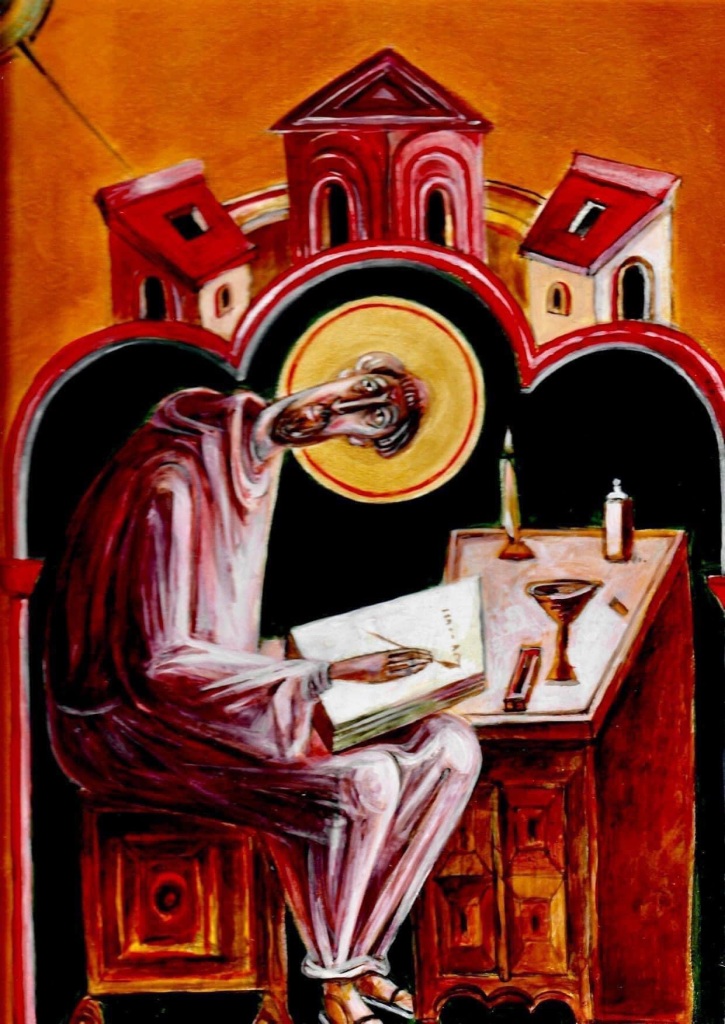
-icon written by Mull Monastery Icons (in it you can see St. Bede leaning close to the scriptures to listen for God’s voice)

The CEO of Your Story

Saint Tina of the Turners taught us to dance.

She taught us that you can attempt self-harm and survive and change other people’s lives because healed people can heal people.

She taught us that you can fight back when abused. You don’t have to stay in abuse.

She taught us what forgiveness looks like when she said she’d forgiven Ike, but also reminded us what self-love looks like when she said she’d never work with him again.

She taught us how to sing from our guts and how you can be the CEO of your own story even as others try to take it from you.

She was a true triple threat: singing, dancing, and acting.

She is an icon.

Sweet sleep, even as you keep on rollin’…

-icon written by Posteritty