Unknown's avatar

About Timothy Brown

A pastor. A writer. A dreamer. Occasionally a beer brewer.

Firebrand

Today the church remembers a firebrand of a saint who threw off the shackles of patriarchy every chance she got: Saint Elizabeth Cady Stanton, Speaker, Feminist, and Woman’s Rights Advocate.

Saint Elizabeth was born in Johnstown, New York to strict Presbyterian parents in the first part of the 19th Century. Early into adulthood she married abolitionist Henry Brewster Stanton, and together they had seven children. She organized women across the country to fight for the right to vote, coming alongside other advocates like Sojourner Truth, Harriet Tubman, and Amelia Bloomer.

Together they organized the first Women’s Rights Convention in Seneca Falls, New York in 1848.

She was extremely witty, a brilliant scholar, and a staunch abolitionist. She created the “Declaration of Sentiments,” an expansion of the Declaration of Independence that inserted the word “woman” and “women” throughout the document. Along with advocating for woman’s suffrage and against slavery, she also moved the needle on the right for women to own property and divorce their husbands.

She was a regular church attender, but a sharp critic of Christianity (and religion in general) which makes me think we would probably have been friends.

She died in 1902, never witnessing the 19th Amendment or realizing the right to vote. Nevertheless, she paved the way for that legislation to happen.

Saint Stanton is a reminder for me, and should be for everyone, that sometimes we don’t see the results we labor for, but we must labor on.

-historical bits from Pfatteicher’s New Book of Festivals & Commemorations

-icon written by Fr. Robert Lentz and can be purchased at trinitystores.com
Multiplicity of Thought

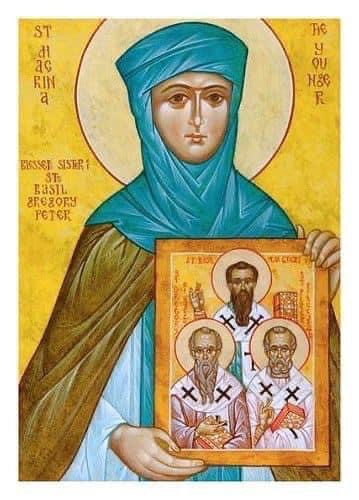
Today the church remembers a 4th Century saint who was often overshadowed by her more famous brothers Greg and Bas (you know them Gregory of Nyssa and Basil the Great, two of the three “Cappadocian Fathers” of the faith): Saint Macrina the Younger, Scholar and Universalist.

Saint Macrina was born in a family already well-steeped in the early Christian movement. She was named after her grandmother, Macrina the Elder, and though her brothers would gain notoriety for their scholarly treatises, they themselves mentioned Macrina as a teacher of faith in their home.

Having been betrothed in an arranged marriage by her father, Macrina never tasted wedded life as her fiancé died before the wedding. She came to see her vows as belonging to Christ alone, and lived an aesthetic and austere life with her mother and a group of women who pledged themselves to communal living. In this community, everyone was equal, whether you were formally a servant or wealthy enough not to owe anyone anything.

It’s one of the early egalitarian communities of the faith, and St. Macrina grew in responsibility as the community grew, taking on what we would call an Abbess role in time.

St. Macrina was also the tutor of her younger brother, Peter of Sebaste who would become a Bishop in the early church. She taught him not only the great philosophical ideas of the time, but also about The Way which was spreading like wildfire in the West and the Near East. In this way, and because she had such a strong influence on Greg and Bas (as I call them), means she was a shaper of the early church, an unseen hand on the needle of the faith.

Known for being a deep thinker, St. Macrina was supposedly a Universalist, and is lifted up by the Universalist Unitarian Church as a great scholar. Her brother, Gregory of Nyssa, composed Dialogue on the Soul and Resurrection in which he records a conversation with Macrina on her death bed (actually, her aestheticism was so great she refused to die in a bed, and chose to die lying on the ground). In that conversation she notes her deep conviction that everyone would be reconciled to God in the end, faithful and pagan alike.

St. Macrina died on this day in 379 AD in Pontus, modern day Turkey.

Saint Macrina is a reminder for me, and should be for the whole church, that the early Christian movement comprised a multiplicity of thoughts and theologies…and still does, despite what the zealots in all corners might want you to think.

-historical bits from open source publications

-icon a classic Byzantine style by unidentified writer where St. Macrina holds an icon of her brothers

Ruler of Land Under Wave

In reading about my ancestors, the ancient Celts, I recently came across the god Manannan mac lir, the Irish god of the sea. They called him, “Ruler of the Land Under Wave” (which I think is a pretty bad-ass title).

For the Celts the sea they spoke of consisted mostly of the Irish Sea and the islands between Ireland and Britain.

It was thought that the Ruler of the Land Under Wave traveled over the water in his chariot called Ocean Sweeper, led by his favorite horse Enbarr (which roughly translates to “Waterfoam”).

Manannan held one of the ancient magical pieces of the world, a great shining cloak that could change color as the sea changed, making him largely invisible for those not paying attention.

On the Isle of Man the ancients would climb a mountain with a bundle of green rushes and pay tribute to him on Midsummer Eve, as they regarded the Ruler of the Land Under Wave as their great protector.

Even now some Irish and Scottish fisherman who hold on to the old ways say a blessing to Manannan before heading out to sea:

“Manannan mac lir (Son of the Sea),
who blessed our Island,
Bless us and our boat, going out well.
Coming in better, with living and dead (fish) in our boat.”

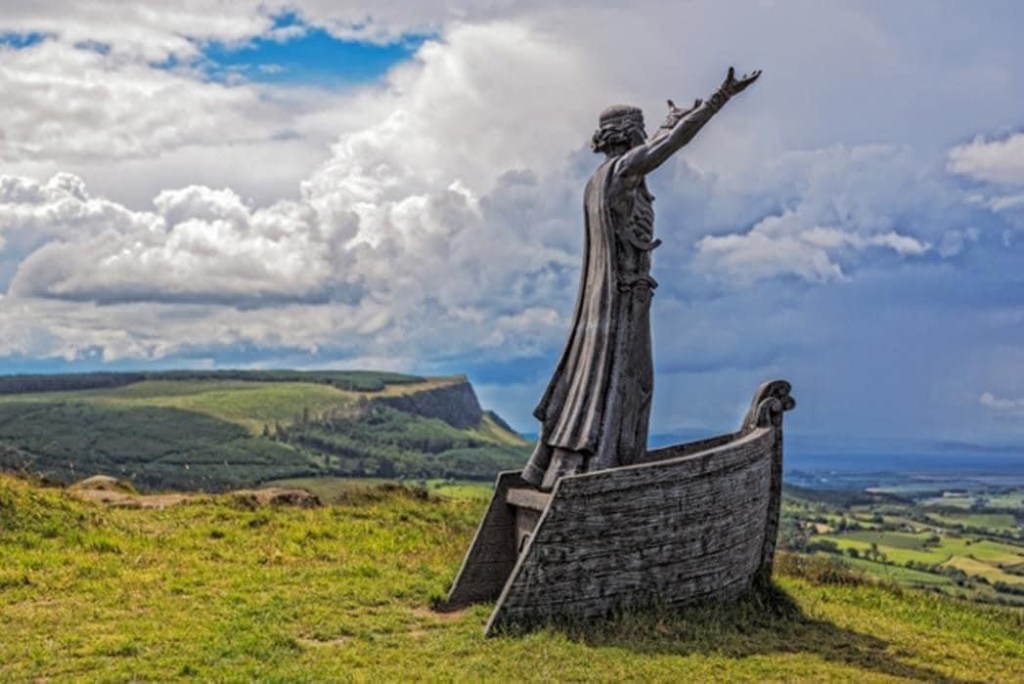
A statue to Manannan mac lir still stands in Gortmore, Magilligan, County Londonderry, Northern Ireland.

Every New Moon

The ancient Celts had a strong inclination that the rhythms of nature were echoed in the rhythms of the human body. Winter was for silence and rest, Spring for energy and growth, Summer for blazing work and toil, and Autumn for winding down and letting go.

They understood that living in a way that was in alignment with these rhythms led to a balanced way of being in this world.

At every new moon they also saw that the cycle of life both as continued and began again at the same time, giving support for this idea that time is circular, not linear, and that every moment is both a continuation of a past step and the opportunity for newness.

Let those with ears to hear, hear.

Patriarchy is Hard to Eradicate

Today the church remembers one who is considered to be the first Christian ruler of Russia: Olga, Princess of Kiev, Confessor and Ruler.

Saint Olga is the grandmother of the first “official” ruler of Russia who confessed the faith. Her grandson Vladimir gets the “official” title because of patriarchy, but in actuality Olga was the first official Christian to rule the nation.

Born in the late 9th Century, Olga married Prince Igor and, after his death in the year 945 A.D., officially ruled in his stead until her son came of age.

She was known for being courageous, “sticking it to the man,” instituting reforms that her husband was unable to carry out regarding financial and administrative changes, and had been an early convert to the faith through the Scandinavian missionaries who traveled down the river system from the West.

In the year 957 A.D. Olga visited Constantinople and some say that is where she was officially baptized, though others claim that she had long been an adherent to the faith. Regardless, her personal faith did not indicate a change of heart for her country, and her son who came to rule after her was not a confessor.

Olga is remembered in Eastern Orthodoxy as the “Blessed Princess Olga,” and is honored in the Ukrainian and Russian branches of the church. She is remembered as being witty and brave. The story goes that when she went to be baptized in Constantinople, the Emperor saw her beauty and asked her to marry him. She replied, “First I must be baptized,” and then followed it up with, “and I need a Godfather. Will you be mine?”

The Emperor agreed and, following her baptism, returned to the invitation of marriage. The bright Princess replied, “We are now family through baptism, and never has a father married a daughter, even amongst the heathens!”

Knowing he had been outsmarted, he gave Olga his blessing to return to Russia with the faith.

She died in the year 969 of old age.

Saint Olga is a reminder for me, and should be for all the church, that too often the female saints amongst us don’t really get their due because, well, patriarchy is hard to eradicate and we must always keep in mind the author of histories and, well, read between the lines.

Let those with ears to hear, hear.

-historical notes gleaned from Pfatteicher’s New Book of Festivals & Commemorations

Glimmers of Hope

Today the church recognizes a peasant from Bavaria who would influence both an entire continent and an island nation, Johannes Flierl, Missionary to Australia and Papua New Guinea.

Born in humble beginnings in 1858, Flierl was ordained a pastor in Bavaria and started his mission work in the interior of Australia with the native aboriginal persons there. Roughly eight years later, he boarded a boat and hopped across the Torres Strait, landing in Finschafen, Papua New Guinea, the capital of the German colony of Kaiser-Wilhelmsland.

Flierl was the first Lutheran missionary on the island. He established a mission near Simbang, but didn’t baptize any locals until 14 years later.

Flierl is remembered not only for his mission work, but most importantly as a champion for the locals in their fight for rights against government oppression. A seminary in Finschafen was established in his name in 1957, ten years after his death.

Flierl’s mission would eventually become the Evangelical Lutheran Church of Papua New Guinea which, along with the Batak Church in Indonesia, is the largest of all Lutheran mission churches.

Flierl is notable for a few reasons, not the least of which is his innovative chin hair. It does my heart good to hear of a 19th Century missionary who was fighting for the rights of the people they were sent to walk with, not just trying to bludgeon them with a religion they didn’t ask to be exposed to.

The ELCA’s model for missions is one of accompaniment, and though it is unclear how closely Flierl’s work embodied that same spirit, I see glimmers of hope in his story that he may have practiced some of that mindset in his missions.

-historical notes gleaned from Pfatteicher’s “New Book of Festivals & Commemorations”

House of Light

As we break into July I’m reminded that the ancient Celts always felt that they had two homes: the “inside house,” and the “outside house.”

In the winter months the hearth became their sun, and the family gathered around it to live well.

But from May-November, they didn’t need the false sun of the hearth, and their world (literally) revolved around the burning star that provides us life and light. The “outside house” was all creation, every living thing not within four walls.

They called this “outside home” the “house of light.”

In July they would sit in the house of light, outside, to learn: how to grow, how to use the light offered you free of charge, how to rise early, and how to retire as the sun retired.

We’d do well in these days to find ways to imagine our lives being between two houses, I think…and being able to learn what is taught in July.