Unknown's avatar

About Timothy Brown

A pastor. A writer. A dreamer. Occasionally a beer brewer.

Mother

Today the church remembers not a particular saint, but rather the Mother to us all: Earth Day.

The first Earth Day was held in 1970 with the rise of the environmental movement. As the Industrial Revolution quickly began taking its toll on the planet, humans began noticing some tangible changes in the way things looked, tasted, and smelled in the world…and it was not good. Though these changes smelled like prosperity to some, others knew it was a warning sign that the Earth was…is…dying, and that death was being accelerated by humans.

In those early days, pollution was the main focus of most Earth Day activities. And while that is still true today to some extent, we’ve now recognized global warming as the true danger to life on, and the life of, this planet.

In the opening lines of Genesis we find the Divine carefully crafting the earth, separating this from that, throwing birds in the air and playing ultimate “catch and release” with the fishes of the sea. The plants are coaxed from their ground, and humans are shaped out of the black soil. This poetic vision of the creation was not meant to be science…it was art. The art of the Divine being infused in every good thing that inhabits this planet.

And then, as the Creator rested, they charged humanity with tending all that had been made.

Earth Day is a reminder for me, and for the church, that this planet was not given to humans, but rather entrusted to them. In our efforts to thrive we’ve stumbled and sacrificed the lives of so many of our fellow creatures…remember: we’re all creation. And while we may not be able to stop global warming, we can slow it and shape it a bit.

Indeed: we are called to do that.

-icon “Holy Wisdom” written by Robert Lentz.

The Life of the Mind

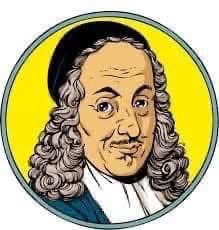
Today the church remembers the embattled Bishop: St. Anselm, Scholar, Erstwhile Bishop of Canterbury, and Preeminent Theologian.

Born in northwestern Italy, Anselm’s childhood was privileged in many ways. His parents were wealthy nobles and, after the death of his mother and an argument with his father, St. Anselm left home at the age of twenty-three to explore the world and further his education.

He found the Benedictine monastery of Bec in Normandy and, though he had been left all the family land by his father (who died while Anselm was abroad), he entered the brotherhood as a novice in 1060. Bec was the intellectual seat of the church at the time, and under St. Anselm’s influence grew ever more so. St. Anselm soon became the prior of Bec and then abbot of the monastery. He encouraged the church to move beyond the recitation of the faith and into an exploration of it. He prized Mary as the mother of God, but argued against her immaculate conception (he didn’t think it was a necessary doctrine). He formalized a process of theology known as “substitutionary atonement,” though it would be his students who would turn it into the (largely heretical) doctrine most know today.

He prized the life of the mind.

Soon he was summoned to be the Archbishop of Canterbury, replacing one of his teachers in the seat. There he entered into a power struggle with the King of England (Rufus…that name didn’t stick) over ultimate authority in the land. Rufus refused to recognize the Pope and, smelling an intense struggle, St. Anselm went to Rome and made his home there for a bit…just until things quieted down in England.

In Rome he worked hard on the Council of Bari (Pope Urban I had appointed him to it) that sought to reunify the Eastern and Western church. It didn’t happen, but St. Anselm’s contributions to the council remain distinguished.

Ultimately King Rufus died and King Henry I (that name did stick!) summoned St. Anselm back to Canterbury. Unfortunately the power struggle continued for the little island to the north, catching St. Anselm in the hot seat there. Now at the end of his days and in poor health, St. Anselm died on Wednesday in Holy Week on this day in 1109.

One of my favorite quotes of St. Anselm is this little ditty about the Christ, a totally feminist viewpoint:

“Are you (Jesus) not a mother too? Indeed you are, and the mother of all mothers, who tasted death in your longing to bring forth children to life.”

St. Anselm is a reminder for me, and should be for the whole church, that the life of the mind is far superior to the recitation of stale doctrine.

-historical bits from Pfatteicher’s New Book of Festivals & Commemorations

Signs

The Christian Celts (and the pre-Christians Celts, even, celebrating the newly thawed ground and the emergence of Spring) would celebrate Easter week with signs of new life and abundance.

Children would go about looking for nests in trees and underbrush, collecting any eggs they could find. They’d hide them in cubbies in their rooms, or under their houses, and on Easter they’d haul their findings out into the woods and have a pre-dawn breakfast of roasted eggs with the other children of the town.

On Easter Sunday the town would come together, having reserved some of those eggs for cake baking, and they’d present a village cake called a “prioncam cake,” which loosely means “capering cake” or “dancing cake.” It was decorated with woodland animals and a garland of wildflowers.

They’d put the cake in the middle of the gathering, and around it they’d dance and prance to fiddle and pipe. The best dance won the prize, the cake, hence that old saying, “That takes the cake!”

Now, on this Easter, there may still be some eggs, some treasures still hidden to surprise you…

If you’re willing to look.

Hodie

Today the Celtic arm of the church remembers the Eve of St. Expedite: Carrier of Messages.

St. Expedite, despite the humorous name, is an actual saint that the Roman church canonized, yet took from the rolls due to lack of ”lived evidence.” Like Sts. Christopher and Valentine, this saint doesn’t have much historical backing to legitimize their existence.

And yet, they remain an important part of lore. Why?

Glad you asked…

Expedient soldiers were Roman officers who carried no packs and could move with ease. They were often employed to deliver special messages or deliver pertinent materials to other divisions in quick step.

St. Expedite was thought to be an Armenian Christian who, rather than give worship to the Emperor, died a martyr as a faithful member of the faith, running their errands as necessary.

Calling the phrase “Hodie,” this fast runner yelled “today!” before him, delivering messages far and wide.

Yes, this saint is largely lore. But why are they important?

Because “today” is really the only day we’re promised, Beloved.

And this saint, like so many of the Celtic tradition, draws our attention to what is needful in the world.

So, as St. Mary Oliver rightly asked, what will you do with your, “One wild and precious life?”

-historical notes taken from common sources

The Triduum

As we enter Holy Week, a thought on the events to come:

The Triduum, or Great Three Days, is the antidote to an overly saccharine Easter.

Maundy Thursday gathers the disciples, including you, around a shared table where we all get our feet washed and we all share in dipping our bread in the same bowl as Jesus.

Then the sanctuary is stripped, like our souls now feel stripped, as we realize not only what is about to happen, but also that we must stay to bear witness.

On Good Friday we come not to church, but, with everything bare and the lights low, to a darkened tomb. There we encounter the story of that fateful night, a story we know well not only because we’ve heard it every year, but also because we’ve lived it. It’s familiar.

We’ve all been betrayed by our friends, and have all betrayed a friend. We’ve all been falsely accused and accused others without evidence, let alone our unspoken shame knowing our justice system does this, and profits from it all the time.

We’ve all seen power prey on the powerless. This is that story, but instead of the local courtroom it’s the courtroom of the cosmos.

The reproaches are sung where we’re challenged to answer unanswerable questions of eternal proportions, and the service ends with the cross alone left in the room.

We are, in the end, left only with the cross: this twisted tool of torture to which we now cling, hoping that something good can yet come from it.

Sound familiar?

And then we spend the whole next day in the quiet of non-answers. And at dusk we stream back to that tomb, create a new fire to keep our souls warm, and tell campfire stories of salvation to console ourselves.

“Remember that time that God created the world?” we ask around the fire. “And remember when God saved those folks from the fiery furnace?” We retell these stories as a way to spark hope that, as in those impossible moments, God might be able to do something new with this impossible moment. We teach these stories to our babies, even as we reteach it to ourselves.

And then before we know it, the tomb has turned into a lush garden, and that tomb that was full of death is suddenly full of life: flowers, water, and yes, living bodies.

Our bodies.

Our bodies who now gather around the body of the risen Christ now seen in bread, wine, water, and the faces around us. And we baptize people who have newly heard all of this. And we sing and dance and party because, yup, resurrection has happened again, by God!

The whole arc has import. Every scene plays a part.

Easter is not a day, it’s a journey

Monday in Holy Week

For the Christian Celts, the Monday (and sometimes Tuesday and Wednesday) of Holy Week was dedicated to cleaning the house and the home (with Holy Thursday dedicated for cleaning the chapel).

After months of inside smoke from the hearth dusting everything with soot, and with the spots above and around the well-used candles getting dingy and oily, Spring cleaning served both practical and spiritual purposes. Spring was a time of renewal, and so it made sense to renew the home from the dinge of winter.

But, as importantly, Spring cleaning mirrored the inward housecleaning of the Lenten days. With Easter almost upon them. the last few corners of the soul were tended, swept, and exposed to the light for purification.

True Discipleship

Today the church remembers a 17th Century saint, the first Native American that the church officially canonized: St. Kateri Tekakwitha, the Lily of the Mohawks.

St. Kateri was born to an Algonquin mother who was a practicing Christian and a Mowhak Turtle chief, who was not a Christian. When she was just four years old, a smallpox epidemic took both of her parents and her brother, leaving her with damaged eyesight and noticeable scars on her face. She was taken in by her uncle, who did not approve of her mother’s faith.

At the age of 18, St. Kateri secretly started studying with Jesuit missionaries, and she decided to be baptized and assume the name “Kateri” in honor of St. Catherine of Siena.

A year after her baptism, French conquerors came through and massacred her people and burned their village. St. Kateri escaped by taking to the St. Lawrence River. She was taken in by a First Nations tribe down river who happened to be Christian, and she dedicated her life to prayer and the care for the sick.

At the age of twenty-three St. Kateri contracted tuberculosis, and died shortly before turning twenty-four. Her final words were reportedly, “Jesus–Mary–I love you.”

She was canonized by Pope John Paul II in 1980, the first First Nations saint to be canonized (though, truly, many are canonized in the hearts of those who know their stories). She is often referred to as Lily of the Mohawks.

St. Kateri is a reminder for me, and should be for the whole church, that sometimes those who have walked the most unjust roads are the perfect companions for those in need. St. Kateri’s life was ravaged by white invaders who brought their diseases, guns, and unbridled ambition to take over a land and subjugate a people they had no claim to, often in the name of religion and the church.

But, like her Jesus whom she loved so much, St. Kateri was a model for them of true discipleship.

-historical bits gleaned from Claiborne and Wilson-Hartgrove’s Common Prayer: A Liturgy for Ordinary Radicals

-icon written by Barbara Brocato

On Palms

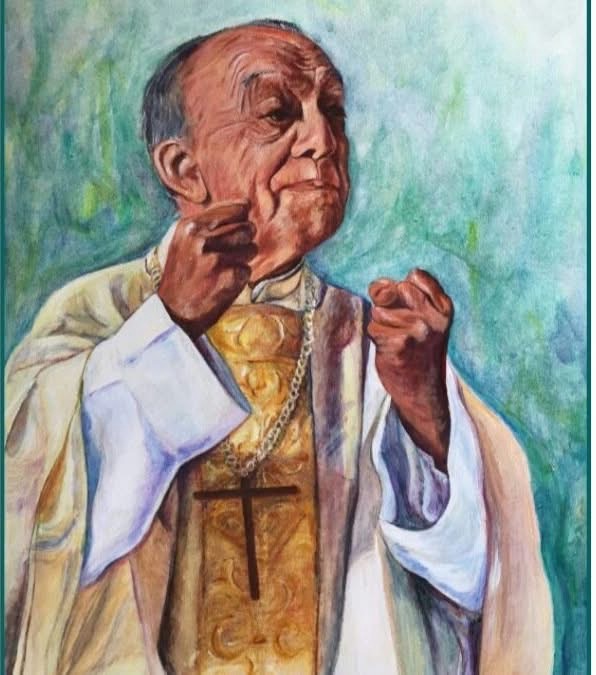
Today the church commemorates the Palm Sunday processional in many parishes across the globe. This moveable commemoration is the beginning of the end of the new beginning for Christians who observe the liturgical calendar.

Bishop Theodulph of Orleans penned the hymn my heart is singing on this Palm Sunday morning, “All Glory, Laud, and Honor.”

It truly is one of my favorites, made more sacred by the fact that we really only sing it once a year.

He is said to have written it from his prison tower, thrown there by King Louis the Debonair, son of Charlemagne.

The story goes that the Bishop wrote this hymn and, in the year 821 as the Emperor passed by on Palm Sunday heading to Mass at the cathedral, he sang it loudly over the passing procession from his stone entombment. The emperor, taken with the song, released the good Bishop.

Truly the rocks themselves will shout for justice.

-painting by Polly Castor