The Christian Celts (and the pre-Christians Celts, even, celebrating the newly thawed ground and the emergence of Spring) would celebrate Easter week with signs of new life and abundance.
Children would go about looking for nests in trees and underbrush, collecting any eggs they could find. They’d hide them in cubbies in their rooms, or under their houses, and on Easter they’d haul their findings out into the woods and have a pre-dawn breakfast of roasted eggs with the other children of the town.
On Easter Sunday the town would come together, having reserved some of those eggs for cake baking, and they’d present a village cake called a “prioncam cake,” which loosely means “capering cake” or “dancing cake.” It was decorated with woodland animals and a garland of wildflowers.
They’d put the cake in the middle of the gathering, and around it they’d dance and prance to fiddle and pipe. The best dance won the prize, the cake, hence that old saying, “That takes the cake!”
Now, on this Easter, there may still be some eggs, some treasures still hidden to surprise you…
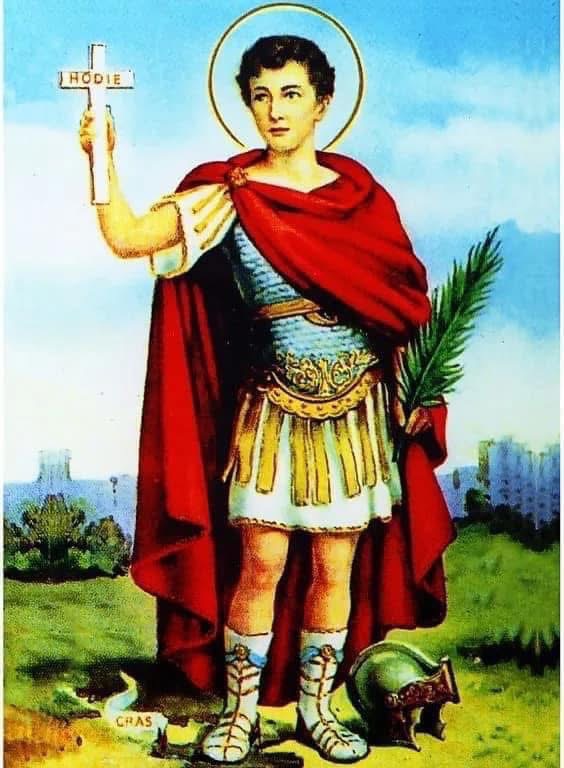
Today the Celtic arm of the church remembers the Eve of St. Expedite: Carrier of Messages.
St. Expedite, despite the humorous name, is an actual saint that the Roman church canonized, yet took from the rolls due to lack of ”lived evidence.” Like Sts. Christopher and Valentine, this saint doesn’t have much historical backing to legitimize their existence.
And yet, they remain an important part of lore. Why?
Glad you asked…
Expedient soldiers were Roman officers who carried no packs and could move with ease. They were often employed to deliver special messages or deliver pertinent materials to other divisions in quick step.
St. Expedite was thought to be an Armenian Christian who, rather than give worship to the Emperor, died a martyr as a faithful member of the faith, running their errands as necessary.
Calling the phrase “Hodie,” this fast runner yelled “today!” before him, delivering messages far and wide.
Yes, this saint is largely lore. But why are they important?
Because “today” is really the only day we’re promised, Beloved.
And this saint, like so many of the Celtic tradition, draws our attention to what is needful in the world.
So, as St. Mary Oliver rightly asked, what will you do with your, “One wild and precious life?”
As we enter Holy Week, a thought on the events to come:
The Triduum, or Great Three Days, is the antidote to an overly saccharine Easter.
Maundy Thursday gathers the disciples, including you, around a shared table where we all get our feet washed and we all share in dipping our bread in the same bowl as Jesus.
Then the sanctuary is stripped, like our souls now feel stripped, as we realize not only what is about to happen, but also that we must stay to bear witness.
On Good Friday we come not to church, but, with everything bare and the lights low, to a darkened tomb. There we encounter the story of that fateful night, a story we know well not only because we’ve heard it every year, but also because we’ve lived it. It’s familiar.
We’ve all been betrayed by our friends, and have all betrayed a friend. We’ve all been falsely accused and accused others without evidence, let alone our unspoken shame knowing our justice system does this, and profits from it all the time.
We’ve all seen power prey on the powerless. This is that story, but instead of the local courtroom it’s the courtroom of the cosmos.
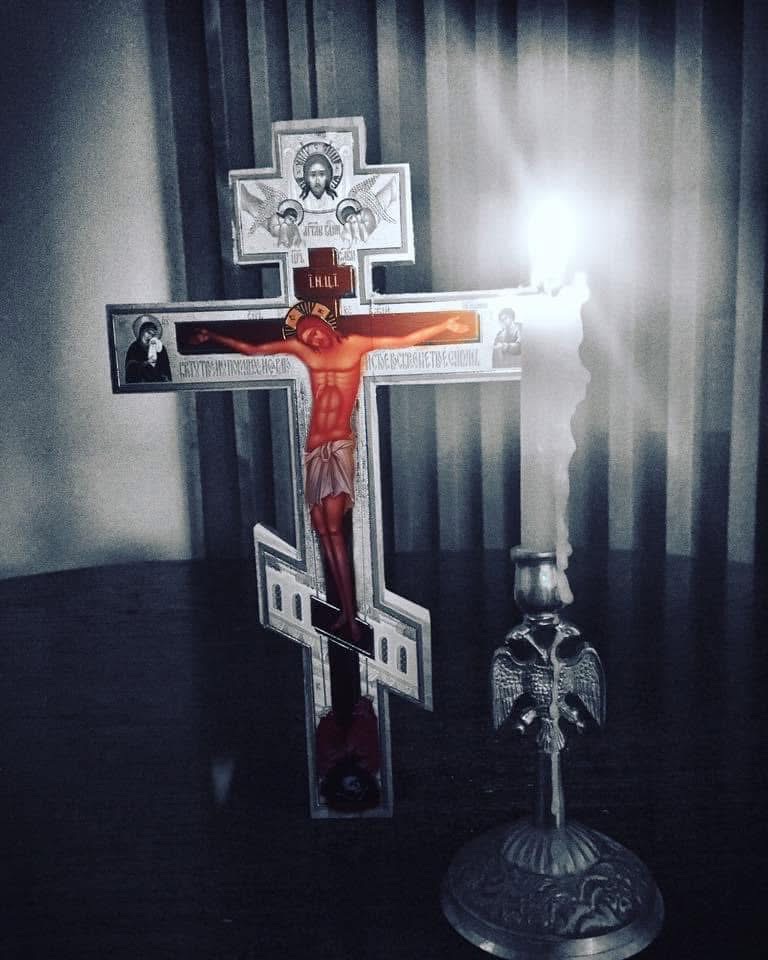
The reproaches are sung where we’re challenged to answer unanswerable questions of eternal proportions, and the service ends with the cross alone left in the room.
We are, in the end, left only with the cross: this twisted tool of torture to which we now cling, hoping that something good can yet come from it.
Sound familiar?
And then we spend the whole next day in the quiet of non-answers. And at dusk we stream back to that tomb, create a new fire to keep our souls warm, and tell campfire stories of salvation to console ourselves.
“Remember that time that God created the world?” we ask around the fire. “And remember when God saved those folks from the fiery furnace?” We retell these stories as a way to spark hope that, as in those impossible moments, God might be able to do something new with this impossible moment. We teach these stories to our babies, even as we reteach it to ourselves.
And then before we know it, the tomb has turned into a lush garden, and that tomb that was full of death is suddenly full of life: flowers, water, and yes, living bodies.
Our bodies.
Our bodies who now gather around the body of the risen Christ now seen in bread, wine, water, and the faces around us. And we baptize people who have newly heard all of this. And we sing and dance and party because, yup, resurrection has happened again, by God!
The whole arc has import. Every scene plays a part.
For the Christian Celts, the Monday (and sometimes Tuesday and Wednesday) of Holy Week was dedicated to cleaning the house and the home (with Holy Thursday dedicated for cleaning the chapel).
After months of inside smoke from the hearth dusting everything with soot, and with the spots above and around the well-used candles getting dingy and oily, Spring cleaning served both practical and spiritual purposes. Spring was a time of renewal, and so it made sense to renew the home from the dinge of winter.
But, as importantly, Spring cleaning mirrored the inward housecleaning of the Lenten days. With Easter almost upon them. the last few corners of the soul were tended, swept, and exposed to the light for purification.
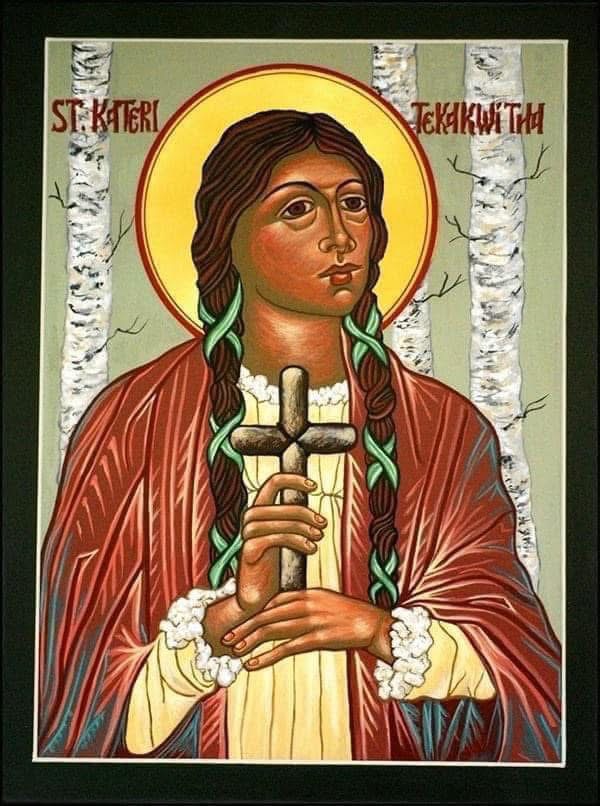
Today the church remembers a 17th Century saint, the first Native American that the church officially canonized: St. Kateri Tekakwitha, the Lily of the Mohawks.
St. Kateri was born to an Algonquin mother who was a practicing Christian and a Mowhak Turtle chief, who was not a Christian. When she was just four years old, a smallpox epidemic took both of her parents and her brother, leaving her with damaged eyesight and noticeable scars on her face. She was taken in by her uncle, who did not approve of her mother’s faith.
At the age of 18, St. Kateri secretly started studying with Jesuit missionaries, and she decided to be baptized and assume the name “Kateri” in honor of St. Catherine of Siena.
A year after her baptism, French conquerors came through and massacred her people and burned their village. St. Kateri escaped by taking to the St. Lawrence River. She was taken in by a First Nations tribe down river who happened to be Christian, and she dedicated her life to prayer and the care for the sick.
At the age of twenty-three St. Kateri contracted tuberculosis, and died shortly before turning twenty-four. Her final words were reportedly, “Jesus–Mary–I love you.”
She was canonized by Pope John Paul II in 1980, the first First Nations saint to be canonized (though, truly, many are canonized in the hearts of those who know their stories). She is often referred to as Lily of the Mohawks.
St. Kateri is a reminder for me, and should be for the whole church, that sometimes those who have walked the most unjust roads are the perfect companions for those in need. St. Kateri’s life was ravaged by white invaders who brought their diseases, guns, and unbridled ambition to take over a land and subjugate a people they had no claim to, often in the name of religion and the church.
But, like her Jesus whom she loved so much, St. Kateri was a model for them of true discipleship.
-historical bits gleaned from Claiborne and Wilson-Hartgrove’s Common Prayer: A Liturgy for Ordinary Radicals
Today the church commemorates the Palm Sunday processional in many parishes across the globe. This moveable commemoration is the beginning of the end of the new beginning for Christians who observe the liturgical calendar.
Bishop Theodulph of Orleans penned the hymn my heart is singing on this Palm Sunday morning, “All Glory, Laud, and Honor.”
It truly is one of my favorites, made more sacred by the fact that we really only sing it once a year.
He is said to have written it from his prison tower, thrown there by King Louis the Debonair, son of Charlemagne.
The story goes that the Bishop wrote this hymn and, in the year 821 as the Emperor passed by on Palm Sunday heading to Mass at the cathedral, he sang it loudly over the passing procession from his stone entombment. The emperor, taken with the song, released the good Bishop.
Truly the rocks themselves will shout for justice.
Today the church remembers a Finnish Bishop who studied under Martin Luther himself: St. Mikael Agricola, Bishop of Turku, Renewer of the Church, and Mystic.
Born in Uusimaa (the Fins think “why use one vowel when you can use two?), he went to school in Viipuri and then Turku. He was a good student and due to his scholarly achievements, he was sent by his Bishop to Wittenberg to study under Luther and Malanchthon.
After his graduation, Luther wrote him a letter of recommendation (apparently those have been necessary in the schola forever) and he became Assistant to the Bishop at Turku, eventually succeeding him in the bishopric without seeking Papal approval (a big no-no).
As Bishop St. Mikael undertook extensive Lutheran reforms throughout Finland, encouraging greater participation and catechesis of the laity. Toward this end, he developed an orthography, the basis for modern Finnish spelling, and prepared a book of ABC’s, a prayer book, a New Testament translation, a translation of the Mass, and a collection of Finnish hymns.
Truly, he was an educator as well as a theologian.
After being sent to Russia as part of a delegation to negotiate a peace between Russia and Sweden, he fell ill on the return trip. He died the night of Palm Sunday in 1557 after having been Bishop for only three years.
Though much of his work was in the practical changes needed for an informed church, he was a deeply spiritual person who held ancient mysticism in high regard.
He is widely commemorated in Finland to this day.
St. Mikael is a reminder for me, and should be for the whole church, that you don’t have to be in a position for very long to make a huge difference.
-historical bits gleaned from Pfatteicher’s New Book of Festivals & Commemorations
For the ancient Celts, April was the month of new life long before the Christians invaded their lands. They saw the blossoming of the ground and understood deep in their bones that resurrection was not only possible, but probable in this life (and others).
One of the things they took the time to do in these days was connect with trees. They imagined that the trees had their own kingdom, and their own way of communicating (which they do…Google the latest science on the matter!). Tolkien understood this, which is why the Ents played a lovely part in his fantasy world.
Here is the suggestion for deepening your relationship with trees (honestly, they would do this):
-Wander through different groves. Quiet your mind. Touch the trunk of a tree or two and pay attention to it.
-Take a leaf from a tree and rub it between your fingers.
-Sit against a trunk and imagine in gratitude that it gives you shade and fruit (whatever kind it gives) and life.
-Fall into a state of peace and just be with it for a while.
As trees awaken in these April days, the Celts believed humanity, the ground, and the animals would follow that energy and awaken, too.






 Reluctant Xtian