
Unknown's avatar

About Timothy Brown

A pastor. A writer. A dreamer. Occasionally a beer brewer.

“If it’s wrong, I don’t want to be right” or “I don’t want to be right, even if that’s wrong.”

In the July 8th issue of The Guardian, David Hare has an interesting interview with the Archbishop of Canterbury, Rowan Williams.

Yes, get your “Mr. Bean” jokes out now.

Williams has been an outspoken critic of the New Atheist movement happening in his backyard, but his critiques have been mostly what I would call a “failure to engage.”  But as I read more and more about Williams, his theology, and his argumentative style, I would classify his critiques less as a failure to engage and more as a choice not to talk over.

That is, after all, what most of these shouting matches between atheists and theists have been: talking over one another.

So when one can boil the Archbishop’s responses down to the simple, awfully British, phrase, “Oh, please…” I now understand better why.  Williams finds the whole process of argumentation to be an exercise in futility.  And one, I might add, that leads to more bitterness and entrenchment than anything else in my experience.

I, too, came to this realization about a year ago.  In my search to mine the depths of my own skepticism, I finally came to much the same conclusion that Williams appears to have known for some time (if only those with ears would hear): argumentation in this arena is a futile attempt at making oneself believe by mind what is only known by heart.  Or, as St. Ambrose reminds us, “It does not suit God to save (God’s) people by arguments.”  Williams apparently often recites this.

This realization is not an escape, mind you.  That’s ultimate Truth.  And if you think you know it, I would question if you do.

Willaims explains this idea much more satisfactorily in the interview:

“Oh, look, argument has the role of damage limitation. The number of people who acquire faith by argument is actually rather small. But if people are saying stupid things about the Christian faith, then it helps just to say, ‘Come on, that won’t work.’ There is a miasma of assumptions: first, that you can’t have a scientific worldview and a religious faith; second, that there is an insoluble problem about God and suffering in the world; and third, that all Christians are neurotic about sex. But the arguments have been recycled and refought more times than we’ve had hot dinners, and I do groan in spirit when I pick up another book about why you shouldn’t believe in God. Oh dear! Bertrand Russell in 1923! And while I think it’s necessary to go on rather wearily putting down markers saying, ‘No, that’s not what Christian theology says’ and, ‘No, that argument doesn’t make sense’, that’s the background noise. What changes people is the extraordinary sense that things come together.

In reading Harris and Hitchens, in reading Craig and McGrath, I’ve come to this conclusion: I enjoy the reading.  On both sides.  I find myself nodding to Hitchens about just as much as I find myself nodding to McGrath.  And I find myself shaking my head in the same places, too: where the argumentation devolves into silly straw-people stereotypes and supercilious name calling.

(Harris and Craig, actually, I find pretty tedious because their anger is not mixed with enough sarcasm.  I prefer my agitants to be laced with humor.  It helps the hate go down better.)

But all in all this interview with the fine Archbishop has helped me to hone in, once again, on what it is that I am giving up in this life constantly, and that is the need to be “right.”  He notes:

Put it this way, if I’m not absolutely paralysed by the question, ‘Am I right? Am I safe?’ then there are more things I can ask of myself. I can afford to be wrong.

My dance with religion has led me to find that I’m not dancing to learn the steps, I’m dancing to dance.  And perfection is not the goal of this endeavor; dancing is.  I’ve given up my need to have the right steps.

But if that’s the case, why are so many Christians concerned with orthodoxy?  In my own church, my own denomination, we’re continuing to struggle with issues over orthodoxy, and yet, if we’ve given up the need to be right as the Christ has freed us to, it appears we haven’t given up the need to fight about it.

It is at this point that many will say, “Sure, but your point certainly doesn’t mean that anything is permissible!”

Quite correct (I’ll refrain from using the word “right”).

But must we argue and divide and split on account of it?  Williams’ own tenure as Archbishop has shown that diverse opinions can be pillars that hold up the same house.  And whether it’s because his eyebrows are too threatening to tussle with, or because he’s actually on to something here, he truly believes in the church in a way that makes me not want to fight him on it.

But I’ll allow his belief to be my own for the present time.  For while I want to believe in the church, the church often makes me a reluctant Christian.  Christians make me a reluctant Christian. While I find myself free from the need to be right, it appears my sisters and brothers throughout the church do not.

Sigh.

And sure, the one last argument the dissenting reader will throw out is true, “But don’t you think you’re “right” in believing its correct to give up being right?!”

Fine.  Incurvatus in se.  I won’t argue with you on that…because arguing will get us no where.  But I don’t believe in the rightness of my belief.  I don’t believe in the rightness of religion; no way.

Instead, I’ll just say that it’s my lens. I lean on it.  I look through it. Or to put it another way, I’ll quote someone else much smarter than me:

“Religion is not primarily a something to be believed…Religion is first and foremost a way of seeing.” (Kushner, Who Needs God)

So, I guess I don’t want to be right, even if that’s wrong.  Because in my reading and my experience, being right or needing to be so, well, it just leads to blindness.
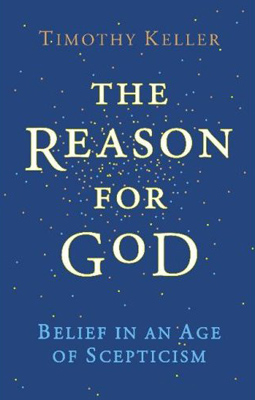
Books about Theism, Atheism, and the Intersection of Belief

The book behind the minister. Or vice versa?

I first read Timothy Keller’s book, The Reason for God, after reading an article on him in Newsweek.  I was intrigued by his approach to ministry and his interactive preaching style.  Although his theology is a bit more conservative than my own, I think he’s quite a good scholar, and quite good at message conveyance.

The Reason for God did not disappoint in either its scholarship or its clarity.  Keller’s impetus is to provide for the reader his reasoning for belief in a God, specifically the God known through Christ, and you get an adequate picture of both what his belief is and the pillars that sustain his logic.  And I have to say that I found myself nodding more than shaking my head.

The book is configured into two primary sections: “The Leap of Doubt” and “The Reasons For Faith.”   Both are intertwined with narrative and questions that Keller has received over his years of ministry at Redeemer Presbyterian Church (PCA), with Keller providing responses and answers.

Actually, I would call them “pseudo-answers,” because, while they appear to answer the question, Keller writes with an overconfidence and overstatement that I just can’t fully stomach.

In Keller’s attempt to wrap things up tightly for the reader (and convert the reader, I suspect), he leaves large gaping holes that go unacknowledged.  You don’t need to read far in the work to fall into one.  Chapter 2, “How Could a Good God Allow Suffering,” is one such example. Although I think Keller is on the edge of some really wonderful thinking on the issue of systemic suffering (his section entitled “Evil and Suffering May Be [If Anything] Evidence for God” deserves a second and third look…despite the appalling title), he ends spouting the same old argument heard before and wished for by anyone who has ever suffered: that the past suffering makes the future joy that much better.

I don’t think that’s true.  And even if it were, I don’t think it’d be helpful to say.  Ever.

Chapter 7, “You Can’t Take the Bible Literally” is another example of taking an argument too far, and represents, I think, the lowest point in the book for me personally.  Although he makes some perfectly good arguments, he often ruins them with ridiculous rhetoric.  One example can be found on page 105:

Mark, for example, says that the man who helped Jesus carry his cross to Calvary ‘was the father of Alexander and Rufus’ (Mark 15:21).  There is no reason for the author to include such names unless the readers know or could have access to them.  Mark is saying, ‘Alexander and Rufus vouch for the truth of what I am telling you, if you want to ask them.’  Paul also appeals to readers to check with living eyewitnesses if they want to establish the truth of what he is saying about the events of Jesus’ life (1 Corinthians 15:1-6).  Paul refers to a body of five hundred eyewitnesses who saw the risen Christ at once.  You can’t write that in a document designed for public reading unless there really were surviving witnesses whose testimony agreed and who could confirm what the author said.  All this decisively refutes the idea that the gospels were anonymous, collective, evolving oral traditions…

Really?  Decisively? Keller drops the ball here in scholarship, and going against the overwhelming view of modern theologian/historians, claims too much.  While it does seem that the author of Mark (conveniently often called “Mark”) is name dropping for a particular reason, we can only speculate why.  Perhaps it was because Rufus and Alexander were still around.  Or could their insertion be an interpolation?  And I completely disagree with his idea that Paul’s letters were meant for public proclamation.  I think it is reasonable to believe that Paul expected his Corinthian letter(s) to be read to that church, but can we really claim that to be “public” or that the church that received them would scrutinize them?  To me that sounds like a Western mind (Keller’s) trying to put its own lens on Eastern thinking (Paul and the church at Corinth’s).

I found his strongest thinking in Chapter 9 where he addresses morality and the knowledge of God.  In looking at a number of conventional arguments on the subject, Keller provides a very accessible description of the popular thinking of how morality is found, configured, and reinforced in this world, citing both Annie Dillard and Ronald Dworkin in his formulation.  Yet again, he goes too far in answering the question for the reader, instead of just letting the question hang (as, I think, all theological questions should).

This book is worth the read if you can take the over-confidence.  Keller presents wonderful arguments.  But, like with all things, one shouldn’t be totally persuaded.  Over-confidence in one’s own arguments can lead to idol worship, and Keller’s conviction of his correct beliefs borders on that.

But, then again, I really have yet to find an author on this subject that isn’t over-confident.  Including the author of this blog.

“Love is not a victory march. It’s a cold, and it’s a broken Hallelujah…”

“What if there’s nothing there?”

A good question.  An old question.

I get it more often than one might think.  It’s not a question that people like to entertain.

At least in the company of other people.  Especially a pastor.

The question hung in the air like a thick fog.  You couldn’t see the tubes, the wires, the gown, the pad meant to catch whatever might fall from the failing body, protecting the bed.  The question obstructed everything in the room.

You couldn’t see the white tab, the black suit, the small red book clutched in my hand.  “Pastoral Care” was embossed on the cover.

But there wasn’t a section for apologies for the faith in there.

No.  Simply prayers.  And readings of prayers that people had written two thousand years ago to the God now in question.

We just sat there through tears as the question lingered.

Finally, a cough.  It broke the silence, allowed for a bit of light.

The tubes were now visible, the wires, the pad, the collar, the book.

“A good question, ” I affirmed.  Because it is.  It’s an old one.

“But…I don’t know, I can’t grasp on to nothing.  And when cells morph and stomachs rebel and eye sight fades, the Something of this world still seems graspable.  Or rather…it still feels as if I’m in a grasp of some sort…the grasp of a promise made long ago that still speaks to my heart today…”

The ribbon led me to the passage.  Psalm 31.  An old one.

“In you Lord I take refuge…”

And the machine beeps, slowly.

“…let me never be put to shame.”

And the covers are pulled over the toes, readjusted.

“Turn your ear to me…”

A sigh of resignation is released.

“…come quickly to my rescue.”

There’s a knock at the door.  The nurse shuffles the medi-cart in.  On it a computer screen with meds and doses to be doled out.

“Thanks.”  All that is said.  To me or to the nurse?  To both?

Or to the question, that though remains unanswered fully, is at least shared on more than two shoulders.

It’s true.  Love is not a victory march.  It’s cold, and it’s broken, and full of tubes and wires and pads…and collars and small books clutched tightly, and old promises kept…

Hallelujah.

“Baptismal Reflux” or “Stop baptizing your kid to appease Grandma…”

Yeah, this isn’t going to be popular.

I really think the church needs to readdress our baptismal policy.  And by “the church,” I mean the wider church.  As wide as you can paint it.  Biggest brush ever.

There are issues everywhere.  And I don’t claim to have answers for them.  Trust me, if I thought I could address every nuance of the issues Christians have with baptism, I’d patent it and sell it for an unlimited supply Smithwicks.  Or fairly traded shade-grown coffee.

But there are a couple of things that run across my desk every-so-often.  Scenario 1:

“So-and-so would like to have their child baptized on March 23rd.”

First question: who is so-and-so?  I’ve never met them.  I’ve never seen them.

So I call so-and-so.  They found us on the internet.  They liked the look of the church.

“Yes, but are you going to become members?”  No.  They had not thought of that.

“Ok, what church do you currently go to?” None.  Not active in a faith community.

“Ok, so what makes you think it’s time for a baptism?” The child was born.  Grandma is getting antsy.

“Ok, so this is about grandma, right?”  Yes.

Now, I’m all for affirming the fact that baptism, as a ritual act, has an inward affect on a person. Indeed, we are introducing the baptized to a life lived in God’s Spirit.  Yes. Affirmative.

But there’s more, right?  I mean it’s not “one and done,” right?

I’m pretty sure it’s “one and never done…”  Something like that.

And I think that because I read farther in Matthew 28 than just “Go to all nations and baptize…”  It follows with, ” teach them all that I have commanded…” And finishes with “I am with you always…”

What’s the connective tissue there, then?  It seems we baptize, and then teach.  Oh, and the Christ is always with us.  I don’t get the impression that the third is a conditional.  But it seems to me that the first two are pretty connected.

Instruction is important.  Not as a prerequisite.  Not as some sort of belief that makes us “ready” for baptism.  Indeed, I don’t think our beliefs ever make us ready for anything!  After all, I believe I’d be a good sailor.  But if you stick me behind the wheel of a schooner right now and send me off to sea you’d better call the Coast Guard.  And instruct them to bring coffee and Smithwicks.

So how do we ensure that we keep the second part of Matthew 28?  We have parents and/or guardians make the promises for them.  And then as a back-up, we have sponsors (ideally sponsors from the church, who are already practicing) make them.

We can’t get around it: in baptism we make certain promises, at least on this side of the denominational church aisle.  The parents and/or guardians promise to teach the child the creed, the ten commandments, place in their hands the holy scriptures, take them regularly to communion, and raise them in a community of faith where they will learn to lean on the crucified and risen one.

It’s a promise.

And then we, as a community, promise to help the child in their life of faith.

But we can’t do it, see, we can’t keep the promise, if we never see the kid again.  It’s an issue.

Scenario 2:

“Pastor, so-and-so would like to have their great-grandchild baptized here next week.”

Uhuh.

“So, what faith community do the parents of so-and-so’s great-grandchild belong to?” None.

“So, why do they want to have them baptized here?  They live out of state!” Because they were baptized here and great-grandma so-and-so comes here.

Uhuh.

Refer to Argument One to hear the reasons why this is a bad idea.

You see, I think it’s time for faith communities all around the world to have a very difficult conversation about this sacrament.  Can we take the promises lightly, knowing that those who make promises have no intention of keeping them?  I mean, c’mon, it’s no guarantee that they’ll keep the promises if we have them join the faith community or anything, but at least its an attempt at honesty.

And for you, parents, can you honestly have your child baptized simply to appease great-grandma?  Can you not, instead, have a conversation with great-grandma about your faith or issues with organized religion?  Can you not, instead, allow great-grandma to make the promises and then take the child to the faith community?  Even that would be a great turn of events, a great step.

But, instead, we’re living in this middle ground where we don’t expect parents to live up to their promises, and parents don’t expect the church to help them keep them or hold them accountable.

Sigh.

The issues surrounding baptism make me a reluctant Christian.  On the one hand I have my evangelical brothers and sisters wanting to make it about “beliefs” or “understanding.”  In which case you’re actually baptizing yourself…because your beliefs make you worthy.

On the other hand we have these other folks who seem to baptize out of tradition with no intention of practicing.  Indeed, “we deceive ourselves and the truth is not in us.”

I’m 30.  I’m still learning how to live without seeing myself as the center of the universe…something that baptism helps me do.  I’m still learning how to live, holding the scriptures in tension with what I see around me…something that baptism reminds me to do.  I’m still learning how to live in a community of faith, asking the tough faith questions…something that baptism asks me to do.

It’s not a tradition.  It’s not a belief system.

Can we not take this seriously?  Can’t we help one another keep promises or refrain from making them if we can’t?!

My advice:I

If you are thinking about baptism but you-

a) aren’t interested in making faith a part of your life

b) aren’t interested in joining a faith community and engaging it

c) aren’t interested in seeking after God

d) can’t make the promises required of baptism

e) are doing it to get Grandma off your back

Wait.  Don’t do it now.  Wait until the child is older, then they can then decide if they want to make the promises.  Wait until you can commit to a faith community and engage it.  Wait until you feel the tug of God strongly on your heart.  Wait until Grandma and you can have a conversation about it.

Or

Let.  Let Grandma make the promises.

However, if you-

a) are thinking that it might be time to re-engage your faith life

b) aren’t sure what you think about this whole “Jesus thing,” but are interested in it

c) aren’t sure what you think about this whole “God thing” but think a community can help you figure it out

d) are willing to make the promises and keep them

e) think Grandma might have some wisdom that you can carry yourself.

Do it.  Engage it.  Take the whole plunge.  Put a ring on it.

This a/theist finds baptism, washing, being made clean such a powerful event, such a powerful story.  But if it doesn’t get reinforced, doesn’t get explored, doesn’t get told and retold and retold…well…

I don’t know.  Just thinking about it gives me acid reflux.  I can’t make heads or tails.

All I know is that as a community who takes promises seriously, especially the promises of God, we should probably take our own promises seriously.

I Wonder if this Elephant is an Atheist…

I love it when people use the phrase, “elephant in the room” to describe that taboo topic that needs addressing in public.  Everytime I hear it I visualize that elephant and just where she might be standing.  I usually imagine her in the middle eating peanuts.

Here’s an elephant in the religious room: there are Biblical inconsistencies.

Not an elephant for you?  Not for me either.  But it is for some people, apparently.  Or at least, was.

Take Bart Ehrman, Professor of Religious Studies at UNC, Chapel Hill (go Tarheels!) for example.  He was trained in a conservative tradition where the Bible is viewed as inerrant.  Going from Moody to Wheaton to Princeton, that view evolved much to his sadness, and he’s written about it.

A lot.

Misquoting Jesus, God’s Problem, Jesus, Interrupted, these are all books which pull back the curtain, as it were, on what he believes people think or have thought about all things Christian, from the words of Jesus to the compilation, contents, and meaning of Scripture.

I was introduced to Jesus, Interrupted by a congregation member. He was reading it, so I figured I should read it.

I found it to be well written, but not particularly instructive.  The congregant, on the other hand, found it to be totally disruptive.  In short: it was faith-shattering.

Ehrman, too, lost faith after studying at Princeton and finding out much of what he has recorded in Jesus, Interrupted.  Apparently finding out that Moses didn’t write the first five books of the Old Testament (surprise surprise, especially considering that if the historical Moses were based off of a real individual he was probably illiterate…and would probably not write in meta-Moses form about his own death) was faith destroying.  Or if not that, perhaps it was learning that the end of the Gospel of Mark was added at a later date because it was just too much to have the “women say nothing to anyone” after the resurrection.  Or perhaps finding out that in the Gospel of John Jesus dies on a Thursday, whereas the synoptics have him dying on a Friday.

Perhaps it was all of these that caused Ehrman to lose faith;  perhaps something else.

My point, though, is that I learned all of this at university, and was taught much of this in seminary.

And here I am, a Christian (reluctantly).

And learning it didn’t destroy my faith at all, it just reconfigured it.

I lost faith in the words, but grew in faith to the story the words pointed to.  I lost faith in the empirical thinking that we for some reason believe must rule our lives, and fostered faith in the storied thinking that truly moves mountains and inspires action.

Dr. Ehrman: in what was your faith?  Was it in the words, or was it in the promise the words pointed to?

In seminary I had a classmate who said boldly, “Even if tomorrow they find the bones of Jesus of Nazareth, I still hold fast to the promise…that is the nature of faith.”

Indeed, it is.

Religion does no good in espousing the inerrancy of its documents, creeds, doctrines, dogmas…whatever.  I have no doubt that people are leaving churches in flocks because they find that their faith in the inerrancy of Scripture cannot stand up to the fact that Paul probably did not write all the letters ascribed to him.

I should also mention that, the early church probably knew this and it didn’t seem to challenge their faith any…

But I do empathize with faith-destruction.  It’s tough.  Even Christopher Hitchens has a touching moment in God is Not Great where he speaks of his disollusionment with Marxism, and likens this to the religious individual losing faith.  He writes,

“Thus, dear reader, if you have come this far and found your own faith undermined-as I hope-I am willing to say that to some extent I know what you are going through.  There are days when I miss my old convictions as if they were an amputated limb.  But in general I feel better, and no less radical, and you will feel better too, I guarantee, once you leave hold of the doctrinaire and allow your chainless mind to do its own thinking.” (God is Not Great, 153)

The rub?  Hitchens and Ehrman point to the same evidence in both of these books.  Sure, Ehrman is less flippant and less inflammatory, but the gist of their arguments are the same.

And their purpose, I think, is probably the same.

And where is the defense of faith?  Usually found in the voice-box of a literalist…and thus the elephant enters back into the room.  Spong and Borg are attempting, Craig and McGrath are making some good noise, but the fact of the matter is this: if we are to defend faith as a life-giving concept, we have to stop teaching ridiculous notions like Biblical inerrancy, which are nothing but death knells waiting to ring.

Where is the emphasis on stories and how story shapes our reality?  Where is the emphasis on promise, beauty, love that defies description?

I read Hitchens and Ehrman, and find myself nodding a lot.  A lot of what the atheist and agnostic says makes sense to me, a reluctant Christian.  But none of it destroys my faith.  So either I’m deceiving myself (the Truth is not in me, I assure you), or my faith is in something other than words on a page or empirical proof.

So now, what are we to do?

Perhaps we can start by ushering the elephant out of the room, and then tell a story.  That’s what this a/theist does.

“Utopian Smoke” or “Bono was Right: I Still Haven’t Found What I’m Looking For”

It’s been a while since I’ve posted.

The absence has not been due to disinterest; quite the contrary.  The absence has been due to an overabundance of interest!

Reading, writing, reflecting…hospital visits, counseling…

But here and now, it’s time to post again.  And the topic at hand is a fun one, I think.

Utopia.

Or more precisely, the promise of utopias.  I love utopian promises almost as much as I love tacks in my socks and splinters in my finger nails.

And this is a promise that I hear from both theists and atheists alike.

An acquaintance of mine once said, “I feel sorry for those who haven’t accepted Christ in their life.  The world would be a better place for it.”  And, while I don’t necessarily disagree with the words she put forth, I think we’d disagree over the intention.

I have no illusions over the corrupted and corruptible nature of humanity.  It does not fill me with despair, mind you.  It just is.  So, would the world be “better”?  Depends what you mean by better.  I think the Middle Ages tried pretty hard to have the “known world” (leaving out entire continents, of course) under a banner that displayed a cross…erroneously…and that didn’t seem to go so well.

In even more stringent circles you have Darby-ists trying to create perfect heifers and advocating for all people of Jewish heritage to make it back to the “promised land” (a land that had been subsequently promised to the Palestinians, but then un-promised later on) in the hopes that somehow this will start some kind of cosmic clock to kick off a bloody Armageddon.

Sigh.

On the atheist side I find much the same argument.  The trick one must do is insert the word “science” or “reason” where the fanatical theist might insert the word “God” or “faith”.

In Sam Harris’s new book The Moral Landscape he actually begins to chomp at the utopian dream, believing that “science” and “reason” (always by his own definitions) will lead us to begin to make moral decisions.  Because, afterall, everything has to do with the chemical make-up of the brain.  Once that is mastered, once controlling and identifying those aspects are mastered, we’ll actually begin to discern what is moral and immoral not using ethical systems, but using science and brain chemistry as the plumb-line.

It sounds nice.

The problem is, we’ve tried it…with disastrous consequences.  Eugenics promised something akin to what Harris describes; how he misses the similarities is beyond me.  It ended with shame we still haven’t apologized for and atrocious smoke stacks full of humus, not to mention Pol Pot and other genocidal experiments.

One of my favorite sections of Harris’s frustrating book is his commentary on “Psychopathy” where he advocates for identifying the brain development of children early in order to identify them at the outset.  He writes:

“Unlike others who suffer from mental illness or mood disorders, psychopaths generally do not feel that anything is wrong with them.  They also meet the legal definition of sanity, in that they possess an intellectual understanding of the difference between right and wrong…for the purposes of this discussion…it seems sufficient to point out that we are beginning to understand the kinds of brain pathologies that lead to the most extreme forms of human evil. And just as some people have obvious moral deficits, others must possess moral talent, moral expertise, and even moral genius. As with any human ability, these gradations must be expressed at the level of the brain.” (The Moral Landscape, 98-99)

What’s so scary about that?  Take it one step further.  Do we allow those with “moral deficits” (by Harris’s definition) to exist alongside us “moral geniuses” (and I do suspect that that wording is correct…how many of you will place yourself under the “moral deficit” banner)?

Harris is not unusual in this line of thinking.  I’ve read a similar line in almost all of the New Atheist writings I’ve read.  And if you wonder if Harris is actually suggesting that we weed out “morally deficient” individuals, simply look at his writings on Islam and the solution to Islamic terrorism (hint: it includes the phrase “preemptive strike” and has lots of explosions).

But are these two positions really any different?  The fanatical theist wants to usher in the end of all things to expose the stupidity of those who don’t believe; the fanatical atheist wants to usher in the supremacy of science on the belief that it will expose the morally deficient and reform humanity.

Sigh.

The problem with both of these convictions is the absence of “competing truths.”

Can science usher in peace?  No.  Last time we tried that as a society we created a bomb that would destroy everything.

Can religion usher in peace? No.  Not as long as we refuse to accept that when we say the phrase “I believe…” we also, simultaneously are saying, “but I could be wrong…”

Utopias aren’t possible; humans haven’t the ability.  Heaven requires Divine intervention…something one side is trying to force while the other side is trying to prove is impossible, while claiming itself as divine.

And I’m a reluctant Christian because too often evangelism has turned into this sort of practice: ushering in utopia.  Instead its just made suburbs pop up around big-box churches.

Sigh.

Perhaps Einstein was right when he said, “I know not what weapons World War III will be fought with, but World War IV will be fought with sticks and stones.”

We have a dystopia.  It’s cause is Sin.  Are we capable of better?  Somewhat.  Are we willing?  No…

It seems we still haven’t found what we’re looking for…but we’ll probably kill ourselves, one another,  and the Earth, trying to prove we have.

“Divorce” or “Why the Governor of Alabama Reminds Me I’m a Reluctant Xtian…”

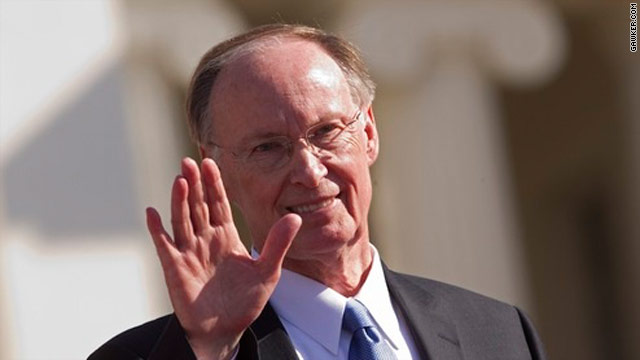
Governor Bentley waving to people who may or may not be "brothers and sisters."

Sometimes rolling your eyes just isn’t enough; sometimes you have to slam down the paper.

That fact alone makes me wish the news cycle of Alabama Governor Robert Bentley‘s inane comments on what constitutes “brothers and sisters” in a Christian context wasn’t on CNN.com.  For one, I can’t slam my computer on the desktop.  It harms my computer.  Secondly, I fear more people read CNN.com than traditional papers nowadays.  Which means there is one more example from the clowncar of the public Christian tumbling out.

But the fact that Governor Bentley doesn’t consider those who haven’t “accepted Jesus Christ as their savior” as a sibling doesn’t irk me half as much as the underlying theological claim.  Namely, that somehow accepting (defined loosely) Jesus Christ (again, loosely defined) as a savior (again…well, you get the picture) has some sort of theological bearing.

Before you stone me, have a seat to analyze that statement.

First, what does it mean to accept something?  Do you assent to it’s veracity?  Is it a mental construction, much like I accept that the number 2 is Real, and yet can’t produce the number 2 purely?

Or is something only accepted when actions flow from its internalization,  much like I accept that the fact that I have a goddaughter requires a response on my part to her faith life?

And if I accept a concept, how can I really tell if I have truly accepted it?  That question alone leads me to my next point: which Jesus Christ?

Is it the “historical Jesus,” the 160lb Jewish guy who walked out of Galilee?  Or is it the “Christ,” the a-sexual salvific presence that God has called us into communion with?  Or is it, perhaps, the Jesus as purported to in various Scriptures who occasionally knows who he is, but more often does not?  Is it the crazy Rabbi of John or the prophecy fulfiller of Matthew?  Which Jesus?

And if we do arrive at which Jesus to accept, we must then contend with how this Jesus is a “savior” and from what this Jesus “saves.”

Sin might be an answer.  But are we talking about the beautiful definition of Sin provided by Luther, this lovely navel-gazing, or are we talking about the sins of John Edwards (the theologian, not the politician…although perhaps the Edwards of the 18th Century might have a thing to say about the contemporary Edwards as well)?  Or are we perhaps talking about communal sin?

And if so, are we discussing Substitutionary Atonement (which, by the way, is a theory to which Christopher Hitchens seems to think all Christians subscribe…yet another error in his “rational process”), or are we talking about a moral example, or…

You see, the point is, I don’t think Governor Bentley would consider us siblings.  Because even if I were to say that I have “accepted Jesus Christ as my savior,” we would probably squabble over what it means to accept something, bicker over who this Jesus guy is (let alone how Jesus is the Christ), and blatantly disagree about what it means to be “saved”…half of my work has been saving people from being “saved.”

I say this not to provide a loophole for relativity, but rather to allow for complexity.

Governor Bentley talks of unification, he longs to have “brothers and sisters,” but only if they conform.  He talks of unification, but paints a picture of divorce.  Those who do not think as he thinks are cut off from him in a very real way.  Where is the sibling nature of a shared humanity?  Where is the sibling nature of a shared state of being?!

Gone.

And divorce of this sort is dangerous.  It’s fundamentalism.

It doesn’t take a radical jump from this type of thinking to a more extreme one.  Bentley’s is one version from the theistic side, so let us look at an atheistic model.  Consider this quote:

“I think the enemies of civilization should be beaten and killed and defeated, and I don’t make any apology for it.  And I think it’s sickly and stupid and suicidal to say that we should love those who hate us and try to kill us and our children and burn our libraries and destroy our society.  I have no patience with this nonsense.”

That is Christopher Hitchens from God is Not Great.  It probably goes without saying that he considers a good bit of the population to be divorced from himself as well, not brothers or sisters, because they assent to something other than his definition of reason or science (both of which are narrowly defined).

Two sides of the same coin.  Both turn my stomach.

Chris Hedges, in his work When Atheism Becomes a Religion, makes a great point concerning this coin.  He writes,

“The blustering televangelists and the atheists who rant about the evils of religion are little more than carnival barkers.  They are in show business, and those in show business know complexity does not sell.  They trade cliches and insults like cartoon characters.  They don masks.  One wears the mask of religion, the other wears the mask of science. They banter back and forth in predictable sound bites.  They promise, like all advertisers, simple and seductive dreams. This debate engages two bizarre subsets who are well suited to the television culture because of the crudeness of their arguments.”

Crudeness indeed. “Accept Jesus Christ as your Savior.”  “Accept Science and Reason as the answer to all of life’s mysteries.”

Both are as simple as can be…and both smack of divorce.

I’ve seen it in my own church as local congregations have splintered off into estrangement over sexual identity discussions.  Obviously “accepting Jesus Christ as your Savior” isn’t quite enough…you must accept the Jesus that dislikes gays.

Sigh.

Brother Bentley, sit down.

Brother Hitchens, sit down.

As Martin Luther so wisely said, “We all have gods, it just depends on which ones.”

And with that, I’ll sit down as well.

Credibile est, quia ineptum est

I’m a terrible shaman.

Despite people’s requests, I have yet to be able to heal a wound without the aid of ointments.  I haven’t been able to call down water from heaven like Elijah (and I question if Elijah literally did as well…that’s not the point of that story anyway).

Nor have I been able to exorcise supposed demons or even provide the “right answer” to life questions such as “Why did he have to die?” Oh, if there were an answer to that question!  Theologians can’t even agree on the significance of Jesus’ death, let alone the tragic death of Congressional staff workers, children, judges, or plumbers at a Safeway in Tucson.

And yet people come to their pastors expecting miracles only to find out that we’re poor miracle workers.  Oh, sure, I don’t deny that miracles happen…just not because of me.  Miracles are un-explainable, by definition.

Priests and pastors have become shaman for the religious in many ways, and its not like organized religion has done much to dispel this notion.  We preside over communion because of “good order,” and yet the magic words and the magic hands are the impression we give off…sometimes willfully.  That’s shameful.

Ordination is done for good order.  But a pastor is not ontologically different.  Any attempt to say they are is, I think, wishful thinking at its most benign and demagoguery at its worst.  The “change” of ordination is simply in title and training; I do not converse with God in a different way than you do.

And what is the change of ordination, really?

Cynically it is the certificate from the church body that declares you as having filled the requirements of an organized religion to teach and lead a branch of the organization.  A letter of call, a funny collar, the blessing from the head of the church.

Speaking from a place of hope, the piece of paper says reliably that an individual is competent in worship and counseling arts and that a community wishes them to lead them.

It says nothing about my ontological status apart from what any certificate says of any individual: “You exist enough to receive this piece of paper for which you have worked.”

And we ordain to retain good order, to have someone to lead, to match gifts and abilities with callings.  We do not ordain to make demi-gods…but I still get:

“Pastor, your prayers worked!” or “Pastor, will you bless us for protection?”

I will pray for you, of course.  I will ask for protection, much as my greatest desire for you is protection, safety, and wholeness.  But I do not have a Divine ATM with a secret code that was placed in my pocket upon ordination.  I do not have Divine influence for good or for ill.

Insight? Yes. Training? Yes. Gifts for communication, for listening, for instruction? Yes.  These I admit that I have, that have been identified as gifts of mine.

But magic hands?  No.

I’m sorry.  I’m no shaman.

I’m just a pastor…for what that means.

And what does that mean?

Well, if we’re sticking with the ancient vocations, I’d say that I’m most like a bard, a traveling storyteller.  I tell the story of God’s work through Jesus, and this seems to change things for people, for situations, for the world.

Does it work like magic? No.  But can I explain how or why it works?  No.  It’s beautifully empty, if you will; empty of definition.  Empty by definition.  And when we try to define it too tightly we end up with magic.

But even though I can’t explain how it works, it does work.

And I travel telling this story, and learning new ones, or pointing out new ones that I see in the people around me.  And then I tell those stories, too.  And it changes things.

But, dear people, it is not magic, it is not shamanism, it is not conjuring up a secret portal of connection with the Divine by which I and I alone (or others who hold similar degrees from human institutions that laughably claim we’ve “Mastered Divinity”) can traverse; a perverted Jacob’s ladder.

And that sort of thinking is indeed what drives people to abandon that search for God altogether, because we so easily let each other down and ourselves down.  Believing in magic gets you far enough to the curtain, until you pull it back and realize that the hands moving the puppets look like your own.

Suffer through another Hitchens reference.  He speaks of traveling through Sri Lanka and coming into a tight scrape between two warring tribes, one of which he was traveling with.  Using his English heritage and shining clothes, Hitchens is able to talk his way out of a tight situation saving him and his companions.  It is at this point that his companions surmise that he is, in fact, Sai Baba in temporary form.  Sai Baba, a psuedo-god of sorts who could perform miracles and raise the dead, had come back to make a visit in the eyes of the Sri Lankans.

Hitchens laughs at the concept.

I don’t blame him, though.  He laughs as a person who, upon looking at his hands, sees merely hands.  He cannot see that even those hands can be, from someone else’s perspective or from a teleological perspective, just what is needed in a hopeless situation.

Is this not the definition of salvos?

In telling the story he is attempting to squash the concept of religion.  Unfortunately for him, he propogates it.

Because, you see, he is not the point…and no one should mistake him for it: his hands, his clothes, his English heritage, or his witty speech.

I am not the point, either, even if I’ve mastered divinity…on paper.

It is absurd, yes, to believe that even these hands could be bringing about Divine telos.  But I have to believe it, not in a magical way, but in the way that I know traveling around and telling how Jesus’ hands, and yours, too, is doing the same thing.

Freud made his living off of pointing out transference.  In a way, so do I.  I firmly believe God is transfering Godself onto humanity daily, moment to moment, and I try to keep my ears and eyes attuned to it.

In that I’m a good bard.

But I can’t make it happen…which is why I’m a bad Shaman.

I’m OK with that.

On Doctrine: A Re-Traction

Lennie and George speak in broken conversation.  George telling, and retelling Lennie about the farm that they’ll have one day.  Lennie basking in the glow of this beautiful thought: rabbits of his very own.

But George cautions Lennie when it comes to cats.  Afterall, every farm has to have cats to keep rodents away…and to generally complete the requisite animal quotiant  to relegate a dwelling a “farm.”

“We’d have a setter dog and a couple  stripe cats, but you gotta watch out them cats don’t get the rabbits.”

And Lennie really only desires the rabbits.

“Lennie breathed hard. ‘You jus’ let ’em try to get the rabbits.  I’ll break their God damn necks.  I’ll….I’ll smash ’em with a stick.’ He subsided, grumbling to himself, threatening the future cats which might dare disturb the future rabbits.”

Steinbeck’s Of Mice and Men is a great study in literature…and a great study in people.  Lennie’s defense of that which he desires most, rabbits (or the feel of rabbit fur, or the idea of keeping fur around without breaking the necks of the furry, or whatever you deem his deepest desire is), is typical of people, I think.  In fact, I would say that this reactionary defense is probably the one lone characteristic in Lennie that is not affected by his cognitive struggles.

We defend most heartily that which we desire most.

I received a communication recently from a good friend and fellow pastor asking about the apparent dichotomy created in my first post between doctrine and dogma on the one hand and the Jesus movement on the other.  This friend was quick to point out that he wasn’t disagreeing, but simply wanted some clarification:

Didn’t the Jesus movement necessarily need doctrine (and the creation thereof) in the face of Donatism, Docetism, Arianism, and other such challenges?

The short answer: yes.  Of course.  In any sort of conception of a theological position there is never an “a-position.”  That is, even if you claim to stand nowhere…that is a stance, a place, a position.  The Jesus movement surely needed to refine, re-think, re-discover it’s position on the role of pastors, on the person of Christ, on the oneness and threeness of God…

Yes, of course.

But they are rabbits, are they not?  Dreams of a possibility that can’t yet be touched.

They’re not imaginary; they’re very real.  But they’re only real in so far as they point to the Real.  If they go further, they become no longer the symbols, the subject, of the desired, but the object of desire.

“I desire Trinity.”  “I desire Orthodoxy.”

Instead of, “I desire the God that the doctrine of the trinity helps me to wrap my mind around, if incompletely.”

Instead of, “I desire the God that orthodoxy (however defined) wants to show.”

We need a re-traction of doctrine.  Doctrine should not give something, but should point to something…point outward, further than itself.

Back to Rollins:

“The job of the church is not to provide an answer-for the answer is not a phrase or doctrine-but rather to help encourage the religious question to arise…the silence that is part of all God-talk is not the silence of banality, indifference or ignorance but one that stands in awe of God.  This does not necessitate an absolute ‘silencing,’ whereby we give up speaking of God, but rather involves a recognition that our language concerning the divine remains silent in its speech.”

We say too much in saying anything, and say too little in saying nothing.

But doctrine, for all its benefit, has become a rabbit.

“Believe this and be saved.  Attack this and I’ll smash you with a stick.”

This past weekend I watched religious TV on Sunday morning…the bed and breakfast had cable.  I flipped through four different religious programs.  Some were complete services, some were snippets of “teachings,” some were call-in shows.  Very different.

Yet very similar.

They each promised to give the viewer something.  One was “The Four Essentials of Faith.”  Another was, “How God can Help your Wealth.”  Fill in the blank here with some other infraction on the Second Commandment, as I am most certain that God does not want to help you, or me, get wealthy in any sort of way that we would identify as wealth…

And they each reminded me of why I’m a reluctant Christian.

These programs are so popular with their lovely memes impregnating the minds of views, both live audience and electronic audience.  And this is the mistaken, idolatrous promise (illusory as it is) of doctrine: it gives you something.

Instead, the real promise of doctrine is that it points to something…points past itself.

Please, Lord, save me from being saved and all the wonky ways we’ve devised to save ourselves from each other, from other doctrines, from, whatever it is we run from.

“The religious individual tears out all the idolatrous ideas that have impregnated the womb of his or her being, becoming like Mary, so that the Christ-event can be conceived within him or her-an event whose transformative power is matched only by its impenetrable mystery.”

Do we need doctrine?  In so far as it points us toward that which is beyond our knowing, yes.

Do we need to be saved from doctrine?  In so far as it has become our rabbits, mice, soft toys to pen, and hold, and pet, and defend with sticks, yes.

The Sighs of an Oppressed People

Sisyphus Crossing

I’m not a Marxist.

I do, however, like the t-shirt put out by Threadless.com of the “Communist Party.”  I imagine a Marxist has to drink a lot.

But Marx, in his wisdom (and foolishness…aren’t we all of that same coin currency?) wrote in Contribution to the critique of Hegel’s Philosophyof Right:

“Religion is the sigh of the oppressed creature, the heart of a heartless world, just as it is the spirit of a spiritless situation.  It is the opium of the people.”

The call to slough off the cubicles of the bourgeoisie, including the cubicle of religion, is the call to get sober, to get organized, to get…to get.

I took an interesting class the final semester of my seminary career.  It was entitled, “Engaging Violence through Theater” or something as equally ambiguous and enticing.  In preparation for our final practicum, the class assembled with some residents of a local retirement community to talk about the nebulous topic of “spirituality” to plumb the depths of using theater as a way to bridge gaps and rips in the societal fabric caused by factious religious tension.

In that circle of chairs were priests, Christians, Jews, agnostics, atheists, all defined broadly. With the exception of the advanced ages of all the attendees (minus the seminary students), there was quite a bit of diversity in the room in general.

Through the course of a mostly civil and enlightening discussion, there were a couple of peaks of agitation.  At one such peak a very irritated woman, a devout atheist, said something to the effect of, “I don’t need a god, and I think the implication that I do is insulting!”

Point well taken.

Directly following her statement, an elderly African American woman with a severe palsy, who had previously spoken of the faith of her parents in slavery, spoke up, “Listen.  From my tradition, we made a god because we needed a god.  If you don’t need him, don’t take him. But, leave our god alone.”

Point well taken.

Religion is the sigh of an oppressed people.

I like this notion of Marx however much I would like to divorce the opiate reference.  After all, if religion is an opiate of sorts, you’d think that “religious people” would be happier…another notch in Hitchens’ belt for pointing out that fact.

But that idea takes for granted that the point of religion, or even faith for that matter, is to impart happiness; a mistaken conclusion, I think.  For while religion or faith (not the same, mind you, but I’m not interested in dissecting each at this junction) might indeed provide for it’s adherents’ happiness, this is not the goal…at least not in the mind of the faith-laden individual writing this blog.

Kiekegaard, in Fear and Trembling, warns against looking at faith lightly.  He writes,

“But what no one has the right to do is let others suppose that faith is something inferior or that it is an easy matter, when in fact it is the greatest and most difficult of all.”

Difficult because, well, our oppressions…in their forms…cause us to scramble for the concrete: beliefs, forms, arguments.  Cause us to scramble for happiness, satiation, comfort.  Cause us to set goals that we can fill ourselves with until we get that “just full enough” feeling.

Yes, full of it.  It’s gotten.  And I do not discount the fact that many people use their beliefs in this way, whether theistic, atheistic, or somewhere in between.  It gets us that “just full enough” feeling.

But the Knight of Faith, a person whom Kierkegaard is admittedly not able to be, knows that, “faith finds its proper expression in (the person) whose life is not only the most paradoxical conceivable, but so paradoxical that it simply cannot be thought.  (They) act on the strength of the absurd.”

The strength of the absurd.

Why do we shy away from this word, “absurd”?

I’d like to think that it is probably the absurd that overcomes oppression in most situations.  In those situations when it appears that power, however its form, should win, we then and there find that power is in fact weakness because in the face of the absurd you are not dealing with elements of the same nature.

Like steel and fire: both powerful, but in different ways…one dissolving the other.

And yet, metaphors only go as far as they do.

Sigh.

Kant, in section III of the Philosophical Doctrine of Reason, relates an interesting bit on the sigh of humanity.  He notes,

“A member of the English Palriament exclaimed in the heat of debate: ‘Every man has his price, for which he sells himself.’ If this is true (and everyone can decide by himself), if nowhere is a virtue which no level of temptation can overthrow, if whether the good or evil spirit wins us over only depends on which bids the most and affords the proptest pay-off, the, what the Apostle says might indeed hold true of human beings universally, ‘There is no distinction here, they are all under sin-there is none righteous (in the spirit of the law), no, not one.”

Sigh.

And were religion, as an institution, meant to address this situation, to answer the moral question, we would end up looking at straw as well.  Indeed, I’m quite convinced that morality is not contingent upon organized religion.  And yet, organized religion is used by many in just this way…another way of getting full of morality, of seeking to point at the moral seed and exclaim, “I’ve found the tree of life.”

And yet.

And yet, we have never arrived at that thing that acknowledges the communal “sigh”.  You see, even with moral and emotional satisfaction being found outside of organized religion (and within), we still, as a whole, as humanity, sigh.

That seems absurd…to sigh even when it seems that all we are needing is at hand with and without systems.

And that absurdity, that, I think, is no drug.  That’s more real than anything I’ve found.  And it hints of faith…the faith that in chaos is indeed order.

Whether we are insulted by the insinuation that somehow God is necessary, or insulted by the fact that God may not be necessary, we fall under the same oppression.  We think we know.  Slavoj Zizek claims that the god we think we understand is like a Tamagotchi toy-our own creation which subsequently makes demands upon us.

Whether it is the god of Reason, like Hitchens, the god of Order, like Marx, or the God of Israel, like Swindol.

Perhaps the sigh, then, is the only appropriate response.  It is not a sigh of despair, nor a sigh of anguish, but a sigh of relief.

Relief in the fact that we don’t understand God.

That’s absurd.  Indeed.