Unknown's avatar

About Timothy Brown

A pastor. A writer. A dreamer. Occasionally a beer brewer.

Why I Dislike Mega-Churches (No, Really…)

willowcreek-megachurch_thumb

A colleague of mine wrote a blog post today entitled, “Why I Hate Mega-Churches.”

But it’s a bait-and-switch (which he admits halfway through).  He likes mega-churches and, by his writing (in this and other pieces I’ve read), would probably like to lead one or build one.

Fine, I guess.  But when I look around the world, one thing I don’t tend to say to myself is, “Gosh, this world needs another mega-church.”

Just saying.

A good thing about mega-churches?  They have a lot of resources to do a lot of good in the world (should they choose to).

The consolidation of people and money under one mega-roof creates mega-possiblities (a quick qualifier: if one does some math to subtract the ecological and sociological impact from a mega-building, mega-pastors, mega-salaries, mega-parking lots, and mega-messaging-machines that often tout a message that I’d consider more damaging than helpful, the possible good shrinks considerably).

A bad thing about mega-churches?

They’re mega.

No, seriously, I think that’s a bad thing.  The anonymity that’s possible by slipping into stadium seating creates this wonderful silo-effect for the participant.  It makes you feel like the mega-speaker in the mega-space is speaking directly to you…and yet you never actually interact.

And there’s no need to!  You have thousands of others around you who can take up their time.  Why should you?

Also, I imagine it’s a little difficult to talk about giving yourself up for your neighbor when you’re sitting on a building whose footprint is effectively the size of a neighborhood.  Can we talk about the God who empties for the sake of humanity if we’re looking to fill our lives with mega?  Is there no cognitive dissonance there?

And, from my office, another problem with mega-churches is that it’s mega-taxing as a pastor to care for so many people…so, often you don’t.  It doesn’t happen.  The voice of Sunday morning is not the voice of the hospital or home visit. That’s not always bad, mind you.  Lots of people can and should do such care.  But there’s something about knowing the people you’re serving, and knowing them well.

Listen, I feel taxed enough keeping 300 people’s issues, concerns, schedules, and needs clear in my head. The possibility of 10,000 people sends me into convulsions.

Another problem I have with mega-churches is that I think  mega-churches teach, implicitly or explicitly, that mega-blessings and mega-sized programs and mega-sized hopes and dreams are what fuels the world and counts for success in life.

And they’re not.

My colleague says in his opinion piece that mega-churches seem to understand that God is found amongst the poor and the lonely because of all the good work they do for the poor and the lonely with their mega-resources.

If I may be so blunt: bull.

Such romanticizing of mega-sized resources  and mega-sized programs for the poor is a mega-sized dream.

If it is true that mega-sized churches really did believe God is best found amongst the poor and the lonely, the pastors would lead the charge there by putting the mega-sized buildings up for auction or, as a little church here in Wrigleyville (Chicago) has done, take out the pews and allow the homeless to sleep on the floor during the week.

That’s mega-voice with a congregation of 40 on a Sunday morning.

Finally, I guess I’ll also say that I don’t like mega-churches because it just feeds the mega-monster in the American (not exclusively, but largely) personality that bigger is better, success is godly, and fancy is freeing.

Again, bull.

Jesus, who had a large following but just over a dozen main players, who had no job, no home, and by any modern measure of success was, well, not successful, gives me no indication that mega-churches are anything but mega.

They are no more church than any other size gathering, no matter how you spin it.  And despite my colleague’s parsing of “God in mystery” and “God that repels” as motivating factors for church size,  I don’t think the argument for building church empires lies in how people relate to God.

By and large I think the truth lies in how people relate to egos, to money, and to what typical “success” is supposed to look like.  This is why we have mega-churches: because we like mega for all the wrong reasons.

But, lets be honest, I don’t like many small churches, either.

Mostly because I usually find that they think they should be mega, and get depressed because they’re not.  Or because they say they don’t want to be mega, but secretly do.

I like churches who are honest about themselves, who they are, and confident that in God, they can do all they are called to do in this world.

Mega is so attractive on paper…

Funny.  Nothing about Jesus is attractive on paper.

“Obscenity” or “On Why I Discourage People from Writing Their Own Marriage Vows”

I do a lot of weddings. I have a young community that I serve; it comes with the territory.writing-wedding-vows

And marriage is certainly on the radar these days in the States as more and more parts of the Union have legalized the union of same-sex couples.

I support same-sex marriage.  I should just say that off the bat.  I support it because, despite what you might hear out there, the Bible doesn’t have a thing to say about marriage.  It has many things to say.  And many of those things run contrary to modern notions of marriage.

What I don’t support, though, is for couples to write their own vows.  Sometimes I allow it…with conditions.  But, by and large, I don’t support it.  I’ll just come out of the proverbial closet on this: I’m against crappy vows.

If you want me to use my special designation by the State to do marriages, I’m going to force you to do pre-marital counseling with me.  Each session focuses on a different aspect of life together (and life, in general): family, finances, friends, and intimacy.

(If you want to keep going with “f” words it become obscene).

Another “f” word, faith, is woven through all of those.  Faith as trust: trust in the Divine and one another.

The very first session, though, is where we plan out the ceremony itself.  We spend a little while talking about order and structure, and then we look at words.  I think words are important (as you may know from previous posts).

I think words are so important, in fact, that I don’t continue with my string of “f” words when describing the different pre-marital counseling sessions…even though it would fulfill my great delight in alliteration.  The “f” word we commonly associate with intimacy is anything but intimate.  And although it’s a curse word that spices up language (and I’ve been known to curse), let’s not kid ourselves: we don’t feel particularly intimate with the “f” word in a way that is lasting.

If we did, we wouldn’t use it so liberally.  It is an obscene word that we use to indicate that something is just that: obscene.

“Love” is by far a scarier word to say.   And intimacy is not obscene, it’s scary.

So, because words are important, I always take the couple through the various words that I can/will use in the service: the declaration of intention, the prayer of the day, the blessings.

And then we get to the vows. And at this point I usually say something like this, “Now, I’m going to give you some options for vows and I want us to talk about them.  I want you to use one of these options. If you want to write your own vows, that’s a possibility…but I need to see them before hand.  And we need to talk about them.”

In all honesty, most couples aren’t interested in writing their own vows.  They’d rather have someone write something for them on a day when they’re already more visible than they’d like to be.

But every so often a couple will want to write their own…and that’s when I do my damnedest to try to talk them out of it.

See, this is the thing: in marriage, you can’t just promise whatever you might want.  And because love is scary, we often don’t know exactly what we want…and so we just go with what we know.

And so much of what we know is just sentimental generalist crap.

A vow is something very specific.  I had one of my best couples consider writing their own vows because, as the future bride put it, they wanted to “publicly express their love for one another.”**   Of course they do.  But that’s what the marriage ceremony is in and of itself.

A vow is not an expression of love, and yet so many labor under the delusion that it is.

A vow is a sacred promise, a statement that you say in front of people who, if they are at their best, will hold you accountable to them.  A vow is you saying, “Hey everyone listen up! I’m going to pledge some very specific things to this person across from me, and I want you to hear them and hold me accountable to them.”

Expressions of love are not vows.  Expressions of love are emotionally based.  Vows are not emotionally based, no matter what popular culture tries to tell you.

Vows don’t come from your heart, nor do they come from your head.  Vows come from that place that exists somewhere between rationality and emotionality, because you keep them even when it doesn’t make sense, and even when you don’t feel like it.

So many couples want to write their vows in secret, apart from one another, and then surprise the other with them.  Such surprises are best left for other points in the service, or other times in the whole event of the marriage day.  If you write your vows in secret, how are you to ensure that you’re vowing the same things to one another?

One of you cannot vow to be with the other to the bitter end, while the other only mention staying together in sunny times.  That happens, you know.  I’ve heard self-stylized vows that had very little to say about “the worst that is to come.”

And that’s when the vow is so important!

In a day and age of choice, which is what we are in, I’m sorry…I’m not willing to provide you with this particular choice.  You cannot choose what you vow to one another in marriage; marriage cannot mean whatever you want it to mean.

And I know that may seem to trample on individuality, but I’m trying my hardest to impart one thing and one thing only on you two: this is important.  You will make of your journey together what you will, but I want to hear how you’re going to make the journey, and I’d prefer you use ancient words that people have leaned on throughout all of time.

Because for as much as this is about you and your love, it’s also about all of us who witness it.  Because you invited us to be there.  So I’m going to try to hold you accountable to these things to the best of my ability.

And I’m not one who believes a couple should “stay together at all costs.”  Sometimes an amicable divorce is healthier than an acrimonious marriage.  But, at the very least, can we not look at the vows you made and figure out where things went wrong?  Let’s not pretend that people divorce over irreconcilable differences.

We divorce because vows are difficult to keep and we have trouble living together in covenants.

And so, instead of vows, too often we just have statements of love and intention because other people are really really difficult to live with.

No one marries intending not to stay together; I know what you intend.  I want to know what you vow.  I want to know what you promise from that place between your head and heart, that place of deep yearning that leads people to come together in marriage in the first place.

I don’t think marriage is under threat because people of the same sex want to marry.  Any two people can make a vow; gender doesn’t have much to do with it.  Marriage is under threat because people, of any sex, want to marry on their own terms.

And so much of the church is missing the boat here, I think.  We shouldn’t stand against same sex marriage, we should stand against shoddy vows and a society unwilling to comment on them in a meaningful (read: not judgmental) way when they fall apart.

I think the Bible has many things to say about marriage, most of them absolutely foreign to our modern ears and notions about the institution.  The question for the church isn’t, “What does the Bible say about marriage?” It is rather, “What does our faith say about marriage?”

And our faith, the Christian faith, says vows and covenants are important.  This thread flows through both testaments.

I’m a reluctant Christian at times because, well, we’ve been silent on the vows…but have a heck of a lot to say about who should marry.

And to not see the difference?  That’s just obscene.

**The couple eventually decided to have some statements of love that they had written to one another read before the vows themselves.  This is a great option, I think.

The Pews Stink (and So Do the Chairs)

There is so much going on in faith communities.girl-church-pews_8615_990x742

…and so much NOT going on…

Arguments pop up all over the place in mainline protestant churches (mpc’s) over the stupidest things: where an American flag is placed, where a baptismal font is placed, whether guitars or organs are appropriate in services.

By and large I look at these things and think, “Holy crap, folks.  We have enough dysfunction in our families outside of the church doors, we don’t need more inside.”

No wonder the rumor is that mpc’s are dying if these are the things they’re arguing about (I say “rumors” because, well, every bush needs some pruning to grow so all the fervor over “dying” is just anxiety over “changing”).

But it is true: I’m not interested in inviting spiritual dysfunction in my life.  I think spirituality is about me and about others and about the Divine.  Too often churches focus on just one of the three (“God loves YOU…it’s all about YOU and YOU’RE decision to invite Jesus into your heart (the physics of which boggle the mind)” or “God loves your neighbor and you must, too!  Community is God and God is community!” or “You owe God a hell of a lot…don’t you feel bad about that?  Don’t you want to ask forgiveness and be shown mercy? God is angry…”)

I mean, there is a lot in all three of those statements, but by and large I find most churches choose one to focus on and ignore the others.  Like churches who only mention “God” or only mention “JEEEHESUS” or only mention “Slain by the Spirit!” and forget about the other two.

As if faith can be parsed so crassly and simply…

But there is one argument I’m wanting to have, but it’s difficult to have.  I want to have it for practical reasons and spiritual reasons.

In short: I hate pews.

They’re uncomfortable.  They’re difficult to navigate (bump your knee recently?). They force you to face only one way.  They’re immovable.

But…I also hate chairs.

They take a long time to set up.  They’re sloppy looking when set up.  Their style doesn’t lend itself to formal settings (no matter how you gussy up that seat cushion).

The church I serve is a cathedral-style church.  A bunch of chairs in there looks like a mistake.  The pews, though, are immovable and too close together and breaking.  But we can’t just do chairs because it wouldn’t work. One of my marginally-churched friends noted one day that they’d far prefer a pew to a chair if given the choice because your butt can take up the room it takes up instead of being confined to a chair seat.

Plus, I don’t want to do just chairs.  They stink just as much as pews.

I know it seems like so much dysfunction to chat about how you sit in a worship service, but I actually think how our bodies are will impact how our spirits and minds are.

Flexible seating disorients us enough that we subconsciously begin to realize that it’s not all about us, or all about our neighbor, or even all about God.  Different arrangements highlight different foci…and that’s an important thing to acknowledge about faith that the church usually refuses to acknowledge: at different points in life faith takes on different foci.

And then I came across St. Peter’s Lutheran in NYC.

St. Peter’s has short pews that can sit three to four butts…and are moveable.

You have to sit close, but you can change the seating.  You can’t think it’s all about you sitting so close (the benefit of a pew), and yet you can use them flexibly (the benefit of a chair).  You can turn them for intimacy at times that call for intimacy.  You can face them all in the same way for times that call for that, too (and, yes, sometimes that is called for, I think).

And for mpc’s that are “dying”, often times the struggle is how to build intimacy in a cavernous space.  When our second service at the church I serve was launched, this was one of the problems for my community.  We had about 30 folks in a space that seats 200.

What to do?

We took out some pews to make some gathering spaces.  And we gathered.  We gathered around the altar for communion.  We gathered in the aisle for prayer.  We gathered around the font for baptism.

We got our butts out of the seats and into flex space.

And, lo and behold, the intimacy created energy…and now we’re at the point where we can’t do that anymore because there are too many people.

…but I still want to.  How to do it now?  I think I have an idea…but it’ll be a hard sell.  Because we like things we can rely on.  We like things the same.

And if there’s one thing most people rely on, it’s that church is a place where they won’t be confronted with discomfort.  It’s all about them, after all.  Or all about community, so they don’t have to deal with their own crap.  Or all about God, and God loves them but is tired of their crap and the community’s crap.

It’s not about the uncomfortable tension that all three of those things combined causes, right?

Pews stink.  Chairs stink.  I want a hybrid.  I want flexibility.  I want to acknowledge that faith in post-modernity must be more flexible than most places want to acknowledge.  The conservative churches want you to think they’re linking you into unmoveable truth tenants, and yet most of them use chairs because they think they can anchor you theologically as long as you can move physically.

A nice bait and switch.

The so-called liberal churches suggest that nothing is fixed and all is fluid…and yet most use pews because you can change your religious views, but God forbid we change how we view the front of the sanctuary.

Mixed signals galore.

In truth, faith is a mixed bag of all that and a lot more…and how our bodies are can affect and reflect how our minds and spirits are (thanks yoga and t’ai chi for reminding the West of this).

So, how about we chop up our pews, un-anchor them from the floor, and start acknowledging something different in our lives? How about we ditch our silo-inducing chairs and start sitting closer so that our neighbor’s faith might affect ours? It might be uncomfortable.

But, hell, I’ve never been in the presence of God and felt comfortable…

If Church Websites Could Talk

Hi. Welcome to our siindexte. Do you like my stock photos of people who don’t go here representing a diversity that isn’t actually present?

Hi. Welcome to our site. Check out the “Our Beliefs” section where, when you scroll to the bottom, you’ll see that we think people who don’t agree with the tenets above end up in an eternal hell.  It’s at the bottom of the section…because we’re hoping you won’t get there.

Hi. Did you check out the “Our Beliefs” section yet?  Because it gives you the impression that you should believe those things, too.  And if you don’t, we’re going to ask that you start believing them, especially if you want to hold any sort of position in church leadership.

Hi! Did you notice how many exclamation points we use in our text?!  That’s because it’s exciting to be here!  Much like the YMCA!  Or any summer camp!

Hi. Welcome to our website.  It’s true that over half of the buttons on the site are “under construction.”  We just kind of figured that having a site up would be enough.

Hi. Welcome to our church website.  Does it look like we’re selling something?  It’s because we’ve commodified Jesus as something you lack and need, and something we sell.

Hi. Welcome to our website. Did you notice that there are no women in leadership?  Please ignore that…we think women are important, just not authoritative.

Hi. Welcome to our website. You won’t find it said on this page, but if you’re gay we’re not OK with that.

Hi. Welcome to our website.  Do you like the pic of the silhouetted person looking up over the body of water with arms outstretched as if they’re having a spiritual experience at the edge of the ocean?  It’s neat, right?  That’s what every service is like.  Promise.  It’s like standing at the edge of the world reaching up toward God.  Promise.

Hi. Welcome to our website. We’ve decided to use background music on every page.  It’s digitized hymns and not annoying.

Hi. Welcome to our website. We haven’t really updated the announcements since Christmas.  Yes, we know it’s July.  Just think of it as Christmas in July!

Hi. Welcome to our website.  We’ve listed the heads of all the different committees on the “About Us” page.  Because we want to show you all the things we’re going to lobby you to join and/or head up when the person listed there gets burned out.  It’s not confusing or overwhelming, is it?  Don’t you know what the Evangelism Committee does?  They partly designed this website…

Hi. Welcome to our website. We’re going to say that you can believe whatever you want to come here, but really we’re going to insist that we and we alone hold the truths of the world.  And we have answers.  Lots and lots of answers.  In fact, we’ve got it all figured out!  And most of the answers to your problems include the words “Jesus” and the phrase “Have more faith.”

Hi. Welcome to our website.  What makes us different from the other church meeting in that other gym down the street?  What makes us different from that other big-box church the next suburb over?  What makes us different from the other church who uses these same stock images?

Good question.


The Bible summary you may have wanted but never took the time to compile…or maybe you didn’t want it. Regardless, here it is.

This past Sunday at my church we started a new adult education series called, “The Bible: What is it?”images

I wanted to name it, “The Bible: What the Hell?” but my editors decided against that.

Overall, the first day of the class went OK.  I say just “OK” because, well, we talked about some boring stuff on Sunday like how the Bible came about. Basically some Bishops of the ancient church started proposing that there should be a particular “plumb-line” for what is acceptable to use as scripture…mostly in reaction to some interesting suggestions (they called them “heresies” but, whatev) from some other Bishops like Marcion.

So in the year 331 they arrived at what we commonly call our Biblical canon (“canon” is a fancy word for “ruler”…as in, what something is measured by).

So the Christian Bible (of the Protestant flavor) contains 66 books with histories, myths, poetry, wisdom writing, prose, letters, and little snippets of other stuff here and there (like apocalyptic writing).  How did they decide on the books they would allow?  Well, for the Older Testament they took books being used in Jewish circles already.  They were a little bit easier to agree on.

The books that ended up in the Newer Testament were not so easy to agree on.  And, here’s something to chew on, the early church didn’t ask if God had “divinely inspired” each book before they put it in the canon.  They wouldn’t have been considered “Bible believing” by modern evangelical standards.

Instead they asked questions like, “Who wrote it?”  Because books that were written by people who may have had access to the Christ…or people who had access to the people who knew the Christ…got first dibs.

But they didn’t stop there, they then asked, “Is it any good?”  In essence, were people reading it widely in communities of faith?  And if so, were they gaining some spiritual food from it?

They also asked, “Is it weird?” *  Or, better put, “is it consistent with other things we’ve heard about Jesus.”  This is why the Gospel of Thomas and the Gospel of Mary and the Gospel of Judas aren’t included in the common canon.  I know, you’ve heard the rumors that they were excluded because they lifted up women too much (although, in the Gospel of Mary she turns into a dude at the end…so…yeah), or because they were suppressing gnostic voices or, what have you.

And, sure, some of those theories might have some credence. After all, when you get a bunch of men used to systems of patriarchy in one place, you’re going to get something that fits well within that system.

But I don’t buy the vast conspiracy theories about the formation of the Bible.

And finally, as a person of faith, I believe that God’s breath (the feminine ruach in the Old Testament) moved through this whole thing, as incomplete and laden with patriarchy as it is.  Because God always works with broken things.  And there are certainly parts of this process, and parts of the scriptures and the way they’re interpreted, that are very broken.

I’m not one who worships the Bible.  I worship the one the Bible points to.  I don’t think that’s true for all of Christianity out there.  And if the ancient church didn’t worship the Bible (heck, it didn’t even have a Bible for 200 years after Jesus died), why would we assume that to be Christian you have to believe the Bible is “inerrant” or “infallible”?

But, for those of you wonder just what is in the Bible, here’s a rundown of it’s books with approximate dates of authorship according to scholars, much of which is taken from the Lutheran Study Bible (Augsburg Fortress Press/Minneapolis, 2009), as well as a brief description of the book/context/author.

This is just an overview…people study this stuff for years, remember.

OLD TESTAMENT

The Pentateuch (first 5 books authored by at least three different traditions, probably 4…and with edits, maybe more)

Genesis: written by a number of authors and compiled over more than five centuries, completed while Israel was taken over by Babylon (587-538 B.C.E.) Talks about the common connections of the people who would be known as Israel. Note: Not written by Moses.

Exodus: Meaning “exit,” this book tells the story of Israel leaving Egyptian slavery (perhaps around 1250 B.C.E.?). We find Israel mentioned in a stele erected by Pharaoh Merneptah, the son of Ramses II. Note: Not written by Moses, either.

Leviticus: About offerings, rituals, and some other rites partly compiled during Israel’s monarchy period (1000-600 B.C.E.), but also containing some concerns of the community post being taken over by Babylon.  Written and redacted over centuries. Note: Moses probably couldn’t write if historical accounts are true.

Numbers: Probably to account for people who could serve in the armies.  Continues with the stories and themes begun in Exodus…with a whole lot of counting and “so and so begat so and so” in there. Note: Moses?  Nope.

Deuteronomy: Written around 700-640 B.C.E., this book is another one about rules and relationships, like Leviticus, but with some significant prose and changes to previous laws/understandings.  It was hoped that, if Israel followed the rites and laws of Deuteronomy, they wouldn’t be overtaken by foreign armies because God would protect them.  Let’s just say, that didn’t happen.  Note: Still not Moses.

Historical Books

Joshua: This tells the story of Israel settling down again in the promised land of Canaan after the Exodus.  It’s written about the history of the 13th Century, BCE, but was actually written and completed sometime in the 7th Century BCE.  Not exactly eye-witness accounts, here. The battle of Jericho is one famous story in Joshua…although in an archeological dig we didn’t really find any walls around Jericho.  Just sayin’.

Judges: Written about the time between 1200 and 1020 BCE, this book records the people who watched over Israel (the “Judges”) before there was a king/queen.  This book was put together when Israel was conquered by Babylon, between 587-539 BCE.  Coolest judge? Deborah.  Want to know why?  Read the book.

Ruth: A book of inspiration taking place between the period of the judges and the kings/queens of Israel.  May have been written by a woman after Israel returned from Babylonian capture!

1 & 2 Samuel: Written by many people collected and edited over time, mostly after 721 BCE.  These two books were only one book originally, and speak of the beginning of the monarchy period for Israel.  King David is the major character here.  And Bathsheba.  And David’s harp.

1 & 2 Kings: The author of this book loved the book of Deuteronomy, and records the Kings of Israel (much like 1 & 2 Samuel) in an effort to say that Israel kept being conquered by people because they didn’t follow the rules of God.

1 & 2 Chronicles: Originally one book, Chronicles was written by an author in Jerusalem sometime after Israel had returned from Babylon (539-532 BCE).  It’s main thrust is to give a people who had been without a home (in exile in Babylon) a connection back to Jerusalem.

Ezra: May have been written by the same author as Chronicles (or maybe not), it was completed somewhere around 400 BCE scholars think, and it tries to assign meaning to the events that had happened the previous 300 years.  Much like Chronicles, as the people return from exile in Babylon, they try to distinguish themselves from the surrounding people (Samaritans), while re-claiming a connection to Jerusalem.

Nehemiah: See above…Ezra-Nehemiah were one book until the 15th Century.

Esther: A book with Persian influence! Esther is a fun book about idiotic leadership, there is no direct mention of God, but it speaks of Persia’s power of the Jewish people after they left Babylon (Persia conquered Babylon and let the Jewish people resettle where they wished…and many went back to Jerusalem).  Grab some stuffed grape-leaves and read this book.

Wisdom Writings and Poetry and Songs

Job: A story whose date of composition is unclear.  Maybe the 6th Century BCE.  A meditation on the problem of suffering, it is a difficult book and not a history, but rather a story that raises good questions about the human condition.

Psalms: The ancient songbook of the church 150 units long.  It was composed by many different authors.  There are Psalms for help, comfort, thanksgiving…you name it, it’s here.

Proverbs: Connected with King Solomon, it was finished somewhere around the 4th C BCE and is largely intended to provide practical advice and wise saying.

Ecclesiastes: One of the youngest books of the Old Testament (maybe just 3oo years before Jesus was born), it is narrated by an aged person called “The Teacher” and is a personal memoir to share thoughts that he has learned about the difference between what is fleeting and what is fulfilling.  It was once said of Ecclesiastes that, if you ever needed a reason to hate yourself, read this book.  I don’t see it that way, but I get the sentiment.

Song of Solomon (Song of Songs): Written in the 4th or 3rd Centuries, we don’t know the author…but it wasn’t Solomon.  It has a strong female voice, and may have been written by a woman.  It’s a series of scandalous love poems…and should be read immediately.  Because we all need some scandal in our lives.

Prophetic Books both Major and Minor (“big deals” and “littler deals”)

Isaiah: Big deal.  You know much of what’s in here if you’ve been around the Bible at all.  It tells of the promise of a “Messiah” (anointed one) and was compiled by several prophets and editors over many many years, from around the 740’s BCE to 538 BCE…basically much of Israel’s monarchy to when they were taken over by Babylon, to when they started to return to Jerusalem.  Lots here (not the person, “Lot,” he’s back in Genesis).

Jeremiah: Another big deal. Jeremiah lived from 626 BCE-586, and many of his sermons are in writing in this book.  His secretary, Baruch, wrote some of the end of Jeremiah, and we don’t know who wrote the last chapter but it certainly wasn’t either of those two…

Lamentations: If you need a reason to be sad, read this book.  It’s 5 poems about Babylon destroying Jerusalem’s much beloved temple in 586 BCE.  We don’t know who wrote it, but they sure were sad.

Ezekiel: Ezekiel was a priest during the time when Israel was taken over by Babylon, and had some prophesies for his fellow exiles.  It started around 593 and extended to 571 BCE.  It’s obviously edited by someone, but we think most of the writing comes from the priest himself.

Daniel: A book of stories and visions, Daniel contains some of the oldest material we have as far as the Old Testament goes (including some cool apocalyptic writing).  Written in Hebrew and Aramaic (in different parts), main characters are Daniel (of lion den fame) as well as Shadrach, Meshach, and Abednego.  And a furnace.  This book covers a long period of time, from the Babylonian captivity all the way to Alexander the Great (320’s BCE)!

Hosea: A prophet from 769-697, Hosea prophesied during 5 of Israel’s kings in the northern half of the kingdom.  His words were shared through oral communities, scholars think.

Joel: Written after the Babylonian exile, scholars think Joel was composed sometime before 348 BCE and is focused at an Israel trying to rebuild itself.

Amos: He’s a pissed off prophet who said his share around the first half of the 8th C BCE.  See how these prophets aren’t chronological order?  It’s confusing, right?  Mostly just to us…

Obadiah: Written (most likely) after the destruction of Jerusalem by Babylon, Obadiah’s vision is of an Israel sad over the loss of their kingdom and longing for good news from God.

Jonah: A short story, probably what we moderns would call a “myth,” it’s set in the time when the Assyrians had taken over Israel (720’s BCE) and is a tale about what you should not do if you’re a prophet. Main characters: Jonah and a big fish.  Oh, and God.

Micah: Micah foretells doom for an Israel (split into a northern and southern kingdom) who is living a little too comfortably in the shadow of Assyria.  It appears to have been written in the mid 8th C BCE.

Nahum: A group of oracles from around 612 BCE, his sayings celebrated the fall of the Assyrian capital city of Nineveh.  It’s supposed to be a story of good news.  The bad news is that, after Assyria fell Babylon took over…and things got bad again.

Habakkuk: A prophet around 600 BCE, this book is a book where a prophet pleads on behalf of God’s people not to be squashed between Egypt and Babylon.

Zephaniah: Probably written in the second half of the 7th C BCE, Zephaniah begins mad but ends peacefully assured that God will prevail over the threatening power of Babylon.

Haggai: Written after people had returned from exile in Babylon (in 520 BCE), the community of Israel begins to feel some difficulties in rebuilding both community and the temple.  Haggai provides encouragement for a community in depression.

Zechariah: A contemporary of Haggai, this author (and book) offers a vision of an Israel beautifully reformed and reconstructed.

Malachi: Not the scary dude from Children of the Corn, this book asks the people returning from exile in Babylon to become re-devoted to God and use the priests to aid them in leadership.  Probably written after the temple had been rebuilt (515 BCE).

NEW TESTAMENT

The New Testament does not “pick right up” where the Older Testament left off.  There’s a number of gap years.  Rome is now the major imperial power (after Egypt, Assyria, Babylon, and Persia all had taken turns).  And then Jesus shows up in an Israel controlled by Rome.  The New Testament starts off with stories about Jesus.

The Gospels

Matthew: Probably written in the 80’s by someone who had read the gospel of Mark.  We call it “Matthew” because that name became associated with the book somewhere in the early 100’s.  Did “Matthew” the apostle write it?  Very doubtful.  It appears that the author of Matthew also uses a source that scholars call “Q” (short for quelle or “pen”) to provide some Jesus stories.  The magi are in Matthew at Jesus’ birth, but no angels or shepherds.

Mark: Oldest gospel book, written in the 60’s or very early 70’s.  Probably was written by the same “Mark” talked about in the book of Acts, and may have had some eye-witness accounts of Jesus.  Jesus is the most human in this Gospel.  In Mark there is no birth in Bethlehem.  Jesus just walks out of Galilee.

Luke: Probably written between 80-90 CE, this writer also had read Mark (because he, like Matthew, copies parts of Mark word-for-word), and also had access to this other document we’ve called “Q”.  Did someone named Luke write it?  We think it may have been.  It is clear from it’s style that this gospel was recited and performed orally, and is the first half of a longer story (the second half is the book of Acts).  Here we have angels and shepherds in the birth story of Jesus…but no Magi.

John: The gospel of John doesn’t fit well with the first three.  It’s thought to be the one written the latest (90’s), and Jesus dies on a Thursday in John…which doesn’t line up with the other three.  Jesus is also most fully seen as divine in John, as he knows what’s coming next.  That being said, it is included because a large number of people were using this gospel book when the Bible was compiled, and although it contains some unique material, it is not out of character for Jesus drastically.

Books about the Church

Acts: The second part of the Gospel of Luke, Acts picks up where Luke lets off and describes the formulation of the early church.  Probably written in the 80’s CE.  Main characters: Paul, Silas, the early church, the Holy Spirit.  You know, the usual.

Letters of/attributed to Paul

Romans: Written by Paul to the Christian community in Rome (context clues!), sent in the mid-50’s CE.  Paul had already been a missionary for around 20 years. Paul entreats the Romans to live peacefully between Gentile Christians and Jewish Christians

1 Corinthians: Written in the early 50’s CE, this letter was written to the church in Corinth by Paul to heal a division in the church.

2 Corinthians: OK, we’re pretty sure this is actually like three or four letters all put together by someone other than Paul from letter fragments of Paul’s.  There is no agreement here, though, on the subject.  It was written sometime after 1 Corinthians and pieced together (if that theory is true) much later.

Galatians: Written by the apostle Paul sometime between 50-55 CE, about 20 years after Jesus’ death and resurrection, to the church at Galatia.  Again…context clues.  The big fight in this letter that Paul tries to resolve is whether or not Christians had to follow Jewish practices.  Verdict: nope.

Ephesians: One of the coolest letters in the New Testament, it’s almost certainly not Paul who wrote this book (though it claims he did) because the style and verbage is not very Paul-like.  It could be a disciple of Paul’s, though, as the central ideas are echoes of Paul’s other letters.  BTW, it was pretty common for a disciple to write under their teacher’s name…so, who cares if Paul didn’t write it?  It talks about the Cosmic Christ and all of creation being redeemed and is just so freakin’ cool.

Philippians: A letter to the first Christian church in Europe from Paul and Timothy, this is a happy letter and it’s clear that Paul loves this little church.

Colossians: We do not know who wrote this letter. It may be Paul; it may be someone else.  It’s got some not-so-very-Paulish theology in it.  It may have been written in the 50’s or as late as the 70’s.  But it is written to the church of Colossae, and we don’t know much about that church because a big earthquake destroyed much of the area.  Regardless, the author had never been there, but is writing to talk to them about Christian teaching and living.

1 Thessalonians: May be the earliest letter, from the early 40’s CE!  It is Pauline, and is one of the oldest writings that we have of the early church.

2 Thessalonians: Probably not written by Paul, this letter writes again to the church at Thessalonica.  It may have been written by Timothy or Silvanus (Paul’s compatriots), but probably not by Paul.  It’s a letter of encouragement for the church.

1 Timothy: It may have been Paul’s letter…or maybe not, and is relatively late for the letters (80 or 90 CE).  Paul was already dead by then.  It’s obvious the author respected Paul…as he went on to write 2 Timothy and Titus…but it was probably not Paul.  Remember, just because it says it’s from Paul doesn’t mean it actually is.  This didn’t cause the ancient church much trouble, and they knew about it…you don’t need to be troubled by it, either.

2 Timothy: Read above.

Titus: Same dude who wrote the letters to Timothy, this letter goes to Titus (a fun name, right?) on the island of Crete and includes general instructions for the early church.

Philemon: I love this little book!  It’s probably from Paul and written while he was in jail about his friend Onesimus who had a falling out with the church of Colossae that met in this man Philemon’s house.  It’s a book about reconciliation and love.

Other Letters

Hebrews: This book is an odd duck in the New Testament.  It’s written in elegant Greek (much more elegant than even Paul’s writing), and probably is from the 70’s CE.  Hebrews is all about interpreting the Older Testament for the current times, and holds up the cross as central to understanding God’s work in the world.

James: Martin Luther hated this book.  It may have been written as late as 130-140 CE, this letter is dedicated to James the leader of the Jerusalem church, and speaks heavily of right action (rather than right belief…which is why Luther disliked it so much).

1 Peter: Not written by the apostle Peter, but probably dedicated to him.  It was also not written to one specific church, but most likely to any/all churches of the time.  It’s focus is on new life and living hope through Jesus the Christ.

2 Peter: See above.  Same sort of deal except the author now seems to feel his death coming soon.  All sorts of talk about “false prophets” and “false teachers” which has often sent literalists smelling false prophets under every rock…

1, 2, 3 John: We don’t know who wrote these books (may be referred to as “the elder” spoken of in 2 John), but we think that all three of these John books are written from the perspective of a faith community that relied heavily on the Gospel of John.  Time period is unclear, though certainly after the composition of the Gospel of John (90’s)

Jude: We don’t know who wrote this or who they were aiming to write this letter to, but we think it was written in the late first century.  Again, “false teaching” is a major theme in this book (like 2 Peter).  You can imagine that would be a central theme because these Christian communities were so scattered that different traditions and ideas popped up in different places.

Revelation: This book almost didn’t make the canonization cut!  It’s not written by the John who wrote the gospel, nor the John who was the apostle.  It is a type of writing known as “apocalyptic,” which means it uses stark imagery to talk about modern themes.  That’s right, it’s not about the future or the “end times.”  It was about the current times of this John writing at the end of the 1st Century (or maybe even later).  It does not, repeat, does not tell the future.  But it sure does say a lot about Roman imperialism and the Christian call to fight against bowing down to nations rather than to God.

So, there you have it.  For all of you in the Bible course, we’re going to be talking about the history of the Bible this Sunday: how it’s been read over the centuries, by who, and for what.  It’s a much sexier topic than canonization, I think…

Lonely footnote:

*Taken from “Animate: Bible” (Augsburg Fortress Press/Minneapolis, 2013)

Please remember: these dates and much of the descriptions were gleaned from a number of sources over the years (from my brain), but chiefly from The Lutheran Study Bible which is a great resource.

God’s Work? Our Hands.

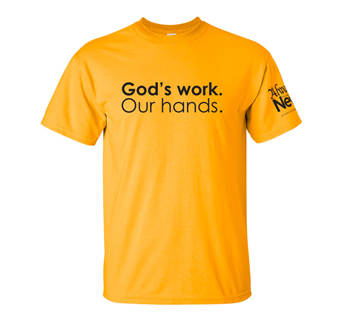
This last Sunday my denomination, the Evangelical Lutheran Church in America (ELCA) had a nation-wide Sunday dedicated to service in GodsWork-OurHands_Tshirthonor of our 25th anniversary as a church body.

Good stuff happened all over the country as people took to the streets to do acts of kindness and charity.

And we did this all the while knowing that acts of kindness and charity are poor replacements for systemic change and activism.

Really; that’s just the plain truth.  Systems don’t change because I’ve handed a person a sandwich.  Systems change when I press back against a culture that creates the have-nots in the shadow of the haves.

But there is something to be said for the stop-gap measure that passing out a sandwich can do.

I know this because this last Sunday one of our service offerings was what we called “Operation PB&J.”  We made about 100 sandwiches in our church basement utilizing people’s gifts of peanut butter, jelly, and bread, and then a few of us took the train downtown to pass them out to whoever wanted one.

We passed out 100 sandwiches in just under 2 hours, and we walked about a mile and a half.

I want you to pause to let that sink in.

When we got of the train at Chicago and State (just West of the north end of what is known as the Magnificent Mile), we started looking around to see who might be hungry.  This is trickier than you might think because, believe it or not, hunger is not always on the faces of people you pass.  All sorts of questions raced through my mind.

What if we approached someone who was offended that we thought they were hungry?  What if someone asked us for more than sandwiches (which they did)?

We were also wearing our t-shirts that prominently said “God’s Work. Our Hands.” and a part of me worried that people would mistake us passing out sandwiches on busy Michigan Avenue with actually doing “God’s Work.”

In one way it is; people need to eat.  In many ways it’s not.  Charity often just props up a cycle of degredation where the haves can give to the have-nots and feel like they’re doing good.

This all weighed on me.

But as we passed out sandwiches on the street, what was God’s work more than anything were the interactions that we had while doing it.  I’m so impressed with our Youth Director, Brian.  After passing out every sandwich he’d tell me the name of the person he gave it to, and often something about their situation.  And they were sure to know his name, too.  And some of them even got his church card and an invitation to our community.

This, truly, was God’s barrier-breaking work.

And we met Marcus on Lower Wacker Drive, the underbelly of opulence in the city of Chicago.  Lower Wacker is literally feet below the Magnificent Mile, and yet there is no magnificence to behold.  When I came upon Marcus he was telling some teens in a shiny white Lexus that they needed to get back up to the main level.

“Hey, can I interest you in some sandwiches?” I said.

“Sure, man.  I’ll take two.” Marcus said.  No problem, I had plenty.

And then my two companions met Marcus and we asked him where we could pass more out.

“If you go just north of here and around the corner, there’s a whole strip of people over there.”

So we gave him thanks and followed his directions.  And sure enough, we came upon a small village of men and women living on Lower Wacker with shiny Trump Tower visible just over the river.  Some were asleep, some were chatting, some were doing business.  And we started passing out sandwiches, one after another, sometimes three at a time.  And we put them by the sleeping heads, and on some cardboard mats whose owners were off doing other things in the city.

And as we walked out onto the River Walk, we took note of the vast difference between the shopping district of the Magnificent Mile and the shopping district of Lower Wacker.

God’s work?

God’s work would be to flatten those economies in a way that changed life for everyone.  And I do mean everyone.  Because it would change the life of the Mag Mile stores and their patrons (and I’m one of their patrons at times) as well as the patrons of Lower Wacker.

For instance, in most of those stores on the Mag Mile you’ll see a sign that says, “Bathroom is for Patrons Only.”

I get that.

But then you have parts of Lower Wacker that absolutely reek of the acid-smell of urine…and some of the River Walk patrons noted it as they passed, wondering why people would pee there.

Where else is there to go in the place where feet separate the lives of the haves and have-nots, and yet you’re not welcome to utilize the city sewer system through a flush toilet?

Bathrooms are for people with money?

No, bathrooms are for people with functioning biological flush systems, and yet we put a value on even our ability to flush our bodies these days.

That’s symptomatic of an unequal economy.

There would, of course, be many more changes.  Perhaps the lights wouldn’t shine so brightly, and the rents wouldn’t be so high because there would be less money circulating as more hands had some rather than fewer having more.

Something inside of me says that’s God’s work more than our passing out sandwiches.  And yet, I know we did good.  We did do God’s work on many levels…and failed on others.

You realize that life is a mixed bag when you have the resources that allow leisure time enough to reflect on it.

As we walked up Dearborn toward Chicago Avenue, we met a mother and two children.  She had a nice stroller, and the kids were dressed decently, and you probably wouldn’t know she was hungry just by looking at her.  On a whim, though, I said, “Can I interest you in sandwiches?”

She smiled widely and said, “Yes, please!”  Her little boy and little girl introduced themselves to us, Jayda and Jayden.  We had planned on going into the lobby of the Chicago YMCA to pass out the rest of our sandwiches, about a dozen, but this mom happily took the rest.  We all introduced ourselves and she thanked us heartily.

As we walked away Brian said something that I think was really true, “I think we just made her week a little easier.”

Yeah.  I think we did, too.  That’s God’s work done with my hands on Sunday, September 8th.

But what am I prepared to do to make her life easier? That’d be God’s work done with my life…and I’m sometimes a reluctant Christian because Christians continue to confuse that reality.

Syria and Catch-22’s

The politician in me is worried aboubombs1t the United States (and the UN’s) response to Syria’s (alleged) use of chemical weapons.

We target military sites…or so we say.  We try to do “surgical strikes.”

But I’m a pacifist; these things scare me.

The Christian in me isn’t worried, though.  The Christian in me, the person of faith in me, is absolutely terrified.

I’m terrified at the video on CNN of the child being doused in water to wash off the chemical agents as he convulses (even if this video is not authentic to the current situation…although it appears it is…it is absolutely horrifying).

I’m terrified that many times we target “military sites” and hit schools and children and people doing business.

I’m terrified that a “surgical strike” actually means we’re just cutting out another slice of our humanity in a failed attempt to show power.

I’m afraid that non-intervention will just result in having to ignore continuing genocide while we sing Christmas carols again this year.

I’m afraid that non-intervention will be a stain upon our moral conscience.

I’m afraid that intervention will be a stain upon our future as the wrong people get the wrong weapons that we manufacture, which means that the wrong people will get paid to continue building weapons with no other purpose than to kill other people, which means that the war machine monster gets fed instead of starved, which means…

Death. A lot of death.

I come from a faith tradition that lifts up a “two kingdoms” doctrine when it comes to the world.  Essentially it asserts that the world is ruled by God, and the world is split into two kingdoms.  The spiritual kingdom of God is ruled by grace, while the kingdom of humanity is ruled by rightly ordered governments and principalities (an extension of God’s Law)*, and we live in both simultaneously.  First of all, I’d argue that Martin Luther never fleshed out this so-called doctrine, and that attempts to do so by scholars are largely just defenses for their own political ideals.  In short: I don’t buy it.  It makes me a bad Lutheran, I guess.  But I think it makes me a good Christian, even if I am so reluctantly.

Secondly, if you show me a rightly ordered government I’ll ride my unicorn over the moon.

I think people of my generation (I’m on the millennial bubble with a cursed 1980 birth year) look back at World War II and largely figure it was “just war.”  But when I listened to (the one time) my grandfather talk about flying over occupied China and being absolutely piss-pants scared about what he was doing and how he was doing it, I’m not sure I even know what “just war” means no matter what metric you put in front of me.

I know people shouldn’t be slaughtered.  I also know people shouldn’t fly planes built to kill other people.

I’m terrified because I care about life, and this is a catch-22.

And a church that is radical enough to understand that only God can redeem in any sort of lasting way is a church where our soldiers and our conscientious objectors are both honored and prayed for, and where our loudest shout as people who claim to be of God is one for the catch-22 nature of this whole damned business.

If life is sacred, that means all life.

And I’m typing this as I hold my son, and I see my son in that little boy being doused in a futile attempt to save his life. And I know he’ll die. And I know we can’t allow these things to go on, and yet I also know that fighting violence with violence only perpetuates violence.

And so…yeah, there we are.

And I am wondering what the church will say about this.  Drumbeats for war are antithetical to the message of Jesus.  Watching innocents (or even the guilty, I would argue) be poisoned and killed without some sort of action is antithetical to the message of Jesus, too.

But real sacrifice for the other…the heart of the message of Jesus…who is really willing to do that?

I just wanted to be honest here. This is what this reluctant Christian is meditating on today.  And I know we will, and should, do something.

I just want to lament about that “something”, whatever it ends up being, and stand with Rachel as she weeps for her children.  And your children.  And my children.  And Syrian children.

All of us.


*Many thanks to Pr. Mark Williamson in encouraging me to better define and make more distinct the modern formulation of this “doctrine.”  While I don’t agree that it is a doctrine, I shouldn’t cut it short in deference to brevity.

I’m an Addict

I’m addicted to mapl2-imin1-20y cellphone.

I’m addicted to Ted talks.

I’m addicted to social media.

I’m addicted to being connected.

I’m an addict.  I imagine a not-so-distant future where we have TA meetings in churches.

I’m serious.

When I forget my phone at home, I feel naked.  Like missing my drivers license before a cross-country trip.  Or like forgetting my kid at the grocery store.

No really; the anxiety can be that bad sometimes.

It preoccupies my mind. No, that’s wrongly said.  It doesn’t preoccupy my mind.  It colonizes my mind.

I’ll call my wife from the middle of Target to find out where she is when we’re in the same store.

You laugh.  I laugh.  But it’s serious. It’s like laughing the way we do when a friend describes a drinking escapade that is obviously indicative of an issue.  It’s funny and we laugh because if we were to take it seriously we’d have to change our behavior.

And this is the thing: I know it’s a spiritual condition.

It’s a spiritual condition because my phone and my ipod and my computers prevent me from being present.  Oh, sure; I’m up to date.  I read the New York Times like it’s nobody’s business.  Back articles galore.

And I know exactly where folks are because of Twitter and Facebook and…

Except myself.  I’m not sure exactly where I am in those moments.

Because physically I’m in a room with my family, my boy babbling on the blanket spread out on the floor.

But mentally I’m in cyberspace.

And I don’t want to be.

The thing is, I don’t think that Christianity is talking about this addiction very much.  In fact, I often am encouraged in my addiction by other pastors and professional leaders and leadership gurus who encourage us to “up our presence” on social media, on web blogs and chat sites.

Our Klout scores must rise…

And as it rises, my spirituality falls.  Because I’m never present.

Sunday morning can be a time of presence, of course.  As I ring the meditation bell after the scripture readings at services, I fall into the present in a way that really is transcendent.

That’s the irony that I find in worship: it grounds me in the present by lifting me beyond myself.

And I pray for it at other times in my life.

But the bell of a new text calls me from my present into the anxiety of the digital words on my screen; a different scripture reading of sorts that lays claim on my time and attention.  And I worry some about introducing technology into sacred spaces.  I’m not totally against it…but I have mixed feelings about it.

And it has nothing to do with “old” and “new” styles of worship (whatever that means).  It has to do with breaking an addiction.  And I know I rarely listen to any one thing anymore.  Listen; really listen.  I know that meditation is pretty much the only thing I do in a day that doesn’t involve a computer chip (except that I do prefer old-school books to Kindles and Nooks…though I usually am listening to my ipod when I’m reading).

I don’t think we’re doing this very well, church.  We may be encouraging our people’s addictions.  I’m of mixed emotions on it.

I’m not saying the church should be anti-technology; I’m a blogger after all.

But, by God, we’re very much reinforcing the terrible addictions of so many by our deafening silence on this spiritual issue.  And it’s not only making me a reluctant tweeter, it’s making me a reluctant Christian.

And it’s killing me.  Killing us, I think.

Is technology to blame?

It’s interesting to me that technology intends, by profession, to connect the world, and yet by doing so it cuts us off from those right in front of us and around us. And I’m not complaining like the octogenarian who wishes things were “like the old days.”  The “old days” weren’t all that awesome from what I can tell.

I’m really just wondering if we should do something just because we can.

But, I digress.  No; technology is not to blame.

It’s my need to know. To constantly know.

That is to blame.

Perhaps we should stop texting about it and start talking about it as a faith community.  Because our addictions to know are preventing us from being, now.

“Jesus Wouldn’t Like That…” and “What Would Jesus Do” Shouldn’t Be Uttered Anymore

I once had a teaimagescher in High School tell me that Jesus wouldn’t like that I told a kid to kiss my ass.

He was probably right, I guess, if I thought Jesus had an opinion on my language when there are wars to be fought and bellies to be fed and slavery to be abolished and the kid in my theater class was getting picked on by another teacher because he had good hair and he liked  to shop more than he liked shop class, and nobody said anything about it.

Not to mention that the kid I had cursed at had been picking on me mercilessly for two years, and I finally had gotten the nerve to tell him that I wasn’t interested in being a chew toy for him to throw around to impress his friends anymore.

I wonder if Jesus has an opinion about that.

We talk about Jesus all the time as if Jesus is opining about our every move, and while part of me thinks this is a healthy response to a theology that reinforces the nearness of God, it can sometimes just be plain stupid.

As catch-22 as “What Would Jesus Do,” when we imagine that Jesus wouldn’t “like” a particular action, I wonder what kind of guilt we think we’re laying on the person.  I think that they’re “Rubik’s Cube” questions.  We puzzle them about, except that with these cubes, there’s no solution.

I think we ask these questions and make these statements because we’re trying to escape the fact that we don’t like it and we don’t know what to do (or we do, but we’d like to pretend we don’t so that we can justify our actions by saying we prayed on it).

When we’re held up a mirror and the truth about ourselves is exposed, we don’t like it.

Truth is, that teacher saw that kid pick on me about 10 times a week for two years.  I wonder if Jesus has an opinion on that.  Maybe that’s why he didn’t like me telling the kid to kiss my ass; I had gotten the guts that the teacher had lacked.

Or maybe the teacher didn’t care.  I don’t know.

What I do know is that we don’t like mirrors. We rebel against them.

Like when I read a little blog the other day where a pastor goes off on Hollywood for flaunting what he calls “anti-Christian propaganda.” It’s a preview about a kid’s movie that talks about how some families have a mom and a dad, while others have two mommies and two daddies, or one parent, or a whole bunch of relatives in one house. Movie looks cute.

Apparently this is propaganda and oppressive for this particular parent.

God forbid that his children hear that families come in all sorts of forms (as if the kid can’t look around and see that).  How dare Hollywood expose his children so such truth?!  The bubble of brainwashing is burst in such ways; that’s not what he wants as a parent, I guess.

I imagine he doesn’t think Jesus would like that.

So I wonder what he’ll do when his kids get invited over to a classmate’s house who has two mommies.  And I wonder if he’ll consider, before uttering “Jesus wouldn’t like that,”  how one of those mommies was forced by society into a loveless marriage at a young age because she had been told that Jesus wouldn’t like her acting on her attraction to women.  And she had broken free of those societal chains that were killing her insides, speaking up in a way that society couldn’t or wouldn’t and found a way to be more whole.

And then I wonder if he might consider that Jesus wouldn’t like his child turning down an invitation to celebrate another child’s birth just because the sight of two mommies might cause some cognitive dissonance for that young kid being raised in a bubble full of half-truths.

Because, as much as the father doesn’t want to believe it, the child will be living in a world where there are two mommy families and two daddy families and divorced families and all sorts of families.  And to pretend that they won’t, well, I wonder if Jesus would like that sort of ignorance…

See the kind of bind we get in when we think like this? We pretend to pit Jesus against these situations when really all we’re doing is crashing the mirror set up in front of us because we don’t like being shown truth and our own inabilities to deal with life situations.

Because my teacher didn’t like being confronted with the fact that I had been picked on in front of him for far too long without him saying a word, and I wasn’t having it from the bully or from the voiceless teacher anymore.  And this father doesn’t like the fact that love comes in a few different forms–even if he doesn’t approve of them–and his speaking out against same-sex couples, his flaunting of his “traditional, Biblical values,” is now being drowned out by other voices of love as he cries out that he is now the oppressed one.

Jesus wouldn’t like that, I think.

And I wonder what Jesus would do in that situation.

And as you sit with those unsolvable Rubik’s Cube questions, perhaps you’ll just come to see, as I see, that they are manipulative ways of trying to get around the fact that we’re sometimes confronted with our own shortsightedness and don’t like it.

Perhaps we shouldn’t get Jesus into the damning business like “Jesus wouldn’t like that” does.  And perhaps we should get Jesus out of the “choose your own Christian adventure” business like “What would Jesus do?” tries to press on us.

Instead, why don’t we live like Jesus lived. Or try to.  And I don’t think you have to ask WWJD in every situation to try to live like the Christ.  We have a pretty good understanding of what Jesus would do: love God and the neighbor as yourself.  Give of yourself for others. Get mad at injustice in the world and act on it, even if it kills you.  Be peaceful. Forgive.

I mean, I guess we can look at the rampant malnutrition in a world full of food and say, “Jesus wouldn’t like that…”  But we won’t, by and large.  Because there’s probably not enough guilt in the world to make us change our economic practices and allow the food insecure to eat well.  We’ll just save Jesus’ damnation for people who use the word ass…

I’m a reluctant Christian sometimes because we’ve confused trying to predict how Jesus would act in the 21st Century and what he’d opine on 21st Century problems without even mastering how to live like he did in ancient Palestine first, and we call it “Christian values” or “the Christian life.”

When you’ve mastered loving your God and your neighbor as yourself, then perhaps we can ponder what Jesus thinks about movie previews and what Jesus would do about it.

My hunch is he’d smile and mark his calendar to go see it.

“Success Will Kill You” or “I Want You to Go Home. Seriously.”

Isaiah 55 asks a good quesimagestion.

Well…a number of good questions.  Verse two asks, “Why spend money on what is not bread, and your labor on what does not satisfy?”

God, if we could only ask that question more.  To ourselves.  To our kids. To our spouses.

But mostly to ourselves.

See, I have a lot of people sit on my couch in a week.  They talk.  I talk.  I listen.  They listen.

There’s a lot of it.

And one thing that I notice more and more from  pretty much everyone under the age of sixty these days is that we have this fixation on 80 hour work weeks and being busy.

There is a nasty myth going around that we need to be the first ones at work and the last ones home.  In fact, there’s a Forbes article from yesterday where entrepreneur extraordinaire John Nazar gives that very same advice.

We don’t.  And it’s killing us.  Jason Nazar may be successful, but at what price?

It’s at this point where I’ll say, “Physician, heal thyself” because Lord knows that I fall into the 80 hour work week trap a lot.

And it costs me.

So much, in fact, that I have a couple of blogs waiting in the wings where I admit to some of my bad work habits and what it’s doing to my spiritual life.

But more than anything I want to tell the majority of these couples, and singles, and people under sixty, to just go home.

Seriously.  Go home.

Part of the bane of the middle class is the idea that success means more money and prestige and more toys and more expensive vacations and more, more, more.  It’s like we get addicted to stuff and once we have a snort of “stuff” we can’t get it out of our noses and we have to consume it until our houses and calendars are cluttered and our hearts are empty.

This is a spiritual problem.  And it’s hard for someone like me because I can pretty much do “work” anywhere.  Because I deal in people, and people have this amazing way of sticking with you and crowding out your vision so that you don’t see your wife or husband or child or partner even when you’re at home because you’re stuck on someone else’s issues that you’ve decided is your own issue.

And by God you’re going to work that problem from sun up to sun down.

Because that’s success.  That’s what it takes.

If that’s it, then I’m going to excuse myself from the race.

And I want you to, too.

Our mothers and fathers fought hard in the labor movements to ensure a 40 hour work week.  And God damn our prosperity because we have kindly forgotten that and have opted in favor of 80 hours and email inboxes that must always be open lest we miss something.

80 hours, which means we burn the midnight oil long after our kids and spouses are in bed.  Because that’s what it takes. It takes us not spending quiet time next to our loved ones to be successful.  It takes being tired and grumpy in the morning to our kid because we have to put food on our middle class tables.

There are people who are working two or three jobs because they have to; that’s what it takes to survive.  That’s a terrible truth that could take some midnight oil to solve.

But many of us are working one job twice over in a week because that’s what it takes to have a three car garage.

Physician, heal thyself.

But I can’t.  And I don’t think the church has sufficiently taken on this issue, which is spiritual in nature, with our congregants.  We bemoan the demise of the family but blame it on mixed up gender roles instead of our addiction to success.  We bemoan that nobody comes on Sunday mornings and blame it on faithlessness and institutional decline instead of the fact that an 80 hour work week doesn’t want another hour of obligation…especially if that time could be spent catching up on work or getting a jump on work. Or spending time with our spouse and kids that we forfeited on Thursday to stay late.

We spend money on things that don’t feed us.  We labor for things that won’t satisfy.

We all know the story of pastors and nurses who sit at the bedsides of the dying and hear them say they wish they had worked less and loved more.  But somehow we all think we’re the exception to that.  And that we won’t regret 80 hours because we’ll retire early. And that’s what it takes.  And it’ll pay off one day.

I ran into a fellow pastor who is hired part-time at a church.  We were chatting and I said, “So what does part-time look like for you?” to which he responded, “Well, if I actually worked part time, I think I’d be a pretty crappy pastor.”

And I disagreed and said so.  I pushed back.  I don’t want to cultivate a society that expects full time work for part time pay, and I don’t want to cultivate an individual who accepts that they aren’t valuable enough to not be defined by their job.

It’s a spiritual issue.  In my work I can “work for God” so much that I lose sight of God altogether because I’m so busy.  In our work we can lose sight of ourselves, of our God-given identities, because we take on the identity of “success.”

Don’t be successful if it’s going to kill you.  In fact, I’d say that success will probably kill you…at least the parts of you that people love most and want most.

Time in community.  Time in family.  These are things I value.  These are things I want my parishioners to value.  Jesus wasn’t successful by any measurable standard.  And yet Jesus followers flock to mega-churches in mega-numbers because they want to be a part of something that succeeds…hoping it will bleed over into their personal lives.

How can we have spiritually healthy people if we have spiritual leaders and spiritual homes who are in the same rhythm as the mega-firm and the mega-business?

By and large, I just want you to go home.  And I want me to go home more. As a Christian, as a pastor, as someone who cares about the health and souls of my people, just go home.

And I want the church to tackle this issue more.

Seriously.