The First Month of Summer
Reply



Today parts of the church, especially those of Frankish origin, remember a 9th Century saint whose story is all too familiar: Saint Solange, Patron Saint of Sexual Assault Victims and Resistor of Rape.
Saint Solange was the daughter of poor vineyard workers in central France. She eventually took on the role of shepherdess, tending her sheep in the fields of the area. She was raised devout in the faith.
Her beauty attracted the attention of a local nobleman. She rebuffed his advances, even though he continually sought her out, especially while she was doing her work in the fields, alone.
Yet, she persisted.
Frustrated by her lack of interest in him, he snuck up on her one night and, using brute force, kidnapped her. In the moments after being taken Saint Solange struggled violently and, as a result, fell from the horse he had tied her to as they were crossing a stream. Her abductor was so angry at her reluctance to do what he told her to and give up her body to him, he killed her on the spot.
The year was 880 A.D.
But it was also this year. And last. And every year before it.
She is remembered as a strong woman who, when accosted by the wealthy and powerful men who thought they could do what they wanted to her and with her, resisted. Her tale is one of bravery, fear, and one all too often repeated in this life.
She is a reminder to me, and should be for the whole church, that patriarchal systems of power must never be reinforced, must never be taught and, where they are found, must be resisted and fought against.
And we need to teach this to all our children, regardless of gender.
Let those with ears to hear, hear.
-information gleaned from public sources as well as Daily Magic by Judika Illes

Today the church remembers an obscure, but important saint, especially for those of us who find ourselves Lutheran in the Carolinas.
Today we honor Nicolaus Ludwig, Count von Zinzendorf, who may be considered the founder of the modern Moravian Church.
Zinzendorf was raised in an Austrian Lutheran family, and trained at Wittenberg University. Being of noble heritage, he took up a post in the court of King August the Strong of Saxony.
While there, he opened his home to Austrian Protestant immigrants, mostly of Bohemian descent. His hospitality, and the colony growing under his care, flourished, and he resigned his political post to attend to “the Lord’s watch,” as it came to be known.
He was a little too pious even for the Lutherans, but all the same was considered a Lutheran theologian. He was exiled from Saxony for his extreme piety, and founded communities in the Baltics, the Netherlands, England, the West Indies, and North America.
In 1737 he was consecrated a bishop in the Church of the Czech Brethren, a branch of the church that John Hus followers formed after his death. Because the church was founded around Moravia, it became known as the Moravian Church.
Zinzendorf also had great concern for social justice, a streak which continues in the Moravian Church to this day.
In the United States, and particularly Pennsylvania and the Carolinas, the Moravian Church and the Evangelical Lutheran Church in America maintain a special relationship. Here in Carolina it’s not unusual for families to have both Lutheran and Moravian members, and for churches close to one another to work together in mission. We are close theological cousins, and though there are certainly differences, we share pastors and are in full communion.
While many might know Moravians for their thin, wafer-like sweet cookies (and a pretty good thing to be known for!), they should be known more-so for their continued care for the poor and the oppressed around the world.
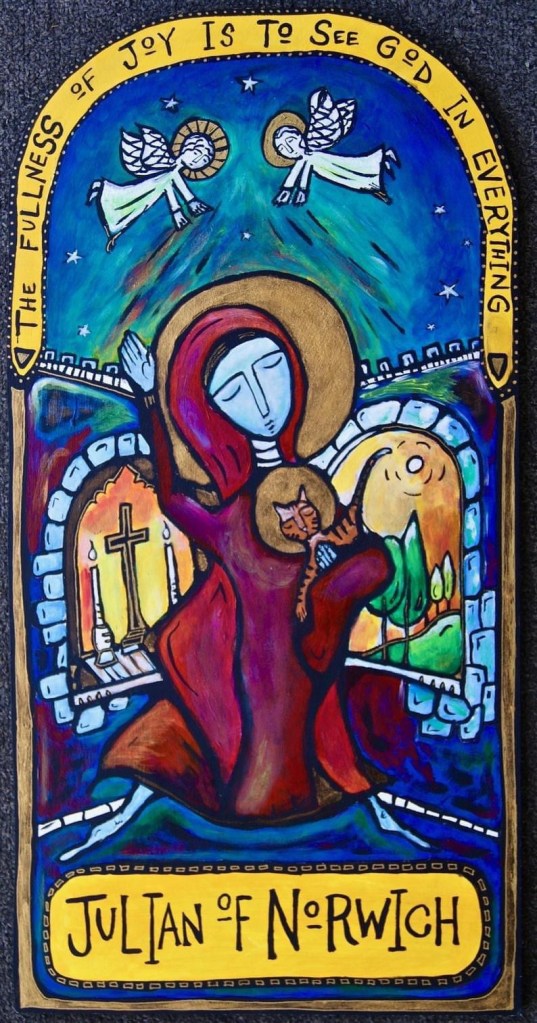
As Mother’s Day dawns, I’m compelled to note that today the church honors the mothering mystic 15th Century icon: St. Julian of Norwich, Enigma and Anchoress.
We know little about St. Julian, though she left us a treasure trove of writings from which to grow from. She became an anchoress of St. Julian’s Church in Norwich, a statement which means little to our ears, but explains that she lived in a shack adjacent to a particular church, in exile and voluntarily alone. She sought the contemplative life without distraction, and at the time this was seen as a benefit to her and her insights. We would later know it was certainly a benefit for our collective knowledge, but may have done her personal harm in the long run.
St. Julian called her insights “showings,” and she has recorded fifteen of them for the world. She was only around thirty years old when these visions happened to her, and they show both her admiration for the Divine and what she believes the Divine was showing her. In these experiences she recounts a God who is close, intimate, and “homely,” according to her description. She draws upon scripture and other medieval writings of the time to extrapolate on these extraordinary experiences.
St. Julian (sometimes called Dame Julian) was sought out for her wisdom. Though she lived as a recluse, others traveled far to hear her thoughts and seek her guidance.
St. Julian of Norwich died in the year 1417, and has long been honored on May 7th or May 8th by much of the church.
My favorite quote of hers, which was scribed while she was on her death bed, is, “All shall be well, all shall be well, and all manner of things shall be well.”
She is a reminder to me, and should be for the whole church, that insight into the Divine can happen to anyone, anywhere. And sometimes the most feeble amongst us holds the most acute lens.
-historical bits taken from Pfatteicher’s New Book of Festivals & Commemorations
-icon written by Marcy Hall of Rabbitroomarts: https://www.etsy.com/shop/RabbitRoomArts?ref=simple-shop-header-name&listing_id=973273358
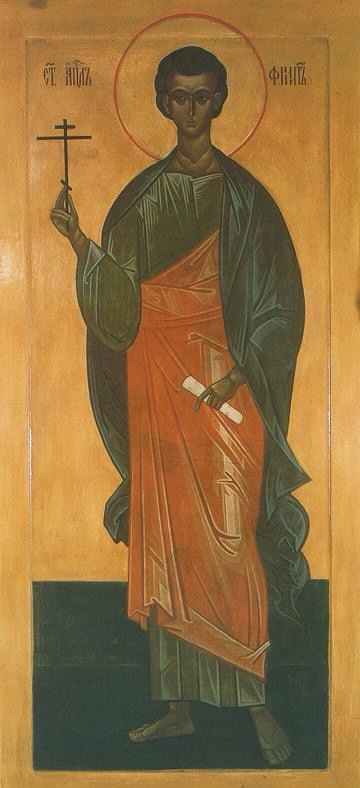
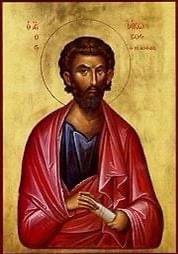
Today the church remembers two of the original twelve disciples: St. Philip and St. James the Less, Apostles, Martyrs, and Friend of the Obscure.
While there are disciples of Jesus with fewer speaking roles than Philip and James the Less (lookin’ at you Simone the Zealot and Mattias!), St. Philip and St. James the Less are pretty obscure, with James taking the lion’s share of that cloud of mystery. Nevertheless, like many characters in the scripture, these two deserve remembering because they “were in the room where it happened,” and went on to work in the world even after it happened.
St. Philip is more well-known, hailing from Bethsaida, that fishing village that birthed St. Peter and St. Andrew. He’s remembered for two main stories in the scriptures: his call story in John 1:43-51, and the Feeding of the Five Thousand (John 6:5-7). He’s mentioned a few more times, but most people will recall these two tales more readily.
St. Philip is said to have traveled to modern day Turkey after the Pentecost story, preaching and teaching with reported success. Lore says that he was married and had two daughters who accompanied him. His death came at the hands of the townspeople of Hierapolis in Phrygia (Turkey), where he was either stoned or crucified, depending on which literature you follow. He was buried there and his daughters, who remained unmarried, survived him and are also buried there.
In iconography you’ll often find St. Philip depicted with a “Tau Cross” (T-shaped), and/or with two loaves of bread, referencing both his death and the Feeding of the Five Thousand.
St. James the Less (a moniker that distinguished him from James the brother of John), is simply noted as one of the disciples of Jesus and his mother may have been one of the Mary’s present at the crucifixion. Apparently they were at a loss for names in the ancient world, hence why there are so many named Mary and James…but I digress.
Post-Pentecost we don’t really have any stories of note about James the Less other than that he was said to have been martyred using either a saw or a “fuller’s club,” a large club with spikes or knobs. One of these two images usually appear in his iconography.
St. Philip and St. James are commemorated by the Roman church on this day, May 3rd, though Lutherans and Anglicans usually commemorate him on May 1st (which is more traditional). But in 1955 Pope Pius XII declared that May 1st should be a day dedicated to remembering the working class, and so he put St. Joseph the Worker’s feast day on that day, and transposed these two obscure apostles to May 3rd.
Honestly, it’s six in one hand and half a dozen in the other, because half of the church honors them on May 1st and the other half on May 3rd. Decide which candle to light and do your thing, Beloved.
St. Philip and St. James the Less are a reminder for me, and should be for the whole church, that sometimes in life all you get to be remembered by is your name.
And sometimes that’s enough, by God.
-historical notes from Pfatteicher’s New Book of Festivals & Commemorations
-it is worth noting that Pfatteicher encourages the church to adopt the older commemoration date of May 1st to honor these saints

Today the church remembers 4th Century Bishop St. Athanasius, who presided in Alexandria and was not known for brevity.
Athanasius is known as “the father of Orthodoxy,” arguing vehemently with the Arians who denied the full divinity of Jesus. Because of him the phrase “of one Being with the Father” became central to the Nicene Creed at the Council of Nicaea in 325.
He assumed the Bishopric as the successor of Bishop Alexander, but many opposed his selection and, like he with Arius, brought him up on heresy charges. He appealed to Constantine himself, and was mercifully exiled to northern Gaul.
After Constantine’s death he was allowed to return to Alexandria and resume his duties. Yet, it wasn’t before long that he was charged again by those who disliked him. Pope Julius I convened a council in the late 330’s and declared Athanasius innocent.
He would be brought up on heresy charges again, of course, and by his death he would see exile from the church five times.
The Athanasian Creed, named after Athanasius (though not written by him) is still sometimes recited on Holy Trinity Sunday in some parishes. It is yet a further “circling of the wagons” of the creeds of the ancient church, leaving less room for interpreting God’s work in the world.
Athanasius is seen as a great “doctor of the church,” but he should also be seen as a case study for what happens when our search for what is “correct” overwhelms the church. The one who cried heresy against others was quickly charged of heresy himself…and it would mark his whole life.
The schisms in our own Lutheran legacy are a testament to this deep and unfortunate truth.
If the faith is contingent solely on right and inerrant interpretation, you eventually end up with a church of one: yourself.
-historical bits from Pfatteicher’s New Book of Festivals & Commemorations
-icon can be purchased at monasteryicons.com

Today the church honors the feast day of a number of saints in the mystic tradition including St. Catherine of Siena, Johannes Tauler, and Blessed Henry Suso.
But I’d like to lift up one of my favorite 14th Century mystics, Meister Eckhart.
Eckhart, whose formal name is Johannes, was born sometime around the year 1260 in Germany. He was trained as a Dominican, and true to form was known as a wonderful preacher.
His teachings were not only deeply mystic and spiritual, but were also seen as being on the fringe for his day (and still may be considered so, today!). Because of this, he was brought up on heresy charges by the Archbishop of Cologne, and died before the matter was settled.
Years after his death a papal bull was distributed that named some of his writings as heretical, noting that “he wished to know more than he should.”
My favorite quote of the great Meister is:
“What good is it to me that Mary gave birth to the son of God fourteen hundred years ago, and I do not also give birth to the Son of God in my time and in my culture?
We are all meant to be mothers of God. God is always needing to be born.”
Eckhart is a reminder for the church, and for each of us, that the quest to “know more than we should” is one to be risked.
We should all quest to know more than we should…

Today the Church remembers an obscure, but important, contemporary saint: Toyohiko Kagawa.
Toyohiko was the biological son of a member of the Japanese Cabinet and a geisha girl, and was raised by his father’s wife. He was eventually sent to live with an uncle, and learned English through a Bible course. At 15 he became a Christian, and was rejected by his family of origin.
He dedicated his life to serving in the slums of Japan. He lived in the most impoverished slum, Shinkawa, for most of his young adulthood, abiding in a 6ft by 6ft hut with his wife Haru.
From there he began organizing.
In 1912 he organized the first labor union in Japan for shipyard workers. in 1918 he founded the Labor Federation and in 1921 the Farmer’s Union. He was arrested numerous times in worker strikes and street riots, and in 1925 he worked successfully for universal male suffrage in Japan.
His work in both unionizing and social welfare was born from what he saw as the Christian ideal for social order, lifting up the poor and the marginalized. His writings helped the powerful see the plight of the poor in Japan.
As nationalist fervor started to bubble, he founded the Anti-War League in 1928. In 1940 he was arrested in Japan for apologizing to China for Japanese aggression, and in 1941 he was part of a group who came to the United states to try to avert the war.
Despite all of this, the climate in Japan during the war influenced him greatly, as did the fear of political retribution. He was known, during the war, as being a nationalistic hardliner.
After the war, Kagawa led efforts to establish democratic institutions in Japan. He died in Tokyo on this day in 1960.
Kagawa is a wonderful example of how the complexity of a heart for the poor and geo-political realities affect humanity. Hindsight leads us to see where we have succeeded, and where we have stumbled, and despite our best efforts to keep our feet under us, no one leads an unblemished existence.
His commemoration is a good reminder, for all of us, that our missteps should not, in the end, erase the times we were in alignment with justice. No saint is perfect, after all.
-historical information gathered from Pfatteicher’s New Book of Festivals & Commemorations: A Proposed Common Calendar of Saints

Today the church remembers not a particular saint, but rather the Mother to us all: Earth Day.
The first Earth Day was held in 1970 with the rise of the environmental movement. As the Industrial Revolution quickly began taking its toll on the planet, humans began noticing some tangible changes in the way things looked, tasted, and smelled in the world…and it was not good. Though these changes smelled like prosperity to some, others knew it was a warning sign that the Earth was…is…dying, and that death was being accelerated by humans.
In those early days, pollution was the main focus of most Earth Day activities. And while that is still true today to some extent, we’ve now recognized global warming as the true danger to life on, and the life of, this planet.
In the opening lines of Genesis we find the Divine carefully crafting the earth, separating this from that, throwing birds in the air and playing ultimate “catch and release” with the fishes of the sea. The plants are coaxed from their ground, and humans are shaped out of the black soil. This poetic vision of the creation was not meant to be science…it was art. The art of the Divine being infused in every good thing that inhabits this planet.
And then, as the Creator rested, they charged humanity with tending all that had been made.
Earth Day is a reminder for me, and for the church, that this planet was not given to humans, but rather entrusted to them. In our efforts to thrive we’ve stumbled and sacrificed the lives of so many of our fellow creatures…remember: we’re all creation. And while we may not be able to stop global warming, we can slow it and shape it a bit.
Indeed: we are called to do that.
-icon “Cosmic Christ” written by Alex Grey
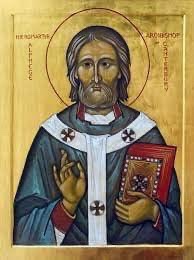
Today the church remembers the embattled Bishop: St. Anselm, Scholar, Erstwhile Bishop of Canterbury, and Preeminent Theologian.
Born in northwestern Italy, Anselm’s childhood was privileged in many ways. His parents were wealthy nobles and, after the death of his mother and an argument with his father, St. Anselm left home at the age of twenty-three to explore the world and further his education.
He found the Benedictine monastery of Bec in Normandy and, though he had been left all the family land by his father (who died while Anselm was abroad), he entered the brotherhood as a novice in 1060. Bec was the intellectual seat of the church at the time, and under St. Anselm’s influence grew ever more so. St. Anselm soon became the prior of Bec and then abbot of the monastery. He encouraged the church to move beyond the recitation of the faith and into an exploration of it. He prized Mary as the mother of God, but argued against her immaculate conception (he didn’t think it was a necessary doctrine). He formalized a process of theology known as “substitutionary atonement,” though it would be his students who would turn it into the (largely heretical) doctrine most know today.
He prized the life of the mind.
Soon he was summoned to be the Archbishop of Canterbury, replacing one of his teachers in the seat. There he entered into a power struggle with the King of England (Rufus…that name didn’t stick) over ultimate authority in the land. Rufus refused to recognize the Pope and, smelling an intense struggle, St. Anselm went to Rome and made his home there for a bit…just until things quieted down in England.
In Rome he worked hard on the Council of Bari (Pope Urban I had appointed him to it) that sought to reunify the Eastern and Western church. It didn’t happen, but St. Anselm’s contributions to the council remain distinguished.
Ultimately King Rufus died and King Henry I (that name did stick!) summoned St. Anselm back to Canterbury. Unfortunately the power struggle continued for the little island to the north, catching St. Anselm in the hot seat there. Now at the end of his days and in poor health, St. Anselm died on Wednesday in Holy Week on this day in 1109.
One of my favorite quotes of St. Anselm is this little ditty about the Christ, a totally feminist viewpoint:
“Are you (Jesus) not a mother too? Indeed you are, and the mother of all mothers, who tasted death in your longing to bring forth children to life.”
St. Anselm is a reminder for me, and should be for the whole church, that the life of the mind is far superior to the recitation of stale doctrine.
-historical bits from Pfatteicher’s New Book of Festivals & Commemorations
 Reluctant Xtian