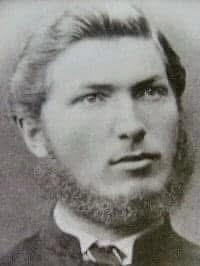
Today the church recognizes a peasant from Bavaria who would influence both an entire continent and an island nation, Johannes Flierl, Missionary to Australia and Papua New Guinea.
Born in humble beginnings in 1858, Flierl was ordained a pastor in Bavaria and started his mission work in the interior of Australia with the native aboriginal persons there. Roughly eight years later, he boarded a boat and hopped across the Torres Strait, landing in Finschafen, Papua New Guinea, the capital of the German colony of Kaiser-Wilhelmsland.
Flierl was the first Lutheran missionary on the island. He established a mission near Simbang, but didn’t baptize any locals until 14 years later.
Flierl is remembered not only for his mission work, but most importantly as a champion for the locals in their fight for rights against government oppression. A seminary in Finschafen was established in his name in 1957, ten years after his death.
Flierl’s mission would eventually become the Evangelical Lutheran Church of Papua New Guinea which, along with the Batak Church in Indonesia, is the largest of all Lutheran mission churches.
Flierl is notable for a few reasons, not the least of which is his innovative chin hair. It does my heart good to hear of a 19th Century missionary who was fighting for the rights of the people they were sent to walk with, not just trying to bludgeon them with a religion they didn’t ask to be exposed to.
The ELCA’s model for missions is one of accompaniment, and though it is unclear how closely Flierl’s work embodied that same spirit, I see glimmers of hope in his story that he may have practiced some of that mindset in his missions.
-historical notes gleaned from Pfatteicher’s “New Book of Festivals & Commemorations”
As the sun rises, it’s worth noting that the church honors a 20th Century saint on this day who worked hard to unify the quarreling factions of the body: Saint Nathan Soderblom, Archbishop of Uppsala, Unifier of the Church.
St. Nathan was born in Sweden at the end of the 19th Century to a family helmed by a pietistic pastor father. He was ordained a minister in the Church of Sweden in 1893, and served as chaplain to the Swedish legation in Paris until 1901. While in Paris he studied comparative religion, and his mind and heart was expanded.
Upon receiving his doctorate he taught History of Religion at Uppsala while also lecturing in Leipzig. He was known for being highly intellectual, highly liturgical, and highly progressive in his theology.
Despite opposition from more conservative pastors, he was elected the Archbishop of Uppsala and Primate of the Church of Sweden. In his leadership and his writing he sough what he called “evangelical catholicity,” encouraging different factions of the church to work together for the social good.
You might remember a similar agreement between St. Peter and St. Paul…
Through his leadership and efforts the predecessor bodies that would eventually become the World Council of Churches began to form and do their work.
During World War I he vehemently sought the freedom of prisoners of war and refugees, arguing for peace on behalf of the people. In 1930 he won the Nobel Prize for peace.
He died on this date in 1931.
St. Nathan Soderblom is a reminder for me, and should be for the whole church, that education not only expands the head, but also expands the heart, and a church that can agree to serve the poor is like a tree standing by the water.
It shall not be moved.
Now, if only it could agree to that…
-historical notes from Pfatteicher’s New Book of Festivals & Commemorations
Today parts of the church, especially those parts with Black Church roots in the American South, remember a saint who helped to coordinate the 1822 slave revolt in Charleston, South Carolina: Gullah Jack, Community Organizer and Conjurer.
Gullah Jack’s early life is a bit of a mystery. He was born in Angola, kidnapped by slave traders and illegally purchased and sold (because you can never legally own humans) in 1806 to a mister Zephaniah Kingsley. Kingsley identified Gullah Jack as “priest in his own country,” which probably means that he was a tribal holy person in Angola.
Nevertheless, upon coming to the States he called himself a Methodist, though he merged his ancient practices with that of his new land, as so many have in this life. We never fully give up our mother tongue.
In 1822 enslaved leaders got together to organize a revolt in Charleston. Gullah Jack was seen as the spiritual leader of the group, offering them prayers and blessings of protection. It is said that over 9,000 slaves were willing to join in on the revolt, which gives you an idea of just how much of a scourge slavery and racism was (is!) on that land.
Eventually the plot was revealed, and over 130 people were arrested. Out of those, 36 were hanged on this day, including Gullah Jack.
Gullah Jack is a reminder for me, and should be for the whole church, that the blight of slavery still lingers on the land, and we need to remember the sins of the past so that we can figure out ways to work together to make sure they never happen again.
Louder in the back for those trying to amend school curriculum to whitewash, literally, this kind of thing…
-historical bits taken from Daily Magic by Judika Illes
Today is the saint day of a patron who is near and dear to my craft-beer loving heart: Saint Arnold, Beer Brewer and Savior of Humanity.
So, here’s the thing about St. Arnold: he is an unlikely saint, as most are, but not because he did things wrong, but because he did them correctly.
He started his career in life as a soldier near modern day Brussels, but ended up at a monastery in France, learning beer brewing from the brothers. He rose to become the Abbot of Medard’s Abbey, though he tried to flee from the responsibility. Lore has it that he ran from the cloister and wolf chased him, hunted him down, and convinced him to go back and serve the vocation.
That’s a fun call story if I’ve ever heard one…
Instead of being OK serving this monastery in France, he chose to found his own in Oudenberg, and there began brewing beer in force. The people of Oudenberg were being plagued by infested water, probably from human waste dumped too close to the local water source, and encouraging them to drink the beer rather than the water actually saved lives.
Plus, this beer was low gravity, giving them the ability to do their work well while also staying alive. A plus in my book.
This blessed saint is still honored in Brussels on the “day of beer,” as a reminder that sometimes when the local water source is contaminated, some boiling (and hops) will be the cure.
Saint Arnold is for me, and should be for the whole church, that no topic is as simple as “good or bad,” and sometimes science in the kitchen can lead to health in the streets.
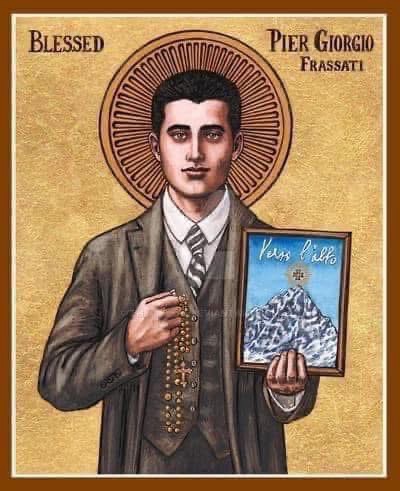
Today the church remembers a saint who fought hard to move the needle of justice, especially for his poor neighbors in Turin Italy: Pier Giorgio Frassati, Social Reformer and Activist.
Saint Pier was born in 1901 to an agnostic father and artistic mother. His father would go on to serve in the Italian government, and his mother would go on to produce artwork that would be bought by royalty. Saint Pier, though, had his eyes set on adventure and advocacy.
As a young boy a mother and shoeless son came begging at the Frassti household. Pier answered the door and, so moved by the sight, gave the young boy the shoes off of his own feet. One night he witnessed a beggar come to his door intoxicated, and was horrified when his father sent him away with nothing. Sobbing Saint Pier ran to his mother who wrapped some food in a napkin for him, and sent him out into the night to find the hungry man.
For as big of a heart Saint Pier had, he also had a wonderful sense of humor. He would play practical jokes on his family and friends, and earned the name “Terror” for his wisecracks.
Though he was a smart boy, he was only an average student, and rather than find his home inside books, he found it inside the organizations working for justice. Especially dear to his heart was the anti-fascism work going on in the day, and those causes seeking to bridge the inequality gap. He spoke out against the regime of Mussolini, and was arrested for protesting alongside the Young Catholic Workers Congress.
“Charity is not enough,” he was known to say, “we must have social reform!”
His friends called him a “saint with a cigar,” as he marched, wrote (riffing off of Thomas Aquinas and St. Catherine of Siena), and spoke out against injustice.
In his leisure time he was an avid athlete, boating and mountaineering with his friends.
On one such boat trip in 1925 Saint Pier started to complain of a back ache. Returning home he was met with the death of his grandmother. Not wanting to add to the grief, he kept his pain largely to himself, though it grew in the following days.
Within a week Saint Pier found himself unable to rise from his bed, stricken at the age of 24 with Polio. He died in the arms of his mother, saying with his last breath, “May I breathe forth my soul in peace to you…”
Saint Pier is not a well-known saint, but is one who reminds me, and should remind the whole church, that moving the needle on social inequality often begins in the compassionate hearts of the young.
Which means we should listen to the young, as uncomfortable as that might make us.
-historical bits gleaned from 365 Saints by Koenig-Bricker
-icon written by Theophilia of Deviant Art (deviantart.com)
As we break into July I’m reminded that the ancient Celts always felt that they had two homes: the “inside house,” and the “outside house.”
In the winter months the hearth became their sun, and the family gathered around it to live well.
But from May-November, they didn’t need the false sun of the hearth, and their world (literally) revolved around the burning star that provides us life and light. The “outside house” was all creation, every living thing not within four walls.
They called this “outside home” the “house of light.”
In July they would sit in the house of light, outside, to learn: how to grow, how to use the light offered you free of charge, how to rise early, and how to retire as the sun retired.
We’d do well in these days to find ways to imagine our lives being between two houses, I think…and being able to learn what is taught in July.
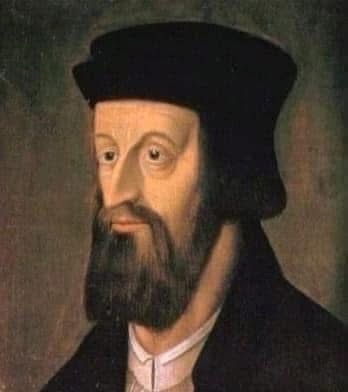
Today the church honors a proto-Reformer who, had the printing press been available during his life, may have caused all of us to be called “Hussians” rather than Lutherans: Jan Hus, Martyr, Gadfly of the Church, and prelude to Luther’s Reformation.
Jan Hus was born “Jan of Husinec” sometime around 1373 to peasant parents in Bohemia. He was fortunate to attend the newly established Charles University in Prague, where students shortened his name to “Jan Hus”…which was funny because “hus” literally means “goose.”
St. Jan, that wild goose, would go on to receive his Masters Degree and eventually teach Theology at Charles University while also being named the preacher of the Chapel of the Holy Innocents of Bethlehem. In that church he preached in Czech, a drastic departure from the Latin used in the rest of Christendom. But in these days the church was in conflict (three Popes claimed the Chair of St. Peter), and reformation was in the air!
St. Jan had been greatly influenced by that other rascal, John Wycliffe, who had truly formalized much of the radical thinking that Luther would glom onto in the Reformation. Though Jan and John differed in many areas, St. Jan began to be more Wycliffian in his preaching and writing, including condemnations of the abuses of the church (and her lazy priests) in his regular sermons.
This, as you can imagine, was a problem for the Archbishop.
St. Jan did crazy things like, oh, suggest that the bread AND the wine could be provided to the laity in the Mass. He openly questioned the historic episcopate, and started to advocate for only two sacraments (baptism and communion) to be officially recognized.
Sound familiar?
Pope Alexander V condemned Wycliffe’s writings in 1409 and, in short order, excommunicated St. Jan in 1412. Interestingly enough St. Jan was not excommunicated for his own writings, but rather because he refused to travel to Rome to give an account of them. Basically, he didn’t show up to court…
St. Jan Hus refused to be quiet, though, and even as a heretic of the church preached against the avarice the local priests showed. He was summoned to the Council of Constance in Switzerland in 1414 and, though he had been promised safe travel back to Bohemia after his trial, was immediately arrested, held in the dungeon there, brought up on false charges, and burned at the stake.
It is said that he was praying the Kyrie eleison as he died.
St. Jan Hus is a reminder for me, and should be for the whole church, that sometimes not saying something is not an option, even if it costs you your job, your status, and yes, your life.
-historical bits gleaned from Pfatteicher’s New Book of Festivals & Commemorations
In July the Celts found themselves under the Holly Moon. The holly tree was lifted up in this time of the year not because it was in particular bloom, but because it was basically unchanged. The fortitude of the holly tree no matter the season was the reason it was elevated in this month: it’s ever green leaves and ever red berries were seen as mythically strong.
The holly tree was also seen to embody the masculine and feminine all in one. The prickly leaves were seen as masculine, and the ripe berries like the feminine womb, a symbol of coexistence and marriage (and fertility, to be honest).
In the ancient lore, the Holly King ruled from the summer solstice to the winter solstice, only to be overtaken by the Oak King from the winter solstice to the summer solstice. Both equally strong and wise, but both specializing in something unique.
The Holly King was everlasting and unchanging, a testament to fortitude.
The Oak King was wise and powerful, a testament to discernment.
As the Celts were slowly Christianized (or rather, adopted some Christian ideas), the holly tree came to be seen as a special symbol for Jesus: the prickly leaves for his crown, the red berries for his blood. And the fact that it never changed was even more-so a symbol for them (and us?).
There is a prayer they used to say at this time of year using holly berries (though any berry can suffice if it is red). Find a flowing body of water and three berries.
Toss the first berry in and say a prayer of gratitude.
Toss the second berry in and ask for divine wisdom.
Toss the third berry in and pray for someone who needs it.
The Holly Moon is one of unchanging fortitude. A good feeling for July.
“There are three kinds of patriots, two bad, one good.
The bad are the uncritical lovers and the loveless critics. Good patriots carry on a lover’s quarrel with their country.”
-William Sloane Coffin
“Love of country is a wonderful thing, but why should love stop at the border?”
-Pablo Casals
Let America Be America Again
-Langston Hughes
Let America be America again. Let it be the dream it used to be. Let it be the pioneer on the plain Seeking a home where he himself is free.
(America never was America to me.)
Let America be the dream the dreamers dreamed— Let it be that great strong land of love Where never kings connive nor tyrants scheme That any man be crushed by one above.
(It never was America to me.)
O, let my land be a land where Liberty Is crowned with no false patriotic wreath, But opportunity is real, and life is free, Equality is in the air we breathe.
(There’s never been equality for me, Nor freedom in this “homeland of the free.”)
Say, who are you that mumbles in the dark? And who are you that draws your veil across the stars?
I am the poor white, fooled and pushed apart, I am the Negro bearing slavery’s scars. I am the red man driven from the land, I am the immigrant clutching the hope I seek— And finding only the same old stupid plan Of dog eat dog, of mighty crush the weak.
I am the young man, full of strength and hope, Tangled in that ancient endless chain Of profit, power, gain, of grab the land! Of grab the gold! Of grab the ways of satisfying need! Of work the men! Of take the pay! Of owning everything for one’s own greed!
I am the farmer, bondsman to the soil. I am the worker sold to the machine. I am the Negro, servant to you all. I am the people, humble, hungry, mean— Hungry yet today despite the dream. Beaten yet today—O, Pioneers! I am the man who never got ahead, The poorest worker bartered through the years.
Yet I’m the one who dreamt our basic dream In the Old World while still a serf of kings, Who dreamt a dream so strong, so brave, so true, That even yet its mighty daring sings In every brick and stone, in every furrow turned That’s made America the land it has become. O, I’m the man who sailed those early seas In search of what I meant to be my home— For I’m the one who left dark Ireland’s shore, And Poland’s plain, and England’s grassy lea, And torn from Black Africa’s strand I came To build a “homeland of the free.”
The free?
Who said the free? Not me? Surely not me? The millions on relief today? The millions shot down when we strike? The millions who have nothing for our pay? For all the dreams we’ve dreamed And all the songs we’ve sung And all the hopes we’ve held And all the flags we’ve hung, The millions who have nothing for our pay— Except the dream that’s almost dead today.
O, let America be America again— The land that never has been yet— And yet must be—the land where every man is free. The land that’s mine—the poor man’s, Indian’s, Negro’s, ME— Who made America, Whose sweat and blood, whose faith and pain, Whose hand at the foundry, whose plow in the rain, Must bring back our mighty dream again.
Sure, call me any ugly name you choose— The steel of freedom does not stain. From those who live like leeches on the people’s lives, We must take back our land again, America!
O, yes, I say it plain, America never was America to me, And yet I swear this oath— America will be!
Out of the rack and ruin of our gangster death, The rape and rot of graft, and stealth, and lies, We, the people, must redeem The land, the mines, the plants, the rivers. The mountains and the endless plain— All, all the stretch of these great green states— And make America again!