
On Being Humble

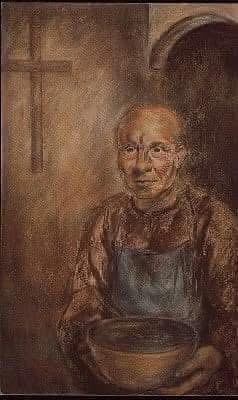
Today the church remembers a simple, humble saint who dedicated his existence to prayer and presence: Brother Lawrence, Mystic and Monk.

Brother Lawrence was born in the early 17th Century in Lorraine, France. We do not know much about his childhood, other than to say that he received very little schooling. He served a stint in the army, but one day had a mystical vision that gave him a new direction.

While gazing at a stark tree in the middle of a French winter, Brother Lawrence received an overwhelming feeling of grace and a deep sense that God was present. He saw in that moment that he, like that tree, was waiting for God’s blooming in his life…which could happen at any moment.

Brother Lawrence took this experience and went off to Paris, joining the Carmelite monastery there as a lay brother.

He was given the base tasks of caring for the monastery, but in his repetitive work he found an avenue to integrate spirituality into every mop swing, every dish scrub, and every menial task given him. He began what he called the “practice of the presence of God.”

He devoted each small task to the Divine, turning every moment into an opportunity for prayer.

Brother Lawrence is a reminder for me, and can be for the whole church, that the small, simple things when done faithfully are a gift to the Divine and to the world.

In fact, I’d go further to say that small, simple communities of faith, parishes, churches, embody Brother Lawrence best when they do their small bit with great attention and devotion.

-historical bits gleaned from Claiborne and Wilson-Hartgrove’s A Liturgy for Ordinary Radicals
Baptism of Our Lord

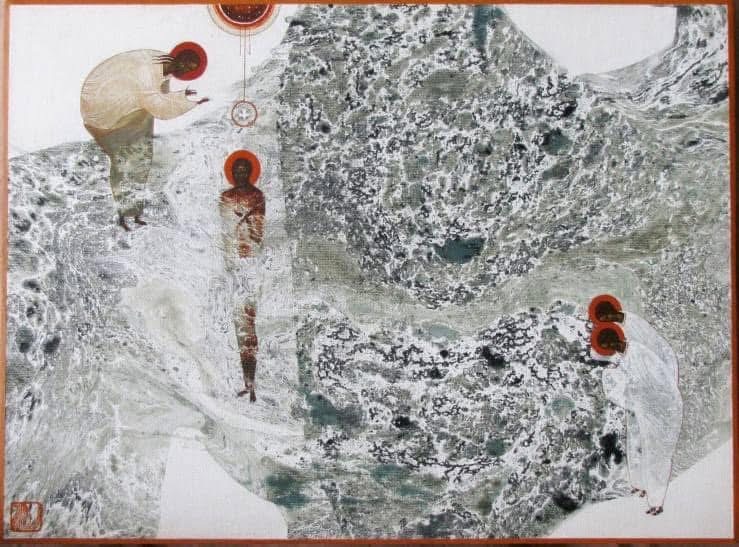
Yesterday the church celebrated one of our moveable feast days: The Baptism of Our Lord.

This is one of the few events in the life of Jesus that every Gospel mentions, and in each of the Gospels it is noted as kind of the beginning of his dedicated work in the world.

Most every major religion has some sort of bathing/purity rite, and for Christians baptism is meant to mark a rebirth of sorts. In your first birth you came into a world that wants you to seek out fame and fortune. The birth from the font, however, dedicates you to a different life of justice, love, and service.

Surely, it doesn’t always take for all people, but the amniotic fluid of the baptismal font, the water, is intended to renew the life of the person and give them a new lens through which to see their work in the world.

In addition to all of the above, baptism is meant to mark the Divine’s deep love for the individual…and that “takes” for everyone, regardless of how well they live into the vows.

Baptism is an interesting rite, too, because it is both a one-time event (for many Christians) and also a life-long process. Every bath is a renewal of life when seen in this way, a chance to be birthed differently and start fresh. There is a penitential element to it, of course, as every bath is intended to make someone clean. But there is also a primal element to it, one that connects all humanity, Christian or not. After all, we don’t baptize using Pepsi, gin, or coffee.

We use water, the stuff of life (though, coffee is also the “stuff of life” in my book, but I digress…).

Genesis, the first book of the scriptures begins with the Divine brooding over the swirling chaotic waters, and the Book of Revelation, the last book, ends at those same waters, but now they’re known as The River of Life. Scripture is bookended by water.

Similarly, in many traditions, a child is brought to the font for rebirth and, at every funeral I’ve ever done in a church, we start saying good bye to the deceased at the font, recalling where it all began. In this way life, too, is book ended by water.

The Baptism of Our Lord is a feast day that reminds me, and should remind the whole church, of a few things:

First: water is life. And because it is life, clean water should be a right for every human, from Flint, Michigan to Finland to far flung Namibia. We must work hard to make it so.

Secondly: rebirth is always possible in so many ways. Every drop of water should remind us that a new way of being is possible, by God.

Finally: that change in the church will require Christians to take a hard look at the baptismal vows and rethink how we apply and live into them. Baptism should never happen “to make grandma happy.” Baptism is a public statement about a person’s intent to live and be and move in the world differently than the world calls them to live, be, and move.

Let those with ears to hear, hear.

-icon written by Ivanka Demchuk (Ukrainian, 1990–)