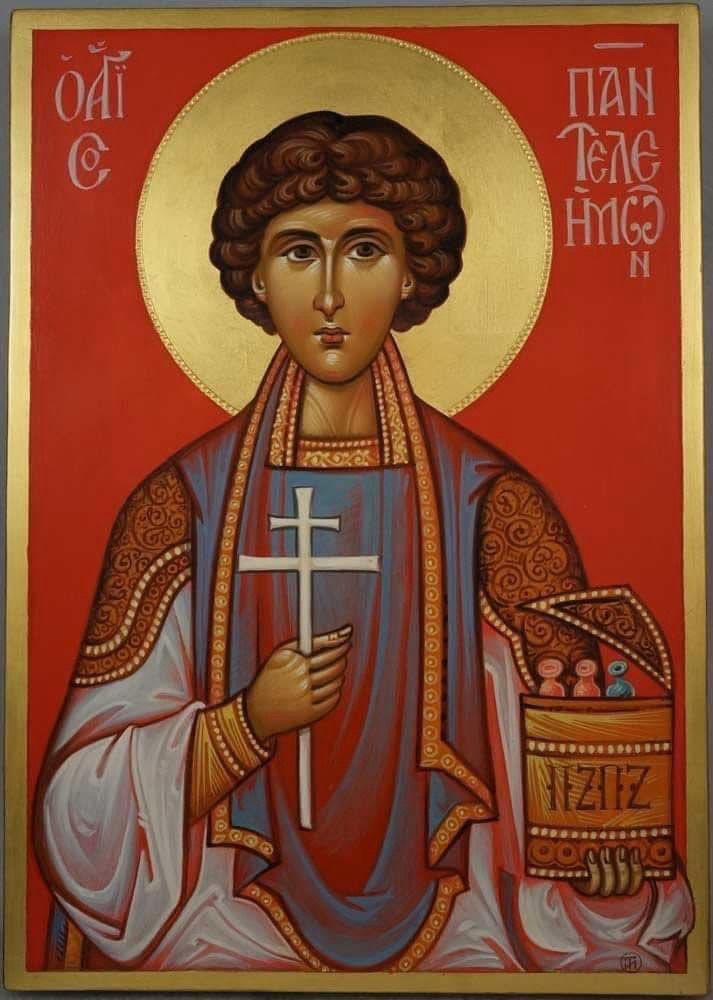
Today the church remembers one of the very early Christians of the faith: Saint Pantaleon, Physician, Martyr, and Emancipator.
Saint Pantaleon was supposedly born to a wealthy well-connected father, and was instructed in the faith by his mother Eubula. She died early in his life, however, and he went off to medical school letting his faith practices fall by the wayside.
A familiar story if there ever was one, right?! How many go off to university and seek out other distractions? Every parent is totally resonating with this story now…
So, Pantaleon is in medical school studying under the renowned early physician Euphrosinos. His acumen in the healing arts got him the enviable position as personal physician to Emperor Galerius.
It was Saint Hermolaus who came back alongside Saint Pantaleon and further taught him in the faith, telling him of the healing stories of Jesus which tantalized this physician’s imagination. He began to practice the faith again.
When his father died (who also became a Christian) the vast wealth of the family was given to St. Pantaleon who promptly freed all of the slaves, distributed the money to the poor, and became known as a wonderful humanitarian in the city.
All of this doing good, and his high position, caused his colleagues to become envious. When Emperor Diocletian came to power, Saint Pantaleon was exposed as a Christian and was beheaded (many a lore arose around his martyrdom, including the idea that the wild beasts were turned on him but only gave him cuddles because he was such a nice guy!).
He died in the year 305 AD.
Saint Pantaleon is a reminder for me, and should be for the whole church, that just saying “Jesus Christ is my Lord and Savior” without doing justice, loving mercy, and walking humbly is weak sauce indeed.
And much of popular Christianity is totally weak sauce.
-historical bits taken from common source materials -opinions my own -icon is traditional Greek Orthodox depiction
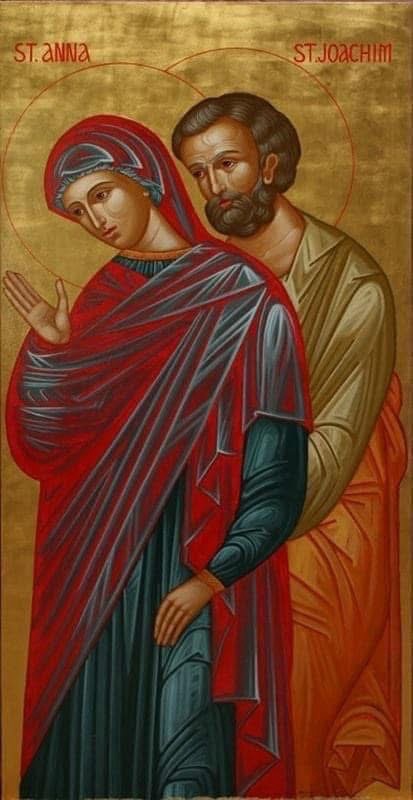
Today the church remembers two saints who we aren’t even sure existed, yet nevertheless hold an important (if figurative) place in the canon of Christianity: Saint Anne and Saint Joachim, Parents of Mary, the Mother of Our Lord.
Mirroring Abram and Sarai, Hannah, and Elizabeth and Zechariah, the lore on Anne and Joachim is that they reached an old age childless. Miraculously one day, Saint Anne was with child, and following in their faith ancestor’s footsteps, they raised the young girl (named Mary) in the temple to be taught by the priests.
Spoiler alert: this Mary would miraculously conceive Jesus and, well, you know the story.
We learn much of this from a second century apocryphal gospel of dubious authorship known as the Protoevangelium of James.
Nevertheless, the ancient world loved a good story, and this one fit the bill. The cult of Saint Anne grew and spread and really rooted itself in the mid 6th Century when Justinian I in Constantinople built the first church dedicated to her. When the details of these two saints became fleshed out and the immaculate conception of Mary (December 8th) was formalized, there was no looking back: Saint Anne would be assumed real, and would be really loved by many Christians.
In fact, our own Blessed Martin Luther loved Saint Anne so much, it was to her that he prayed when he felt his life was in trouble, promising her that, should he live, he’d become a monk.
In other words: the Reformation may never had happened had Saint Anne not been on Luther’s mind (though, perhaps he would have prayed to some other saint…who knows?).
Saint Joachim, like his son-in-law Joseph, takes the back seat in the lore. In fact, nothing else is really said about him other than he and Anne were together, he was old, and he had no children before Mary.
Saint Anne and Saint Joachim are important, though, because it just hammers home how much we love and adore lineage and tradition and long for meaning beyond meaning.
I mean, what are humans but meaning-making mortals?
-info gleaned from Pfatteicher’s New Book of Festivals & Commemorations
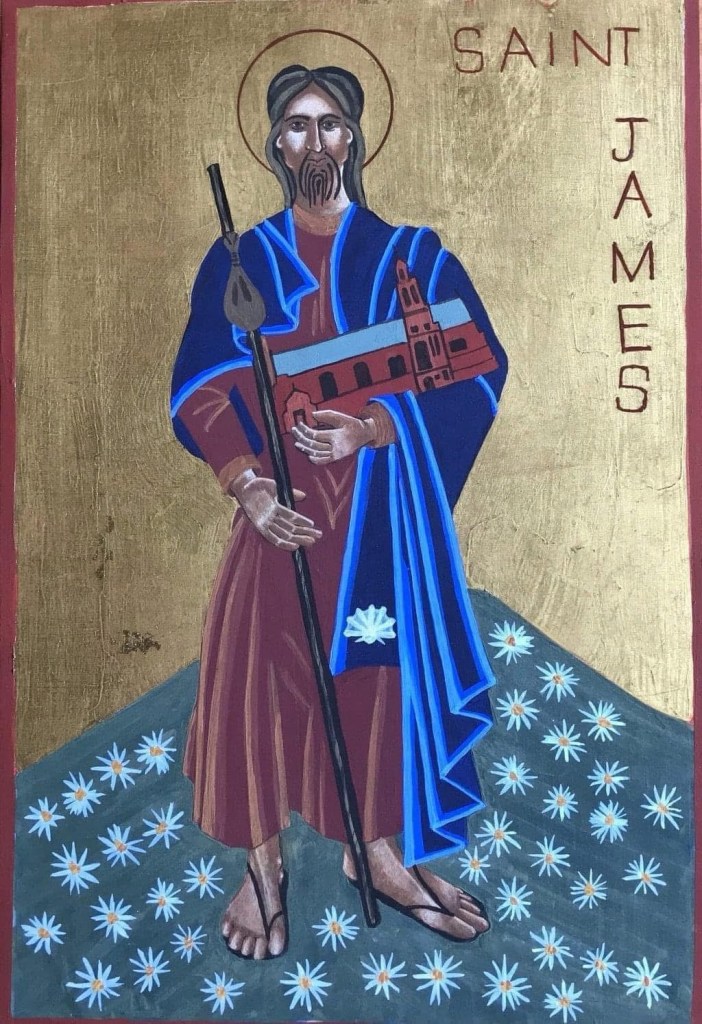
Today the church remembers one of the first called to follow Jesus: St. James the Great, Son of Thunder and Martyr.
Saint James the Great (he was called that because he was older than his brother John) was born in Galilee and worked as a fisherman. Jesus nicknamed James and his brother John, “Boanerges” or “Sons of Thunder,” probably as a nod to their quick tempers and flashpoint spirits.
Saint James was reportedly in the inner circle that Jesus had, the C-suite if you will (though I bet Mary Magdalene was also in there, just conveniently left off the record). He witnessed Jesus raising people from the dead, curing the sick, and being transfigured on the mountain.
He also fell asleep at the Garden of Gethsemane while Jesus was praying and fled when the soldiers came.
Saint James played an active part in the early church post-resurrection, and has the sad distinction of being the only Apostle to have his martyrdom recorded in the Biblical Canon (Acts 12:2) as he was beheaded by Herod Agrippa I in the year 43 (or maybe 44).
Though most all strains of Christianity honor Saint James the Great, no one can agree on a date. The Orthodox Churches give him a nod on April 30th, and the Coptic Churches venerate him on April 12th. The Western Church decided on July 25th probably because his relics were officially buried on this day in 816 AD at the Church of Saintiago de Compostella.
Saint James the Great is a patron saint of travelers, and you can walk his famous “pilgrim way,” the Camino de Santiago. A winding trail of pilgrim roads through Spain, Portugal, and France, the Camino ends at the relics of this beloved and revered Apostle, but best to warm up the hiking boots before you tackle it…it’s not easy.
Saint James the Great is often symbolized by a shell, a nod to his fishing background. Legend has it that eating an oyster on this day will keep you from being poor (though it’s not really oyster season, so be careful!).
Saint James the Great is a reminder for me, and should be for the whole church, that sometimes we get remembered for things that really don’t have much to do with us, and that’s ok. There is no good reason for Saint James the Great to be the patron saint of pilgrimages, and yet, here we are remembering him for it.
I mean, I guess in many ways it’s totally fine, right? He was a pilgrim in this weary world, like all of us, making his way.
-historical bits from Pfatteicher’s New Book of Festivals & Commemorations
-icon is “The Daisy Hill Saint James the Greater, ” written by Glenys Latham specifically for The Church of Saint James Daisy Hill in Bolton, United Kingdom
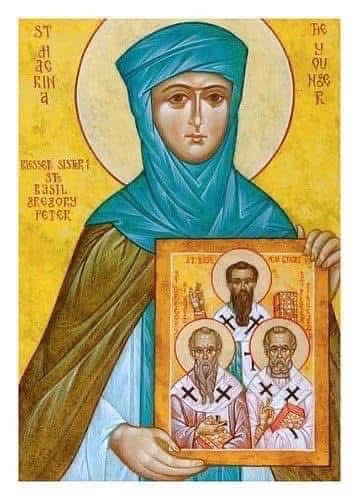
Today the church remembers a 4th Century saint who was often overshadowed by her more famous brothers Greg and Bas (you know them Gregory of Nyssa and Basil the Great, two of the three “Cappadocian Fathers” of the faith): Saint Macrina the Younger, Scholar and Universalist.
Saint Macrina was born in a family already well-steeped in the early Christian movement. She was named after her grandmother, Macrina the Elder, and though her brothers would gain notoriety for their scholarly treatises, they themselves mentioned Macrina as a teacher of faith in their home.
Having been betrothed in an arranged marriage by her father, Macrina never tasted wedded life as her fiancé died before the wedding. She came to see her vows as belonging to Christ alone, and lived an aesthetic and austere life with her mother and a group of women who pledged themselves to communal living. In this community, everyone was equal, whether you were formally a servant or wealthy enough not to owe anyone anything.
It’s one of the early egalitarian communities of the faith, and St. Macrina grew in responsibility as the community grew, taking on what we would call an Abbess role in time.
St. Macrina was also the tutor of her younger brother, Peter of Sebaste who would become a Bishop in the early church. She taught him not only the great philosophical ideas of the time, but also about The Way which was spreading like wildfire in the West and the Near East. In this way, and because she had such a strong influence on Greg and Bas (as I call them), means she was a shaper of the early church, an unseen hand on the needle of the faith.
Known for being a deep thinker, St. Macrina was supposedly a Universalist, and is lifted up by the Universalist Unitarian Church as a great scholar. Her brother, Gregory of Nyssa, composed Dialogue on the Soul and Resurrection in which he records a conversation with Macrina on her death bed (actually, her aestheticism was so great she refused to die in a bed, and chose to die lying on the ground). In that conversation she notes her deep conviction that everyone would be reconciled to God in the end, faithful and pagan alike.
St. Macrina died on this day in 379 AD in Pontus, modern day Turkey.
Saint Macrina is a reminder for me, and should be for the whole church, that the early Christian movement comprised a multiplicity of thoughts and theologies…and still does, despite what the zealots in all corners might want you to think.
-historical bits from open source publications
-icon a classic Byzantine style by unidentified writer where St. Macrina holds an icon of her brothers
The ancient Celts had a strong inclination that the rhythms of nature were echoed in the rhythms of the human body. Winter was for silence and rest, Spring for energy and growth, Summer for blazing work and toil, and Autumn for winding down and letting go.
They understood that living in a way that was in alignment with these rhythms led to a balanced way of being in this world.
At every new moon they also saw that the cycle of life both as continued and began again at the same time, giving support for this idea that time is circular, not linear, and that every moment is both a continuation of a past step and the opportunity for newness.
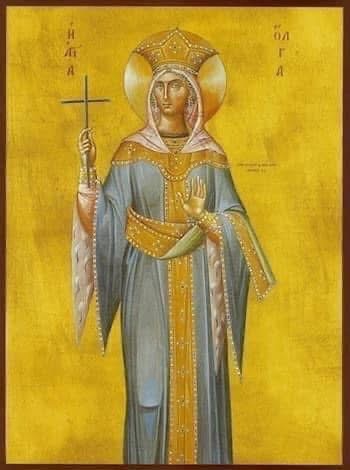
Today the church remembers one who is considered to be the first Christian ruler of Russia: Olga, Princess of Kiev, Confessor and Ruler.
Saint Olga is the grandmother of the first “official” ruler of Russia who confessed the faith. Her grandson Vladimir gets the “official” title because of patriarchy, but in actuality Olga was the first official Christian to rule the nation.
Born in the late 9th Century, Olga married Prince Igor and, after his death in the year 945 A.D., officially ruled in his stead until her son came of age.
She was known for being courageous, “sticking it to the man,” instituting reforms that her husband was unable to carry out regarding financial and administrative changes, and had been an early convert to the faith through the Scandinavian missionaries who traveled down the river system from the West.
In the year 957 A.D. Olga visited Constantinople and some say that is where she was officially baptized, though others claim that she had long been an adherent to the faith. Regardless, her personal faith did not indicate a change of heart for her country, and her son who came to rule after her was not a confessor.
Olga is remembered in Eastern Orthodoxy as the “Blessed Princess Olga,” and is honored in the Ukrainian and Russian branches of the church. She is remembered as being witty and brave. The story goes that when she went to be baptized in Constantinople, the Emperor saw her beauty and asked her to marry him. She replied, “First I must be baptized,” and then followed it up with, “and I need a Godfather. Will you be mine?”
The Emperor agreed and, following her baptism, returned to the invitation of marriage. The bright Princess replied, “We are now family through baptism, and never has a father married a daughter, even amongst the heathens!”
Knowing he had been outsmarted, he gave Olga his blessing to return to Russia with the faith.
She died in the year 969 of old age.
Saint Olga is a reminder for me, and should be for all the church, that too often the female saints amongst us don’t really get their due because, well, patriarchy is hard to eradicate and we must always keep in mind the author of histories and, well, read between the lines.
Let those with ears to hear, hear.
-historical notes gleaned from Pfatteicher’s New Book of Festivals & Commemorations
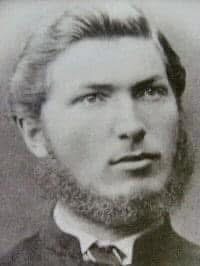
Today the church recognizes a peasant from Bavaria who would influence both an entire continent and an island nation, Johannes Flierl, Missionary to Australia and Papua New Guinea.
Born in humble beginnings in 1858, Flierl was ordained a pastor in Bavaria and started his mission work in the interior of Australia with the native aboriginal persons there. Roughly eight years later, he boarded a boat and hopped across the Torres Strait, landing in Finschafen, Papua New Guinea, the capital of the German colony of Kaiser-Wilhelmsland.
Flierl was the first Lutheran missionary on the island. He established a mission near Simbang, but didn’t baptize any locals until 14 years later.
Flierl is remembered not only for his mission work, but most importantly as a champion for the locals in their fight for rights against government oppression. A seminary in Finschafen was established in his name in 1957, ten years after his death.
Flierl’s mission would eventually become the Evangelical Lutheran Church of Papua New Guinea which, along with the Batak Church in Indonesia, is the largest of all Lutheran mission churches.
Flierl is notable for a few reasons, not the least of which is his innovative chin hair. It does my heart good to hear of a 19th Century missionary who was fighting for the rights of the people they were sent to walk with, not just trying to bludgeon them with a religion they didn’t ask to be exposed to.
The ELCA’s model for missions is one of accompaniment, and though it is unclear how closely Flierl’s work embodied that same spirit, I see glimmers of hope in his story that he may have practiced some of that mindset in his missions.
-historical notes gleaned from Pfatteicher’s “New Book of Festivals & Commemorations”
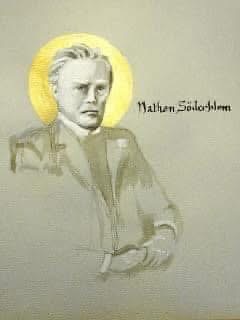
As the sun rises, it’s worth noting that the church honors a 20th Century saint on this day who worked hard to unify the quarreling factions of the body: Saint Nathan Soderblom, Archbishop of Uppsala, Unifier of the Church.
St. Nathan was born in Sweden at the end of the 19th Century to a family helmed by a pietistic pastor father. He was ordained a minister in the Church of Sweden in 1893, and served as chaplain to the Swedish legation in Paris until 1901. While in Paris he studied comparative religion, and his mind and heart was expanded.
Upon receiving his doctorate he taught History of Religion at Uppsala while also lecturing in Leipzig. He was known for being highly intellectual, highly liturgical, and highly progressive in his theology.
Despite opposition from more conservative pastors, he was elected the Archbishop of Uppsala and Primate of the Church of Sweden. In his leadership and his writing he sough what he called “evangelical catholicity,” encouraging different factions of the church to work together for the social good.
You might remember a similar agreement between St. Peter and St. Paul…
Through his leadership and efforts the predecessor bodies that would eventually become the World Council of Churches began to form and do their work.
During World War I he vehemently sought the freedom of prisoners of war and refugees, arguing for peace on behalf of the people. In 1930 he won the Nobel Prize for peace.
He died on this date in 1931.
St. Nathan Soderblom is a reminder for me, and should be for the whole church, that education not only expands the head, but also expands the heart, and a church that can agree to serve the poor is like a tree standing by the water.
It shall not be moved.
Now, if only it could agree to that…
-historical notes from Pfatteicher’s New Book of Festivals & Commemorations
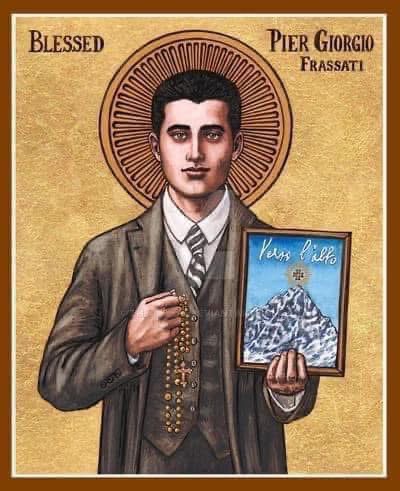
Today the church remembers a saint who fought hard to move the needle of justice, especially for his poor neighbors in Turin Italy: Pier Giorgio Frassati, Social Reformer and Activist.
Saint Pier was born in 1901 to an agnostic father and artistic mother. His father would go on to serve in the Italian government, and his mother would go on to produce artwork that would be bought by royalty. Saint Pier, though, had his eyes set on adventure and advocacy.
As a young boy a mother and shoeless son came begging at the Frassti household. Pier answered the door and, so moved by the sight, gave the young boy the shoes off of his own feet. One night he witnessed a beggar come to his door intoxicated, and was horrified when his father sent him away with nothing. Sobbing Saint Pier ran to his mother who wrapped some food in a napkin for him, and sent him out into the night to find the hungry man.
For as big of a heart Saint Pier had, he also had a wonderful sense of humor. He would play practical jokes on his family and friends, and earned the name “Terror” for his wisecracks.
Though he was a smart boy, he was only an average student, and rather than find his home inside books, he found it inside the organizations working for justice. Especially dear to his heart was the anti-fascism work going on in the day, and those causes seeking to bridge the inequality gap. He spoke out against the regime of Mussolini, and was arrested for protesting alongside the Young Catholic Workers Congress.
“Charity is not enough,” he was known to say, “we must have social reform!”
His friends called him a “saint with a cigar,” as he marched, wrote (riffing off of Thomas Aquinas and St. Catherine of Siena), and spoke out against injustice.
In his leisure time he was an avid athlete, boating and mountaineering with his friends.
On one such boat trip in 1925 Saint Pier started to complain of a back ache. Returning home he was met with the death of his grandmother. Not wanting to add to the grief, he kept his pain largely to himself, though it grew in the following days.
Within a week Saint Pier found himself unable to rise from his bed, stricken at the age of 24 with Polio. He died in the arms of his mother, saying with his last breath, “May I breathe forth my soul in peace to you…”
Saint Pier is not a well-known saint, but is one who reminds me, and should remind the whole church, that moving the needle on social inequality often begins in the compassionate hearts of the young.
Which means we should listen to the young, as uncomfortable as that might make us.
-historical bits gleaned from 365 Saints by Koenig-Bricker
-icon written by Theophilia of Deviant Art (deviantart.com)
Today the church (should, in my opinion) remember one who has long been venerated as a contemporary folk saint, and is now remembered more broadly throughout communities both religious and secular: Saint Denmark Vesey, Carpenter, Community Organizer, and a Founder of Mother Emanuel Church.
Saint Denmark was born into slavery on the island of St. Thomas under Captain Joseph Vesey. Following Captain Vesey throughout the islands, Saint Denmark eventually landed in Charleston, SC and, having won a lottery option, was able to buy his freedom. Unfortunately he was unable to buy the freedom of his first wife, Beck, and their children out of slavery, despite being a very good businessman.
Saint Denmark made his living as a carpenter and was quite skilled. He also grew influential in the Black community both in Charleston and on the surrounding plantations. It should be remembered that by the early 1700’s the population of South Carolina was majority enslaved. Black power was kept in check by intimidation and violence.
Saint Denmark knew this. He saw this. He saw the potential for an uprising, and knew he couldn’t sit still and continue to let his enslaved siblings toil for riches they’ll never see and dignity they’d never be able to earn.
Saint Denmark became very involved in the Black Church in South Carolina, even founding a free African Methodist Episcopal church in the city now known colloquially as Mother Emanuel. Both within the church and through his business he gathered support for an uprising against the powerbrokers and plantation owners that was so massive both with influence and scope, it shook the status quo to its core.
In 1821 plans were made for a mass revolt. Using his skills as a lay preacher, Saint Denmark went over plans for the community action in the classrooms of churches throughout the city, primarily at Mother Emanuel and Second Presbyterian. In the churches the plans for freedom were made, Beloved. Saint Denmark invoked the story of the Exodus in his meetings, weaving the story of the enslaved person in Charleston with that of the enslaved person in Egypt.
Plans were put in motion and, being influenced by the French, Bastille Day (July 14, 1822) was chosen as the date. They would all converge on the Meeting Street Arsenal and, once they took control of the weaponry, would commandeer ships and set sail for Haiti freeing slaves along the way.
Because this planned revolt had gained so much support and attention, word slipped out regarding the details. Even after Saint Denmark moved up the date of the insurrection, the wheels of power were already getting set to crush the leaders, and crush them quickly.
Mayor James Hamilton of Charleston quickly formed a militia and rounded up the key conspirators. After his arrest and quick death sentence, Saint Denmark told his pastor, “I will die for a glorious cause.”
Saint Denmark Vesey died on this date, July 2nd, 1822, by hanging in Charleston, South Carolina.
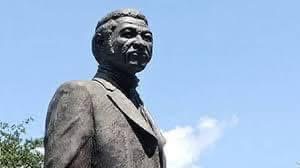
In 1990 African-American residents of Charleston proposed erecting a monument to Saint Denmark, memorializing how he tried to overturn slavery in this city. Many white patrons balked at the idea, noting that they did not want to commemorate one who they considered “a terrorist.” I mean, let’s totally IGNORE the Confederate statues that dot the city landscape (confirmed terrorists), but, whatever.
Racism is alive and well, Beloved.
Saint Denmark Vesey is a reminder for me, and should be for the whole church, that liberation has always been talked about in the Sunday School rooms of our churches…
We just don’t like to talk about it and conveniently have amnesia when doing so makes us uncomfortable and we’re the ones who have to change in order for liberation to happen.
Let those with ears to hear, hear.
-historical bits gleaned from publicly accessible information and Illes’ work Daily Magic.
-statue of Vesey below was finally erected in 2014 in Hampton Park, Charleston, South Carolina. Ed Dwight was the American sculptor.


 Reluctant Xtian