Wrestle with Life and Death

Calling all my Swedish friends! Today’s saint day is for you!

Today the church remembers a 19th Century saint who put pen to paper and out came some wonderful hymns and brooding poems: Saint Johan Olaf Wallin, Hymnwriter, Archbishop, and Restless Existential Wrestler.

Saint Johan was born in Stora Tuna in the late 1700’s and, despite being a sickly child, graduated from the University of Uppsala in 1799. He would go on to receive his doctorate of theology ten years later, and began serving as a parish priest in Solna.

Being a bright and capable pastor, he quickly became a bishop, a chief royal preacher of the King of Sweden, and then shortly before his death was consecrated Archbishop of Uppsala and Primate of the Church of Sweden.

Though he was a great pastor, he was an even better hymnwriter and poet. In 1805 and 1809 he was awarded the highest award for his poetry by the Swedish Academy, and during his life he composed and published a number of hymnbooks containing older hymns he adapted and new hymns he wrote. He was entrusted in editing the new Swedish hymnbook to replace the old one (which had been around since 1695…and people think we hang on to old texts!), and basically did the collecting, editing, and revising the whole thing because the committee assembled couldn’t agree on any drafts (sounds like church work).

King Karl XIV authorized the new Psalmbook (it’s name) in 1819. It included five hundred hymns, a fifth of which were written by Wallin himself.

The Church of Sweden used this hymnbook for over a century. In the next edition (1937) a third of the hymns were still written by Wallin.

On the personal side, Wallin was known as a brooding and rather “stormy-clouded” individual. He wrestled with life, and published an epic poem of restlessness, “The Angel of Death,” written during the cholera epidemic in Stockholm in 1834. He completed the poem just a few weeks before he died on June 30th, 1839 at the age of 60.

You’ve no doubt sung some of his words, and in the Lutheran Church in America’s hymnbook (SBH) his Christmas hymn “All Hail to Thee, O Blessed Morn” was put to Philip Nicolai’s (see October 26th for his saint day) well-sung tune, “Wie Schon Leuchtet.”

Saint Johan is a reminder for me, and should be for the whole church, that beautiful, wonderful, thoughtful people wrestle with life and death.

Indeed, without such wrestling we’d never have real poetry or music that speaks to the soul. Indeed, as Saint Elton of the John’s notes, “Sad songs say so much…”

-historical notes from Pfatteicher’s New Book of Festivals & Commemorations

-hymn found in SBH #33

Erstwhile Frienenemies

Today is a Feast Day for the church unlike most others in that it is a day where the church has, in death, tried to reconcile two saints who didn’t get along well in life.

Today is the Feast of Sts. Peter and Paul, Apostles, Arguers, and Erstwhile Frienenemies.

Simon, later renamed Peter, was identified as the rock upon which Christ would build the church. He’s a clear leader from the start, though imperfect, and took the helm after Christ’s ascension. He would become the first Bishop of the church.

Saul, later renamed Paul, was a rogue leader from the beginning. He had a vision for the Gospel that was not bound by ethnicity, race, or creed, and he pushed the boundaries the emerging religious leaders were erecting around this new wave of spirituality. He would become the first superstar of the church.

Peter and Paul did not get along well. Their quarrels are documented in the Acts of the Apostles, as well as the book of Galatians, with varying degrees of agreement between the texts. Their back-and-forth is emblematic of the kind of push-and-pull that the church would face when love for others met the hard barriers of cold doctrine and group identity.

I mean, this still goes on today.

Paul and Peter eventually did agree on one thing: that they would each continue to serve the poor. And they each did secure their own, separate, feast days around specific events in their lives: Peter’s Confession (January 18th) and Paul’s Conversion (January 25th).

But the church would not let their feud last forever and, after their deaths, decided to reconcile them on a single feast day. Most icons even have them kissing, or at least embracing, imagining that their honest love for the faith would overcome their seemingly honest contempt for the other.

Their issues in life would not follow them past the grave.

Maybe that’s one of the most beautiful things the church can offer a world as divisive as this one in these days: the chance to continue to work on loving and being loved even past the grave.

-historical bits gleaned from Pfatteicher’s New Book of Festivals & Commemorations, the Book of Acts, and because I study.

-icon written by Fr. Thomas Loya

From the Center

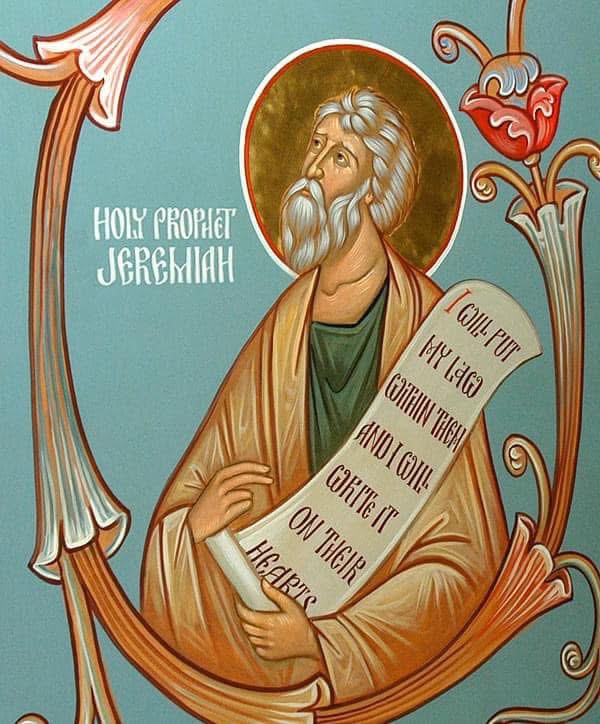
Today the church remembers a warning beacon of a prophet who sounded the alarm (but few heard it): Saint Jeremiah, the Weeping Prophet.

Saint Jeremiah lived between 650 and 570 BCE, telling truths during the 13th year of King Josiah of Judah. He was mentored in the prophetic tradition by Zephaniah and called into it by Divine voice in 626 BCE.

And what was the call?

To announce that Judah should reform and turn from their ways, or else destruction would surely come. Saint Jeremiah resisted the call, reminding the Divine that he was “only a child,” and not a great public speaker (a protest used by many prophets, I might add). These protests are pretty curious, of course, because it’s pretty clear from the beginning that Saint Jeremiah was an articulate speaker, and perhaps had been schooled in oratory in one of the early Jewish schools. In the Book of Jeremiah, of which he authored (along with 1 Kings, 2 Kings, and parts of Lamentations with the help of his trusty scribe, Baruch) Saint Jeremiah is said to have been fed words by God…an odd meal, I’m sure!

Ultimately the reforms that King Josiah (to his credit!) put in place seemed to not be enough to avoid disaster. Speaking the harsh truths that he did prompted many people to shun him, his family to plot to take his life, and ultimately he became a priest on the run. It’s important to note that Saint Jeremiah was part of the elite of the day, the inner circle, critiquing the power structures that kept the wealthy, wealthy, the powerful, powerful, and the hard-strapped, hard-strapped. With Saint Jeremiah preaching from the inside, and Saint Amos (the yin to his yang) preaching from the margins (as a simple farmer) years before, you’d think folks would have heard a little better, right?

But power is seductive. Money has a way of silencing dissent. Marx wrote that “Religion is the opiate of the masses,” but sometimes I wonder if health insurance and benefits are the true opiates…

Saint Jeremiah said that he tried to stop telling truths, but that the words burned his throat and tongue if it sat too long. Perhaps too many of us dull the burn with platitudes and “just waiting out the clock.” He called out the religious elites. He called out the political elites. He called out the ruling class.

And they threw him into a cistern, attempting to starve him. He was saved by Ebed-Medech, an Ethiopian, and eventually released from captivity by the Babylonian army.

Turns out, when Babylon laid siege to Judah, the Babylonians were the ones who understood mercy.

Saint Jeremiah is a reminder for me, and should be for the whole church, that sometimes critique must come from those sitting at the table.

-historical bits from publicly available information

-icon written in traditional Orthodox style

Quiet Brilliance

Today the church remembers the Siskel to Luther’s Ebert, the Bert to Luther’s Ernie, the Ginger to Luther’s Fred: Saint Philipp Melanchthon, Reformer, Renewer, and Editor.

Saint Philipp’s true last name is Schwarzerd, and he was born on February 16th at the end of the 15th Century. In Greek, though, his last name is Melanchthon, meaning, “dark earth,” probably a nod to his family’s farming heritage.

Saint Philipp was a great student and a natural talent. By the age of twelve he had already mastered Latin, and by thirteen had Greek under his belt as well. He attended both Heidelberg University and Tubingen where he was awarded a Masters Degree for his studies. He was brilliant, he was a humanist, and eventually he became the first professor of Greek at Wittenberg where he would encounter a grumpy, fiery Martin Luther in the Theology Department.

Luther encouraged Melanchthon to study theology as well as Aristotle, and he eventually started teaching that as well at Wittenberg, proving quite popular with the students. With this outstanding professor roaming its halls, Wittenberg became a leading university in Medieval Europe.

In the fall of 1520 Saint Philipp entered unwittingly into the arena of politics when he married the daughter of Wittenberg’s mayor. Their marriage was both a blessing and included a good bit of tragedy as two of their children died quite young. In this both Saint Philipp and our own Blessed Martin shared a similar heartache. All the same, Saint Philipp and his wife, Katherine, were known to be generous and hospitable to everyone they encountered.

In 1521 Saint Philipp published his Loci Communes, the first compilation of Lutheran doctrine ever assembled. But Saint Philipp was not only interested in theology. With Luther’s help, Saint Philipp would go on to tackle social issues in Germany, reorganizing schools and championing public education. It was Saint Philipp who would take the lead in the development of elementary and secondary education, making the study of the classics as the bedrock of public schooling.

Saint Philipp was often called upon to make appearances at debates and meetings where he would draft reports, refutations, and articles of reconciliation. He was a master writer and had a way of tempering Luther’s often bombastic treatises.

Saint Philipp never entered the priesthood, but rather played the important role of invested layperson. He died in Wittenberg just three years after his beloved Katherine in 1560. He is remembered on this day because today is the anniversary of the Presentation of the Augsburg Confession, the founding document of the Reformation. Melanchthon’s influence and pen is all over that document, and he presented it to Emperor Charles V at 3pm at his diet to settle religious controversies because Luther had already been excommunicated.

Saint Philipp is a reminder for me, and should be for the whole church, that every endeavor is a team effort. Luther would not have gotten far without Saint Philipp, who quietly, brilliantly, created the road on which the Reformation trod.

-historical bits from Pfatteicher’s New Book of Festivals & Commemorations

Decrease

Today the church celebrates the Nativity of John the Forerunner, you probably know him as “John the Baptizer,” popularly called the Cousin of Jesus.

John is the miraculous child of the aged Zechariah and Elizabeth, and we first hear of John’s movement in the world when a very pregnant Mary visits a very pregnant Elizabeth, and the still-wombed John leaps for joy.

John was religiously an Essene, otherwise known as a Son of Zadok, an extremist streak of Judaism known for odd behavior and dress. The Essenes focused heavily on repentance, rejected an immoral life, and publicly critiqued the rulers of the day, the Herodians.

This last part will get him killed in the end.

There are still followers of John the Forerunner in Iraq, believing that he is the rightful and true Messiah. They are a severely oppressed minority.

John’s birth day is no accident and is certainly not factually bound. The ancient church put it squarely six months before Jesus’ natal day, near the other pole of nature’s sequence, the Summer Solstice. As Jesus’ birth was placed near the Winter’s Solstice where light will ever increase, John’s natal day was placed near the Summer Solstice, where light will ever decrease, but never be extinguished. This dating of John the Forerunner’s feast pairs nicely with his own words in the Gospel of John (3:30) where the baptizer says, “I must decrease so that he might increase.”

Interestingly, Saint John the Forerunner is the patron saint of Quebec, and is celebrated all across French Canada.

Saint John the Forerunner is a reminder for me, and for the whole church, I think, that the call of the faithful is the call of both personal and societal critique. So much of what passes for Christianity today is focused too heavily on personal reform. John reminds us that our own internal reform should always lead us to call for societal reform.

Even if we lose our life in the process.

Not Like Us

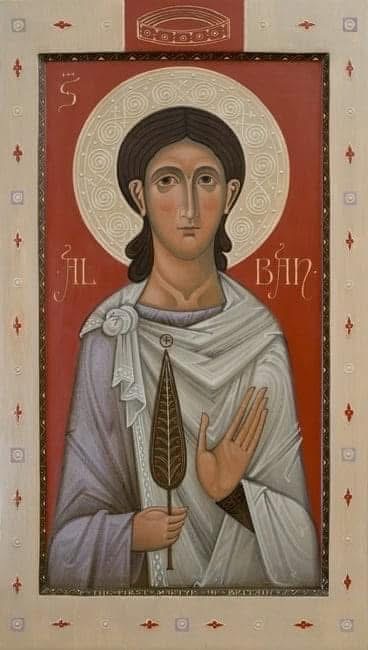
Today the church remembers a 4th Century saint that has largely been lost to history, but whose name continues to be used on church signs, street markers (even here in Raleigh), and a number of notable British towns and landmarks: Saint Alban, Master of Disguise and Martyr.

St. Alban was a Roman soldier stationed in what was then the far reaches of the Empire: Verulamium, twenty miles north of London on the British Isles.

One night a priest came knocking at his door seeking shelter from bounty hunter soldiers who intended to kill him for the reward offered. St. Alban took him in, and when the marauding soldiers came to his house, St. Alban dressed as the priest and let the old Father escape.

The soldiers took St. Alban, tortured him, and martyred him in place of the priest, even though they knew they had the wrong person.

At the place of the martyrdom an abbey, St. Alban’s Abbey, now stands.

St. Alban is the earliest person we know tied to the Christian faith on the British Isles, and he’s largely considered the first Christian martyr of Britain (though we have no knowledge of his belief system).

Personally, I like to think that St. Alban was not a Christian, but rather just a good human who understood that when someone knocks at your door intending to harm someone in your house for their beliefs, their skin color, or their heritage, you have no choice but to tell them the truth: there is no one in that house that they can take.

St. Alban is a reminder for me, and should be for the whole church, that sometimes salvation isn’t found in people who believe like you do, but rather in wonderful humans of every creed and stripe who just know the face of the Divine when they see it.

Let those with ears to hear, hear.

For the Solstice

On the Summer Solstice the ancient Celts would give thanks for our star.

They’d build fires on the tops of the hills, believing these fires would further fuel the sun. They’d bring their babies close to the fire as a blessing, and they’d dance and sing and daring couples would hold hands and leap over the flame for good luck.

Midsummer was a day of indulgence with shared feasts and partying and plays and dramatic re-enactments of all kinds. As the sun indulged the Earth on this day, so the people took the minute here as summer was half gone (summer on the Celtic wheel is May-July) to bask in the House of Light, as they called the summer fields and hills.

Tonight is a very appropriate night to light a bonfire, enjoy some food outside, and give thanks for our star without which none of us could live.

Mourning in America

Today is a day when the church laments.

It laments of white privilege which, by the way, I’ve had more than a handful of “good, God-fearing church members” tell me is fictional. What an ignorant pleasure it must be to ignore truth.

It laments of racism, in which it is (not has-been, is) complicit.

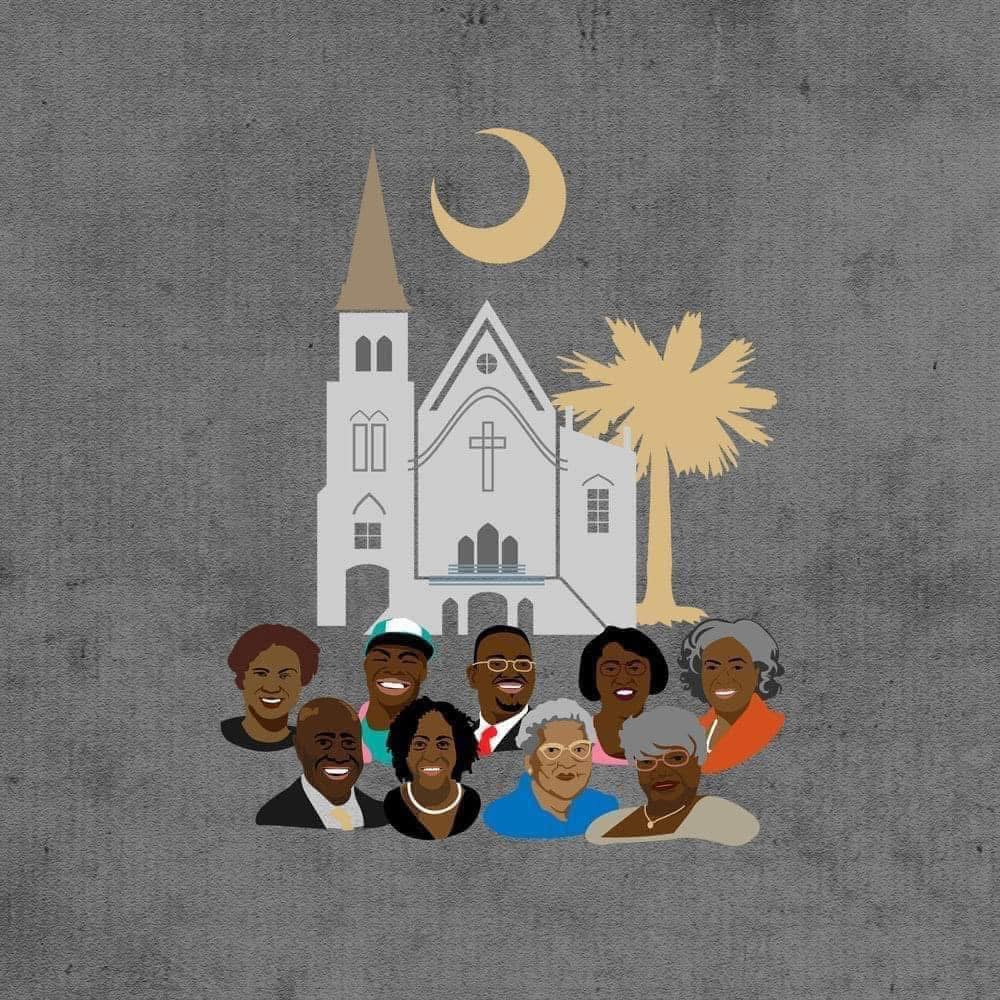
And it honors the Emmanuel 9, gunned down in Bible Study and prayer, after they welcomed the stranger, Dylann Roof, in their midst, a boy taught in a Lutheran church and raised on a supposed diet of grace and peace.

There are no fail-safes in this world, Beloved, not on guns nor gospel perversions.

Today I am reminded of the words of the Reverend William Sloane Coffin, my spiritual mentor and muse, when he said,

“Believers know that while our values are embodied in tradition, our hopes are always located in change.”

So as the Confederate monuments (real and metaphorical) continue to topple around us, as Mary predicted they would in Luke 1:52, we also today lift up our voices in confession for having erected too many racist monuments in our lives by the things we have done and left undone.

Indeed, in many cases the cross, our symbol, has become a racist monument, twisted into the swastika, burned in front of hanging bodies, a barrier between peoples.

But not just those literal monuments. Most especially we repent of all of the figurative ones we erect, too.

Today we cry and lament and work for that change which is the currency of our hope.

(art by Philippe Lazaro)

On State Violence

Today many parts of the church remember a duo of 4th Century saints, a mother and son: Saint Cyricus and Saint Julitta, Family of Fortitude.

Saint Julitta was of noble birth, living in Asia Minor. During the persecution of Christians during Diocletian, she is said to have fled to Tarsus with her young son, Cyricus. To avoid detection, she hid her noble status, and tried to pass as a typical citizen, but having been widowed early on in her life, had little protection in the eyes of the law. As she fled, Saint Julitta was captured by the governor of Tarsus, along with her child, and tortured and interrogated until she admitted she was a follower of The Way. Her son was said to have called for his mother even as she was being hurt by the system that sought their demise.

Legend has it that St. Cyricus, when grabbed by the murderous governor, scratched his face and screamed. They both were reportedly martyred for the faith, victims of state-sanctioned violence against the vulnerable.

So, here’s the thing Beloved: I make note of these two saints of the faith, obscure as they are, because I believe we are still witnesses to state-sanctioned violence against the vulnerable and the weak.

Saint Cyricus is a patron saint of children, one we need to lift up in these days where schools are still shot up. Saint Julitta is the patron saint of single mothers and, unfortunately, is the unwitting saint of mothers whose children are victims of state-sanctioned violence.

Black and Brown citizens are gunned down shopping for their daily bread, just two years ago. Babies were killed learning their ABC’s, just a year ago. And lest we think this happens occasionally: gun violence happens every day in this country.

Every day.

A unique occurrence here in America. Perhaps this is “American exceptionalism” at it’s most raw.

And it’s not like other nations do not have mental health crises. They do. What’s the difference?

Access to assault weapons.

Saint Julitta and Saint Cyricus are reminders for me, and should be for the whole church, that the state is absolutely willing to put up with violence, especially at the expense of the weakest amongst us.

But the church? The church cannot be willing to put up with it…and neither should the larger citizenry.

Let those with ears to hear, hear.

-historical bits gleaned from publicly available sources and from Judika’s Daily Magic.

-icon written in the traditional Greek Orthodox style

Modern Mystic

Today the church remembers a recent spiritual hero, Saint Evelyn Underhill, teacher of mysticism within the church.

Born in England and taught at King’s College in London, she was already a promising writer when she underwent a spiritual conversion. Initially drawn to Roman Catholicism, she eventually was unable to make the Catechumenate oath due to the church’s rejection of modernism.

Instead, she turned to the mystics, of all denominations, for spiritual guidance.

She devoted her time to compiling and anthologizing the writings and lives of saints and mystics, resulting in her tome Mysticism (1911). She then came under the influence of Baron Friedrich von Hugel, a spiritual director who led her to her own mystical experiences. This led to her second major work, Concerning the Inner Life, which incorporated the the life of the saints with her own reflections, ponderings, and insights.

She eventually joined the Anglican church, and led retreats for spiritual seekers. After her death various letters of hers were published, indicating that she cared for her retreat attendees long past their individual retreats.

A lovely quote she’s known for is, “A certain wise Prioress said, ‘Most books on religion have thousands of words–we need only one word, GOD–and that surrounded not by many words but by silence.'”

Saint Underhill is a reminder for the church, and for me, that the spiritual quest need not be found in one doctrine or under one umbrella but a seeker, in the end, should at least anchor themselves to one as a way of rooting and grounding. That rooting and grounding doesn’t prohibit you from exploring, but rather keeps you solid as you spiritually stretch.

-historical notes from Pfatteicher’s “New Book of Festivals & Commemorations”

-icon written by Schleckicons.com