Today is another sacred day: The Visitation, where Mary, “great with child” visited her elderly relative, Elizabeth, also miraculously pregnant.
Together they noted their hope and expectation that their children would change the world.
This hope and expectation is felt by every parent, I think.
I hope.
But on this convergence of holy days and extraordinary days, where a beautiful visitation is met with the reality that many parents fear for their babies when they go off to school, we must call to mind this hope and expectation again.
I hope that my boys will know and fight for the truth that Black Lives Matter. I hope that they will never fall victim to unmitigated gun culture, and will never get used to the sight of hand guns and machine guns carried in public and will stay away when they see them.
I hope that my children, and the children of those I love, will honor the lives of those who have died because of our addiction to violence.
I hope that my children, and indeed my own self, who give our lives to public service will never abuse that service.
And I hope that we will one day mourn our dead the way some mourn the loss of our supposed “rights” and economic structures.
That has yet to happen. That has yet to happen.
Beloved: we are all just visiting this life. Let us do all the good we can, while we can.
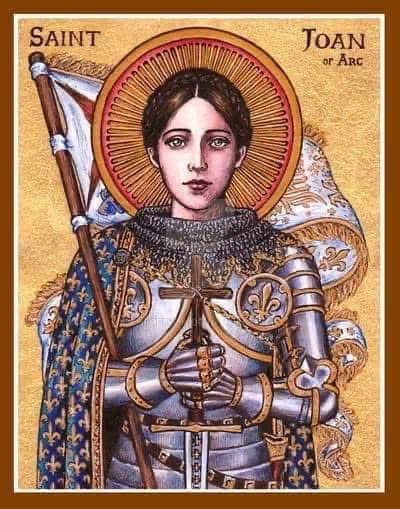
Today the church remembers a young teen with a calling: Saint Joan of Arc, Fierce Warrior and Visionary.
Saint Joan was born in Northern France to a peasant family in 1412, when Britain controlled most of France.
In 1428 Saint Joan traveled to Vaucouleurs to see would-be King Charles. She was rejected twice from his audience, but the third time is the charm. She revealed that she had received a vision from Saint Michael and Saint Margaret to fight for France’s independence.
At 17 years of age she entered the war to great prestige, and upon her arrival at the battle of Orleans, the city’s siege ended within days. She went on to fight valiantly and bravely in a series of other campaigns and in 1453 The Hundred Years War was ended in a French victory, (though some cities remained under British control) with French morale bolstered by stories of the young warrior.
King Charles was coronated with Saint Joan by his side.
Joan continued her campaign for a unified France, she joined an assault on occupied Paris. The attempt failed and Joan was wounded.
In 1430 Joan assembled an army of volunteers to continue fighting for France, and she was captured by Burgundians. In captivity a pro-English bishop put her on heresy trials and, once convicted, she was burned at the stake on this day in 1431 at the age of 19.
About a decade after her death her trial was overturned by Pope Callixtus III, and she is now considered a national symbol for the French people. And though she was only officially canonized in 1920, she has long been venerated by the faithful seeking an inspiring story of a young person’s ability to influence global events.
Saint Joan of Arc is a reminder for me, and should be for the whole church, that the young are powerful and should be given the opportunity to act on it.
Today the church celebrates one of our calendar-contingent feast days: The Feast of the Ascension.
Or, in German, Himmelfahrt (which is much more fun to say).
In Norwegian it’s Himmelfartsdag (even more fun to say).
But, I digress…
The Feast of the Ascension follows the Biblical pattern of 40, and finds itself a square 40 days after Easter. That Biblical pattern of 40 is meant to be a touchstone for those who pay attention.
40 days and 40 nights of the floating ark. 40 years of wandering for Israel. 40 days of temptation in the desert for Jesus.
This is not coincidence, Beloved, but rather a repeating tracer by Biblical writers to say, in a concise way, that 40 is “when you’re at your wit’s end” and you can’t take anymore.
When it comes to the Ascension, though, it’s flipped. The Biblical account notes that Jesus appeared to the disciples, and a few random folx, for 40 days and then exited stage left. It’s kind of like the Divine has “had enough.”
Why?
Because if Jesus had stuck around, the disciples never would have. We love to get attached to things and then depend on them for the hard lifting, right?
If Jesus had stuck around, the church would never learn to lean on one another (I mean…they’re still struggling to do that 2000 years later, right?).
Just like birds are kicking the chicks out of the nest in these May days, saying, “You’re made for this!” the Ascension is a way to explain that Jesus isn’t showing up in the same way anymore.
So you, Beloved, have to.
In fact: you’re made for this.
-art by Bagong Kussudiardja (Indonesian, 1928–2004), Ascension, 1983
Today the church honors 17th Century hymn writer and “Luther of the Slavs,” Juraj Tranovsky.
Tranovsky is heralded as the creator of Slovak hymnody. He studied at Wittenburg in 1607, and became a wandering educator, taking posts throughout Bohemia and Moravia.
Tranovsky was ordained in 1616, but soon toleration for Lutheranism in Bohemia came to an end, and he was imprisoned in 1624. The next year a plague came upon the world, and the following famine killed three of his children and caused the scattering of half of his congregation.
He was eventually called to a church in Liptov, Slovakia, and served there until his death in 1636 after a long illness. He was 46 years old.
He was a lover of poetry and a composer of many hymns, composing them in both Czech and Latin. His hymnal, the Cithara Sanctorum (Lyre of the Saints) appeared in 1636, and is the basis of Slovak Lutheran Hymnody to this day.
It is often forgotten that the Slovak tradition within Lutheranism continues even today, and has offered a great wealth of hymns, doctrinal distillations, and translations of important documents to the Lutheran movement throughout the ages.
We still sing, in the ELCA, one of his hymns to this day, ELW 602, “Your Heart, O God, is Grieved.”
With this lingering pandemic, and in the shadow of the killings in Uvalde and Buffalo and the massacres still happening, the words of the first stanza speak something to me today.
“O God, Father in heaven, have mercy upon us. Your heart, O God, is grieved, we know, by every evil, every woe; upon your cross your forsaken Son our death is laid, and peace is won.”
-historical notes from Pfatteicher’s “New Book of Festivals & Commemorations”
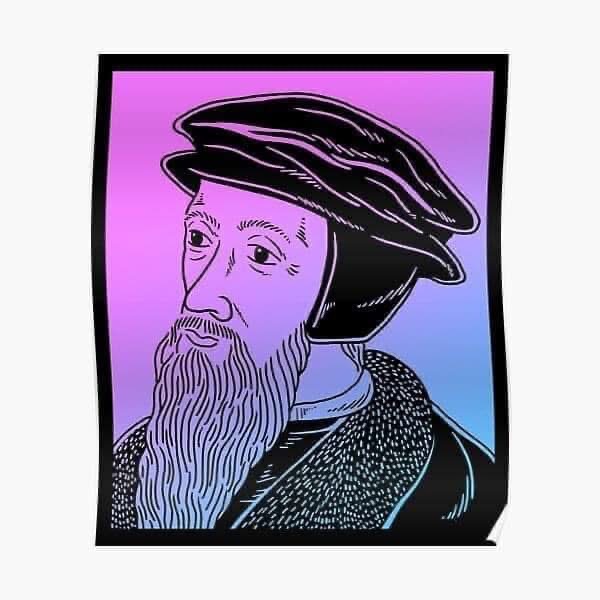
Today the church remembers a theologian who was probably a little too smart for his own (and our) good: Saint John Calvin, Renewer and Reformer.
Calvin was a serious child, and would grow up to be a very serious adult. He had a logical mind, and was not prone to swings of emotion (like Luther), but rather relied on formulas to make sense of the world, for better or for worse. He was well read, and devoured Augustine and books on grammar and rhetoric. At the age of 19 he had already earned a masters degree.
Calvin studied law at first, like many who would go on to serve the church (looking at you Luther), and as his father had recently been excommunicated over some legal issues, Calvin’s love of theology stayed strong but his relationship with the church was frayed.
After his father died, Calvin officially broke with the Roman church and joined the Reformation movement in 1533. He left France, settled in Basel, and began publishing theological works in earnest. Institutes of Christian Religion was put in print in March of 1536, and he eventually found himself in Geneva, organizing the Reformation movement there. He developed a theocratic organizational schematic for the church there, but was eventually invited to leave Geneva when his formulaic approach came into conflict with the popular Zwinglian practices adopted by many of the patrons of the city.
Calvin found himself under the care of another famous player in the Reformation, Martin Bucer, and stayed in Strasbourg for a time. There he married Idelette de Bure and had a son, adding to her two children from a previous marriage. Idelette died 1549, and Calvin cared for his new, young family as a widower.
Geneva came calling again when a pro-Calvin faction of Protestantism took political power. Calvin once again returned to that city, and under the new constitution developed the four-fold ministries of the Calvinist church: pastors, teachers, elders, and deacons.
Calvin continued on in Geneva, often taking in religious dissidents from other places in Europe, and died on this day in 1564. He was a powerful preacher and prolific writer, and his strict and unbending theological ideas remain in place today (though some of them bend a bit these days).
St. Calvin is a mixed bag for me. Though he certainly pushed theological thought and hastened the needed reformation of the church, his ideas could be extreme and simplistic in their rigidity, especially around election and atonement. He didn’t leave much space for beauty and mystery, and uber-Calvinist strains of Christianity often lead the way in bulldozing other ideas that fall outside of familiar doctrinal formulas.
That all being said, he is a reminder for me, and should be for the whole church, that while we do need some formulas for understanding metaphysics, art and beauty can’t be trampled in the process or else we lose our ability to stand in awe at the ineffable.
-historical bits gleaned from Pfatteicher’s New Book of Festivals & Commemorations
-icon written by dinosareforever and can be purchased at redbubble(dot)com.
Today the church remembers a goofball saint whose brilliance was often wrapped in a joke: St. Philip Neri, Jokester, Vegetarian, and Confessor of the Church.
St. Philip Neri was born in a post-Renaissance world ripe with schism. The Reformation began while he was an infant, and the church landscape was changing rapidly in his formative years.
As he entered his late teens he abandoned dreams of going into business, and instead moved to Rome to study Theology and Philosophy, diving deeply into the spiritual life. The waters he found there, though, were not to his liking, and though he enjoyed his studies he decided not to become ordained at that time.
Instead, St. Philip became what most of the church is: an invested layperson with a keen spiritual life.
St. Philip’s problem, though, was that everyone liked him, and his popularity was making it harder and harder for him to turn down ordination. This was especially true as the Council of Trent in the mid-1500’s was starting to re-imagine what the Roman church would look like (and people wanted St. Philip Neri to be a part of that shaping).
St. Philip was eventually ordained and became what too few pastors were (and, maybe, are?): an outstanding preacher and confessor. He used image and metaphor and allusion to tie together disparate parts of the faith into lovely and meaningful sermons.
And, he was funny!
His two favorite books were the New Testament and a joke book. Seriously.
He founded The Oratory, a group of priests living together, that included amongst their rituals of Mass, prayer, and fasting, times to “just chat” and compose hymns and speeches together. While this looked suspicious to many in the church, it was eventually accepted as a movement that embodied the ideals of the faith.
St. Philip Neri was also known as a lover of animals, and is often depicted in icon form holding his pet dog, a Maltese. He was an advocate for vegetarianism, and would often free captured birds he found in the market or on the street…and then the birds tended to follow him around. He went so far in his defense of all living things, that he wouldn’t even swat away flies, but constantly left the windows open so that they could escape.
St. Philip Neri died on this day in 1595 while he was hearing Confessions. He was quickly beatified, and is still held in high regard across the church catholic for his keen intellect and his gaiety.
As an example of his fun nature, he one time told a woman with a propensity for gossip that, as penance, she had to throw a bag of feathers in the air and pick up every one. She protested, saying it would be impossible. “Ah,” St. Philip said, “you see, that’s exactly what it’s like with gossip. Once you let those words out, you cannot gather them back in!”
St. Philip Neri is a reminder to me, and should be for the whole church, that we don’t have to take ourselves too seriously. After all, it’s just life, folks…
-historical bits gleaned from Knoenig-Bricker’s 365 Saints
-icon written by Br Robert Lentz and can be purchased at Trinitystores.com
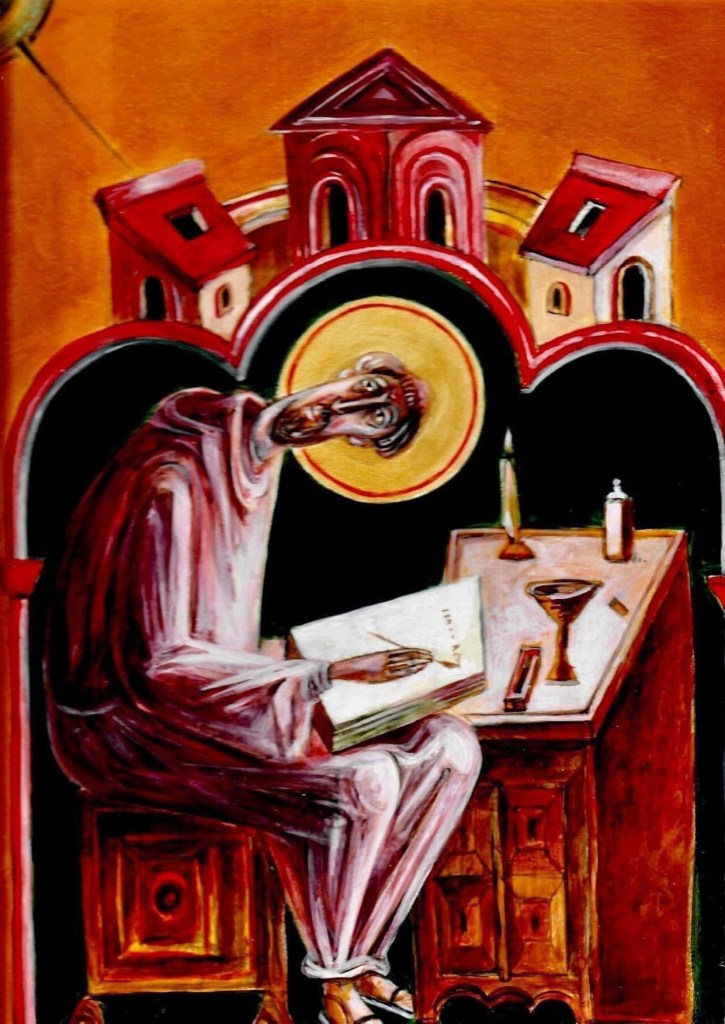
Today the Church remembers an 8th Century Saint who lived an uneventful life (which is what makes him interesting): St. Bede the Venerable, Monk, Priest, and Scholar.
St. Bede, known as “the father of English history,” was born in the late 7th Century near Durham, England. At the age of seven his parents dropped him off at the new monastery in Wearmouth to be educated, and he quickly grew in both learning and stature as being intellectual and wise (a combo that don’t always run in tandem).
He was ordained a Deacon at the age of nineteen, and became a priest at the age of thirty.
St. Bede devoted his life to scholarly pursuits, and could often be found in the monastic library. It is thought that he was the most learned person in Western Europe, and dabbled in history, grammar, metrics, understanding time (still an abstract topic!), and, predictably, the Scriptures.
He wrote An Ecclesiastical History of the English People (in Latin) which remains a primary text for understanding the 6th, 7th, and 8th Centuries of Anglo-Saxon culture and the ascendency of Christianity on the island.
St. Bede received the title of “Venerable” in accordance with the practice of the time as awarding that title to anyone who proved themselves as knowledgeable and holy. For him the title seemed to stick more than others in history.
St. Bede the Venerable died on Ascension Day in the year 735 A.D. while he was in the middle of dictating an English translation of John’s Gospel.
St. Bede is a reminder for me, and should be for everyone, that your life doesn’t need to be remarkable to be remembered.
-historical bits from Pfatteicher’s New Book of Festivals & Commemorations
-icon written by Mull Monastery Icons (in it you can see St. Bede leaning close to the scriptures to listen for God’s voice)
It was just two years ago when we stopped for a moment to reflect on the reality that Saint Tina of the Turners, who taught us to dance, had made her final move.
She taught us that you can attempt self-harm and survive and change other people’s lives because healed people can heal people.
She taught us that you can fight back when abused. You don’t have to stay in abuse.
She taught us what forgiveness looks like when she said she’d forgiven Ike, but also reminded us what self-love looks like when she said she’d never work with him again.
She taught us how to sing from our guts and how you can be the CEO of your own story even as others try to take it from you.
She was a true triple threat: singing, dancing, and acting.
Today the church remembers a star-gazer and mathematician whose mother called him Mikolaj Kopernik, but who you know as: Saint Copernicus, Revolutionary Thinker and Mapper of Worlds.
Born at the tail-end of the 15th Century in Poland, Saint Copernicus was privileged to have a successful copper merchant as a father. Yet he would taste bitterness before he hit his teens, as his parents died when he was still young and he was sent to live with his minister uncle.
In 1491 he entered the University of Krakow and developed a keen interest in astronomy. He would go on to study at the University of Bologna and spend hours reading and discussing Plato while he waited for familial strings to orchestrate an appointment as a canon of Frauenburg Cathedral (where he could live with some financial security).
This eventually happened, but Saint Copernicus had become an addict of education and refused to stay there.
Feeling like he didn’t yet know enough to be enough, he went on to study law and medicine at the University of Padua and in 1503 graduated with a degree of Doctor of Canon Law at the University of Ferrara. He settled back into Frauenburg and began to serve the poor and his medical knowledge.
All the while Saint Copernicus continued to look at the stars with fascination and profundity. He had given up on the reigning Ptolemaic geocentric model of the universe and thought there was something better to describe what was going on in the vast, crowded emptiness that was colloquially known as “space.” The geocentric model of the universe was increasingly unintelligible, even as theologians and scientists tried to defend it, and this moved Saint Copernicus to ponder an ancient idea that was much simpler and explained things a bit clearer: heliocentricity.
He started to run his own experiments with his crude instruments and though he became convinced of his own idea, convincing others would be dangerous and difficult.
In 1530 he published a private document, shared mostly amongst friends, that sufficiently argued his theory. His friends, being good friends, told him that he should publish it immediately. Copernicus, though, was hesitant. Heresies were not exactly embraced by the church nor society. Look what happened to Luther!
After years and years of hemming and hawing, Copernicus eventually sent one of his pupils, a Georg Joachim Rhaticus, to head to Nuremberg to get heliocentricity in mass publication. His thoughts were published with an unauthorized preface by Lutheran pastor Andreas Osiander where Osiander tries to soften the theological and scientific blow of the work by qualifying it, saying that a stationary sun “is only a convenient and simple way to describe the universe.”
As Copernicus lay on his death bed with only a few hours of breath left in his body he was brought his published work, The Revolution of the Heavenly Bodies, and he died without knowing the universe-shattering implications his models would have on the world.
His book was quickly banned, despite its truth (looking at you Florida and Tennessee) until 1758, and is now considered the prevailing model for understanding the movements of the observable heavenly bodies.
Saint Copernicus was not an especially devout Christian. In fact, it’s pretty clear he thought his ideas put him outside most church circles. Yet his ideas would eventually force the church to become more humble in the face of science, a lesson the church continues to need to learn. If God has given humanity brains to delve into the mysteries of the universe, our reluctance to do so just because we might have to reorient our thoughts is unfaithful to a creator who would give us such capabilities.
Saint Copernicus is a reminder for me, and should be for the whole church, that when presented with better evidence and better understanding, turning a blind eye to new knowledge is not only chosen ignorance, it’s unfaithful, by God.
-historical bits from Pfatteicher’s New Book of Festivals and Commemorations
-icon written by the fine artists at San Miguel Icons (sanmiguelicons.com)
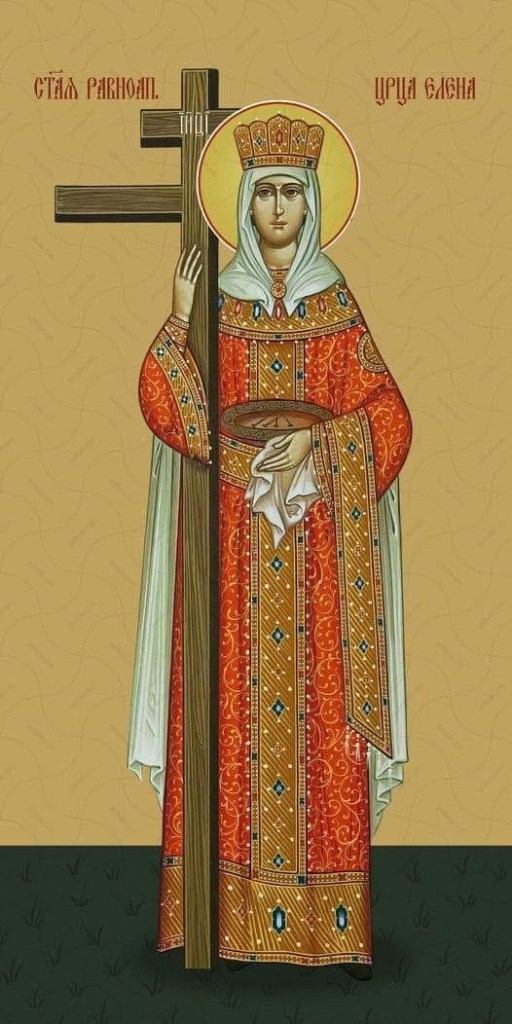
Today the church remembers a saint who went on a search for lore and said she found what she was looking for: Saint Helena, Mother of Emperor Constantine and Seeker of Relics.
Saint Helena’s childhood is a bit of a mystery. She was probably born in the Roman empire to a poorer family, though this is unconfirmed. She somehow found herself wedded to power, however, in the form of Constantius Chlorus who would become co-regent of the Western portion of the Roman empire. They had a son in the late part of the 3rd Century and named him Constantine.
Not one to pass up a political power play, Constantius divorced Helena and married Theodora, the step-daughter of the then Emperor (Maximinianus Herculius), making him next in line.
Constantius died in 308, and Constantine took the throne. As he ascended those steps, he brought his dear mother along with him, making her one of the “in crowd” again. Constantine ordered the empire to revere his mother as much, if not more, than he himself did, and under his influence Helena slowly converted to Christianity.
Now that she was the Empress of the land once again (Augusta Imperatrix was her official title), a newly revitalized Saint Helena undertook Indiana Jones-like quests to explore the life of Jesus on foot. Constantine charged her with finding any relics that she could relating back to the life of Jesus.
In her search for relics, Saint Helena built churches on the “sites” where she believed Jesus did important things like, oh, get birthed and ascend into heaven. These churches are still there in Jerusalem, including the one on Golgotha. Emperor Hadrian had built a temple to Venus on the site, and Saint Helena ordered it to be demolished. Lore has it that in the excavation they found three crosses, the middle being the cross of Christ.
Saint Helena supposedly recovered the nails used in the crucifixion, parts of the rope that bound Jesus, parts of his tunic, and parts of what is called “the true cross.” She took these back to Rome with her, and you can see all of these supposed relics still, the pieces of the cross being held at the Basilica of the Holy Cross in Jerusalem.
Now, of course, this is all very fantastical, right? Truly is unbelievable…and yet some do.
One of the issues is that the search for the historical Jesus will always come up lacking. No amount of splinters or threads of yarn can patch together what is actually being sought in that journey: verification.
Faith can’t be verified.
One of the gifts that Saint Helena did do was provide the world with beautiful things. The churches she started at these “holy sites” are truly remarkable, even if they may built on wishes and hopes. Sometimes that’s all we have.
Saint Helena is a reminder for me, and should be for the whole church, that even though we seek out verification regarding the matters of the faith, we won’t find them. But, seek we still do, and as we do it I hope we make some beautiful things along the way…







 Reluctant Xtian