The Great

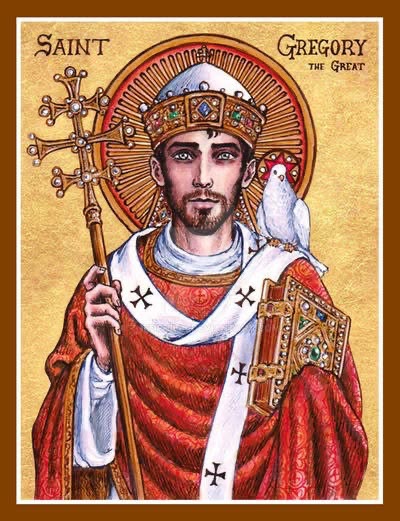
On March 12th the church honors and reveres one of the most dedicated early leaders of the church: Saint Gregory the Great, Bishop of Rome and Reformer of Liturgies.

Saint Gregory the Great (you can call him Greg) was born into an important family in the middle of the 6th Century who had long been converts, his grandfather having been Pope when he was young and full of dreams. Saint Gregory was born into great wealth, had the benefit of a world-class (for the time) education, and became a Prefect of Rome (basically an Alderman), was in the Roman Senate, and proved that ambition and the roll of the privilege dice were all that were needed to be in the seat of power.

And then his father died.

In the shadow of this death, something happened to Saint Greg and he decided to not only become a monk, but turn his family home into a monasttery and give most of his inheritance to the poor.

Saint Gregory was ordained and was sent to Constantinople, learned about the church in the East, and then returned to Rome to become the personal counselor of Pope Pelagius II. While in Rome a plague devestated the city killing masses, including Pope Pelagius.

Once again Saint Greg would be called to take the seat of power, becoming Bishop of Rome in short order, but not being consecrated for a bit because the church of the East had to first give its blessing. While he waited to assume the miter Saint Greg kept himself busy by personally tending to the sick and dying in Rome, leading the people there in prayer for release and relief.

As if the plague wasn’t enough, in 592AD the Lombards besieged Rome. Because so many of the civil leaders had died of the rampant sickness, Saint Greg was the one to rally the people to defend the city and contribute to the rebuilding through a yearly tax.

Saint Greg basically became a real-day superhero for many in Rome. Civil government had failed. Appeals for help from others (looking at you Byzantine Empire) had failed.

Saint Gregory had empowered them to succeed and get through it.

And not only that, Saint Gregory the Great had done it with care and compassion for the poor and calls for justice for the needy. He instituted liturgical reforms, even presiding at a variety of parishes himself, writing chants and prayers (you know them as “Gregorian”), calling for the Alleluia to be sung except during Lent (you have him to blame), changing the second petition of the Kyrie to “Christ have mercy…,” reminding priests that their sermons needed to be timely and good, and to cap it off he stuck the Lord’s Prayer to the spot in the Mass where it currently remains during the Eucharistic rite.

He was busy. He claimed that he saw himself as the “servant of the servants of God.” Not a bad way of looking at the office, no?

But for those of us who come from the Isles, we know of Saint Gregory mostly because it was the missionaries he sent who decided to talk about Jesus in the frigid north of Briton.

Saint Greg was not particularly brilliant (relatable content), nor was he supremely profound (ditto), but he was known as sincere and masterful at understanding how power can both trample the people or elevate them, and he chose to elevate them.

Though he described himself as “sickly” his entire life, and said he longed to live as a simple monk somewhere in the countryside, he lived a very robust and public life until his death on this day in the year 604AD. Though our Roman siblings honor him in September (so as to avoid his feast during a potentially penitential season), Lutherans prefer to honor him today.

Saint Greg the Great is a reminder for me, and should be for the whole church, that you don’t have to be brilliant or profound to be kind and make a whole lotta damn difference in this world.

Let those with ears to hear, hear.

-historical bits from Pfatteicher’s New Book of Festivals & Commemorations

-icon written by Theophilia at DeviantArt (where you can purchase it)
Oh The Lord is Good to Me…

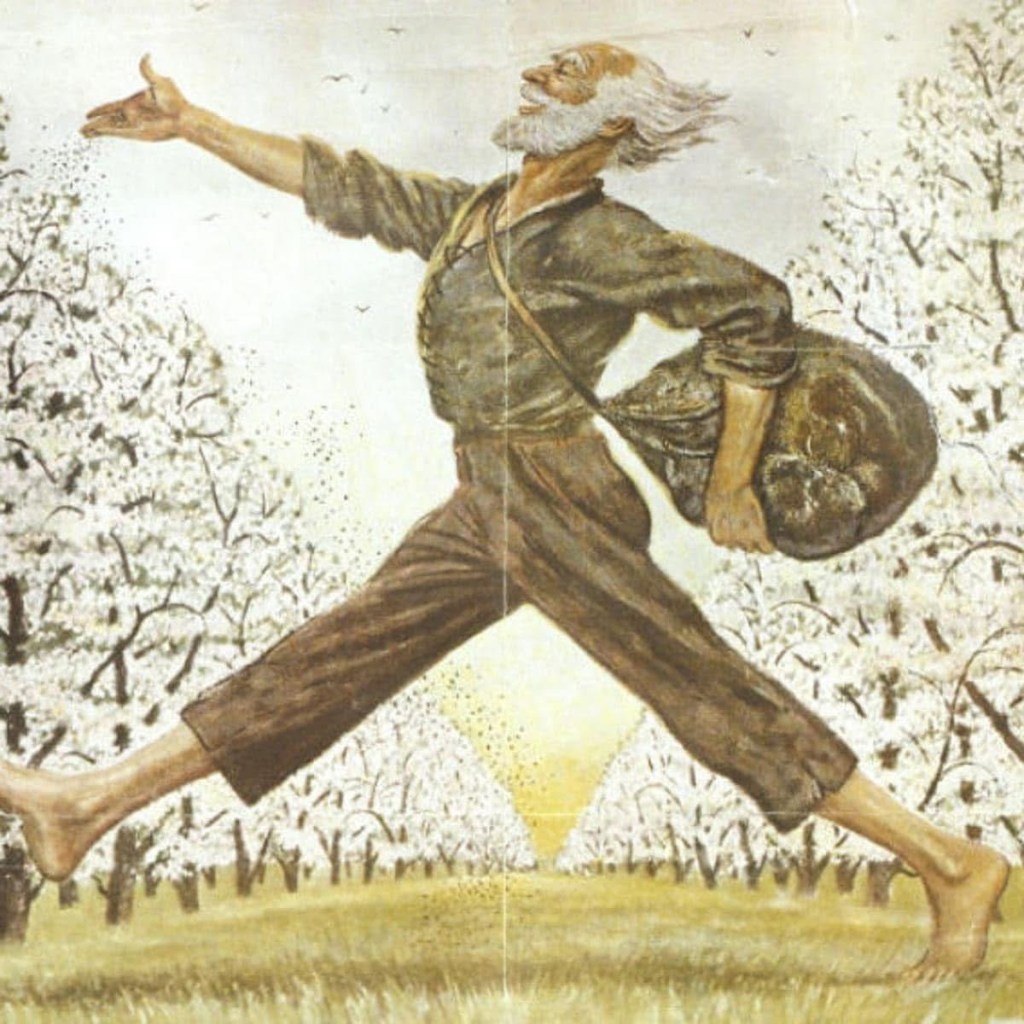
Today we remember a legendary (literally) character in Americana: Johnny Appleseed, Evangelist and Erstwhile Ecologist.

Born John Chapman in the late 18th Century, Johnny’s mother died at a young age leaving him and his infant sister in the care of their father, a Minuteman who fought at the Battle of Bunker Hill.

At the turn of the 19th Century a young adult Johnny shows up in Pennsylvania, tossing around apple and pear seeds like they’re confetti at a ticker-tape parade, espousing the philosophical and religious teachings of a certain Emanuel Swedenborg, a Swedish spiritual teacher.

Yeah. All you forgot about that, didn’t you?

Because he carried around these seeds and threw them everywhere, wanting to “provide shade for all travelers,” Chapman became known as Johnny Appleseed. But chiefly he was a religious fanatic (not in a bad way, just was), preaching the Swedeborgian philosophical beliefs as he went along. With a pack of apple seeds you also got a free religious pamphlet, as if to say, “Please, throw this away for me.”

As unusual as his journey was, his dress was just as odd for the times. Like a mirror of John the Baptizer, Johnny traveled barefoot with a broad-rimmed hat, to keep the sun out of his eyes. He traveled largely by horseback or canoe, and lived off of the extreme kindness of strangers who found a place for the young evangelist at their supper tables.

Though Johnny’s birthday falls in September (and some heretics honor him in that month), the sane Americana-lovers like myself prefer this March date because now is the time of planting.

Do yourself a favor and check out Swedeborgian churches. There are some still in the United States, though it’s a quickly-shrinking religion.

One final note, and this is worth remembering: though Johnny Appleseed dressed funny and espoused an unusual religious creed, most every legend or personal account of him notes his pure kindness.

Honestly: despite all our quirks, if we’re remembered just for that…that’s a pretty good life.

“Oh, the Lord is good to me, and so I thank the Lord,
for giving me the things I need: the sun, and the rain,
and the apple seed.
The Lord is good to me. Amen!”

Protector of Humanity

Today the church remembers a 19th Century saint who deserves to be remembered much more widely than she is: St. Sojourner Truth, Abolitionist, Voting Rights Activist, and Fierce Protector of Humanity.

Born in New York under the name Isabella Bomfree, St. Sojourner was bought and sold four times by people who thought they could own other people. At 15 she was joined with another slave and birthed five children, eventually fleeing slavery with her infant Sophia to take shelter with an abolitionist family. That family bought her freedom for $20, and helped her sue to have her son Peter returned to her after he was illegally sold to a family in Alabama.

St. Sojourner Truth moved to New York City and, joining the Black Church movement there, became a charismatic speaker and preacher, proclaiming in 1843 that the Holy Spirit had called her to be renamed Sojourner Truth. In New York City she joined forces with Frederick Douglass and William Lloyd Garrison in decrying the demonic pandemic of slavery that spread across the land. She also began speaking out for women’s suffrage, taking up the mantle with Susan B. Anthony.

In 1851 she went on a national tour in the North, famously delivering her “Ain’t I a Woman?” speech at a women’s suffrage conference in Akron, Ohio. At six feet tall, St. Sojourner brought the audience to attention by pointing out both her strength and femininity make her extremely powerful in equal measure.

St. Sojourner eventually settled in Battle Creek, Michigan to be near her three daughters and help them raise their families. From her outpost in Michigan she continued to preach, speak, and help fleeing slaves escape to the North by providing safe harbor. As the Civil War began, St. Sojourner encouraged soldiers to join the cause of freedom, and became a gatherer of supplies for black Union troops. Because of her efforts, many black regiments were outfitted in ways that the neglectful Northern Army reserved only for white regiments. After the war she was invited to the White House to meet President Lincoln, and began on a new course in life to help the freed slaves find jobs in a fractured America.

Having spent her life as an advocate for others, St. Truth died in 1883 having used up most of her physical faculties (she was both hard of hearing and legally blind at death), but retaining her mental tenacity.

St. Sojourner Truth is a reminder for me, and should be for the whole church (and all people), that the moral arc bends toward justice, but the Divine calls upon all of us to aid in the bending, by God.

Even if it takes a lifetime.

My favorite quote by St. Sojourner is,

“That man say we can’t have as much rights as a man ’cause Christ wasn’t a woman. Where did your Christ come from? From God and a woman. Man had nothing to do with it.”

-historical bits gleaned from entry in the National Women’s History Museum

-icon from St. Gregory of Nyssa Episcopal Church, San Francisco

He Ain’t Heavy…

Today the Church remembers a saint who embodied that old tune, “He ain’t heavy…he’s my brother…”: Saint John of God, Patron Saint of Those Struggling with Mental Health.

Born Joao Duarte Cidade at the tail end of the 15th Century, he would spend his first years shrouded in mystery as he was abducted from his parents at the age of eight, though history has lost why or how this happened. Though he was born in Portugal, he found himself as a young boy living on the streets in Spain, and eventually was taken in by a man named Francisco Mayoral, and became a shepherd for the sheep of the estate.

Francisco took a liking to young Joao, and asked him to become betrothed to his daughter. But Joao wasn’t really feeling the marriage thing, and so as to not have to keep turning Francisco down, he went off to join Charles V in the Crusades. Military life wasn’t for him, though, and he got caught up in some unfortunate mishaps and ended up being falsly accused of stealing some of the treasure that, ironically, had also been stolen in the campaigns.

He went back to the hills of Spain disheartened, but enlisted again to fight another war. For 18 years he was a soldier and, having served his time, wound up back in Portugal in search of his family roots. He tracked down one of his uncles who told him of the sad state of his birth parents: his mother died shortly after his kidnapping from grief, and his father had become a Franciscan monk and had also died years later.

Once again Joao felt homeless and people-less, and felt an urge to visit the contentint of Africa to find purpose. On his way there he befrieded a Portuguese knight who had been exiled to the furthest reaches of the kingdom with his family. Joao traveled with them and after they arrived in Ceuta (a northern part of Africa then colonized by Portugal) it became clear that the knight’s possessions had been stolen in travel, and the whole family came down with severe illness. The knight begged Joao to care for them, and Joao took on the role of nurse, caring for the family’s daily needs and tending to their illness.

He had found his purpose.

Despite feeling purpose in caring for the knight and his family, Joao struggled with his mental health and some guilt for not having been a person of faith in his younger years. He sought Franscicans to help him sort through this anguish, and they encouraged him to return to Spain and seek God’s will for his life.

Arriving back in Spain, Joao began to wonder, waiting for God to speak to him. It was here that he had a vision where the infant Jesus spoke to him, naming him John of God, a name he would assume moving forward. He also came under the spiritual direction of John of Avila, and in what can only be described as an acute mental breakdown, began harming himself and begging forgiveness from God and anyone he met for wrongs he felt he had done.

John of Avila soothed John of God, and encouraged him to start once again healing people rather than beating himself. Spiritual Direction had reminded him of his purpose.

He went on pilgrimage to see the Black Madonna of Guadelupe and heard a Divine voice telling him to care for the sickest in the world. He did so, establishing a home for the healing of those the world wouldn’t touch, often carrying the sick there himself. He had a practice of giving his cloak to anyone who asked for it, and this happened so often that the Bishop of Tui had a habit sewn for him so that he would no longer be seen walking around in almost nothing.

Saint John of God’s devotion brought others to join him in mission. He organized the group into the Order of Hospitallers, and it was approved as a Holy Order in 1572,

Saint John of God died on this day in 1550. It is his birthday, and he was only 55 years old. His order continues on to this day, however, and has the distinction of being charged with caring for the help of the Bishop of Rome, the Pope himself.

Saint John of God is reminder for me, and should be for the whole church, that those who have mental health struggles are sometimes best equipped to touch the needs and wounds of others. They have known the shadows of the soul, and can help lead others through those shadows into healing.

-historical bits from public sources and Illes’ book Daily Magic

-icon written by Noah Gutz

Leading the Way

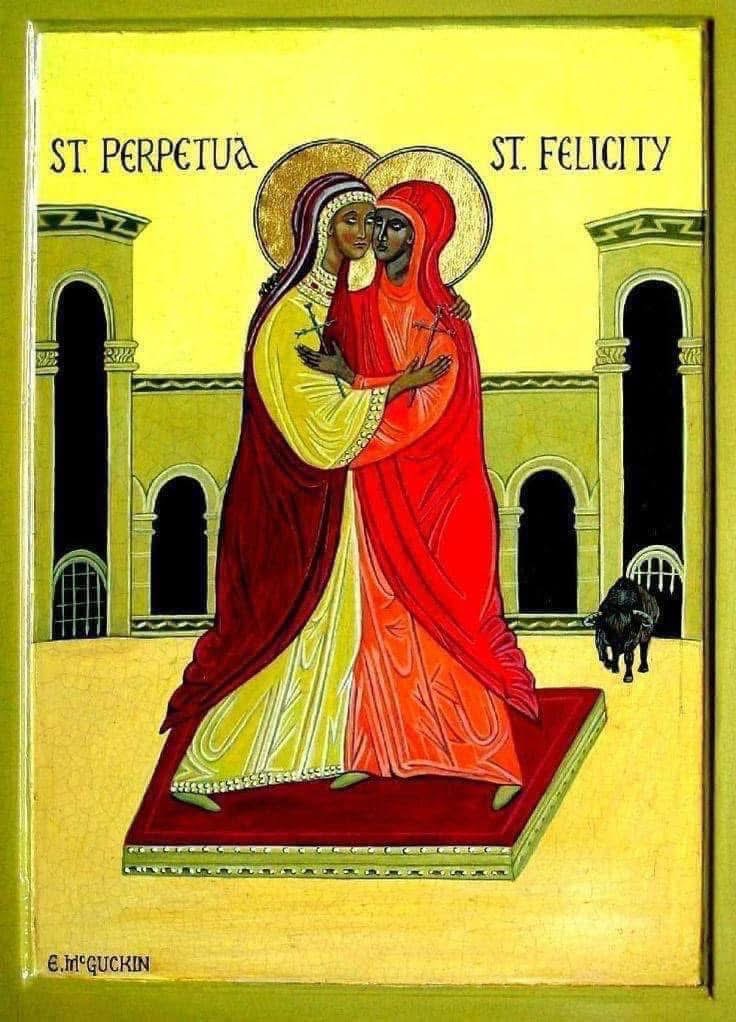
Today the church honors Perpetua and Felicity, 2nd Century North African martyrs arrested just as they were preparing for baptism.

In Perpetua’s writings we have the earliest confirmed first-person account of a woman’s journey with the faith, especially her last days waiting for execution.

It’s poetic that her name means “unending,” and Felicity’s “articulate” as we see their story continue through the women who journey in the faith today, especially as Deacons, Deaconesses, and Pastors, who serve with distinction and articulation.

And using their life as a lens, we can also hear the cries of the women who are arrested or otherwise obstructed from obtaining those things they greatly desire and work hard for: promotions, border crossings, equitable pay, voting rights, and freedom.

Perpetua and Felicity are usually depicted together, often embracing, as they had a deep friendship, and perhaps even a partnership.

St Perpetua and St Felicity are another reminder for me, and should be for the whole church, that women led the way in the ancient church, and still do today.

Background on Carnival and Ash Wednesday

After the church and the empire had joined hands, the rhythm of the church year was overlaid on the rhythm of the ancient celebrations of humans.

Ash Wednesday, the day of penitence, became a massive event; a “full Nineveh moment” in the face of the “holy” church’s Jonah proclamation: “Repent, lest ye be damned!”

Sackcloth. Ashes. Solemnity. That was the prescription. Interestingly enough, the diagnosis was proclaimed by the entity who also claimed to have the cure. Religion tends to do that…

But the people, used to more festive holidays, demanded some revelry before the fast. Intrinsic in our human bones, divorced of any religious pietistic profundity, we all know that a fast is seen best through the lens of a feast, and vice versa. A little bit of denial needs a little bit of indulgence to truly know what you’re missing, right?

And so Carnival was declared, a time to fatten our stomachs, our spirits, and our souls before the sobriety of Lent.

Masks were handed out so that, if you were in hiding for a crime, you could come out of your shelter and join in the fun. A hall pass of sorts. Acts of extreme gluttony are best done anonymously, right? On Carnival, everyone is criminal in some way, everyone is queen and king of their universe for just a bit.

Carnival was a day for reclining, gesticulation, and for pretending we don’t fear fat and sumptuousness, if only for a minute.

And then comes today.

Ash Wednesday.

Ash Wednesday is for remembering that time for bending a knee to mortality will come; for sure.

One day all masks fall.

Mortality

Today the church also holds a somber fast traditionally known as Ash Wednesday which dates back to the 11th Century.

In a number of places in the Hebrew scriptures ashes were associated with penance and remorse. The books of Jonah, Amos, and Daniel all note the practice of heaping ashes upon your head as an outward display of how guilt and penitence feel inside.

As the church year begins to ponder the death of the Christ in anticipation for resurrection, a more introspective, prayerful, and yes, honest tone is kept. Ash Wednesday is the start of that long road to Calvary.

While some might consider the practice to be sad or even scary (after all, who likes considering their mortality?!), the wise mystics of all faiths remind us that we must ever keep death before our eyes if we are to truly live.

You cannot outrun mortality, Beloved.

You cannot out-diet, out-exercise, out-supplement, out-buy, or out-smart the quiet, pervasive truth that all creation is indeed, dust at our core (beautiful stardust, to be exact), and we will all one day return to that dust.

There is no out.

And yet, as is true with all paradox, there is a certain amount of freedom that comes with embracing this hard truth. Being Wonder Woman and Superman for too long weighs on us all, and we’re really not meant to fly anyway.

We’re meant to walk, which means we stumble like all walking beings do from time to time. The reality of our imperfection is, too, a gift of grace.

Plus, God loves things made out of dust.

Today we remember that.

A Breakthrough

March is, for the ancient Celts, the second month of Spring.

It may be odd to see it as that, especially as so much of the Northern Hemisphere continues to be frozen, and much of it under snow. But the ancient Celts understood that growth happens even if you can’t see it, and that March would be the “break-through” month for much of creation.

It would literally break through the ground in bits and pieces.

I remember one March in Toledo, Ohio, listening to the radio as the snow fell on a Sunday night. Those wonderful words I had longed to hear finally came out of the announcer’s mouth, “No School for Trinity Lutheran Church and School,” and my brother’s and I cheered from our beds that we’d have a snow day that next day.

And as I lay in that bed and looked out the window, I saw the large tree next to my window, snow-covered, with small buds hanging off the branches.

It was ready to bloom, even as a blanket of ice and snow covered it.

And I remember feeling both glad for no school, but also quite sad for that tree that was ready for a break-through, and I resolved at that moment not to wish or pray for anymore snow that March, even if it meant no more snow days, so that tree could have a chance.

A quaint little story, for sure. But impactful for me. I had both extreme naivete (as if my prayers had caused or hastened snow), and some profundity, feeling connected with nature and a responsibility to allow it to do its thing.

March is the break-through month. The vernal equinox will balance life for a bit. The Earth will feel more and more alive with each day.

March is associated with the ash tree. In Nordic mythology Yggdrasil, the world tree, was an ash tree. It represented for the Celts the connection between the heavens and the earth, and in the month where the light and shadows balance for a moment, it makes sense they’d choose this tree.

We can meld our intentions with that of creation and allow each and the other to “do its thing.”

Plant the seeds you’re waiting to sow.

Stick daffodils behind your ear (a common practice for the ancient Celts to honor the Spring).

Embrace a new idea, aligning your inner life with the outer burgeoning life around you.

March is the break-through month.

What is breaking through for you?

A Prayer for Fat Tuesday

A prayer for Fat Tuesday:

“O Lord, refresh our sensibilities. Give us this day our daily taste. Restore to us soups that spoons will not sink in, and sauces which are never the same twice.

Raise up among us stews with more gravy than we have bread to blot it with, and casseroles that put starch and substance in our limp modernity. Take away our fear of fat, and make us glad of the oil which ran upon Aaron’s beard.

Give us pasta with a hundred fillings, and rice in a thousand variations.

Above all, give us grace to live as true folk–to fast till we come to a refreshed sense of what we have and then to dine gratefully on all that comes to hand.

Drive far from us, O Most Bountiful, all creatures of air and shadows; cast out demons the demons that possess us; deliver us from the fear of calories and the bondage of nutrition; and set us free once more in our own land, where we shall serve thee as thou has blessed us–with the dew of heaven, the fatness of earth, and plenty of corn and wine.

Amen.”

-Robert Farrar Capon-