
Trans Visibility Day

Today, on Trans Visibility Day here in the states I would lobby hard for the church to remember the stalwart of Stonewall, St. Marsha P. Johnson, Activist and Trailblazer.

Born with the name Malcolm Michaels Jr in Elizabeth, New Jersey, Marsha lived her early years in a town with little acceptance for those who identified as LGBTQ. She remained closeted, was the victim of bullying and sexual harassment through school, and mercifully graduated and headed for New York City to live and work at the age of 17.

In her early days in New York she came out of the closet, and took on the persona Black Marsha, which eventually morphed into Marsha P. Johnson (the “Johnson” taken from Howard Johnson Motels and the “P” standing for “pay it no mind” in reference to questions about her gender). In the 60’s and 70’s Marsha used many labels to identify herself, often utilizing the term “transvestite,” an attempt to reclaim the moniker from contemptuous slurring. But many queer studies experts agree that, had the term been accepted and more widely used, Marsha would have identified herself as transsexual (mostly indicated by her preferred pronouns she/her…this is why pronouns matter).

Though St. Johnson was often portrayed as a drag queen, she described herself as “low drag” because she couldn’t afford the fancy clothes and makeup that professional queens utilized. She was just being herself…it was not an act or a performance. In her dress and personality she embodied the intersection of the masculine and feminine, inviting an analysis of assumptions and stereotypes.

Johnson was one of the first drag queens to cross the Stonewall threshold when they first began to allow drag queens to enter without interruption (it had primarily been a gay men’s bar). We often forget (and may our children always ask “why?!” when this bit of history is unveiled), but homosexual activity, cross-dressing, and same-sex pda was illegal in many states in the USA, even in 1969.

Right. We forget that. And in the age of “Don’t Say Gay” bills and “ban Drag Queen” bills, it appears we’re trying to actively move back that way…

On June 28th, 1969 Stonewall Inn was raided by New York City police, and many were arrested sparking an uprising that lasted for days. The gay rights movement surged in the days following, with Marsha P Johnson on the front lines, pushing back against police brutality, claiming, “I got my civil rights!”

Marsha joined the Gay Liberation Front, and in coordination with other movements across the United States, helped to push both public opinion and political legislation to include protections of sexual minority rights in courtrooms and classrooms.

Toward the end of her life St. Marsha, living with HIV herself, took care of her good friend dying of AIDS during the AIDS pandemic. She became a vocal advocate for better care and conversation of AIDS victims, and sat at the bedside of many who were dying of the disease as a comforter.

Despite not being accepted in many religious circles, Saint Marsha was a practicing Catholic, often praying and lighting candles for those she loved. She felt that Christ unified all living people, across the spectrums and diverse personhoods in which we live.

Tragically, directly following a Pride Parade in 1992, Saint Marsha P Johnson was found dead in the Hudson River under mysterious circumstances. Her legacy of love and activism and self-acceptance lives on in a movement that will not be stopped.

Saint Marsha P Johnson is a reminder for me, and should be for the whole church, that loving yourself is holy, by God.

-historical bits from publicly available sources

-icon written by Kelly Latimore
Defender of the Poor

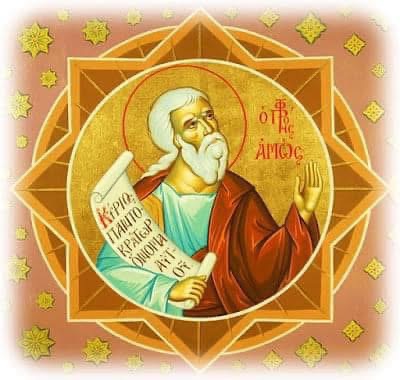
Today the church remembers a prophet-farmer who spoke from the margins for the margins: St. Amos of Judah, Critic of the Monarchy and Firebrand Defender of the Poor.

St. Amos was active between 8th century BC, and is considered one of the twelve minor prophets in the Hebrew Scriptures (Hosea, Joel, Jonah…they round out the rest). The book of Amos is attributed to him, and though he was from the Southern Kingdom (Judah), he preached in the Northern Kingdom (Israel).

Having felt the call of the Divine upon his heart from the rural outskirts of the kingdom (and of society), Amos is a farmer-turned-prophet who pointed the monarchy toward the margins and asked, “Do you see who you are neglecting?! You claim to be working on behalf of God, but the growing wealth and opportunity gap between the elites and the working poor exposes your talk as just lies!”

Seriously, that’s the gist of his argument.

He said, “I am not a prophet, nor the son of a prophet!”(Amos 7:14) are his attempts to get the elites to listen to him. In essence he said, “I’m not doing this for show, y’all! This is real life.”

He warned that not watching out for the welfare of the weakest would lead to the Northern Kingdom’s fall. And, well, the Northern Kingdom fell in time…

As the wealthy continued to amass lands that did not belong to them, and on which they did not work, Amos reminded the circles of power that their goal was to honor God by protecting and elevating the laborer, not to get the “best deal” and take advantage of them.

Justice. Egalitarianism. A preference for the poor and the margins. This was the cry of the prophet Amos.

At his core Amos sought to do something that, throughout history, has been the hardest thing to do: convert the wealthy and the comfortable.

The feast day for this Biblical prophet varies depending on tradition. The Armenian and Orthodox calendars place the day in the summer months (June 15th or July 31st), while the Roman branch waits until March 31st.

Today, though, is an excellent day to honor the firebrand of a saint as March 28th often lands in the season of Lent, a season where we attune our spiritual hearts toward repentance.

St. Amos is a reminder for me, and should be for the whole church, that in times of prosperity conversion is still necessary…and often it has little to do with “giving your heart to Jesus,” but rather offering up your life and gifts for the sake of your neighbor.

Let those with ears to hear, hear.

-historical bits gleaned from publicly accessed information, the Harper Collins Study Bible, and Claiborne and Hartgrove’s Common Prayer: A Liturgy for Ordinary Radicals

-icon is a Russian Orthodox depiction of the prophet making their appeal.

Why Bother?

Today the church remembers a different carpenter from the ancient days: Saint John of Egypt, Wood Worker, Hermit, and Mystic.

Saint John of Egypt was born into a very poor family, not unlike the Jesus he so sought to emulate. He was trained as a wood worker (perhaps another connection to that wandering wonder in ancient Palestine), and at the age of twenty-five officially became a hermit after being trained by an unnamed ancient mystic who was following The Way.

The story goes that this ancient unnamed hermit ordered Saint John of Egypt to douse a wooden stick in water every day for a year, without explanation. One imagines this to be a test in obedience, not unlike Mr. Miagi and young Daniel from “The Karate Kid” (an underrated mystical movie). Would Saint John of Egypt keep up the task without explanation? What would happen at the end of the year?!

Well, at the end of the year this hermit took the stick Saint John had diligently wetted every day for a year and threw it away.

One hears this and recalls the words of that other ancient mystic Qoheleth who penned Ecclesiastes, “Vanity, vanity! Everything is vanity!”

Yet still, even when confronted with the futility of life, Saint John of Egypt chose the hermit’s life in the desert as the way to eek out his existence in the world. In fact, he mirrored his mentor’s seemingly odd acts in life and took them on as his own. He was known for carefully tending dead trees and for randomly moving large rocks from one location to another for no reason.

In the hills outside of Lycopolis, Egypt he created three caves: one for sleeping, one for working, and one for praying, and then walled himself into these adjoining caves, only allowing a small window to connect him to the outside world. Through this window he would receive food (only dried veggies and dried fruits, thank you) and would regularly preach to crowds and crowds of people.

From his small hermitage Saint John was said to do amazing things. He was said to be able to see into the future, seeing events that had yet to unfold (he foretold the victories of Theodosius the Great), and could heal people he had never met, appearing to them in visions and dreams. For this reason he was sometimes called, Saint John the Clairvoyant of Egypt.

Saint John of Egypt lived in this way, cut off from the outside world, for over fifty years, well into his 90’s. The last three days of his life were spent in prayer, and he was found by his devotees on this day in the late 4th Century in a prayerful position, having breathed his last.

Saint John of Egypt is kind of an odd duck, following in the footsteps of Saint John the Baptizer and the other desert mothers and fathers. These esthetes can sometimes cause people to pause and scratch their heads, which is kind of their point. They lived in such a way that people took notice, for better or for worse, and we must remember that they considered this way of life a voluntary calling.

Saint John of Egypt is a reminder for me, and should be for the whole church, that sometimes it’s important to live in such a way that people stop and take notice. It doesn’t have to be as extreme as Saint John here…but if your beliefs don’t change the way you live, the way you treat people, the way you extend your love, your hope, and your advocacy, well…

Why bother?

-historical bits from publicly accessed information

-icon written in traditional Orthodox style

Brother Walt

Today I would lobby hard that the church remember one who held a golden pen and touched the essence of what it means to be human in this existence: Brother Walt Whitman, Poet and Deamer of Dreams.

Born in the early days of the 19th Century on Long Island, Whitman left schooling early on (at the tender age of 11!) to embrace the life of quill-bearer, teaching, working as a journalist, and eking out an existence as a poet and writer. He was intensely curious about the underlying emotions of what it means to be alive, feeling the vibration of the mortal coil with every ounce of his being. This became a central theme in his writing: an analysis of living, specifically living in an America trying to find itself.

Brother Walt took to the hospital room once the American Civil war was underway, and many of his essays and poems touched on healing and hurt, influenced by the care he gave to soldiers in the field. When Abraham Lincoln was assassinated, the grief-stricken Whitman penned, “O Captain, My Captain,” an ode to the fallen forlorn leader (and darling of a poem for those who loved “Dead Poets Society”). He bled his heart on every page.

America loved this homegrown writer who was influenced by the art of the opera, the art of the operating room, and the art of existence. He wrote journal essays and serialized novels (some b tree than others, IMHO) before becoming enamored with the idea of poetry that might capture all of these feelings into one. This he birthed ingenious forms of poetry, and the epic “Leaves of Grass” emerged from his soul, and the study of American humanities has never been the same.

In “Leaves of Grass” Whitman’s sexual energies (he is thought to have been pretty openly bisexual in orientation) mixed with his emotional vulnerability to create a sweeping romp touching on the transcendent, the primal, and the political. He used free verse and symbolism in inventive ways, creating what some consider to be a uniquely American way of articulating the best of what it means to be alive. It truly is a wonder, and my Junior year High School teacher might delight in my memory of him reading pieces of it to his gathered, rapturous students from the perch of his stool.

Any mention of Brother Whitman would be remiss if it also didn’t note perhaps his most popular work, “Song of Myself,” a winding exploration on self-discovery. It is certainly his hit single.

On the spiritual front, Walt considered himself a practitioner of every faith, and sometimes none at all. He thought the Divine to be utterly ineffable and yet immediately accessible, a lovely combination of religious question marks and exclamation points if you ask me.

He wrote and explored and loved.

In his later years Whitman suffered declining health, and after a stroke resigned himself to a quiet life in New Jersey.

He died on this day in 1892 at the age of 72, revising “Leaves of Grass” until the very end.

Many consider him the very first, true, poet of the American experiment…which is kind of lovely to imagine that such a true American was a bisexual wordsmith who loved symbolism more than literalism, good questions more than trite answers.

Would the America (and the church!) take this to heart today.

Brother Walt Whitman is a reminder to me, and should be for the whole church (and everyone), that being alive is a wonderful playground for minds daring and curious enough to explore what it means.

-historical bits from public sources.

-drawing by Michele Rosenthal, and can be purchased at Queer Portraits in History (queerportraits.com)

Theotokos

Today the church celebrates the Feast of the Annunciation, honoring the moment when the angel Gabriel visits young Mary to announce that she is highly favored by God and will carry the Christ into the world (naming Mary the “Theotokos” or “God-bearer”).

My favorite thought associated with this feast day is offered by Sojourner Truth, 19th Century prophet and activist.

She says:

“That man say we can’t have as much rights as a man ’cause Christ wasn’t a woman. Where did your Christ come from? From God and a woman.

Man had nothing to do with it…”

Winter into Spring

As March breathes those final breaths, I’m recalling how this month was the one where the Celts would go in search of “sweet water,” those springs that have sloughed off their mostly frozen nature and gush forth with intensity.

They knew that the end of March meant leaning more into life than into stasis, and they would bodily take the pilgrimage to different waters around their land to pull from the pools. Wisdom was in the water, or so they thought. Life was in the water.

When a babe was born in the Scottish isles, or even in the Highlands on the mainland, a midwife would take a bit of this water gathered from various sources (or, sometimes, from the main local source that fed the village) and would say this nine-fold blessing over the child, dotting the head of the infant with a drop of the water with each line:

A small wave for thy form,
A small wave for thy voice,
A small wave for thy sweet speech;

A small wave for thy luck,
A small wave for thy good,
A small wave for thy health;

A small wave for thy throat,
A small wave for thy pluck,
A small wave for thy graciousness;
Nine waves for thy graciousness.

As we begin to open our windows to greet the coming April, I’m thinking that we’re leaning into life, too.

I’m hoping we are.

Church’s Good Name

Today the church remembers Bishop Oscar Romero of San Salvador.

Bishop Romero was born in the mountains of El Salvador, and was originally trained in the arts of carpentry. At a young age he entered seminary, and eventually completed his schooling in Rome.

He served as a parish priest in El Salvador, and then as the rector of the seminary in San Salvador. He was consecrated bishop in 1970, and then Archbishop of San Salvador in 1977.

He is remembered for being a defender of the poor and the underclass, especially in the conflicts in El Salvador. He used his status as bishop, and then Archbishop, to call the powers to account for their greed and atrocities.

But we forget that he wasn’t always so vocal. He was timid at the start of his bishopric, worried that speaking out too forcefully would be too divisive, even if it was the just thing to do.

A peace brought about by silence, though, is no peace at all…and he eventually felt the weight of this deep truth.

During Mass on the 24th of March in 1980, Archbishop Romero was shot through the heart just as he was elevating the host, killed for his work for justice on behalf of the poor and oppressed.

“The church’s good name,” he once wrote, “is not a matter of being on good terms with the powerful. The church’s good name is a matter of knowing that the poor regard the church as their own, of knowing that the church’s life on earth is to call on all, on the rich as well, to be converted and be saved alongside the poor, for they are the only ones called blessed.”

(excerpt from The Violence of Love, by Romero)

-icon written by Br. Robert Lentz and can be purchased at Trinity Icons

-biographical information from Pfatteicher’s New Book of Festivals and Commemorations

On Illumination

Today the church remembers an obscure (to Westerners) Armenian saint with a cool name: Gregory the Illuminator, Bishop of Armenia and Trailblazer.

We don’t know much that is verifiable about St. Gregory’s early years. Lore and legend have crept up around his historical life so much so that he is a giant standing upon the stories others tell of him.

Nevertheless, we know he was born around the mid-3rd Century, and was baptized as a child while in hiding (perhaps his father was the assassin of the Persian King Khrosrov I?), and a married St. Gregory returns to Armenia in the late 3rd Century and converted King Tiridates III to Christianity.

Around the year 300 St. Gregory was consecrated Bishop of Armenia, and under his leadership Armenia was the first country to officially adopt Christianity as the national religion, paving the way (for better or for worse) for Constantine to do the same.

The Armenian Church continues to have a strong Christian presence, and is a companion to the Anglican Communion (though not officially part of it).

St. Gregory is called “The Illuminator” because he sought to bring Gospel light to Armenia. Toward the end of his life he appointed his son Aristages to be chief Bishop in his place, and lived out his remaining years in holy solitude.

St. Gregory the Illuminator is a reminder for me, and can be for the whole church, that a good and righteous life can be eaked out of tragic beginnings. The sins of the parents need not trickle down to the children. Though his father (probably) was a murderer, he went on to shape a whole nation for good.

-historical bits from Pfatteicher’s New Book of Festivals & Commemorations

Mixed Bag

Today the church remembers an 18th Century pastor and theologian who, though kind of a mixed bag in my view, deserves a nod: Saint Jonathan Edwards, Wunderkind and Firebrand.

Saint Jonathan was the fifth child of eleven children, and the only son, born into a preacher’s household in 1703. He was educated at home and sent off to Yale at the age of thirteen and received his Bachelor of Arts in 1720. As he continued on to seminary studies he took the pulpit of a nearby church, vacillating between practical ministry and continuing his studies in the academy.

In 1726 he came alongside his grandfather as the pastor in Northampton, the most prominent church in Massachusetts, was ordained and married a young woman, Sarah, in the following year. Jonathan and Sarah would go on to have eleven children themselves.

In time Jonathan took over the pulpit at Northampton from his grandfather, and became widely known for his brilliant intellect. His understanding of philosophy, the mathematics of logic, and human psychology were astounding, but even more interesting was the way he applied these disciplines to his theological ideas. In his left hand he held the academy, and in his right hand he held intense mystical conversion experiences, and he brought them both together as he prayed.

Armed with a profound conversion experience and a robust mind, Edwards took on Arminianism, a growing theological trend that emphasized free will and downplayed traditional notions of original sin, essentially relegating religion to the realm of trite moralism. He embraced his inner Luther and took on faith and grace as the legs of the ladder of salvation, and through conversion one might ascend that ladder toward a higher way of being in the world.

Saint Jonathan was also a victim of fortune in these days as the American landscape was ripe for a religious revival and through his preaching joining the witness of others (George Whitefield and Gilbert Tennant amongst others), the Great Awakening spread across the colonies.

But, like most rock star pastors, Saint Jonathan’s growing fame came at a vocational cost. His congregation didn’t want a rock star pastor and were a bit jealous of the fame he was gaining. That, mixed with Edwards’s very strict ideas regarding who was saved and who wasn’t (he had a habit of refusing people communion if they weren’t “clearly converted”), caused a break in their relationship. Saint Jonathan eventually left the parish to become a frontier missionary to First Nations tribes elsewhere in Massachusetts. There he was met with a significant language barrier, personal demons that still gave chase, and tribal wars, but still was able to publish what some consider his greatest works, Freedom of the Will and The Great Christian Doctrine of Original Sin Defended.

In 1757 Saint Jonathan was called from the frontier to serve as the president of the College of New Jersey (you know this college as Princeton). Princeton was experiencing an outbreak of smallpox just as he took his chair, and though Saint Jonathan had received inoculation (get vaccinated!) he suffered a secondary infection and died on this day in 1758.

His gravestone still stands in Princeton’s cemetery.

Saint Jonathan Edwards’s ghost has had a bit of a resurgence lately as the revival at Asbury College in Wilmore, Kentucky reminded corporate memory of the kind of “convincing conversion” he wrote so passionately about. Whatever you call what happened in Asbury, it is pretty clear that there is a longing for belonging that still happens in humans, and a longing to feel.

On a personal note, though I do not agree with much (most all?) of Saint Jonathan Edwards’s theological notions it cannot be denied that he influenced humanity through his brilliance and passion. He was an intense and fiery preacher, and his zeal to make those in the pew feel something is important (even if I think it is wrong-headed and theologically abusive).

For his desire that people to be moved he deserves to be remembered, if not fully revered. I do not think we are “sinners in the hands of an angry God” dangled over the pit of hell as “one holds a spider on its web.” It can’t be denied that the image, though, is powerful and evocative…even if I think it’s wrong.

Saint Jonathan Edwards is a reminder for me, and should be for the whole church, that intellect and mystical conversion can sometimes hold hands and, though we’re not often sure what to do about it, it does no good to deny it or scoff at it or decry it.

-historical bits gleaned from Pfatteicher’s New Book of Festivals & Commemorations

The Ash Moon

In Celtic tradition, the month of March is associated with the great ash tree. The ash tree is one of three trees that the pre-Christian Celts held sacred (ash, oak, and thorn), and according to tradition, Yggdrasil, the “world tree” was an ash tree from which all life was birthed.

Because ash trees are so tall, they were seen as the connection between the heavens and the earth, and therefore were understood to be powerful symbols of good in the world. In fact, it was rumored in ancient times that snakes were so afraid of the ash tree that they wouldn’t even slither over its shadow.

Snakes are an interesting evil symbol, too, until you remember that in the ancient world the snake was very scary: quiet and often venomous. It would attack you in your sleep, often looking for warmth in the bed of a person. Or it might strike you in the field, shaded by the grass.

Our modern zoological minds may wonder at this ancient symbol of evil, but our pre-modern ancestors just knew “stay away!” This, and its unusual form, is why it’s often a representation of evil in the ancient world. After all, snakes are not bad creatures, just misunderstood by humans who think they have to understand everything.

Celts would often carry ash leaves in their pockets to ward off evil, and would sometimes put ash leaves in their shoes to help with foot problems.

Beyond the magical and practical, though, the metaphorical can speak to our lives today. The ash tree can be a reminder for all of us to tap into our strengths in this month of March, trying to balance our lives a bit, bridging the heavens (ideals) and the earth (reality) of our being.