
Good-Trouble Rule-Breaker

Today the church remembers one of the “dragon saints” who, in iconography, is often accompanied by a dragon (think of Saint Michael or Saint Margaret who also often have dragon companions/foes): Saint Juliana of Nicomedia, Patron Saint of Midwifry and Slayer of Dragons.

Like many saints, what we learn about Saint Juliana of Nicodemia is more story than history. Born sometime in the late 3rd Century to pagan parents, Saint Juliana was betrothed at a young age to a prominent Senator, Eleusius (whom Juliana was predictably meh on).

Even though her father was suppesdly hostile to Christians, Juliana in an act of child rebellion (as teens are wont to do) got secretly baptized. Children have, since forever, rebelled against their parents, so be careful what you encourage them to rebel against!

As wedding bells were nearing their ringing day, Juliana became more and more fraught. She didn’t want to marry this guy, and even though her father demanded she not break her engagement, she refused to show up for the big day.

As retaliation, her father turned her over to the governor who (cue ominous music) was her former fiance! Senator Eleusius (also a governor) asked her once again to marry him now that she was in his custody. While she could have gone along with it to secure her freedom, she again refused.

The Governor, in a rage, was said to have her flogged her, and beaten her, and dipped her in boiling oil (which is why she’s sometimes written with a cauldron).

In 304 AD during the persecution under Marcus Aurelius Valerius Maximianus, Saint Juliana was said to be beheaded along with her friend and companion, Saint Barbara (December 4). She is especially popular in the Netherlands (who knows why?).

Saint Juliana is the patron saint of midwifry because, well, she endured torture with an honest heart and eager hope, and the midwives of this world accompany women who need that honesty and eagerness in the pangs of labor. She is often depicted with a dragon, and sometimes even fighting a dragon, because sometimes pain in this world needs to be seen with legs and teeth…because that’s how it feels, and she fought that foe to the end.

Also, I’d contend, that the system of oppression she was under was a dragon of a system…is a dragon of a system…forcing women to have their bodies controlled by the powerful rule-makers.

In a world of rule-makers, she was a good-trouble rule-breaker.

Saint Juliana is a reminder for me, and should be for the whole church, that sometimes we gotta break the rules to live moral lives.

-historical bits from public sources

-icon written “St. Juliana of Nicomedia, the devil at her feet,” from a Picture Bible made at the Abbey of Saint Bertin, Saint-Omer, France, ca. 1190–1200. KB, 76 F 5, fol. 32r. Koninklijke Bibliotheek (Royal Library), The Hague, Netherlands.
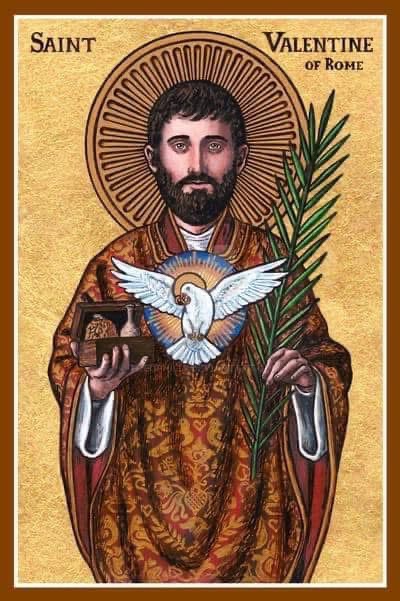
Saint Valentine

Question from a reader:

Why doesn’t the church honor St. Valentine on Valentine’s Day?

Answer:

Nothing historically verifiable at all is known about St. Valentine other than someone with that name was buried in Rome on February 14th. Legends grew, of course, including legends of a gruesome death (kind of an ancient “tongue-wagging” tactic for a church that liked drama), but none of it is thought to be true. In 1969 the Roman church removed him from the calendar of saints for “lack of evidence for existence.”

It is thought, though, that the emergence of this day as a romantic holiday was a way that the church overshadowed a Roman festival, Lupercalia, held on February 15th.

Lupercalia was the celebration of the wolf that rescued the legendary founders of Rome, Romulus and Remus, and nursed and raised them (“Luper” from the Latin root “lupus” for “wolf”). For this reason the celebration was associated with child-birth and fertility, making the Church’s institution of Saint Valentine’s Day in 496 a natural Christianization of the holiday (though it became known more for love than fertility in the end).

Lupercalia honored the wild energies of creation intended for romance and reproduction. Valentine’s Day was a more modest variation of that theme…something the church could stomach.

Btw: Ever notice that the heart icons commonly used look nothing like an anatomical heart? The shape of that icon (all over everything Valentine’s Day) is thought to have been an artistic representation of voluptuous buttocks, the epitome of beauty in Roman times.

A competing thought is that the icon is derived from the fig leaves used as modesty covers in Pagan statuary.

Whatever the origin, though, it’s been used for a very long time and, despite it’s now common place and mild application, was pretty risque!

Blessed Valentine’s Day.

-icon written by Theophilia

Communicate with Clarity

Today the world honors St. Valentine, but the church kind of shrugs toward that saint, and instead dedicates the day to two Greek biological brothers: St. Cyril and St. Methodius, both 9th Century missionaries to the Slavs.

Cyril, in an effort to translate the Gospels and the liturgy into the Slavonic language, created a whole new alphabet. Modern Russian is based on this Cyrillic alphabet.

After Cyril’s death, Methodius took up the missionary mantle and continued the work. Cyril and Methodius met great opposition within the church for their novel way of using the common vernacular to spread the Gospel. Their followers likewise faced oppression, and found themselves scattered…which actually helped the language, and the mission, spread throughout Eastern Europe.

The Slavic tradition in Lutheranism is still very strong, with a whole non-geographical Synod (Slovak-Zion Synod) representing the tradition in the ELCA yet today.

The brothers believed in a deeply contextual approach to engagement with those they were living with, even deconstructing and reconstructing their own systems (alphabet and liturgy) in order to communicate with clarity. They were transformed in the process, even as they transformed the information, and are still deeply revered in Slovak, Czech, Croat, Serb, and Bulgar traditions.

Those with ears let them hear.

-historical bits adapted from Pfatteicher’s _New Book of Festivals and Commemorations

Truth Telling 

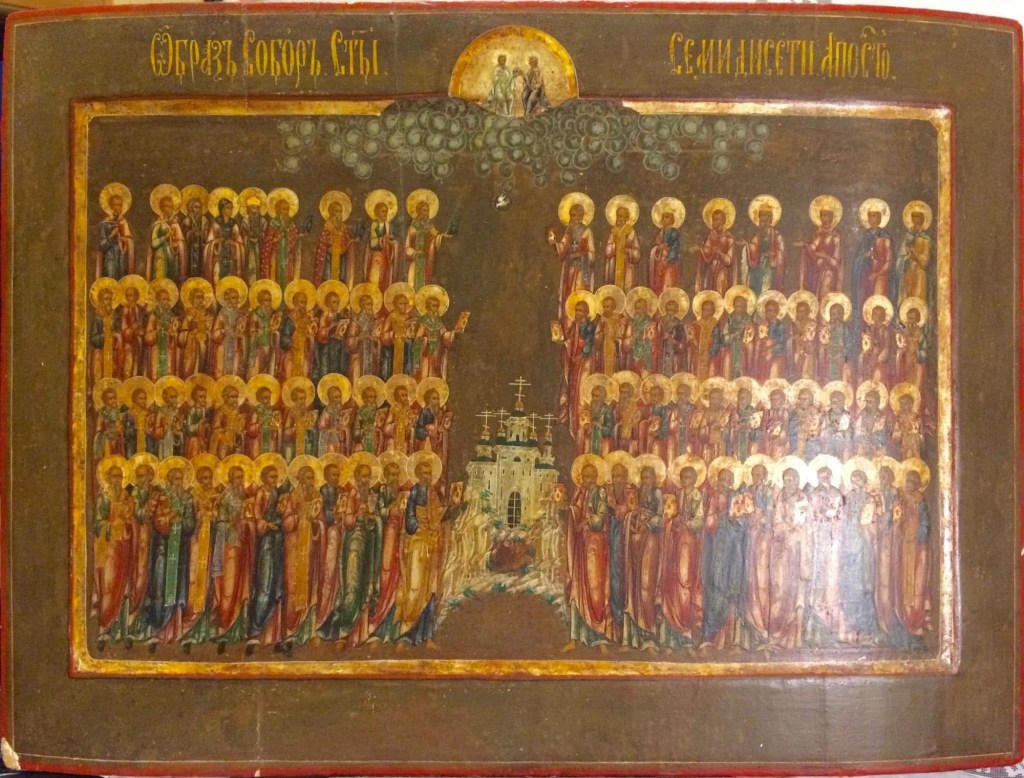
Today the church remembers an obscure First Century Christian mentioned in the Acts of the Apostles, but never really known otherwise: Saint Agabus, Prophet and Patron Saint of Seers.

According to Biblical tradition, Saint Agabus was one of the seventy disciples sent out in Luke 10. This unnamed group of seventy is kind of a “catch-all” for the early church, and many First Century Christians who were of note are said to have been in this number.

Where he first appears by name, though, is in the Acts of the Apostles, Luke’s sequel which, like many sequels in the world, added new characters and new adventures. According to Acts 11 he was one of the prophets with the Apostles at the Pentecost, and traveled from Jerusalem to Antioch where he predicted a severe famine in the area.

Then again in Acts 21 he met Paul on his missionary journey in the year 58 AD. There he stopped Paul in his tracks and, having said to have received a vision, took Paul’s belt from his waist, bound his own hands and feet, and in dramatic fashion said, “This is how you will end up if you continue on to Jerusalem.”

Those who know the Bible well will recognize that this sort of dramatic reenactment mirrors the dramatic prophecies of the Hebrew Testament seers (think Jeremiah, Amos, and Ezekiel). The symmetry is not on accident.

Anyway, Paul would not be deterred and, sure enough, would end up bound in Jerusalem.

Lore has it that Agabus was eventually martyred in Antioch for his prophetic voice and on February 13th is commemorated by many in the church, especially those who follow a prophetic/seer tradition.

Saint Agabus is a reminder for me, and should be for the whole church, that prophets don’t really tell the future, they tell the truth. It just so happens that when you tell the truth about a situation, the outcome is highly predictable.

-historical information from Daily Magic by Judika Illes and public sources

-icon is of the 70 Apostles by Antonio Caldeo because, while Saint Agabus gets his own commemoration day, it appears that he prefers to only be in group shots

Even the Worst

Today the church honors a 4th Century saint who is more story than history, and yet that story is interesting and has lasted the ages: Saint Julian the Hospitaller, Patron Saint of Traveling Musicians, Innkeepers, Hunters, and yes, Murderers.

Saint Julian’s life is not verifiable at all, but as the story goes his parents were informed that ancient magicians put a curse on him the day he was born, and he was destined to kill his parents.

It’s a good opener, right?

Saint Julian’s father wanted to be rid of him, but his mother wouldn’t hear of it. She raised him and, when he was ten years old, told him of the prophetic curse upon him. An alternative twist said that while he was out hunting on his tenth birthday a white stag informed him of this terrible fate (which, honestly, is a better plotline if you ask me).

In either case, however he found out, Saint Julian swore that he’d never do such a thing and went on a pilgrimage, staying with whomever would share room on their floor with him. Growing in age on the road, he got as far a Galicia and found a wealthy widow who stole his heart.

Now, as happenstance has it, his parents went on a journey and also found themselves in Galicia some years later. Tired from their journey, they found a home and asked for lodging. The young woman let them in, noting that her husband, Julian, was out hunting and would be back that night. Overjoyed that they had found their long-lost son, the couple stayed the night.

Julian, arriving late from hunting, found two heads in the bed that was his and, in a fearful rage, slaughtered the occupants.

It was his parents (cue ominous music).

From that moment on Saint Julian swore that he would dedicate his life to charitable works, trying to repay the terrible debt he had incurred upon humanity. They went on another pilgrimage together, this time to Rome, and continued to travel until they came to a large river. There they created a hospice center for those with incurable diseases, and Saint Julian was said to help them, “cross the river.”

That language, of course, is purposeful. In Christian the story “crossing the river” is a way to note that you’re walking people through death to life everlasting.

Despite being more robust lore than real, Saint Julian remains an interesting character to me. Of greatest note, at least in my estimation, is the idea that even those who have done the worst in life can lead a meaningful existence in time.

Saint Julian is a reminder for me, and should be for he whole church, that even the worst in us can be redeemed, by God.

-information gleaned from Daily Magic by Judika Illes and public sources.

-painting by Franz Marc depicting Saint Julian on a hunt

Why the LCMS President’s Response to the Bashing of Lutheran Social Services Both Stinks and Stings

All (the church in Jerusalem) asked is that we (missionaries to the Gentiles) should continue to remember the poor, the very thing that I was eager to do. -Galatians 2:10

“Any word from the LC-MS (Lutheran Church-Missori Synod)?” a colleague asked me in the hours following Michael Flynn’s disparaging and libelous posting about Lutheran Social Services, Global Refuge and Lutheran Family Services.

A post then affirmed and doubled-down on by the supreme ruler of Department of Government Efficiency (a government “department” in the same way that a “closet” is a “room”…in other words, not really the same thing) Elon Musk.

The post called Lutheran Social Services, Global Refuge, and Lutheran Family Services money laundering organizations.

Which, is not only lauaghably false, but dangerously libel. Especially because on the other end of those services are families in need, children in need, babies, Beloved.

Babies.

And the reason that LSS and LFS have some government contracts (some, mind you), is because they have boots on the ground in localities that need the services and <gasp> do them better than a large beauracratic engine like a government agency could.

I mean, I guess I would put it this way: why use a fire hose to provide a drink when a thousand cups of water will do it better and toward better ends?

That’s what we’re talking about here, Beloved. We’re talking about efficiency and actual impact in actual lives.

But instead of noting that reality, these sledgehammering billionairs and synchophantic parasites decide to prey on misinformation and slander to disparage organizations actually doing the good work necessary for human thriving in the world.

The Presiding Bishop of the ELCA, the Reverend Elizabeth Eaton, was quick to respond. Within hours. As were a number of other Synodical Bishops.

But even though Lutheran Social Services and Lutheran Family Services are pan-Lutheran, and even though Global Refuge has (at least historically) worked across Lutheran denominations, there wasn’t a peep from the Lutheran Church-Missouri Synod.

Until there was. Almost a week later.

And it’s no wonder it took a week because what came from the President of the Missouri Synod was, well, weak.

And confusing.

And insulting.

And astonishingly vaccuous.

I won’t bother to read to you the tome (Harrison is in need of an editor), nor will I pick out any of the parts that were particularly troubling (pay attention to his personal opinion on Musk <spoiler alert: praise>). Honestly, slogging through non-speak and word soup once is enough for any ocular exercise…no need to do it twice. No souls will be saved from purgation by going through that torture again.

But I do want to say, quite plainly, why his letter is so disappointing.

I went to Valparaiso University in Valparaiso, Indiana. Valparaiso is a pan-Lutheran university. Quite proudly (or, at least it used to be a point of pride). In our theology department there we had students from both the ELCA and LC-MS learning together.

Debating together. Usually quite collegially.

Communing together (gasp).

Serving together.

Being in honest dialogue together.

And in that ecosystem we embodied the very first church, despite our theological differences.

Because when Saint Peter and Saint Paul disagreed on how to handle ministry to the Gentiles (Paul was for it, Peter was not so sure), they said that, even though they disagreed on a lot of theology, the one thing they could agree on is ministering to the poor (see Galatians 2:10 above).

And I guess that’s why President Harrison’s letter stunk so much.

Stung so much.

Instead of seeing an opportunity to lift up the good work that these organizations do for the poor, the marginalized, and the oppressed, he decided to talk about the benefit the church has had in immigrating white folks…but those days are now gone and so, while he empathizes with immigrants, the LC-MS isn’t a part of the work of these organizations.

Because, you know, they help lots of marginalized people. Like gay ones. And “illegal” ones. And they can’t be a part of that even though <checks scriptural notes> Jesus didn’t put any qualifiers on helping the poor and marginalized.

Oh, and he went to the trouble to even note how Flynn probably “meant well” by his “muckraking” which, last I checked, NEVER MEANS WELL.

It’s a kowtow to the powers, instead of speaking truth to them.

It’s the bullied cozying up to the bully so they don’t get picked on.

And it’s sad.

And for those of us who saw how Lutherans could work across ideological differences and even love each other, well…it makes me sad we thought it could be different.

Because the church used to agree on at least one thing: helping the poor.

That was the least it could do for the least of these.

But now?

Not even that can unite us, by God.

And that sucks, President Harrison.

Do better.

The Twin

Today the church remembers an often overshadowed 5th Century saint who dared to dare: Saint Scholastica, Monastic and Patron Saint of Overlooked Twin Sisters.

Saint Scholastica is the twin sister of Saint Benedict, born to noble Romans around the year 480 CE. Her mother died in childbirth, and Saint Scholastica was known, literally from her birth, to be both a blessing from the Divine and wholeheartedly dedicated to the Divine.

Her brother noted this often. He was in awe of his sister. So often we find this when one sibling overshadows the other: the one with the long shadow greatly admires the other one.

When Saint Benedict left to enter the ministry, Saint Scholastica stayed with the family home and business, tending to the practical needs of the moment. Yet, her heart called her to a monastic life, and she eventually heeded that call.

Saint Scholastica founded a community of sisters about five miles from her brother’s hermitage. Following the Benedictine rule of life, they gathered around prayer, contemplation, and service. She visited her brother once a year, meeting in a half-way house between the two communities, discussing spiritual matters and praying together.

On February 10th in 543 Saint Scholastica breathed her last. That night, long before he had heard of his sister’s passing, Saint Benedict had a vision where his sister’s soul, in the form of a dove, visited him and flew into the heavens.

Perhaps there is something to that idea that twins are connected in special ways, no?

The details of most of Saint Scholastica’s life are lost to memory, blotted out by the eclipse of her brother. Yet we know a few important things: Saint Benedict revered her, respected her, listened to her, and sought her spiritual guidance.

That’s a pretty good endorsement if you ask me.

Saint Scholastica is a reminder for me, and should be for the whole church, that often the brightest sun is hiding a wise planet in another orbit. The pastors with the most prestigious pulpits aren’t always the stars they appear to be. Indeed: the best sermons on any given Sunday are preached to fewer than fifty people, in my opinion.

Let those with ears to hear, hear.

-historical bits gleaned from public access information

-icon written by Theophilia at DeviantArt

Wonderful Stories

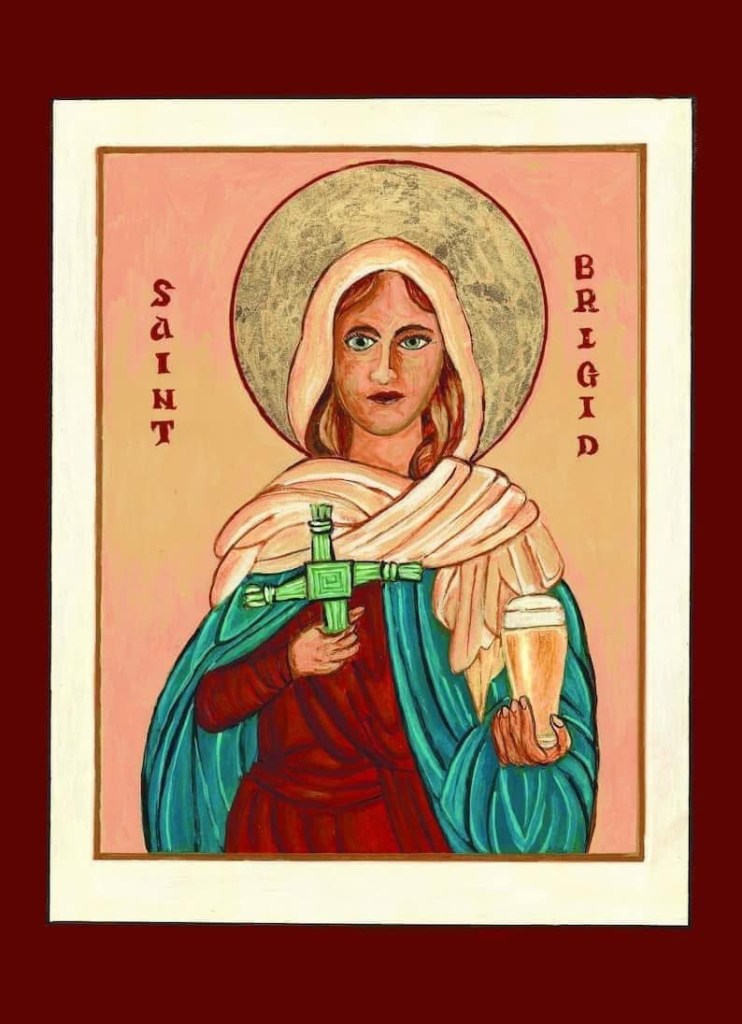
Today the church remembers a Celtic Saint (which makes her close to my heart): Saint Brigid (commonly called St.Bride in Scotland), Abbess and Protector of Ireland.

Sometimes called “the Mary of the Gael,” not much historically verifiable is known about St. Brigid’s early life, though legend and lore abound. On the island of Ireland she is revered as much as St. Patrick in most places, and her story is a mix of Christian and pre-Christian wonder. The daughter of a druid who had a vision from the Divine that his offspring would protect and change Ireland, St. Brigid was said to have been born at sunrise while her mother was walking over a threshold (a point of significance for the ancient Celts, because it meant that she was neither “in nor out” when St. Brigid arrived).

St. Brigid would live into this “neither here nor there” nature throughout her life. She was a peace-loving monastic, but also a fierce warrior. She was both wise and approachable. She was both Christian and pagan in her outlook.

She was known as a strong, happy, and compassionate woman who started a community of women at Kildare in the late 5th-early 6th Century. St. Brigid was said to be wise, and was sought out in life by many for counsel, and admired in death by poets, story-tellers and song-writers who used her as inspiration, many quite fanciful.

Lore has it that it was St. Brigid who spread out her green mantle over all of Ireland to make shine like an emerald.

In Ireland today more than a few rivers bear her name.

In addition to being a wise spiritual leader and community builder, St. Brigid was said to have been the protector of the land, officially the guardian of the pagan king Torc Triath of what is now West Tipperary. In a time when Ireland was a destination for all seafaring people, the need for protection was great. St. Brigid was an accomplished warrior. In ancient Celtic culture women were seen not only as capable leaders, but in many areas superior.

St. Brigid died in the early 6th Century, and her following grew to the point that her relics were prized possessions that had to be continually moved and hidden from invading marauders who sought to steal them as a trophy.

The most remarkable thing about St. Brigid, though, is not her historical self, but the part she now plays in Celtic Christianity. St. Brigid’s day comes in the “dead months” (marbh mhios) of winter when humanity in the northern hemisphere finds itself “Imbolc” or “in the belly” of winter. Her feast day is a reminder for the Celtic Christians that winter doesn’t last forever, and though you now might see only shadows, the sun is growing stronger every day, by God.

This reminder of St. Brigid, woman of wisdom and strength, works for the winter of the seasons, and in all the metaphorical winters of your life, Beloved.

St. Brigid is a reminder for me, and should be for the whole church, at least three things:

First: live in such a way that people write wonderful stories about your wisdom and strength.

Secondly: the intermingling of Christian and non-Christian sensibilities has helped the faith to develop, and this can be seen in no better place than in Celtic Christianity.

Finally: though we must live with winter, it never lasts forever.

Let those with ears to hear, hear.

-historical bits gleaned from Pfatteicher’s New Book of Festivals and Commemorations

-Celtic lore found from stories of my ancestors as well as Freeman’s Kindling the Celtic Spirit

-icon written by Larry at IconWriterArtist on Etsy