
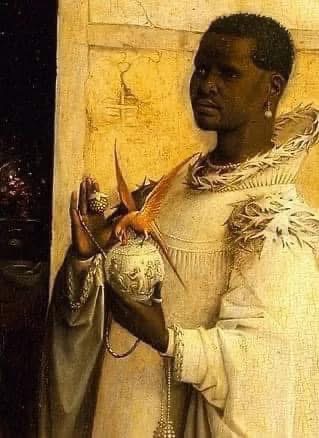
Today is a feast day that, while not honored throughout the church, is especially reverent in African communities throughout Argentina, Paraguay, and Uruguay: Saint Balthazar, King of Macedonia and one of the Magi who sought out the infant Christ.
Saint Matthew’s Gospel does not name the Magi, nor does the writer even number them. The names, and their numbering, are all part of lore. So, where did we get the names of the Magi?
I’m glad you asked!
The names of the Magi are derived from a 6th Century Greek manuscript that was translated into Latin and widely distributed. There we read that the Magi who visited the Christ after following astrological signs were named Caspar, Melchior, and Balthazar. Of the three, Balthazar developed a particularly powerful following, mostly because it was purported that he was the Magi who carried the myrrh, the most mysterious and tragic of the “gifts” given to the infant Jesus.
The Venerable St. Bede describes him as being a black man with a long beard which, while surely conjecture, struck a tone with many parts of the church that were under represented in depictions of the scriptures, especially as the whitewashing of the Bible had largely been completed by then.
In short: Saint Balthazar provided an opportunity for much of Christendom to see themselves in the story when they had largely been erased and replaced.
Today in many parts of South America, in non-Covid days, you’d find festivals and street parades honoring St. Balthazar and his elegantly morbid gift of myrrh. He is the patron saint of those who work with saws, thunder, those with epilepsy, and those who manufacture playing cards (I have no idea why), and of the three kings of lore, is the most popular.
Tradition has him being entombed at Cologne Cathedral in Germany, having been moved there from the original resting place of Constantinople (or is it Istanbul?). There the legend says his remains are kept with his other two companions at the Shrine of the Three Kings.
Now, all of this is legend and lore, from the top to the bottom. So why bother noting this feast day at all?
We must remember that while religion is Divinely inspired is is held in cracked clay jars of the human imagination. This feast day speaks to a wide swath of humanity and, in the Biblical narrative, plays an important part in Matthew’s Gospel. The gift of myrrh to the infant Jesus is a foreshadowing of his death, a little “flash forward” the Gospel writer provides for the ending of the story.
Indeed: the Jesus story is no story at all without the myrrh-y part.
So Saint Balthazar is a reminder for me, and should be for the whole church, of at least two things:
First: the whitewashing of the Bible (making all the characters European) is a disgrace and should absolutely be repudiated as a practice.
And secondly: the legends and lore of the faith still speak, and are still worth remembering and honoring as long as that remains true.
Icon written by Hieronymous Bosch
 Reluctant Xtian