Seasons

Here’s the beautiful thing about the Celts: they understood the rhythms of both nature and humanity. This is why they instituted a marker, a point of note, every six weeks. Every six weeks nature changes and, whether we like it or not, every six weeks humanity needs a re-connecting point to nature, and their true selves, to come back to center.

Imagine, Beloved, if you knew that, in the midst of your depression, a new season was just around the corner and you’d be gathered again with your fellow world travelers to mark it?

The rhythm was not just to keep time, but it was intended to help humans be kept whole by time.

Which is why, on the eve of February, the Celts would note that we are indeed “Imbolc,” or “in the belly” of winter. For us in the USA this means we look toward Groundhog’s Day, a secular throwback to when our ancient ancestor’s looked to the animals to see where they were in the seasonal clock. We find this in all cultures, by the way. Different groups looked to bears, birds, and, yes, groundhogs to tell the story of nature.

The festival of St. Brigid and Imbolc, for the Celts, was a festival of remembrance. It embraced two truths: that winter must happen, and we must deal with it (both literally and metaphorically, Beloved), and also that it doesn’t last forever.

For all my friends who have fallen into depression, for all of us regardless of how we take this season, this wisdom is transformative!

Winters in our lives, happen. We must deal with them.

But, Beloved, they do not last forever.

My Celtic ancestors remind me of this today.

A Blessing Might Be Needed

The ancient Celts had a thing for travelers.

Perhaps it was because there were so many who wandered the old roads, usually long past nightfall, trying to make the most of their feet and miles, looking for a pint and stew at the end of the day.

Traveling at dusk was not unusual.

Tonight, on the eve of St. Brigid’s Day (Feb 1st), they’d leave a scarf out on their outside bushes or porch, knowing that the yin to St. Patrick’s yang might be passing by.

They’d bank that she’d bless the scarf, and thereby bless those who donned it over the next year.

But we’re too scientific and sophisticated for such nonsense.

Still…a blessing might be needed.

Maybe leave the scarf just in case, right?

On Choices

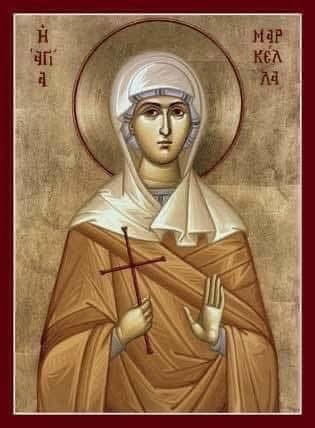
Today the church remembers a saint who, though she could have easily lived in luxury, chose a different way: Marcella of Rome, Widow and Model of Generosity.

St. Marcella grew up with everything someone in the 5th Century might want. Her family was powerful and prominent. She married young, and married wealthy. She lacked nothing.

But shortly after her marriage her husband unexpectedly died. Quickly on the heels of his death, another suitor, Cerealis, cousin of Caesar himself, proposed to her.

She said, “Bye, boy,” and rebuffed his advances.

Seeing this as an opportunity for a different kind of life, she converted her mansion into a communal house for other women interested in living a charitable life. In this converted home/convent, she and other noblewomen used their wealth to help the poor and destitute. It was from this home, too, that she taught other young women in the ways of intentional poverty (chosen, not forced), most notably her favorite pupil Principia.

St. Marcella was known to have said, “I prefer to store my money in the stomachs of the needy than hide it in a purse.”

We know about her and her life through the letters of the prolific St. Jerome, who wrote to Principia. St. Jerome even notes that he learned much about God and the scriptures directly from St. Marcella, making her an early (though under-the-radar) teacher of the church.

In 410 Rome was invaded by the Goths. They stormed St. Marcella’s mansion and, when they had ransacked the place and found she had (as she had told them) given all her wealth away, they tortured and beat her.

Not long after this abuse, St. Marcella died, purportedly in the arms of her dear Principia.

St. Marcella is a reminder for me, and should be for the whole church, that there is, indeed, a choice to make when it comes to how we live in this world.

-historical bits from Clairborne and Wilson-Hartgrove’s, Common Prayer: A Liturgy for Ordinary Radicals

-icon hangs at Holy Transfiguration Monastery, Brookline, MA.