
And Again

Today is the feast day of a giant of theology and philosophy, Saint Augustine, Teacher.

Fun Fact: Augustine was voted by his classmates, “Most Likely Non-Disciple to Get Lutheran Churches Named After Him.”

Augustine was born in Algeria in 354 to a Christian mother (Monica) and a pagan father. He was a good student, and in his early years practiced Manichaeism, a dualistic religion of Persian origin that was very “in the now” of his day.

He fathered a child early on in his life, and he named him Adeodatus which means “Gift of God.” History is quiet on the kind of father he was, but it’s important to note that this happened because all of this early material would lay the basis for his most famous work, Confessions.

Eventually Augustine ended up in Rome where he taught rhetoric and was wooed into the Catholic faith. There he was catechized under St. Ambrose and was baptized at the Great Vigil of Easter in 387.

Shortly thereafter Augustine returned to North Africa and lived a monastic life with friends. In 391 while visiting Hippo, he was chosen by the small church there to be their pastor.

All indicators point to his reluctance to take up the role, but eventually he was ordained into the priesthood and consecrated Bishop of Hippo, a role he kept for 35 years. He traveled extensively in the ancient world, and wrote volumes while he did so.

His book The City of God contains his reflections on society and the body politic in the aftermath of Rome’s collapse. In it he also defends Christianity and sets forth a vision of an ideal Christian society.

Spoiler alert: it looks nothing like America.

He established a Rule of Life and an order, Augustinian, was begun in his name. Martin Luther would adopt this Rule and this order.

Augustine died after he came down with an intense fever in the year 430. His remains, well, remain in the Church of San Pietro in Pavia, Italy.

Augustine is the model of the “second chance” life. And, quite honestly if you read Confessions, a third and fourth chance, too.

He is one of the most human of the saints because his foibles and misadventures are documented for all to see. He remains a gift to the church, even with all his flaws, and is a constant reminder that contrition and confession enable us to be born again.

And again.

And again.

-historical tidbits from Pfatteicher’s New Book of Festivals & Commemorations
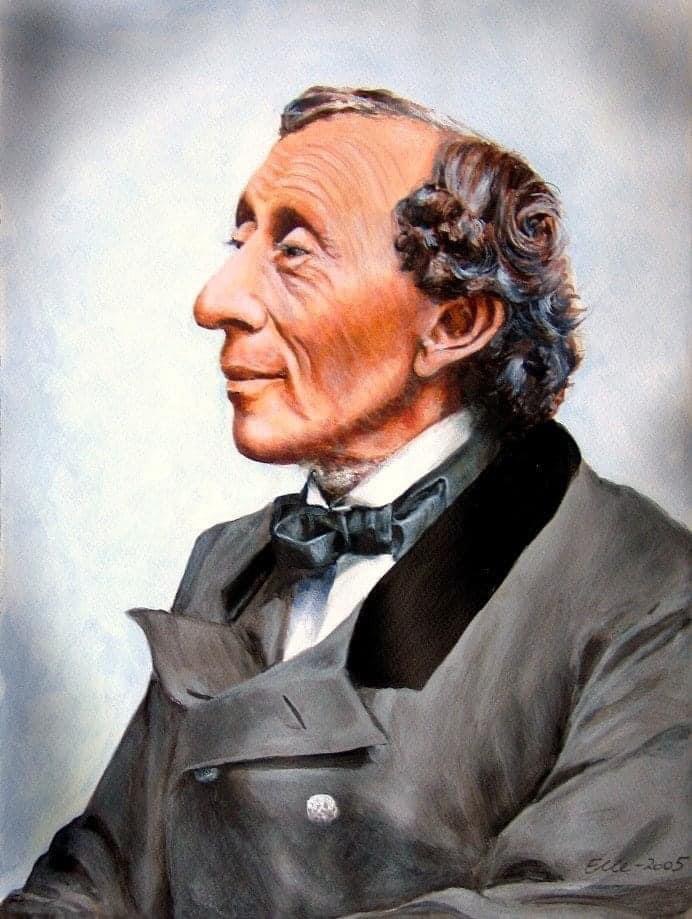
Teller of Tales

Today I would lobby hard that the church remember a premier storyteller who has had arguably as much cultural influence as the parables of Jesus: Hans Christian Anderson, Poet, Teller of Tales, and Social Influencer.

Hans was born in the early 19th Century in Odense, Denmark to an illiterate mother and a father who only had a basic elementary education. It is absolutely improbable that he would end up being a literary force, and yet, here we are.

Hans was originally sent to a school for the poor, and there was taught the basics of reading, writing, and arithmetic. At home, however, his father fueled his imagination by giving him Arabian Nights. After his father died, he began apprenticing as a weaver and a tailor, and then eventually went to Copenhagen to seek his fortune as an actor, a path most New York waiters and LA baristas can tell you about.

A director at the Royal Danish Theater took notice of young Hans and sent him on to further education on the Royal dime. Note: a teacher invested in him and encouraged him in his craft…we owe teachers so much, especially because they are often the first line of encouragement for young artists.

Let those with ears to hear, hear.

Unfortunately Hans often had a tough time in school, sometimes because people didn’t believe in him, and sometimes because he was just of a more morose nature and was taken advantage of by others. One of his earliest fairy tales, “The Tallow Candle,” spoke of an unappreciated wax taper, perhaps a glimpse into his own being.

Obviously these obstacles did not stop Hans from excelling at his craft, and slowly and surely through poems, travel diaries, novels, and plays, he made a considerable name for himself, particularly because his tales had direct moral overtones, often ones that echoed some of the Biblical stories he grew up with.

Interestingly enough, however, Hans had a difficult time with religion, and he wrestled with the church. One of his most famous encounters was with fellow wrestler Saint Soren Kierkegaard, who described Hans as kind of a brooding fellow. Perhaps some of this brooding came from his other big wrestling match in life, his sexuality. In many of his letters, and even in some of his tales, he speaks of a loneliness and longing for a love that was unattainable and taboo.

Your heart can’t help but break for him in this way.

He still continued to work and write, shaping the world around him through the most amazing thing that humans have produced: stories. In his old age the Danish government had started to pay him a yearly stipend simply because he breathed. He was that treasured as a person. With “The Little Mermaid,” “The Emperor’s New Clothes,” and “The Snowman” and so many others, Anderson’s tales continue to tingle the imagination and cause our hearts to stir.

At the age of 67 Hans woke up one morning with a start and fell out of bed, severely injuring himself past the point of recovery. His injury caused him to be thoroughly examined, and in the aftermath they found signs of liver cancer.

He died on this day in 1875.

Hans Christian Anderson is a reminder for me, and should be for the whole church, that stories are truly the things that pluck at the human heart and cause us to move and be moved. Indeed, stories are our best gift to humanity, Beloved.

-historical bits from public sources

-picture painted by Elle, 2005

Grave Finder

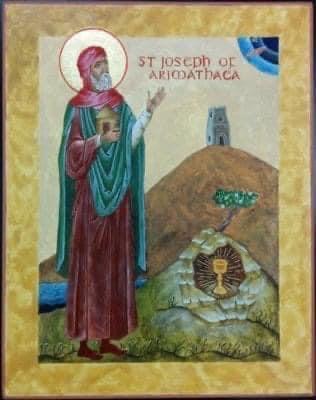
On August 1st the church remembered a saint who gets scant, but memorable, mention in the Scriptures: Saint Joseph of Arimathea, Secret Disciple and Finder of Graves.

Saint Joseph is memorable in the Jesus stories largely for his dissent collar. As a member of the Sanhedrin (the council of the synagogue in Jerusalem), the writer of Luke notes that he “did not agree” to the council’s plan to bring Jesus to Pilate as a blasphemer. The writer of John calls him a “secret disciple,” and it is he who goes to Pilate after the crucifixion to ask for the body, and lays Jesus in a grave that was unused.

The reason Saint Joseph is so important is because, well, he gets his name mentioned. In the ancient world you wouldn’t write about somebody unless that somebody was a body that other people would recognize and know. It’s thought that perhaps Saint Joseph of Arimathea was an important part of that early church, and the writers of the Gospels thought it important to include him. It’s also worth noting that he shows up in Luke and John, two Gospels written far apart from one another, without any indication that John (the one written later) used Luke as a guide. This gives us an idea that stories about Joseph of Arimathea were circulating in that ancient church.

That’s a little trip down theological nerdom, but it’s kinda neat.

Legends about Saint Joseph of Arimathea started growing and by the fourth century his fame was widespread. Some of these lager-than-life stories claimed that Joseph was the uncle of Jesus, was a tin smith, and had brought Jesus to the tin mines of Cornwall when Jesus was a young boy. Others said that Saint Joseph was sent by Saint Philip (post-resurrection) to be a missionary in Britain. On that journey it was said that Saint Joseph took with him the Holy Grail! At Glastonbury Saint Joseph struck his staff into the earth and from it grew the Glastonbury Thorn (and Glastonbury is still considered one of the holiest “thin places” in Britain), though the whereabouts of the Holy Grail remain a mystery…

This all means, of course, that you can thank the legends of Saint Joseph for the third installment of the Indiana Jones series.

None of these stories have any historical merit except for the idea that we do think that Saint Joseph of Arimathea was a real human who played a real role in the Jesus event.

Saint Joseph is a reminder for me, and should be for all the church, that sometimes a holy dissent is necessary.

-historical notes gleaned from Pfatteicher’s New Book of Festivals & Commemorations
-opinions mine

-icon written by W. Micheal Shirk. Note both the thorn bush and the grail!