Siren Song

Today is World Oceans Day, a day to honor the great incubator of life, the first amniotic fluid of creation: The Seas.

The ancient Celts held the sea in high reverence. Like anything powerful, the sea provided for the people and was also dangerous. It was a road to distant lands as well as a graveyard, a reminder that the wilds of creation are to be respected and not taken for granted.

With our modern minds we may imagine that the seas of this world are ours for dominating and using as we please, but with every strengthening hurricane and with every new exploration into the deepest parts of our oceans we are reminded that the oceans still have a temper and a hold a temptation for adventure.

Let us not abuse it nor forget it.

I’ve stood at the base of huge mountains, and I’ve flown over quite a bit of amazing land, and yet it is still the ocean’s siren song that enlivens the most awe in me.

Green and brackish, blue and calm, full of terrors and wonders and teeming with living things yet undiscovered, the oceans of our round rocket ship spinning in this universe are a reminder for me that, even though we may flex our mortal muscles, stronger forces exist and must be honored and respected.

If you’re one who endears themselves to such rituals, the ancients used to thank the Mer-people in these mid-summer months. Mer-folk were known to protect humans as well as correct humans in their courses and, while I certainly don’t believe in such a thing, I understand how the ancients would.

After-all, with so many mysteries beneath the waves, why wouldn’t someone imagine that there might be a whole undiscovered universe of inhabitants who gazed up at the blue sky like we gaze at the briny blue depths, a reflection of what we know…just a little different, you know?

Regardless of what you believe, I hope we can all agree on one thing: the mother of all life, the Oceans, the Seas, deserves not only our thanks and awe, but also our protection.
Land for All People

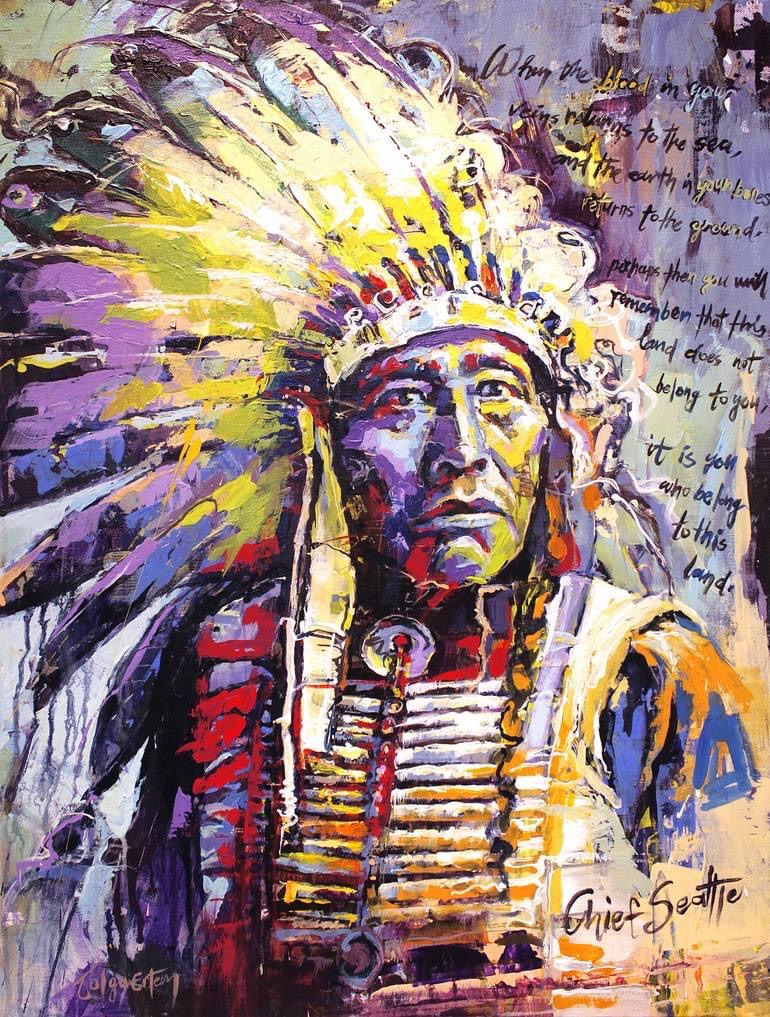
On this day the church remembers the eloquent orator and 19th Century unifier: Chief Seattle, Wager of Peace.

Saint Noah Sealth (translated as “Seattle”) was born in the late 1700’s in the lush North West with the lullaby of the Puget Sound coaxing him to sleep at night. He first saw a European when Captain George Vancouver brought a gun ship to town carrying many products from far off places. Saint Seattle’s fascination with these new people grew and grew.

In the 1830’s Saint Seattle adopted the Roman Catholic faith even while retaining many of the ways of the indigenous faith. He learned to get along well with both other indigenous tribes and the European invaders, and encouraged everyone to wage peace and not war. In early 1855 he signed a treaty at Point Elliott in the heart of settlement now known as Seattle, a city that bears his name, ensuring that the Duwamish Confederacy, an alliance of local indigenous tribes, would retain land in the area even as the Europeans continued to take and take and take.

Governor Isaac Stevens of the newly created Washington Territory spoke to the residents of this new settlement, and Saint Seattle then also gave a speech, captivating the audience and living on into history. A Dr. Henry Smith was taking notes and reconstructed the speech, and it is notable that Saint Seattle refused to speak the pidgin English or Chinook that Governor Stevens asked him to use, and instead went with his mother Duwamish tongue.

Even as the treaty was being struck, Saint Seattle reminded the gathered of deep and sacred truth,

“Every part of this soil is sacred in the estimation of my people. Every hillside, every valley, every plain and grove, has been hallowed by some sad or happy event in days long vanished. Even the rocks which seem to be dumb and dead as they swelter in the sun along with the silent shore, thrill with memories of stirring events connected with the lives of my people, and the very dust upon which you now stand responds more lovingly to their footsteps than to yours, because it is rich with the blood of our ancestors, and our bare feet are conscious of the sympathetic touch.

Our departed braves, our fond mothers, glad, happy-hearted maidens, and even our babies who lived here and rejoiced here for a brief season, will love these somber solitudes and at eventide they greet the shadowing returning spirit.

When the last of my people have perished…the shores will swarm with the invisible dead of my tribe…for the dead are not powerless.

Dead, did I say?

There is no death, only a change of worlds.”

Even when you wage peace you can refuse to be bullied.

Saint Seattle died on this day in 1866. It is said that though many wanted to name the city Seattle after this giant of history, the dear saint did not like the idea and asked that they choose another name. A city is for all the people, not just one.

Saint Seattle is a reminder for me, and should be for the whole church, that the land on which we tread is for all people, not just one…which should make us reimagine how we might use all the land we trod on, and the buildings we “own,” and the space we take up.

-historical bits from Pfatteicher’s New Book of Festivals & Commemorations

-art by Tolga Ertem, “Chief Seattle.”

The Mighty Oak

For the ancient Celts, June was the month where they honored the mighty oak tree. In June this towering tree reaches its zenith in beauty, and was a reminder for the Celts that doing two things at once in this life is necessary: we must plant deep roots while also reaching for the highest heights.

Their ancient priests, Druids, were colloquially known as “oak knowers,” believing that of all of the trees, the oak tree was the wisest. The Celtic word for oak was Duir (again, also where they got the word Druid), which meant “endure” and “truth.”

The oak tree, brightened by the Oak Moon, was both strong and enduring, like truth.

June is a month to deepen your roots and reach for those heights.

Do Good

Today the church remembers 8th Century Saint Boniface, Archbishop and Missionary.

Boniface was born with the name Wynfrith (love it!) in Devonshire England in the late 7th Century. When his father fell ill he was sent to a Benedictine school, and then monastery, where he was ordained. It was there that he wrote a Latin grammar book for scholastic use, and several poems.

When Wynfrith turned 40 he began his missionary work in Germany and the Netherlands. The anti-Christian sentiment in the area was strong, though, and he returned back to his native England, eventually succeeding his abbot at Nursling. He didn’t last long in that position, though, and resigned to petition Pope Gregory II for a missionary assignment.

Pope Gregory II approved it, and gave him the name Boniface, which means “to do good.”

He returned to what is now modern day Germany and, after trial and error, finally succeeded in establishing a monastery in Hesse.

With such success, the Bishop of Rome consecrated him bishop for the German frontier, even though there wasn’t a fixed diocese there. To show bravery, Boniface cut down the sacred oak tree of Thor, and though many expected Thor to strike him down with lightening or illness, Boniface remained perfectly healthy. Because of this, many were converted. Out of the wood of that tree he built a chapel in honor of St. Peter.

Pope Gregory III (popular name) elevated Boniface to archbishop in 732, and was eventually given the see of Mainz as his jurisdiction after the bishop of Mainz, Gewiliob (love it!), admitted to killing his father’s murderer.

At sunrise on June 5, 754, at Dokkum, Boniface, while reading the Gospel to a group of neophytes on Pentecost, was attacked by a pagan mob and killed on the job. His remains, and the Gospel book he was reading from at his death, can still be seen at Fulda.

Boniface is a mixed bag for me. He was obviously dedicated and zealous for the faith. But in his spiritual zeal he committed religious tyranny against those he was sent to serve. To take a sacred object, Thor’s tree, and create another sacred object of a different creed, St. Peter’s church, is religious violence.

That kind of violence totally goes against not only my own code of inter-faith work, but also that of my church.

Yet I do admire his willingness to serve in uncharted territory, and his willingness to leave a comfortable job (being the abbot of a monastery is no small thing!) to enter the unknown. That takes courage…I just wish he’d had a little more wisdom with it.

Or, maybe this is what I mean to say: I wish he’d lived up to his name, “Boniface,” and did more good than he did.

-historical notes taken from Pfatteicher’s “New Book on Festivals and Commemorations”

June Freshness

For the ancient Celts, June was a time of herb collecting. Used in medicine, dyes, cooking, cosmetics, and floor coverings (they would cover their floors with the herbs for a fragrant and hygienic carpeting), herbs were considered a healing gift.

At this time of year they’d incorporate herbs into most every dish, creating lilac teas and treating fish both steamed and pan fried with plenty of dill, parsley, and chives.

As they headed toward the Solstice and St.John the Baptist’s feast day, using all of the given daylight was paramount. Waste nothing, especially daylight, and do those things appropriate with the season.

For June this meant herb gathering, freshening things up, and preserving the harvest for cooking and healing in the year to come.

How You Live

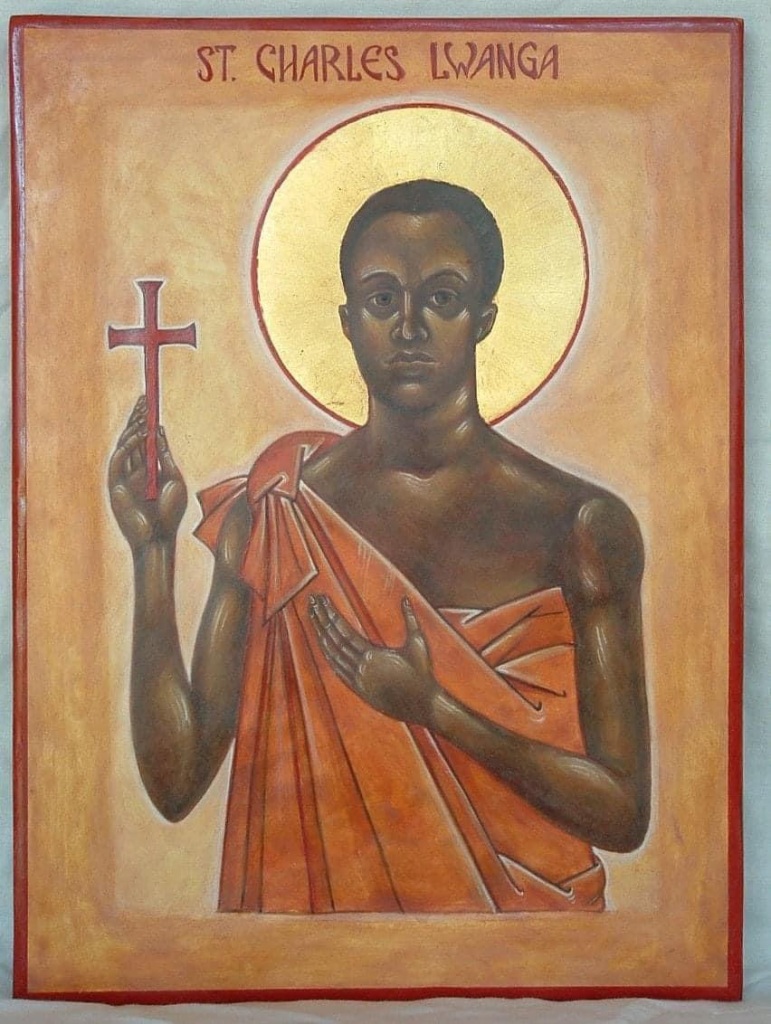
Today the church remembers a horrible 19th Century massacre as it honors St. Charles Lwanga and the Martyrs of Uganda.

In the late 1870’s Christian missionaries came to Uganda, both Catholic and Protestant, to plant churches and spread the Gospel.

Full disclosure: I have very mixed feelings about missionary work, especially the kind that was practiced in that time and place (and still practiced in many corners of Christianity). The accompaniment model I can support, and do support. I do not support the “I have something you need/white savior” model, which is far too often the model still used.

But I digress.

Regardless of how they came to the faith, these thirty-two martyrs were offered up as a “burnt offering” at Namugongo, many of them pages in the court of King Mwanga of Buganda. Many of the men were actually just boys, no more than thirteen years old. Their crime?

They refused to renounce the faith.

Charles Lwanga was seen as their leader, and encouraged them to stand fast to their convictions.

After this massacre, the killings continued as persecution spread throughout the land as King Mwanga attempted to exterminate Christianity. Unfortunately for the king, the stories about these brave martyrs emboldened others to not only stand firm in their faith, but even led some to adopt the faith because they were so inspired.

The conviction of these martyrs helped other Ugandans to understand that Christianity was/is truly African, and not a white religion…which totally makes sense because Christianity started with a man of color (even though much of the church keeps trying to pretend that’s not true).

Led by the example of these martyrs, Christianity started to spread like wildfire throughout Uganda. There was nothing the king could do.

The Martyrs of Uganda, led by Saint Lwanga, are a reminder for me, and should be for the whole church, that sometimes your life and how you live it is the best testimony.

-historical bits from Pfatteicher’s New Book of Festivals & Commemorations

-commentary mine

-icon of Saint Charles Lwanga written by Fr. Kevin Estabrook

Life of the Mind

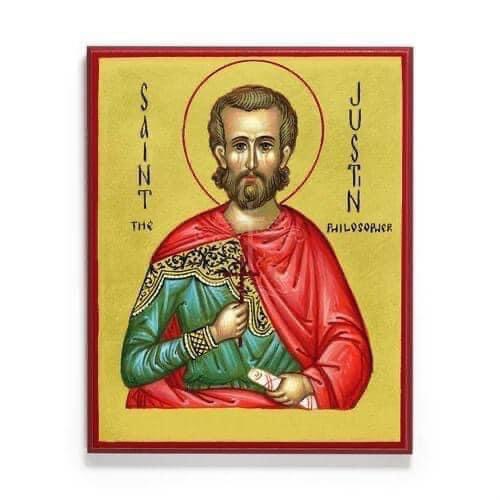
Today the church remembers one of its most influential early thinkers: St. Justin, Martyr, Apologist, and Philosopher.

As the early church began to expand and grow, the Second Century proved to be a difficult time period for those trying to be honest about following the faith in a world hostile to non-conformity.

St. Justin, probably the most influential public Christian figure of his day, was born to pagan Greek parents in Samaria around the year 100 A.D. He sought out the best thinkers of the time in his honest pursuit of philosophy and to understand religion, and while studying in Ephesus stumbled upon the stories of Christian martyrs. He was amazed that people would die for their faith, noting that “no one believes in Socrates to the point of dying for what he taught…” (though, truthfully, the Inquisition would turn this notion on its head, right?).

As the story goes, he came upon an elder Christian by the seashore who explained to him the prophets of the Hebrew Scriptures, and then and there he decided to become a Christian.

St. Justin taught the faith in Ephesus for a while, and eventually made his way to Rome where he made two famous defenses of Christianity: once to emperor Antoninus Pius, and once to the assembled Roman Senate.

He became embroiled in a series of debates with the Cynic philosopher Crescens, and though St. Justin provided honest and tight philosophical defenses, it went…well…predictably for him.

When push came to shove, St. Justin refused to make burnt sacrifices to the emperor, and for that he and some of his students were killed.

His Apologies still remains a sound defense of the faith and an early glimpse at what ancient Christians believed and practiced. St. Justin was also keen to make sure that Christianity didn’t ignore the Hebrew Scriptures (which some strains are wont to do), and kept the faith rooted in the prophecies of old.

Most importantly (at least, for me), St. Justin didn’t see Christianity as a foil for Platonism or as incompatible with deep philosophy. Rather, he saw it as both complementary and, in some ways, a culmination of the life of the mind.

St. Justin a reminder to me, and should be for the whole church, that the faith doesn’t mean a rejection of the life of the mind.

-historical bits from Pfatteicher’s _New Book of Festivals & Commemorations)

-Icon written by the saints at Legacy Icons (legacyicons.com)