On Fire

Today is also one of the church’s moveable feast days, and used to be the second-most honored feast day, only second to Easter: Pentecost, Fire Hazard and Freedom-Giver.

Pentecost highlights the “shy person of the Trinity,” the Holy Spirit. She is unleashed upon the disciples as they are scared and huddled in an upper room, unsure of what to do.

At this same moment it just so happened that people from all the known world were gathered in Jerusalem for a festival…and the symbolism here should not be overlooked.

The Holy Spirit will infuse the world.

The disciples are described as appearing as if they had “flames on their heads.” It’s kind of akin to that time Moses was descending from Sinai and his “face was shining,” or that burning bush moment earlier in Exodus where the flame didn’t consume the shrub. The idea here is that they were glowing with Divine power and wisdom, and it doesn’t consume them, but rather sets them free.

And in this moment, which is a Divine reversal of the Tower of Babel story in Genesis, everyone understands that God is for them in their own language and context, everyone thoughout the known world gathered there.

Pentecost is not a story of God empowering a few to give to the many what they don’t already have, but a story of God unleashing herself upon humanity so that Divine wisdom and saving grace is seen and known in every nook and cranny of creation.

Which should, I think, make us more open to the experiences and ideas of others, especially because they glow with what the Celts called “the spark of Divine life,” just like those disciples glowed that day.

Pentecost is a reminder to me, and should be for the whole church, that Divine grace and wisdom shows up everywhere, like new wine surprising us at every sip.

-commentary my own

-icon written by Jim Whalen
On Nose Tweaking

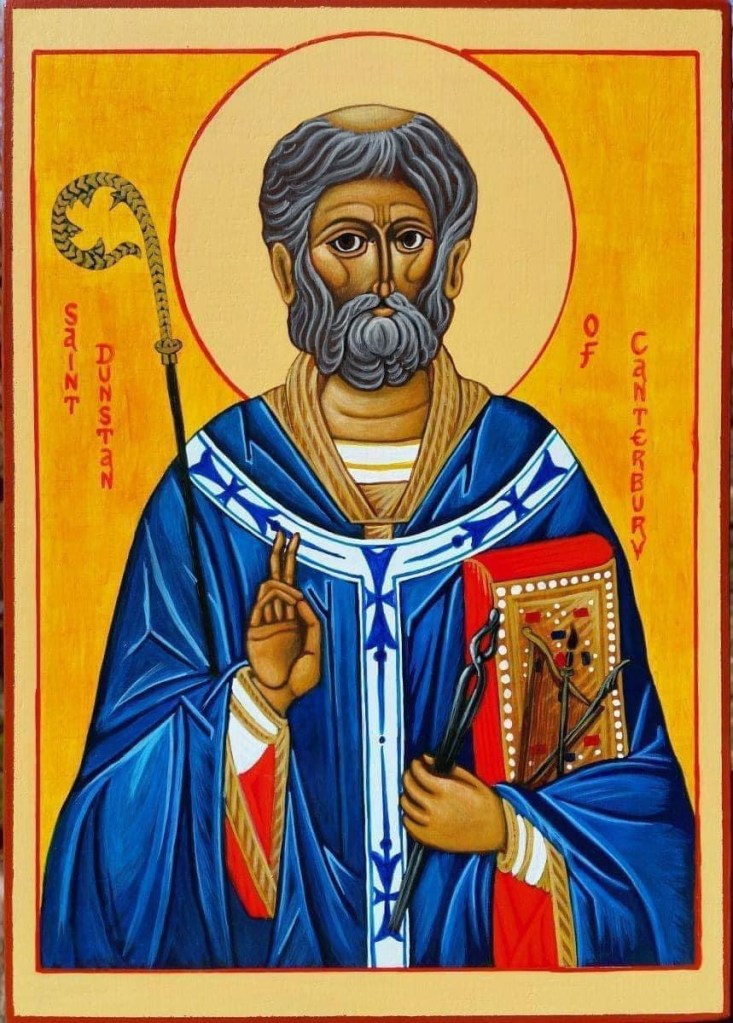
Today the church honors an oft-forgotten saint, but one with a funny story: 10th Century Saint Dunstan, Archbishop of Canterbury.

Saint Dunstan is largely regarded as the person behind introducing the Benedictine Rule to Britain. After the Viking raids had largely decimated the churches and demoralized the clergy to the point of disrepair, he brought back the Rule of St. Benedict to the Island (as he had previously been exiled to Belgium for criticizing King Edward’s conduct) at the invitation of King Edgar in 957, and slowly but surely began the rebuilding process.

He retrained the clergy, re-established the liturgy, and with the protection of King Edgar, began movements among the people to free them from indentured servitude, the landlord system of organization, and provide for better education for lay people and clergy alike.

But that’s not the funny story.

Dunstan was said to have been a keen metal worker, and was rumored to have cast bells and built organs in his time as a priest. One day while working in his foundry, the devil apparently showed up in the form of a townsperson. Dunstan saw through the ruse, though, and as he was attending to his work, he turned around, clasped the nose of the devil with the metal tongs he was working with, and tweaked it until the demon ran off.

This is why, in iconography, Dunstan is often depicted holding tongs.

He is a welcome reminder for the church, and all of us, that initial defeats will not, in the end, define our lives. After all, how many people have been fired from their job, forced out of work, been the victim of office politics, or spoken up and paid the consequences for right action, and yet remain resiliant and continue to make a difference? Dunstan’s exile to Belgium was political, but he stuck to his convictions, his Rule of St. Benedict, and eventually returned to change the lives, hearts, and situation of many.

He is also a reminder that, if you get the chance to tweak evil’s nose, don’t hesitate.