Contemplation and Activism Hold Hands

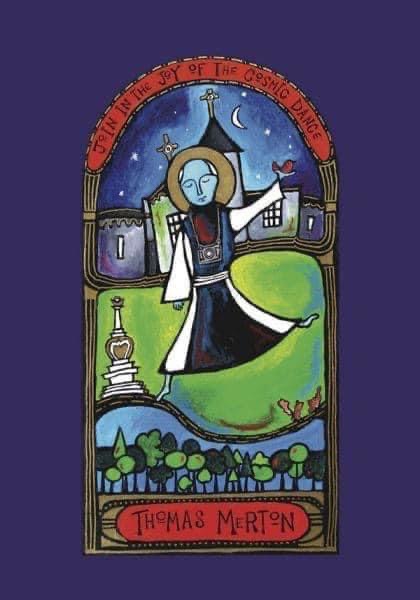
Today the church honors the contemporary Kentucky-dwelling theologian and poet: St. Thomas Merton, Mystic and Renewer of the Church.

Born in France (1915) to a New Zealand painter and American Quaker mother, the family came to America during World War I and settled with family in Queens, New York. His mother died of stomach cancer when he was just six years old and his father quickly fell in love with acclaimed novelist Evelyn Scott. Thomas never liked Scott, and at age eight chose to live with his mother’s family in Dougston, New York. Eventually his father came and moved the boys to France to live after the war (though the family traveled extensively throughout Europe in their youth, shaping Thomas in many ways).

In his early adulthood St. Thomas, like so many saints before him, had a wild streak. While at University in Cambridge, though, he became acquainted with great theological works through a few visiting professor-monks.

Early one morning in 1939, after a long night out at a jazz club, Merton told a few groggy friends over breakfast that he felt the call to become a priest. After fits and spurted attempts to join the Franciscan order, he was ultimately rejected from starting the process. He worked as an English professor at Saint Bonaventure University, believing that if he couldn’t be a friar, he would at least live with them. It was there that he began to practice a monastic way of life.

In 1941 Merton was invited to become an initiate at the Abbey of Gathsemeni in Bardstown, Kentucky, just as his brother was being sent off to war. It is here that Merton leaned into his writing and poetry, even dedicating a poem to his brother who died in World War II.

In 1949 Merton published what he considered to be his conversion story in the much acclaimed (and awesome!) The Seven Storey Mountain. In this work he introduced the greater world to the gifts he found in the monastic life. He continued to write and publish reflections, theological books, and poetry from a deeply mystical standpoint, moving many to explore their spirit and soul both within and without a formal religious tradition.

St. Thomas took up inter-religious experiences as part of his ministry and work, traveling to Asia to pray and study with Buddhist monks there. He saw the great “golden thread” running through the lives of the followers of the great religions, and though he always remained a dedicated and professed Roman Catholic, he sought to traverse religious boundaries, often in the name of world peace, which he fought hard for in his monastic life. In fact, many of his controversial political writings condemning war and militarism were censored by the Church for many years.

He is considered by many to be the one who ushered in a new, contemplative-activist monasticism.

In 1968 St. Thomas died mysteriously while on a speaking engagement in Thailand, but his writings and legacy live on in those mystics who still cling closely to his life and example.

St. Thomas is a reminder for me, and should be for the whole church, that not every religious leader and model wears a fancy clerical collar, and that contemplation and activism must hold hands in this world.

-historical pieces from Claiborne and Wilson-Hartgrove’s Common Prayer: A Liturgy for Ordinary Radicals and a life studying Merton.

-icon written by Marcy Hall at RabbitRoomArts (find her on Etsy)
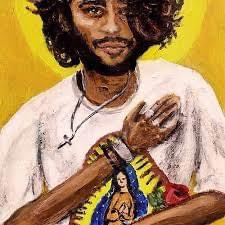
Powerful Visions

Today many parts of the church remembers a 15th Century peasant and visionary who emboldened a people with Divine hope: Saint Juan Diego, Dreamer of Dreams and Hoper of Hopes.

In 1474 Saint Juan was born in Cuauhtitlan, Mexico. He was an ordinary person of his day, and though he had a family (his wife’s name was Maria and he had a sick uncle also named Juan), lore has confused and convoluted many of the details here. More than a few people, including a few nuns throughout history, claim to be descendants of this pivotal figure in traditional Catholicism. What is clear is that Saint Juan was profoundly impacted by visiting Franciscan monks who baptized him and encouraged him in his spiritual journey.

Eventually Saint Juan began to study to become a Franciscan himself, and early one morning on this day in 1531 it is said that Juan encountered the Virgin Mary herself asking Juan to petition the Bishop to erect a chapel in her honor.

Saint Juan, though startled by the vision, did as he was asked. The Bishop gave him a basic non-answer and invited him to exit his office.

Later that same day on his walk Saint Juan encountered the Virgin Mary again. He told her that he had made the request, but was denied. He suggested that the Bishop wouldn’t listen to him because he was a “nobody,” and pleaded with the Virgin Mary to ask someone else to do the work so that the Bishop would take it seriously.

Mary would, apparently, have none of it. “You,” she said, “are the one who will speak my desire.”

On December 10th Saint Juan once again returned to the Bishop, but the Bishop demanded proof that the Blessed Virgin visited him, perhaps also believing that a Divine request would be made to a more suitable emissary. Saint Juan returned back to the site of the previous apparitions at Tepeyac, Mexico, and the Blessed Virgin promised she would provide another sign.

That night, though, Saint Juan’s uncle became gravely ill, and Saint Juan could not return to the site on December 11th as he had to care for his uncle. By the morning of December 12th Juan’s uncle was fading fast. Saint Juan set out to find a priest to come hear his uncle’s final confession and perform the Rite of Extreme Unction (Last Rites). He intentionally did not pass by Tepeyac in order to avoid the Virgin Mary, embarrassed that he had ghosted her the previous day to care for his uncle.

But along that way he once again encountered the Virgin Mary a fourth time and she asked where he was going. Shocked and sad at his failure to meet her the previous day he told the whole story. She gently chided him in these very famous words, “¿No estoy yo aquí que soy tu madre?” (“Am I not here, I who am your mother?”).

She assured him that his uncle was healed and asked him to go collect her flowers on the nearby hill. Finding flowers unseasonably growing there, Saint Juan collected a handful and brought them to the Virgin Mary. She sorted and arranged them and told him to take the flowers to the Bishop as proof of her appearance. When Saint Juan arrived at Mexico City to have an audience with the bishop, he dropped the flowers from his mantle at the Bishops feet and lo, the arranged themselves into the outline of the Blessed Virgin.

Saint Juan returned to his uncle, now recovered, who told Saint Juan that he, too, had seen the Blessed Virgin at his bedside and that she asked to be known by the name Guadalupe.

These visions cascaded into a movement within the Mexican expression of Catholicism, and in 1986 Juan Diego himself was beatified by Pope John Paul II.

So, now for all the Protestants out there, why does this even matter at all?

Well, first we must recognize that whether you think this story is “real” or not, it’s movement through history is not only quite real, but quite important. To have the Blessed Virgin appear not to a Roman prelate, and not to some imported Bishop, but rather to a townsperson from the backroads of the hillside said something clear and unequivocal to an indigenous population enduring genocide and forced conversion: God stands with you.

Secondly, finding hope in broken places has always given humanity the will to continue on. In times of illness and despair, we all long to be visited by a Divine presence. If it can happen to Saint Juan, it can happen to any of us, you know?

Saint Juan Diego is a reminder for me, and it should be for the whole church, that the stories of Divine encounters rarely happen in the halls of power, but rather take place in the back alleys of humanity’s longing. We’d do well to remember this and continue to ask ourselves why, then, do we keep seeking power?

Let those with ears to hear, hear.

-historic bits from public sources

-icon by Gracie at “The Modern Saints”

A Triple Threat

Today the church remembers a triple threat of a politician, theologian, and hymn-writer: St. Ambrose of Milan, Peacemaker, Bishop, and Doctor of the Church.

St. Ambrose is the first Roman church leader born into and raised in the faith. His father was a Prefect of Gaul, and Ambrose was sent to study the classics of the law in Rome.

When he was just thirty-three years old he was appointed the governor of Liguria and Aemilia, and took his seat in Milan where the imperial court was regularly convened.

And then it happened: the Bishop of Milan was an Arian (the strain of Christendom that was competing with Orthodox Catholicism at the time…recall the legend of St. Nicholas punching Arius at the Council of Nicaea), and violent clashes started to break out between the Arians and the Catholics.

St. Ambrose kept his cool and quieted the clashes, and because he was so appreciated on both sides of the aisle, he was unanimously acclaimed as the new Bishop even though he hadn’t been baptized or ordained.

It was a “rush order initiation” for in the year 373 (or maybe 374?) St. Ambrose was baptized a Christian, ordained a priest, and consecrated a Bishop.

Immediately St. Ambrose began doing Bishop-y things like giving half his family wealth to the poor and changing his dress and tastes to reflect humility rather than opulence. He also began, in short order, to make Milan a center of learning, and through his own preaching, writing, organizing, and administration had influence far beyond his little corner of the waning Empire.

Through his writing he inspired one who is thought to be, next to St. Paul, the church’s crown jewel theologian: St. Augustine of Hippo (baptized by St. Ambrose in Milan at the Easter Vigil in 387).

But, see, all this influence and competency comes at a price. Justina, the Empress and mother of Valentinian, became jealous of St. Ambrose and how many fans, followers, and ancient retweets he was getting. She secretly devised a coalition to speak out against the Bishop, tried to retake and rename some of his cathedrals and basilicas in the name of the Arian streak of the faith, effectively pitting portions of the church against the other in order to gain their loyalty.

Doesn’t sound at all like politics today…

St. Ambrose decided not to play Justina’s games. He stood fast, at times seeking refuge inside his own church surrounded by his parishioners as Imperial soldiers attempted to capture him. During these moments of siege it is said that St. Ambrose led the gathered congregation in songs that he himself wrote, an impromptu sing-along to wage a non-violent war against the weapons of the state.

Again, doesn’t sound like any protests I know of…

Eventually Justina realized she was never going to have the following of St. Ambrose, and she stopped her assault, the courts withdrew their edicts for Catholic oppression and the arrest of the Bishop, and he got back to writing, preaching, and teaching.

A couple of fun facts: he’s considered one of the four pillar “Doctors of the Church,” and is credited with the saying, “When in Rome, do as the Romans.” This last piece of advice was given to his charges who, when they came upon liturgical differences in the Mass that were regional, asked the good Bishop which ordo to follow.

The good Bishop, understanding hospitality, told them to do what the locals do. Because, well, “When in Rome…”

My favorite Ambrose quote is:

“The large rooms of which you are so proud are in fact your shame. They are big enough to hold crowds—and also big enough to shut out the voice of the poor…

There is your sister or brother, naked, crying! And you stand confused over the choice of an attractive floor covering.”

St. Ambrose died on the Vigil of Easter, April 4th, 397. Though some remember him on that day, today is a better opportunity, the day of his baptism-ordination-consecration, because it doesn’t conflict with the moveable Easter Feast.

St. Ambrose is a reminder for me, and should be for the whole church, that sometimes the best church leaders are those who know how to stand against the headwinds of worldly power.

And no book can tell you how to do that.

-historical bits gleaned from Pfatteicher’s New Book of Festivals & Commemorations

-icon written by the saints at Monastery Icons (monasteryicons.com)

The Elder Moon

In December the ancient Celts found themselves under the Elder Moon.

Known as Ruish (roo-esh) in Gaelic, the elder tree was known to protect against negative forces, including pests like fruit flies and mosquitos, and so elder was often hung from doorways or in kitchen windows throughout the year. It was also sought out as medicine for so many, and is said to have natural antiviral properties. The elder tree was one you sought when you needed help.

The elder tree is bruised easily, but also regrows quickly, which is why the ancients named this moon at this time of year for this tree. Everything feels fragile right now. But, as the Irish phrase goes, “Every beginning is weak” (bionn gach tosach lag). Fragility allows for birth.

December is about beginnings sprouting from endings. As we head closer and closer to the solstice, the days shorten almost to the point of non-existence (or, at least it feels like that). But the ancients believed that the sun that faded-but-never-abandoned them made a new covenant annually with the earth in these days.

When Christianity began to have an influence and decided to place the celebration of Jesus’ birth in this month at the time of the Yule celebrations, it made so much sense to the Celts that they didn’t bat an eye: a new covenant with the Son/sun was appropriate in these shadow days.

The ancient Celts felt that December was a time for wombing, anyway. The fields were fallow, the family tended to be physically lax but mentally focused. In December they did their “inner-work,” pondering how the shadows of their own being (as Jung would say) helped them live into their full selves.

We’d do well to follow that lead.

And we may find that, at the end of December, we, like the elder tree, find ourselves being birthed differently into a new year after doing the inner work under the Elder Moon.

Ho Ho Ho

Today is one of my favorite Feast Days for one of my favorite saints: Saint Nicholas, Bishop, Patron Saint of Sailors, and Gift-giver.

It is ironic that little is known about the life of Saint Nicholas, this Bishop of a seaport town in what is now Turkey, because he’s one of the most beloved and recognizable saints in popular culture. We know that he was born in the 4th Century, and that he attended the Council of Nicaea where he is purported to have socked Arius (considered a heretic at the time) right in the face. Anyone who has served on a church council understands that it can get a bit testy sometimes…

But other than the above (and the whole “punched Arius” thing may not even be accurate), all else that is said about St. Nicholas is lore and legend.

It is said of him that, as an infant, he refused to nurse on Wednesdays and Fridays, typically fasting days for the pious.

It is said that he aided a poor family once by paying the dowry of three daughters, saving them from a life of prostitution. On three successive nights he threw bags of coins through an open window. This act is how he became known as the patron saint of gift-giving.

It is said that he saved three boys who had been kidnapped by a butcher and returned them to their parents.

It is said that he aided sailors in trouble off the coast of Myra by calming a storm, and showed great courage himself while out on the sea. This is why he is the patron saint of seafarers.

Today around the world Saint Nicholas will be impersonated by many utilizing a long, white beard, parading around in Bishop vestments. In some places small children dress up like the saint to beg for alms for the poor.

In America the rituals of St. Nicholas Day have almost all been moved to December 25th and melded with other Christian-Solstice practices. Still, in some homes (like mine), children leave their shoes out by the fireplace or in the foyer of the home, hoping that St. Nicholas will come by on his horse and leave chocolate coins, oranges, and small trinkets as gifts. The coins are an homage to the legend of the dowries.

The festivities and legends surrounding Saint Nicholas have melded with Norse and Celtic winter legends and lore in these days. Looking more like Odin now than a short, brown-skinned Bishop (which he most certainly was), common depictions of Santa Claus bear little resemblance to this ancient priest from Asia Minor. Still, the practice of gift-giving and charity is certainly worth continuing in whatever form it takes, and in that way St. Nicholas is kept alive age after age in one form or another.

Saint Nicholas is a reminder for me, and should be for the whole church, that charity and love are languages that are universal and, in the form of Saint Nick, take on hands, feet, and a face every year. There is much to be learned about human nature and human connection from the fact that his appeal is so wide and varied!

It almost makes one hopeful, yes?

-historical notes gleaned from Pfatteicher’s New Book of Festivals & Commemorations and too many Rick Steves documentaries on Christmas

Purity is A Fiction

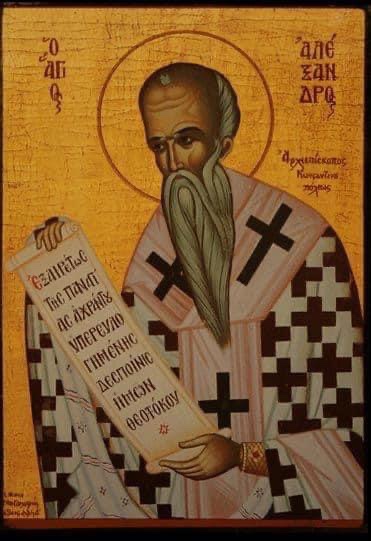
On December 5th the church honors an interesting Saint who sought to incorporate some pagan practices into the Christian faith and life (and, for that alone, he has my admiration): St. Clement of Alexandria, Priest and Scholar.

St. Clement of Alexandria (not to be confused with the Clement of Rome or any of the other many Clements of the ancient world) was a Greek philosopher born in the middle of the Second Century. He found himself making a home in Alexandria, the center of scholarship in the ancient world, and he headed up a school there that would eventually teach catechumenates about the faith.

St. Clement is noteworthy because he was a seeker of truth, and though a professed Christian he honored the truths and practices that other religious paths offered. He defended the faith in the midst of both his pagan friends and his Christian friends, trusting that melding certain practices was not only necessary, but good and human.

He believed that many of the ancient texts the church was using were wonderfully allegorical and applicable to life, and in this way he expanded the reach of the church in philosophical circles. Origen, the greatest biblical scholar of the early church, was his pupil.

His writings are some of the first systematics documents for the church.

St. Clement is a reminder for me, and should be for the church, that “purity” is a fiction we cannot afford in the world when it comes to practices, dogmas, and doctrines. It is appropriate that we honor St. Clement of Alexandria in the Advent-Christmas season because this time of year, in particular, is a beautiful bouquet of melded practices for humanity.

We need not run from this truth or try in vain to defend that it is not so. We must embrace it, revel in its particular beauties, and be at peace.

Nothing is of Face Value When it Comes to God…

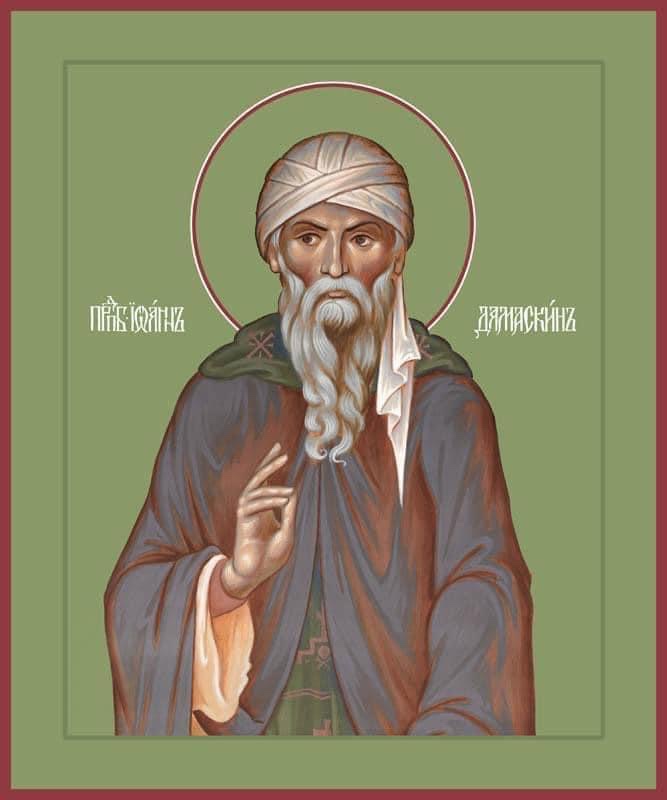
In the breaking days of December the church honors a Saint who found himself in a church at a breaking point: St. John of Damascus, Hymnwriter and Priest.

Born in 675, St. John was born into a wealthy family and was elevated to a political position of prominence at quite a young age when he succeeded his father as an official in the Court of the Caliph of Damascus.

He felt a call to the faith, and became a monk at the monastery of Mar Saba (still in existence!), a hermit colony founded in the year 484. It was there that he gave up his position in the Caliphate Court and devoted himself to simplicity, the study of the Desert Mothers and Fathers, and the priesthood. He was ordained in 725.

It was about this time that the church began to crumble under the weight of melding practices. The Eastern and Western churches were evolving drastically different approaches to faith and life. It would take another 300 years for the split to become official, but it is here in history that we can see the fault lines.

In these days the Byzantine emperor Leo III forbade the veneration of sacred images and icons, and ordered their destruction. St. John of Damascus wrote vehemently that icons and sacred images were portals and glimpses of the Divine, not Divine themselves, and should be saved and maintained. As part of his logic, he successfully defended the Real Presence of Christ in the Eucharist as well, against those who would dismiss it.

St. John of Damascus wrote great mystical treatises on theology, too, that are still foundational for the Orthodox community.

For all of the above, St. John of Damascus is considered by the Eastern Church as the last of its Fathers.

We still sing the writings of St. John, by the way. That wonderful Easter hymn sung every year that goes, “Come, ye faithful, raise the strain of triumphant gladness!” came from his golden pen. He authored a number of Easter hymns that still sing out the faith to this day every Spring.

St. John of Damascus died near Jerusalem around 760. He is a reminder for me, and should be for the whole church, that icons and objects can be glimpses of Divine presence in this world, and we need not take everything at face value.

Indeed, nothing is “face value” when it comes to the Divine. God is always more than they appear…and godly things can be, too.

-historical notes from Pfatteicher’s New Book of Festivals & Commemorations

The Yule

For the ancient Celts, December was a month where they celebrated light being born from winter’s long shadows.

They believed that, on the solstice, the sun would jump up and retreat back down for just a moment, seemingly staying in roughly the same place, signaling that it would once again keep it’s promise to bless the people with its presence the next year.

Every year they believed the sun was born again.

They’d honor this birth with days and days of celebration, usually around twelve, and they would perform ritual acts of welcome including dancing, drama, music, games of feat, and above all, lighting fires that they thought would help the newly-born, fledgling sun gain strength. The “yule log” was both for heat and for fueling the sun back into its summer glory.

Also, interesting tidbit: “yule” is probably where we get the word “jolly” from in English.

Even after Christianity had overlaid its own festival onto the celebrations of Ireland and Scotland, the pagan roots shone (and shine!) through. The Scandinavian settlements of the area had dyed the yule practices in the proverbial wool of the people.

Violence of Negligence

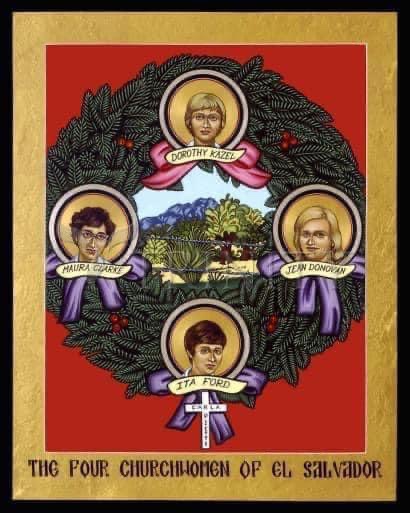
Today the church remembers the Martyrs of El Salvador.

Ita Ford, Maura Clarke, Jean Donovan, and Dorothy Kazel were Catholic Missionaries, Ursuline, and Maryknoll Sisters murdered in 1980 for their outspoken defense of the plight of the powerless and poor. Accompanying the people there, they were irritating the powers of the day with their theology of liberation and hope.

These four sisters were murdered on this day in the same year that Archbishop Romero was murdered, though he was killed in March.

Instead of recounting the details of their lives, I’ll just share a bit from a letter Sister Clarke wrote to her companion, Katie, just before she was murdered:

“There are so many deaths everywhere that it is incredible.

The ‘death squadron’ strikes in so many poor homes. A family of seven, including three small children, was machine-gunned to death in a nearby town just last week. It is a daily thing–bodies everywhere, many decomposing or attacked by animals because no one can touch them until they are seen by a coroner. It is an atmosphere of death.

I don’t know what tomorrow will bring…Write to me soon. Know that I love you and pray for you daily. Keep us in your heart and prayers, especially the poor forsaken people.”

The days surrounding Christmas are filled with Feast Days, some beautiful (like St. Nicholas), and some tragic like today. This is because the Divine entered into the world not as we would like it to be, but as it is: beautiful and tragic.

These martyrs today are a reminder to me, and should be for the church, that the first victims of any sort of violence are the poor and vulnerable.

If you need confirmation of that, just ask any medical professional who they treated most for COVID-19.

Those with means, good insurance, fewer health conditions (that are easily and often exacerbated by poverty!), and who can take off work to get treatment without fear of losing their job largely recovered.

Those without, did not.

It is a different kind of violence, a more negligent kind on the part of the powers of the world, but it is violence none-the-less.

Let those with ears to hear, hear.