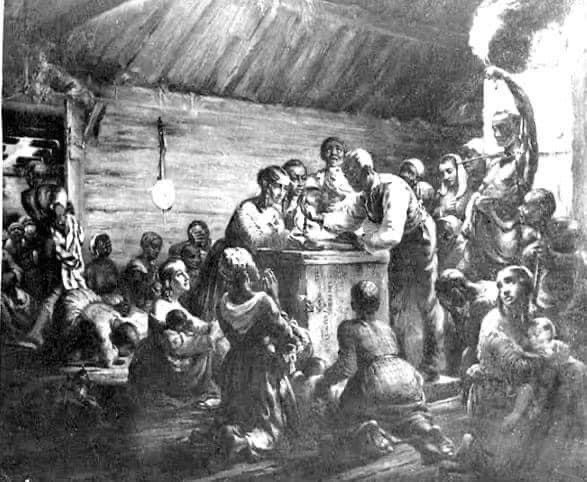
Tonight the church honors not a saint, but an event: Watch Night, remembering the Emancipation Proclaimation of 1863.
Traditions surrounding a “night of watching” on New Year’s Eve can be found in Moravian and Methodist American history through the 1800’s. The practice may have begun almost a century earlier in Bohemian regions of Europe, however, as families marked endings and beginnings.
In America these vigils were taken as an opportunity to reflect on the past year and make resolutions for the coming one. Often held in churches and surrounded by prayer and music, these gatherings usually started in the evening and lasted past midnight.
In 1863, however, the tradition took on new life and a new focus in America as slaves in formerly Confederate States gathered in churches, homes, and rooms in the waning hours of 1862 awaiting President Lincoln’s signature on the Emancipation Proclaimation to take effect.
Watch Night continues to be an annual gathering, especially in communities of color, as a way to both remember what has happened and gather strength for continuing to work for the freedoms still to come. Recent years have been stark reminders that the Emancipation Proclaimation was not, and has never been, enough in the struggle for all in this country to live in peace and enjoy prosperity. Indeed, that first proclamation didn’t “free all slaves” in the United States…that would take acts of individual legislation in many border states and territories over time.
We need to remember that racism and prejudice still influence our civic and religious lives, Beloved.
Watch Night is an invitation for us all to reflect and resolve to partner together to do more.
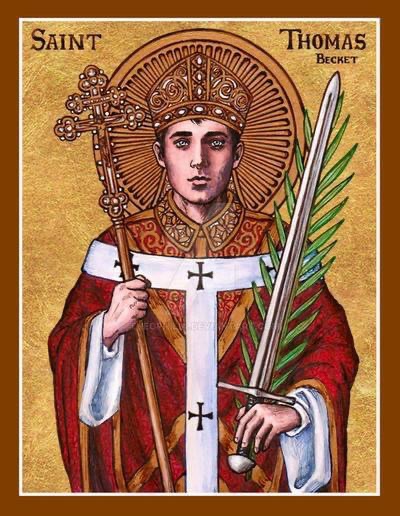
Today marks the saint day of Saint Thomas Becket, Archbishop of Canterbury and Gadfly of King Henry II.
Becket was ordained a Deacon and then Archdeacon for the Archbishop of Canterbury in short order after studying in Paris as a young man. He was born the son of the sheriff of London in 1118, and therefore had many rights and privileges offered to him, including an inroad with King Henry II which allowed him to live the high life.
King Henry II decided, apparently on a whim, that Becket should be named Archbishop though he wasn’t even a priest. Becket protested, saying, “Then I would fall from your favor, your Majesty.”
Henry disregarded this prescient warning, and ordained him a priest and then elevated him to Archbishop in 1162 all in one fell swoop.
Becket, now as Archbishop, took his position quite seriously. He abandoned the trappings of the comfortable life he had been leading, and assumed the role of “shepherd of souls.” He and King Henry soon were on the outs as Becket argued fiercely over the boundary between the church and the state. The feud became so fraught that Becket was forced to leave Britain and take up residency in France, where he lived as Archbishop of Canterbury in exile.
Six years after being exiled, Becket was allowed to return, but the feud continued. One night King Henry, in a rage, asked rhetorically, “Who will rid me of this priest?!” Four knights in the room, who didn’t understand a rhetorical question when they heard one, rushed off to the cathedral in Canterbury and murdered Becket in front of the altar.
Becket’s last words were, “For the name of Jesus and in defense of the Church, I am willing to die.”
The people of England were shocked and dismayed, and soon after his death miracles were reported at the tomb. In 1173 the pope canonized him, and Henry was forced to be whipped by monks from the abbey over the tomb as penance.
The Henrys’ would have the last laugh, however, as King Henry VIII would avenge his ancestor and destroy the shrine over the tomb.
You may know Becket’s story as this ambitious and tough-minded monastic has inspired numerous works of art including Tennyson’s “Becket” and Eliot’s “Murder in the Cathedral.”
St. Thomas Becket is a reminder for me, and should be for the whole church, that the church cannot be in service to the state if it is to adequately critique it. Becket knew this…I wonder if we sometimes forget it in nationalistic fervor.
-historical bits from Pfatteicher’s New Book of Festivals & Commemorations
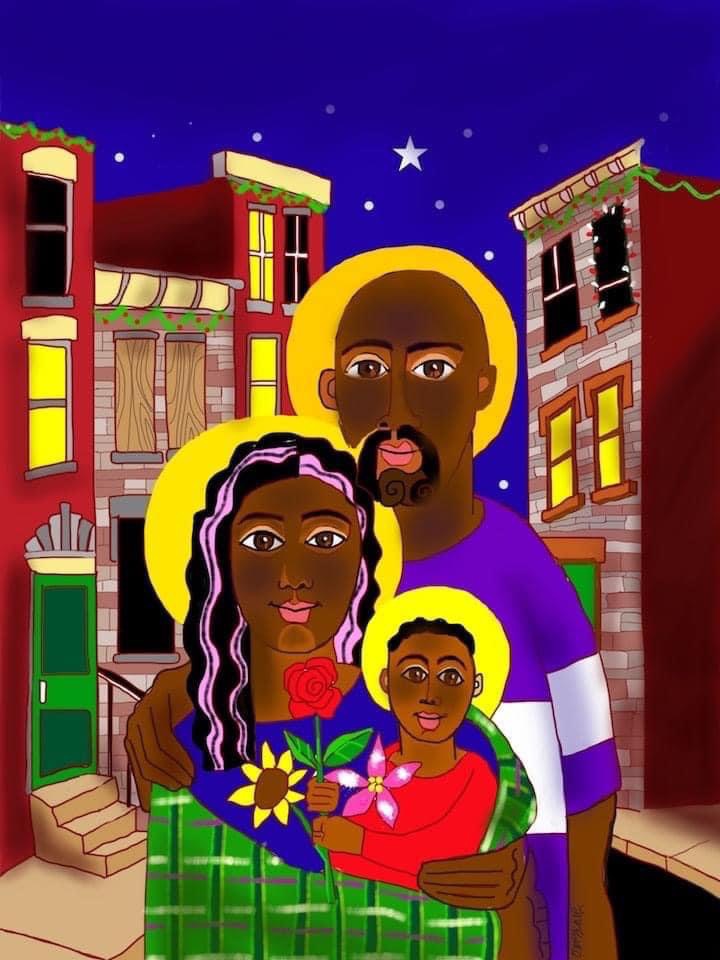
Today the church remembers not one person, but rather a family: The Holy Family, Vessels of Divine Communion.
Typical depictions of the Holy Family usually include Joseph, Mary, and the infant Jesus. We understand through scriptural accounts as well as the conventions of the day, that Jesus had siblings as well, which should not be forgotten.
It should also not be assumed that the Holy Family is somehow a prescription for how nuclear families should look. It is, instead, descriptive of the times…and even then, not so much, as Mary’s pregnancy out of wedlock certainly chaffed against the societal norms of the day.
But even with these qualifiers, the Holy Family as a unit is instructive for the kind of love that people can, and should, share within the family (biological or chosen). Joseph, the step-father of Jesus, is tenderly concerned when he cannot find his son on their pilgrimage, and is, by all accounts, kind and stalwart with Mary, keeping their engagement despite the pregnancy surprise.
Mary is a wise and protecting mother, accompanying Jesus on his travels, and sticking with him until the very end, even the cross. Truly, Beloveds, we are not meant to bury our babies, and yet she does so, not shying away from the heartache.
And though we don’t get much of a glimpse of the child Jesus, we find him appropriately rebelling against his parents, kindly watching out for his mother, and including his brother in his ministry.
Certainly it was not an idyllic family. No flesh-and-blood family, chosen or biological, is idyllic (despite what social media might portray). There were even a few arguments recorded (John 2, Matthew 12, Mark 3) that showed not everything was “Leave It to Beaver.”
And yet, they loved one another through it all.
This is why they are lifted up today: not because they were perfect, but because they loved one another in and through the imperfections.
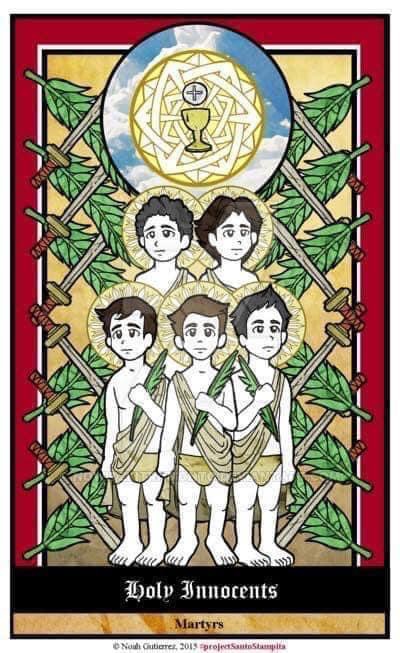
Today the church remembers the slaughter of the Holy Innocents, the children King Herod killed when searching in fear for the Christ child.
We sing of this in the carol “Lully Lullay,” which is meant to mimic the lullaby the mothers of Bethlehem sang to their children to keep them quiet as soldiers searched for them.
“Herod the king, in his raging…”
This still happens today. Children are still our most vulnerable population, especially when the powerful become fearful.
Children are the first to die in times of famine and disease, when food and medicine are hoarded by the powerful.
Children are still the first to die in the wars their parents wage.
Children are the first to feel it when social services are cut by the powerful.
Children are the first to feel it when we pass laws of convenience instead of laws of conviction.
Remember our Holy Innocents today: -The children of Uvalde, Texas, Oxford, Michigan, of Newtown, of Columbine, of every situation where we fail to act to protect them and instead protect guns -The children of Ukraine, Gaza, Israel, Yemen, Iran, Syria, Afghanistan, and all places torn by perpetual war. -The children of the rural poor. -The children of the urban homeless. -The children of undocumented immigrants, especially those used as political pawns in recent years -The children born addicted. -The children who fall into addiction because their futures are bleak. -The children who have every privilege but are not loved. -The children who are greatly loved but have no privilege and suffer in a world of status games. -The children of Papua New Guinea tortured for being accused of witchcraft. -The children sold into slavery around the world for the powerful to abuse. -The children who are left without parents or grandparents in the pandemic because we are selfish.
On December 27th the church remembers St. John, the only apostle said to have died of natural causes.
St. John played a prominent role in the Gospels, and some believe he is even depicted in the Gospel of John as the “Beloved Disciple” (though, I would contend that the Beloved Disciple in that Gospel is actually the one reading the Gospel…but more on that in a different piece of writing).
After the Ascension, John traveled far and wide as an evangelist. He is said to have ended up in Ephesus, where he died of advanced age. Lore has it that in his last years faithful congregants would carry him into the church at Ephesus where he’d bless the gathered people saying, “Love one another, my little children,” a theme of the Epistles of John.
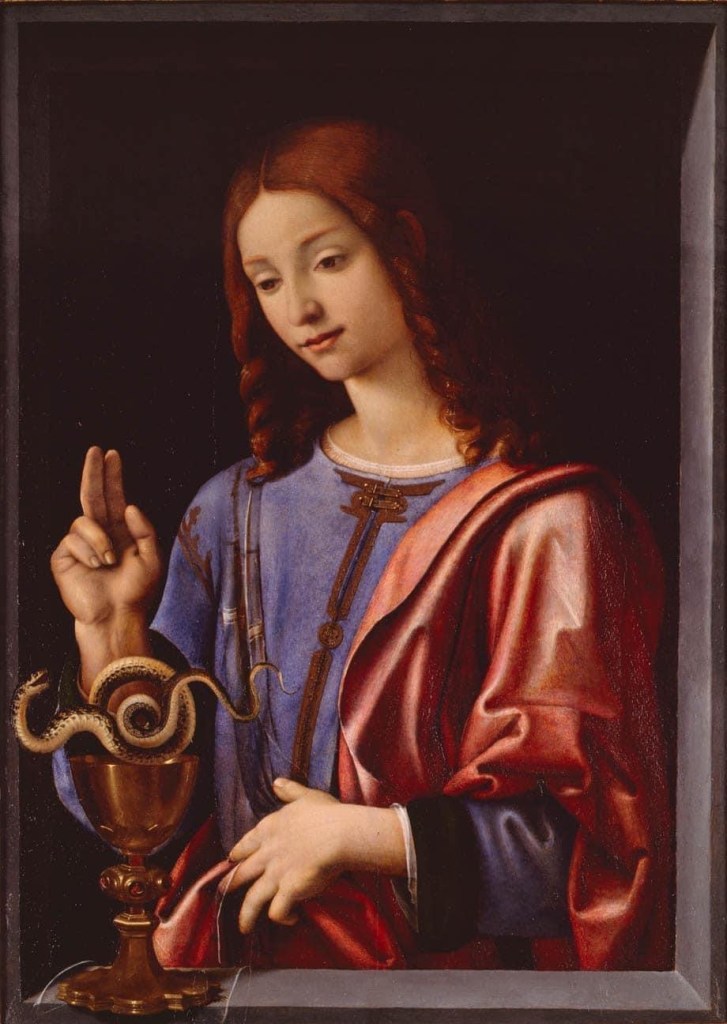
It’s an appropriate day to have a glass of wine or grape juice. Legend has it that John was challenged to drink a cup of poisoned wine, and as he held the cup, he blessed it, and the poison became a snake and slithered out, rendering it harmless. This is why John is sometimes depicted as holding a snake in a chalice.
These saint days following Christmas highlight the “Comites Christi,” or “Companions of Christ.”
St. Stephen died tragically, St. John supposedly died peacefully, and tomorrow the Holy Innocents of Bethlehem who died tragically are meant to highlight how Christ entered a world full of blessing and brokenness, sadness and joy.
God’s incarnation did not solve the problems of humanity, but showed that humanity is worth saving, by God…even broken as it is.
Today the church remembers St. Stephen, Deacon and Proto-Martyr.
It may seem odd to place the feast day of a martyr so close to The Nativity, but the reality is that Jesus came into a world of violence, no matter how loudly you sing “Silent Night.”
The pairing of the birth of the Messiah with the first martyr was intentional: Christ’s arrival is meant to redeem and reform our violent ways…but we’re not there yet.
St. Stephen appears in the Acts of the Apostles as a follower of Jesus whose defining characteristic is love. Even as he was being stoned to death, he prayed for his persecutors. We don’t know anything else about this disciple who apparently led a short, but noteworthy, life.
St. Stephen is joined by two other feast days directly on the heels of The Nativity: the Holy Innocents and St. John. All three will form a few days of peaks and valleys as the 12 Days of Christmastide play out. St. Stephen and the Holy Innocents will remind the us of the tragic nature of our world. St. John, the only Apostle said to have died of natural causes, will remind us that not everything is bad. This back-and-forth swing of the feasts of the church provide a rhythm that calls us to both work for justice, as not everything is well, and thank God for life and creation, because not everything is bad.
By the way, you sing of St. Stephen every year in the Christmas Carol “Good King Wenceslas” who, if you recall, “looked out on the Feast of Stephen, when the snow lay round about, clean and crisp and even…”
St. Stephen is a reminder for me, and should be for the whole church, that love is powerful, and it’s what we cling to and are held by in this life.
Today the church honors the Festival of the Incarnation, also known as Christmas.
While not originally one of the major feasts of the early church, Christmas has become both a major sacred observance (usually following the ancient rite of observing a feast day starting on the evening before the actual day), as well as a secular cultural observance of immense proportions in many places throughout the world. Christmas is now the feeding trough of nostalgia and celebration and kitsch while also remaining an important holy day for those who keep the feast!
Many Christians may be surprised to learn that Christmas was not a high holy day for the first church, but it makes sense when we remember that the first church was more focused on the acts of the Christ rather than the birthday of the baby (and because that birth story is only told in two Gospel accounts, and even those don’t agree with one another on the major details). The early church was more interested in the Resurrection and the Festival of the Pentecost (the latter being uniquely Christian in flavor), but because ancient winter festivals were so prominent in the local zeitgeist of so many cultures, the church adapted these local practices and melded them into a celebration of the birth of the Christ and, boom: Christmas was born.
Melding the nativity of Jesus with other observances (Saint Nicholas, Saint Lucy, Saturnalia, and Yule games), eventually an Odin-like character (Santa) would deliver presents (like Nicholas) in many places, taking on an elvish persona that reflected northern Scandinavian lore more than any Palestinian birth story.
When confronted with these melding of customs and lore an observer is given a few options: adopt them, adapt them, or rebel against them.
The church has done each of these, for better or worse, at different points in history. But let’s not pretend that today originated as anythjng Christian. If anything, this feast above all others is an example of Christianity being nimble (which is ironic because it has only become more inflexible as the years progressed and it’s secular power has been threatened).
Still, the Festival of the Incarnation is a beautiful feast with many local traditions focusing on that first family of the faith by gathering their own families from far and wide. And if your family couldn’t gather together you’d wait eagerly for that “Christmas letter” from kin across the ocean, the precursor to those staged Christmas cards that stress so many out.
At its best today is a reminder that the Divine still breaks into this world in unusual and hidden ways. After all, God coming in such a lowly manner to an ordinary woman of no note is odd, and the fact that the first to witness it are shepherds (who couldn’t even testify in ancient courts because they were considered so unreliable!) makes the whole thing even odder! This inconceivable conception is worth a gift-giving tradition, yes? May we all receive the odd gift of the Divine presence in our lives.
At its worst it’s overly romanticized and divorced from the powerful story it is.
A world in turmoil is visited by God not through a conquering war cry from a general on a horse, but through the cry of a baby born in the food trough of a horse. And the fact that the ancient lands where this story was said to take place is once again in upheaval is even more of a reminder to dismiss the romanticism and embrace the radical subversive nature of the whole thing.
The Festival of the Incarnation is a reminder for me, and should be for the whole church, that God is still showing up in odd and powerful ways…if only we’d remove our romantic blinders long enough to see it!
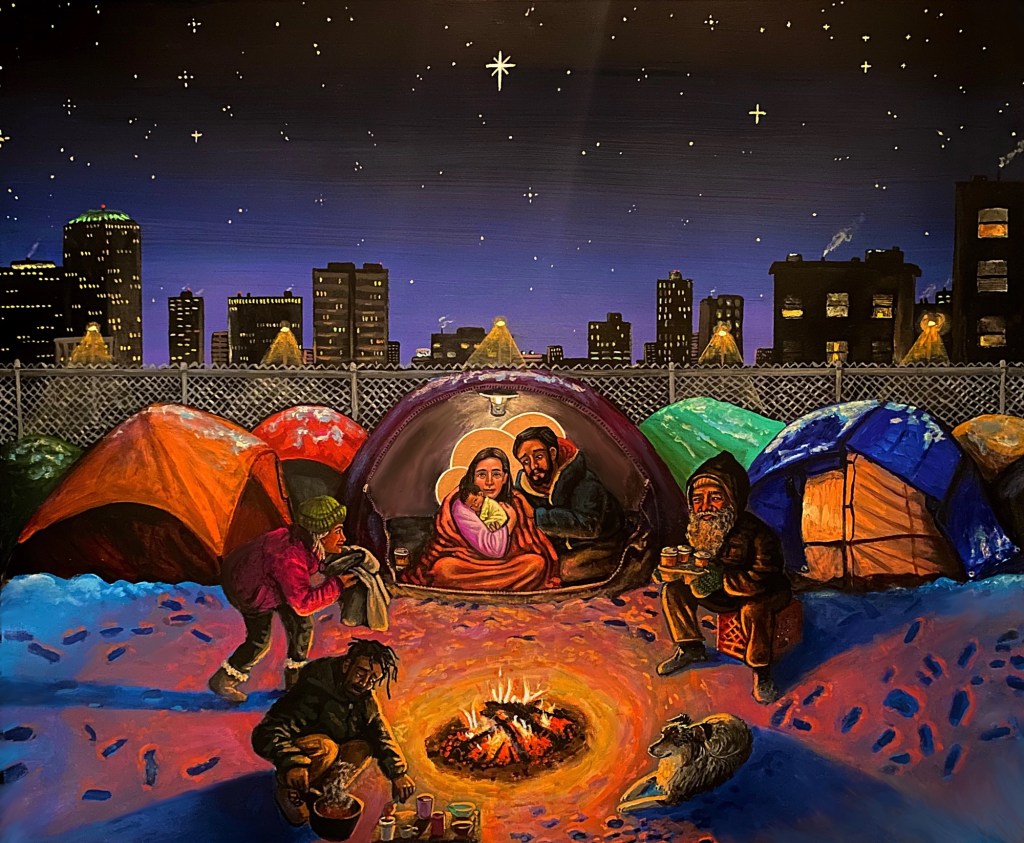
-icon written by Kelly Latimore Icons highlighting how the Holy Family would be in a tent city, or worse, under rubble were this story to be made real today. A recent icon, commissioned in the last few weeks does indeed show the Holy Family born in the rubble of Gaza, but I chose this one because for those of us Stateside this scene hits home.
Indeed…it is real today for too many. Far too many…
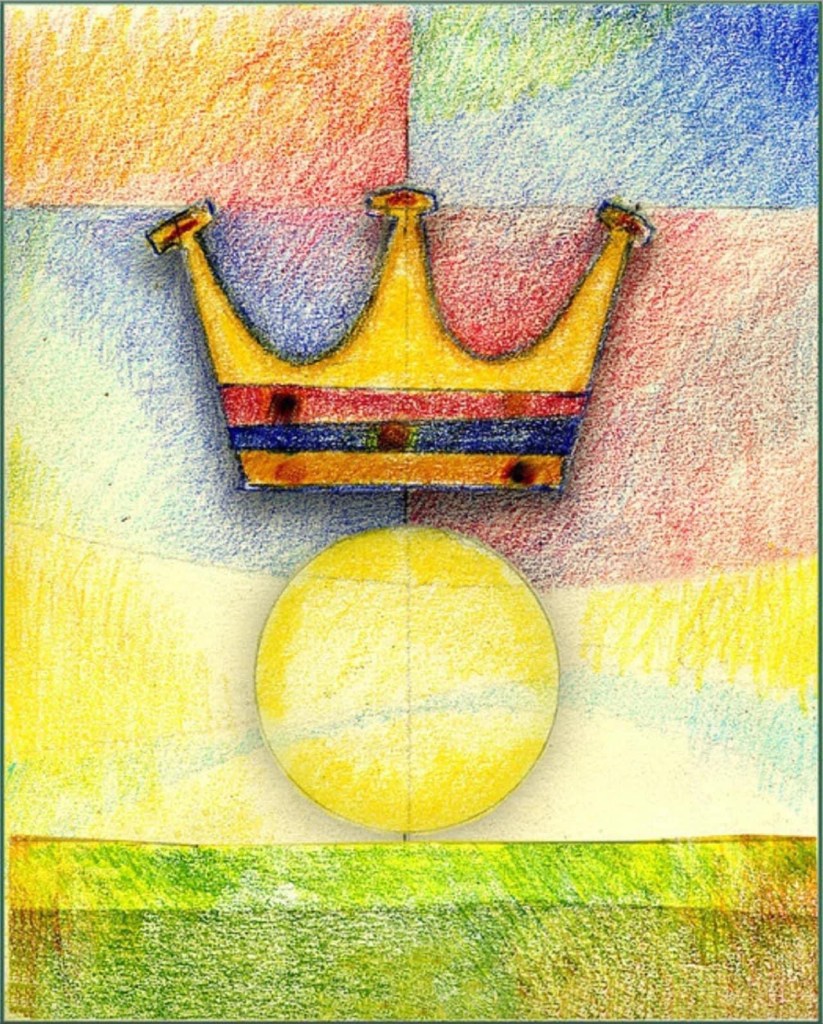
“O Ruler!” are the words sung by the church today. “O Rex!”
In our most honest moments we admit that we both like leadership, and like to rebel against it…humans are fickle.
We’re all ruled by something. Even the most unique individual allows that uniqueness to guide them to a fault. The most “don’t tread on me” flag waving person has a hook in their nose and their ideology is steering the ship.
What rules in your life?
At its best this call is a plea that our basest desires will no longer rule us, and that something more holy will do it. Perhaps peace will rule. Or love. The best of the Divine attributes!
At its worst, well, we’ve turned Jesus into just another self-styled tyrant to whom we demand others give their allegiance…
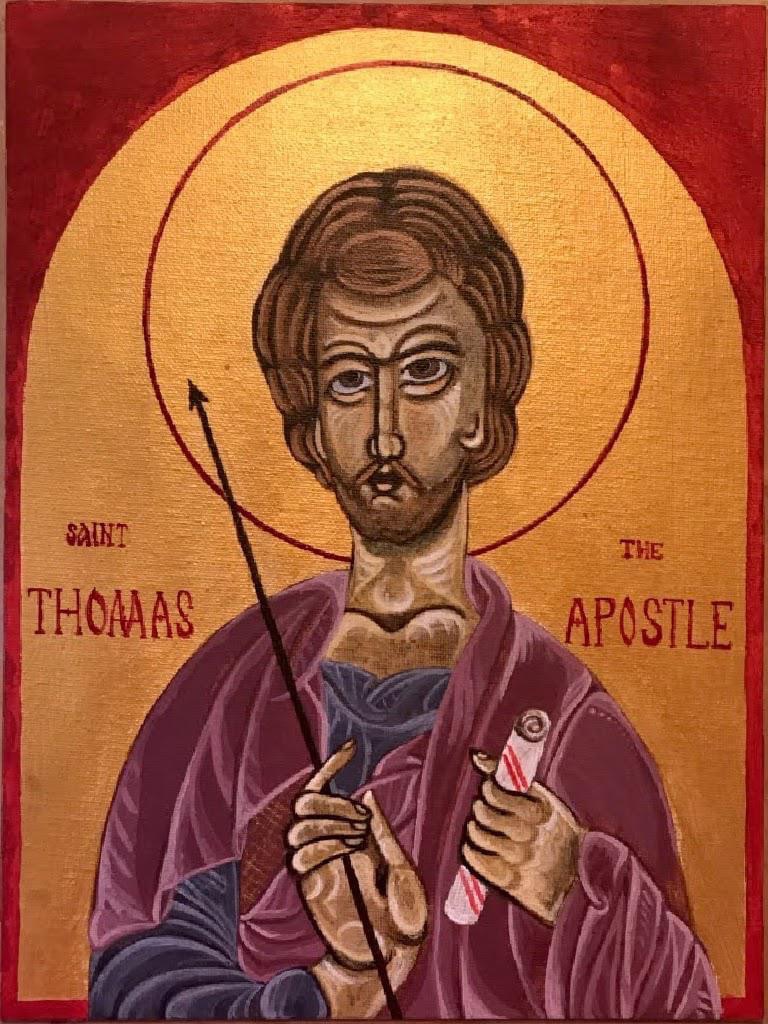
Today the church remembers a saint you know quite well: Saint Thomas, Apostle and Patron Saint of Those Who Ask Questions.
No doubt most everyone remembers Saint Thomas for his, well, supposed doubting of the resurrection as reported in Saint John’s account of the story, but that’s an accident of historical memory more than a reality. Saint Thomas didn’t doubt so much as he asked questions and sought verification.
And more people of faith should ask more questions, IMHO.
His name means “Twin,” and there is a tradition where Thomas is the twin of Jesus (or at least his doppelganger), but that’s largely conjecture. What is more probable is that Thomas, with his inquiry and deep searching for truth in the Gospel of John, is meant to be the reader’s twin in the story.
Or, in other words, you (and I) are the twin of Thomas, seeking to touch the Divine wounds, wondering if it could all be true, honestly desiring to say, “My Lord and God” with conviction and love because our eyes have seen it in real life.
Lore has it that Thomas took to being a missionary in India, planting the Martoma church tradition there that lives in a robust witness of the faith. There is a 3rd Century piece of literature, the Acts of Thomas that says he lived as an apostle carpenter in India, performing miracles, healing the sick, and was eventually martyred near madras. Within the pages of that interesting work is a beautiful Syriac poem, the Hymn of the Soul, a much pondered allegory of humanity’s search for beauty and meaning.
Fitting for a work dedicated to this saint, no?
While most modern scholars think that Saint Thomas probably was a missionary somewhere between the Caspian Sea and the Persian Gulf, never actually reaching India, the presence of the Martoma church and tradition give testimony to his legend and impact all the same, and it is the case that when European missionaries arrived in India in the 16th Century they found a robust Christian faith and practice thousands of years old.
Saint Thomas is a reminder for me, and should be for the whole church, that asking questions and continually chasing deeper and truer truth has been part of the faith from the beginning.
Let those with ears to hear, hear.
-historical bits gleaned from Pfatteicher’s New Book of Festivals & Commemorations
-commentary mine
-icon written by Byzantine icon writer “Krillyboy”


 Reluctant Xtian