Confusion

Today the church remembers a saint from Turkey who is most revered in the Balkans who, when her parents tried to prevent her generosity, balked at them: Saint Paraskeva the New, Activist and Traveler.

Paraskeva (whose name literally means “Friday,”) was born in nobility not far from Constantinople (or is it Istanbul?). Her wealthy parents looked askew at this pious young woman who, even as a child, had a habit of just giving her things away.

Yeah, that’s right: she literally just gave her family’s possessions to the poor, from about the age of ten.

Her parents were not pleased with this, and perhaps rightfully so. But instead of engaging her in conversation and constructive learning, they essentially forbade her from going out anymore, confining her to the home.

The profession of her parent’s faith, as they were Christian, and their displeasure at her generosity caused conflict within the young woman. How could they have taught her the words of the Gospel, even Jesus’ own instruction to “give up everything,” and yet be really angry when she followed those very words they gave her?

In fact, I’d offer up that this situation is happening right now in many homes! Children brought to church are confused when they hear Jesus say “love your neighbor,” and their parents rail against undocumented immigrants or LGBTQIA+ protections. They wonder how Jesus can heal any who came to him, and yet expanding affordable healthcare is somehow “socialism.”

The struggle is real.

Saint Paraskeva left her home and decided to live on the streets, existing off of the hospitality of strangers. She traveled from city to city visiting holy shrines and sites, praying and fasting as she went, welcoming the poor as her sibling on the journey. She eventually set up a hermitage near the Black Sea, living as a desert monastic. On this day she died at the far-too-young age of 27 in the year 1027 CE.

Saint Paraskeva is a reminder for me, and should be for the whole church, that we cause confusion in people when we hear the words of Jesus say one thing, but live our civil lives doing the opposite.

Let those with ears to hear, hear.

-historical bits from public sources and Illes, Daily Magic.
Saint Matthew of Wyoming

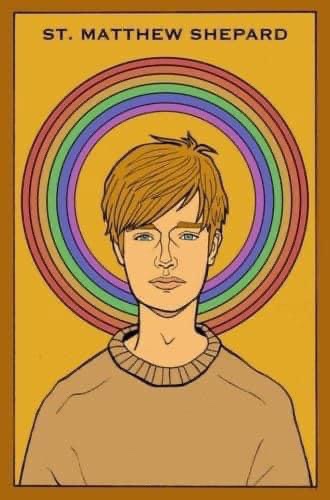
Today I would propose that the church, and the world, remember a modern tragedy that is still all too relevant today: St. Matthew Shepherd, Son, Martyr, and Hate Crime Victim.

Matthew was born in Casper, Wyoming, and was known as a friendly kid interested in politics and theater. After moving around with his family, he eventually landed at the University of Wyoming in the town of Laramie as a Poli-Sci major. He was raised Episcopalian, and his father noted that Matthew had a knack for relating to most anyone he met, but especially those who felt like they didn’t belong.

Here is where I would usually write about what happened to Matthew, but in typing out the incident that led to his death I found myself unable to continue because it was so terrible, horrifying, and graphic.

And it made me think of my own two babies. My heart breaks for his parents, his whole family, still.

On October 6th Matthew was offered a ride by two men at the Fireside Lounge in Laramie. He left with them and, instead of going home, they robbed him, beat him, and left him tied to a fence in freezing temperatures. He was found the next day, comatose, and died in the hospital on October 12th.

The two men, and their girlfriends, were brought up on charges of first degree murder and accessory after the fact. Though their testimonies became convoluted, it was noted that they pretended to be gay to lure Matthew, and then killed him motivated by prejudice, homophobia, and hatred.

When I woke up on this morning in 2022, I woke up to headlines indicating that the head coach of the Las Vegas Raiders, Jon Gruden, resigned due to leaked emails containing misogynistic, homophobic, and racist statements. Statements from years of emails.

Just this last year it came to light that North Carolina’s Lt. Governor, in a SERMON, called homosexual and transgender people “filth.”

He’ll run for governor next cycle.

We remember St. Matthew, martyr, on this day, because the evil that moved in the hearts of people to kill him that night still move today.

It’s literally in the headlines.

And we need to call it out when we see it and hear it.

-icon written by Andrew Freshour

What Prevents Us?

Today the church honors St. Philip the Evangelist, not to be confused with Philip the Apostle…or any of the other nine hundred Philips in the ancient world. Seriously, it’s like they were short on names…

Philip was one of the Greek speaking disciples chosen in Acts 6 to distribute food to the widows and the poor in Jerusalem. This was the first organized ministry we have recorded by the ancient church, and note that it wasn’t planning a Harvest Festival, Rally Day, or a Christmas Bazaar.

It was feeding people.

Philip would go on to preach the gospel in Samaria, where Simon the Magician was said to be converted by him. It’s worth explaining that “Magician” in the ancient world probably meant “Sorcerer,” which is pretty cool if you think about it.

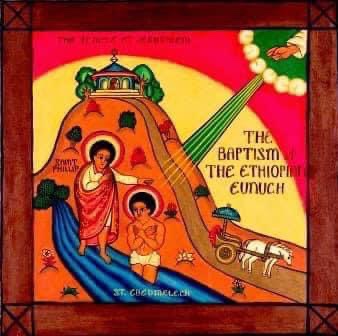
St. Philip would be the one to break down barriers in the church when he encountered the Ethiopian eunuch on the road and helped him make sense of the scriptures. This important Ethiopian was a sexual minority, and I think it’s important on National Coming Out Day (here in the United States) to honor the fact that St. Philip in the First Century welcomed a sexual minority in the church through baptism.

If only the modern church would emulate St. Philip.

Well, actually, it’d be best if the modern church would emulate the Ethiopian, wrestle with the scriptures, and ask to be converted.

St. Philip was also known to have four daughters who were called prophets in the early church. They hosted St. Paul on his journeys, and it is thought that he ended his ministry life preaching and baptizing in Asia Minor.

St. Philip is a reminder for me, and should be for the whole church, that the organized faith has a long tradition of welcoming and affirming humans from all walks of life. St. Philip, when entertaining the possibility of withholding the sacrament of baptism from the Ethiopian, received pushback from the traveler, saying, “There is water here. What is preventing you?”

What prevents us from extending the accepting grace of God to people?

The question remains.

-historical bits from Pfatteicher’s New Book of Festivals & Commemorations

-I love this icon, but cannot find who wrote it. If you can find it, please let me know.

Always

Today I would propose that the church honor two 4th Century saints who loved one another and died together: Saint Sergius and Saint Bacchus, Soldiers, Martyrs, and LGTBQ Icons.

Some calendars honor Saint Sergius and Saint Bacchus on October 7th, but because the Lutheran Church honors St. Muhlenburg on that day, I would offer that today, a day when no particular saint is lifted up, would be a great day to remember these two trailblazers.

Sts. Sergius and Bacchus were young nobles and high ranking legionnaires in the Roman army under Galerius. They were secretly Christian, and when this was exposed, they were arrested and told to make a sacrifice to Jupiter.

When Sts. Sergius and Bacchus refused, they were tortured.

It is reported that Sts. Sergius and Bacchus had pledged themselves to one another in love, and that in that same breath they pledged themselves to Christ, claiming that in their union they had also become one with Christ.

This oathtaking sounds very much like vows.

In the medieval era this oath was considered an act of “brotherly love,” but that moniker over their devotion to one another falls flat when compared to the sincerity of their words.

Sts. Sergius and Bacchus died at the hands of their torturers. It is reported that Bacchus died first and appeared in a vision to Sergius, saying, “My crown of justice is for you, and yours for me.” It’s interesting to note that “crowning ceremonies” were one of the ways same-gendered couples were formally joined in union in ancient Rome.

They are a reminder for me, and should be for the whole church, that LGBTQ Christians are not only not recent, but have always been, from the very beginning of the movement.

Let those with ears to hear, hear.

-icon written by Br. Robert Lenz and was first displayed at the Chicago Pride Parade in 1994

-historical bits gathered from memory and a number of sites

A Different Calling

Today the church honors the person considered to be the founder of the Lutheran Church in America, Henry Melchior Muhlenberg, Missionary to United States.

Born in the early 18th Century, Henry was the seventh of nine children raised in Hannover, Germany. He started his professional life as a school master after graduating from studying at Gottingen and Halle, but soon felt a different stirring.

The Lutheran presence in America was scattered and disorganized. Three disparate congregations in Pennsylvania (Philadelphia, New Hanover, and New Providence) sent a joint delegation to London and Halle in search of a pastor who would unite the Lutherans together in the colonies.

Muhlenberg was chosen and sent in 1742. On his way he spent some time in London to learn about America, and while there adopted a new clerical garment that would be used by Lutherans in the colonies.

Henry arrived in Fall of 1742 and gained the trust of both the German-speaking and Swedish-speaking clergy…no small feat! Muhlenberg struggled mightily to unite the many churches that were so ethnic-specific. He traveled incessantly, wrote constantly, preached in German, Dutch, in English, and became known for his powerful voice.

He established the first Lutheran synod in America, the Ministerium of Pennsylvania, in August of 1748. The delegates met together and ratified a modern liturgy that remained the only authorized American Lutheran liturgy for forty years, and is still sometimes revived for use to this day and can be found in all the Lutheran hymnals up through the Lutheran Book of Worship (1978). Muhlenberg had a dream of “one church, one book,” and he didn’t mean the Bible…that was already done…he meant a liturgy book.

Lutherans in this frontier land struggled with authority issues as it moved from a state-supported church in Europe to congregational-led communities in the colonies. Muhlenberg worked mightily with churches on both stewardship and education, two practices that could use a little reviving today. He even wrote a model congregational constitution, never needed in Europe, that helped to organize the disorganized faithful.

Muhlenberg was in favor of a distinct church in America, noting that local practices must hold hands with local customs. Despite this belief, he was quite pietistic, and had a low tolerance for chicanery or shenanigans from clergy or laity.

Muhlenberg and his children were leaders in American public life as well. His son John Peter dramatically left the parish to serve in the Revolution, becoming a brigadier general under George Washington. Another son, Frederick (also a pastor), became a member of the Continental Congress and the first Speaker of the House of Representatives…much to his father’s disappointment. Muhlenberg believed he would have made a much better pastor and should have remained in the parish.

Another son, Henry Ernst was both a pastor and the president of Franklin College where he excelled as an administrator and a botanist.

Where did he find the time?

And Muhlenberg’s great grandson? He became an Episcopal priest who is honored on April 8th. Maybe that’s why Lutherans and Episcopalians in America love one another so much…

Henry Melchior Muhlenberg died in Pennsylvania on October 7th, 1787. You’ll find his remains under a monument where, inscribed in Latin, is this simple phrase, “Who and what he was future ages will know without a stone.”

Muhlenberg is a reminder for me, and for the church, that sometimes you can get a different calling in life (he and all of his children and a couple of vocations under the belts), and that listening carefully to that still, small voice can enable one to do much for the world.

-historical pieces from Pfatteicher’s _New Book of Festivals & Commemorations

Welcome, October

For the ancient Celts, October signaled the end of their Autumn and opened the door for the shadowed half of the Celtic year.

Samhain (which literally means “summer has ended”) marks the final feast day of the season, and the convergence of the shadows and the weather inclined the Celts to believe that spirits were able to walk among the living causing mischief, curses, and sometimes blessings.

Practically it meant bringing in the cattle and the sheep down from the summer hillside and into the byre and the stable, now full of the harvested hay brought in throughout August and September.

It was also the time to slaughter the animals and prep them to last as far through winter as possible with salts, cold storage, cottaging, and drying.

The very last bits of barley, wheat, turnips, and apples were picked from the now naked fields, because come November the faeries would start breathing on all the fruit, frosting them and making them inedible.

While the sun still glowed it was also time to get the wood and peat stacked and ready for use. No one wanted to chop and gather in the frigid days coming.

This was a joyous month for the Celts, as the whole family was regularly gathered in the house and the barn: baking, salting, prepping, and preserving, envisioning the coming winter feasts and the cozy days ahead.

The summer sun now became the warm, dim room, and the noisy insects would be replaced with long talks and stories from family and visiting friends.

October has come.