Today the church honors a Bishop who tended his flock during a plague, which makes him a bit relatable, no? Today is the feast day of Cyprian, 3rd Century Bishop and Martyr.
Hailing from Carthage in North Africa, Cyprian was a professor and lawyer by trade, only being baptized in his forty-sixth year of life. Amazingly, however, he was elected Bishop of Carthage only two years after ordination…hardly enough time to understand the ins and outs of parish ministry, me-thinks…but no one asked me.
Cyprian was a scholar and assumed the Bishopric when the church was rocked by schism and scandal. He used his office to gather the church together, seeing the office of Bishop as both encourager of the people and the anchor that holds disparate parts of the Body of Christ in communion with one another.
When emperor Decius began persecuting Christians, Cyprian went into hiding, a move for which he was much criticized. He felt that he had to continue to lead his flock through the persecution, and so his survival was paramount. History has taken a more cynical view of this move.
Soon after the persecution a plague broke out in the empire, and the Christians took the popular blame for it. When persecutions again resumed under emperor Valerian, Cyprian willingly and peacefully was arrested on September 14th in the year 258. He died a martyr’s death two days later.
His arrest and appearance before the authorities is well documented, and even appears to have been a peaceful exchange…even though it led to his death.
The charges?
He was accused of not bowing and acquiescing to the gods of the empire, of not siding with the powerful against the powerless, and not worshiping the emperors of the day. He spoke against their self-congratulatory ways of operating and their demands for prestige and accolades at the expense of the people they were supposed to serve.
He plead guilty and died by the sword.
St. Cyprian asks us a question from his grave in these days:
Would we be found guilty or innocent?
-history gleaned from Pfatteicher’s New Book of Festivals & Commemorations
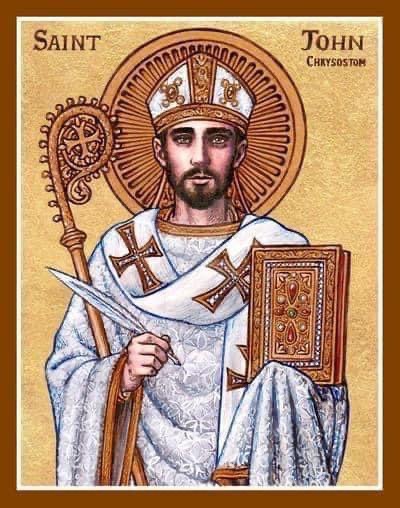
In the second half of the 4th Century the world was blessed with a preacher still unsurpassed in eloquence, and today is his feast day: St. John Chrysostom, Bishop of Constantinople.
St. Chrysostom (which literally means “golden-mouthed”) was born in Antioch and trained under the famous philosopher Libanius, who named him “brilliant,” and the biblical scholar Diodorus. Though Libanius wanted him to become a lawyer, John chose the more-secure-but-less-lucrative route of ministry, and was baptized at the Easter Vigil in ca 368 at the age of 18.
He lived as a hermit for a while, contemplating the life of a, well, contemplative, but was finally ordained into the priesthood and served the Bishop of Antioch, Flavian.
He became famous for his sermons as he preached with the “scriptures in one hand and the headlines in the other,” to borrow a popular phrase. His sermons were thematic and contemporary, addressing topics like social justice, the equality of women in society, his opposition to slavery, and emphasizing the role of laypeople in worship and the church.
He even did a whole series on “toppling statues” as the people of Antioch had rioted and destroyed some statues of the emperor. How’s that for timely?
In 398 St. Chrysostom was chosen (surprisingly) to become Bishop of Constantinople (or is it Istanbul?). This was an important and consequential post in the Church. He won people’s affections for his simplicity, honesty, clarity, and eloquent sermons. Unfortunately, these qualities also caused many people to despise him…if he were around today he’d have gotten many emails. He refused to play political games, and had no problem ousting clergy and Deacons for murder, adultery, and the like.
In 403 the empress and Theophilus of Alexandria conspired to take down this popular and principled prelate at a conference called the Synod of the Oak. There they condemned St. Chrysostom on false charges of heresy and he was officially banished from the city.
The people were outraged and riotous and, coincidentally, the empress herself had a personal tragedy. These events were taken by religious leaders as “signs from God” that they had made a mistake, and they brought St. Chrysostom out of exile. But, because he wouldn’t admit any wrongdoing, they prevented him from taking his seat in the cathedral. Still, John had enormous pull, and on the Easter Vigil, 3,000 converts came to the Baths of Constantine for baptism that year, which amounted to a riot itself. Soldiers broke up the service, and some were killed.
Unable to control the people with this golden-tongued popular prophet around, John was once again exiled, this time to Armenia. He continued to write, however, and was able to be enormously influential even in exile as he corresponded with friends back in Constantinople.
Pope Innocent I finally was prompted to get involved and, following the people’s lead, supported his Bishop. He condemned the Synod of the Oak as illegal, and when he sent papal envoys to Constantinople to investigate the ordeal, his envoy was treated poorly, some were even jailed, and sent back to Rome.
Now Pope Innocent was furious.
As retaliation for the Pope’s intrusion into his matters, the emperor had St. Chrysostom further exiled, and moved to an even more remote location. Having been given orders to vacate Armenia and move to isolated Pityus, John took up this cross on foot, bareheaded, and began the journey that would be his last.
He died at Comana in Pontus, never reaching Pityus. In his last breath he said, “Glory to God for all things.”
His grave is in the choir chapel at St. Peter’s Basilica. He is still remembered as the most eloquent preacher the church has ever produced, and his Christmas sermon is still preached by many faithful clergy every year.
St. Chrysostom is a reminder for me, and for the church, of a few things:
First, a sermon isn’t worth its salt if it doesn’t say something that connects God’s promises to the headlines of the day.
And, secondly, that every good pastor/prophet who does the above will have enemies. Sometimes, unfortunately, those enemies are close to home.
Indeed, it has always been so.
But the work continues, Beloved.
-historical pieces absorbed from Pfatteicher’s New Book of Festivals & Commemorations
-They Might Be Giants references are yours truly’s
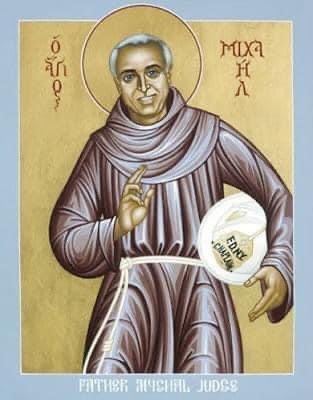
As dawn breaks on 9/11, a saint deserving to be held is brought to my mind: Saint Mychal Judge, Saint of 9/11 and Chaplain of Engine Co/1 and Ladder Co/24.
Saint Mychal was not the first victim of the terrorist attacks on 9/11, but he was the first identified victim: “Victim 0001.” He served as New York City Fire Department’s chaplain. A Franciscan friar and priest, Saint Mychal was known for going above and beyond for the women and men he cared for. He often made hospital visits. He was at most every funeral.
And he went to fires, keeping his radio nearby, which is how he heard about the World Trade Center attacks.
While others fled the scene, Saint Mychal rushed toward it in his priestly garb, following the steps of his fellow fire fighters. He immediately started administering last rites to those who were critically wounded, and when he saw his company rush into the North Tower he ran toward it, too, despite the evacuation order.
Outside that North Tower he helped people escape and, while standing there praying, was killed by flying debris as the South Tower fell.
Saint Mychal was more than just NYFD’s chaplain, though, he was also a gay priest (out to his friends) who openly counseled those suffering from AIDs in the 1980’s, performed funerals for AIDs victims when other shunned them, who admitted quite honestly his struggles with alcohol, and who showed up to New York City’s first gay-inclusive Saint Patrick’s Day Parade in his friar’s garb, taking interviews for the media despite the Archbishop’s warning against it.
Saint Mychal is a reminder for me, and should be for the whole church, that the true work is to walk with the people, especially when their lives are on the line, even as the world falls down around them.
-historical bits taken from Illes’ Daily Magic
-icon written by Br. Robert Lentz and can be purchased at Trinityicons.com
You do not have to be good. You do not have to walk on your knees for a hundred miles through the desert repenting. You only have to let the soft animal of your body love what it loves. Tell me about despair, yours, and I will tell you mine. Meanwhile the world goes on. Meanwhile the sun and the clear pebbles of the rain are moving across the landscapes, over the prairies and the deep trees, the mountains and the rivers. Meanwhile the wild geese, high in the clean blue air, are heading home again. Whoever you are, no matter how lonely, the world offers itself to your imagination, calls to you like the wild geese, harsh and exciting – over and over announcing your place in the family of things.
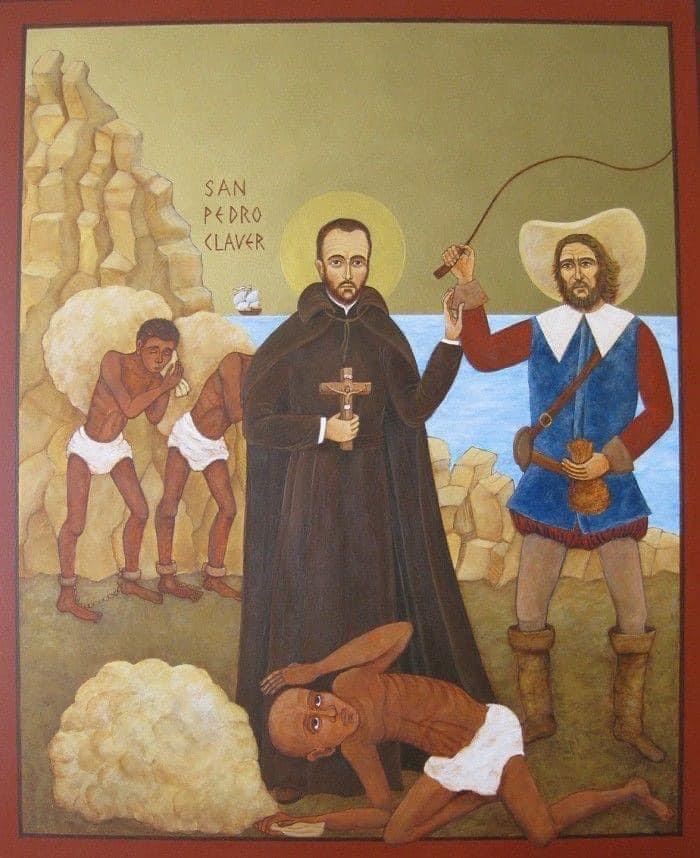
Today the church honors a 17th Century pioneer in equality and human dignity, St. Peter Claver, Jesuit, Servant and Reformer.
St. Claver was born in Spain, became a Jesuit priest, and was sent to Columbia and the mission fields of the new world. There he came under the wing of Fr. Alonso de Sandoval, a fellow Jesuit who was dedicating his life to the well being of the slaves being brought in massive numbers to work the Colombian fields and mines.
St. Claver worked on behalf of the slaves from the minute they were forced from their boats in the inhumane slave trade. Their physical, emotional, and spiritual well-being became his primary concern, and he felt he needed to live among them to serve them, taking a stand with them against the inhumane practices of the powerful.
He argued through the means available to him that slaves, once baptized, should be freed, an argument that seems nonsensical and colonialist to our ears, but which was probably his best means of persuasion at the time. Fellow Christians, he thought, deserved the rights all Christians deserve.
He was known for following up with slaves after their work days in the mines and fields, and faced great hatred and opposition from slave owners and the rich elite who knew his care threatened their control.
St. Claver also found himself in the jails and work camps, often coming alongside those being tortured during the Inquisition. Though Fr. Claver was sympathetic to the Inquisition’s goal, he felt that everyone left imprisoned and alone deserved a friend and advocate. In his work in the hospitals he was known for showing no racial partiality in his care for patients, which to us sounds like “not enough,” but in the 17th Century was “far too much” for the powerful padding their pockets on the backs of cheap human labor.
Often stubborn and difficult to work with, Fr. Claver had many admirers for his guts, but few friends. At the end of his life he became paralyzed and was left in a small room, neglected for four years until his death.
Ironically, in his time of need he was not offered the same care that he had offered others.
St. Claver is often called the “Saint of the Slaves,” not only because he cared so much for them, but also because he argued passionately for their legal rights.
Certainly we can say that he did not do enough. But contextually, he was a unique voice of opposition and action…a combination that was rare in the 17th Century.
He is a reminder to the church, and to me, that words without actions are just noise in a world drowning in a cacophony of noise.
Social media posts and generalized outrage are no strategy for world change, Beloved.
We must find ourselves living in and with our neighbor, advocating with them, not just for them. We must find ourselves utilizing our power to preach both to and against the powerful.
And we don’t do so as some sort of insurance policy, believing that someone will one day do the same for any of us…they may not.
We do so because it’s the right thing to do, by God.
-historical bits from Pfatteicher’s New Book of Festivals & Commemorations
Today’s feast day is a great example of how cultures adapt ancient feasts and tweak them to make meaning.
Today the church remembers The Black Madonna of Regla, a feast honored in homes around the world, but which is especially important for our Cuban sisters and brothers (though similar feasts are held in Spain and the Philippines).
The Black Madonna of Regla is an extension of tomorrow’s feast day, the Nativity of Saint Mary, but honors a particular carving of the Madonna from North Africa out of dark wood. The carving was supposedly commissioned by Saint Augustine himself!
When Spain pillaged North Africa (modern day Algeria), they took the statue and placed it in Chipiona, Spain. When the Moors went on their own conquest in Spain, the statue was hidden in a well, and forgotten about for hundreds of years, only to reappear after a vision was given to the church describing its location.
When Spain came brandishing their swords to the Caribbean, they found an ancient feast at this time of year to the goddess of the sea and “mother to us all,” Yemaya. Venerated in Santeria, a blend of many ancient religions, Yemaya is the black goddess dressed in blue who birthed life through the sea, and thus birthed everything. This goddess draped in blue looked, to those Conquistadors, like the Virgin Mary depicted in this ancient African statue so popular in Spain. Thus the festival for Yemaya was adopted as the Feast of the Black Virgin of Regla, because the Christianized celebration was instituted in Regla, Havanna, Cuba.
As with most holidays/holy days coopted by the church, ancient practices of the old remain blended into the new. The Black Madonna, clad in blue with sequins (mirroring the sparkles of the sea) is paraded through the town. The people give thanks for this “Mother of All” and celebrate life. The water of the ocean, like amniotic fluid, is used to symbolize the divine birthing of all life.
For those of a more Christian bent, the Madonna is honored and the life celebrated on this day is the life made whole in the person of the Christ, “Firstborn of All Creation” (Colossians 1:15).
For those who follow Santeria and the more indigenous religions, the woman dressed in blue is Yemaya, who births all life (especially to those who live on an island).
For some, she is both…and that is perfectly fine by them. Clear-cut distinctions in these kinds of matters are important only to people with too much time on their hands and too much at stake with either claim.
By the way, if you think this is unusual, this coopting of feasts and festivals by the church to tweak a practice, know that most of the highest, holiest days of the church are examples of this very thing. Christmas is a cooption, hence why trees of more pagan practices appear in Christian sanctuaries. Candlemas, in February, is a cooption of the Celtic festival of Imbolc. Easter, even, is in some ways a cooption as the very name is derived from the pagan “Goddess of Spring,” Eostre. This is why bunnies sit alongside empty tombs.
This happens. No need to hide it.
The Black Madonna of Regla is a reminder for me, and should be for the whole church, that sometimes the Divine is more prism than photograph, with many facets depending where you look…or whose eyes do the looking.
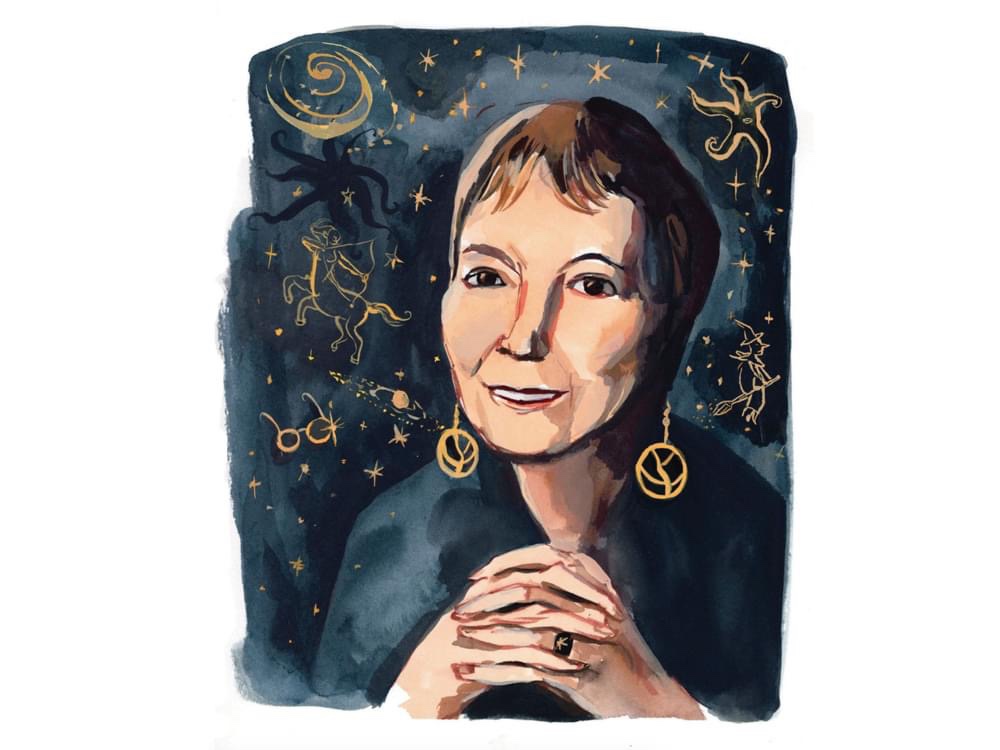
Today I would lobby hard that the church remember one of its premier contemporary storytellers: Madeleine L’Engle, Writer, Dreamer, and Master of Imagination.
Born in New York City in late 1918, Madeleine L’Engle Camp (she would eventually drop the Camp) was born to a pianist mother and a writer father, and took up her own writing discipline at the young age of eight. She was known as an awkward and shy child, and did poorly in school mostly due to her inability to assimilate. Because of her poor marks, her parents moved her around from school to school (and even physically moved, themselves) in an attempt to find the right fit for their family. Due to her social dis-ease, Madeleine found her home within the pages of the books that brought her comfort and friendship.
Madeleine graduated from Smith College and moved back to New York City to live as a writer and stage performer. She published her first two novels there, married actor Hugh Franklin, and birthed their first child, Josephine. Desiring a change of pace, the young family moved to Connecticut and became merchants of a small general store there as their family grew to add a son Bion and an adopted daughter, Maria.
It should be noted that even though she was writing this whole time, Madeleine had very little success getting her work published.
Because money was tight, the family moved back to New York City in 1959 so that Hugh could resume his acting career. Madeleine continued to write even though very little of it was ready by anyone, and by 1960 she had finally finished what would become her seminal work: A Wrinkle in Time.
It was rejected by 30 publishers before finally being picked up.
I’ll say that again for those in the back who fear that their work is no good: A Wrinkle in Time was rejected 30 times before being published. It would go on to win the Newberry Medal for Junior Fiction in 1962.
Madeleine would continue to give herself away for those she loved even after having attained international literary success. She taught at a local school, volunteered at a local library, and was very active in her Episcopalian parish where she not only served with the community but also accepted a few writer-in-residence opportunities. All the while she continued to write for audiences young and old, both in fiction and memoir form, tantalizing the imagination of so many in this world.
L’Engle understood that fantasy is the language we use to tell truths that are just too hard or deep to understand through common symbolism and dry prose. Fantasy is not an escape from, but an invitation deeply into, the heart of reality.
Children get this. Adults…not so much.
Madeleine was a convinced Christo-centric Universalist, claiming that no God could “punish people forever.” She said she could not do that as a parent, nor wish it upon her children, so how could a loving God do so with their own creation?
After a lifetime of writing, speaking, and creating for humanity, Madeleine L’Engle slowly slowed her pace and died on this day in 2007. She remains a beloved author by so many and an ever-present voice of challenge to humanity. In a world obsessed with “did it actually happen?” L’Engle reminds us that a much more important and interesting question is, “It doesn’t matter if it happened, does it happen?”
Madeleine L’Engle is a reminder for me, and should be for the church (and indeed the whole world), that fantasy tells deep truths, and perhaps religion would do well to not only acknowledge that fact, but lean into a bit.
Today I would lobby hard that we remember St. Freddie of the Mercury, Reformer and Musician.
Freddie (birth name Furrohk), was born in Zanzibar (modern day Tanzania) to Parsi-Indian parents. During the Zanzibar Revolution, Furrohk’s family fled and settled in Middlesex, England.
In 1970 he formed the rock band Queen and became the unlikeliest of frontmen. With an amazing four-octave range, which is almost unheard of, Freddie’s stage persona was as lively as his personal life, despite his intense shyness when not on stage. He interacted with his audience. He craved the spotlight while performing, but had few people he considered true friends. And despite having a serious overbite, never sought dental intervention for fear it would ruin his voice.
Mercury wrote 10 of Queen’s 17 greatest hits. His ambiguous and fluid sexuality caused many tabloids to stir with rumors. In a day when anything but heterosexuality was seen as deviant, he kept people guessing. He was diagnosed with AIDs in 1987, and confirmed he had the disease the day before his death in 1991. He was 45 years old. His birthday, September 5th, is still revered by rock enthusiasts and activists alike.
Mercury is a reminder to the world that the underdog in life should never be underestimated nor counted out. He challenged contemporary tropes relating to masculinity and what it means to be a rock star, and with a unique voice changed the way we think about both.
He was born to sing, and he did what he was born to do…may we all be so fortunate.
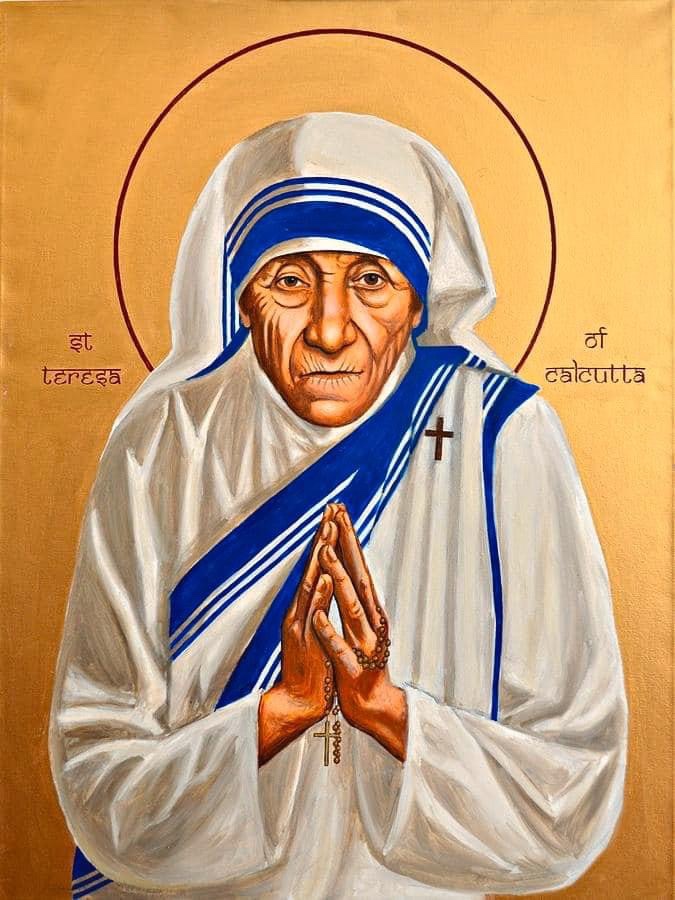
Today the church also remembers a woman who had a small frame but was a giant in the life of so many around the world: Saint Mother Teresa, Servant, Renewer of Society, and Woman full of Existential Doubt.
Born Gonxha Agnes Bjoaxhiu in Skopje, Albania in the year 1910, this slight saint was raised in the faith by her mother, as her father died when she was just eight. In September of 1928 Gonxha left home intending to become a missionary and entered the Institute of the Blessed Virgin Mary in Ireland. Being only eighteen at the time, she changed her name to Sister Mary Teresa after St. Therese of Lisieux, and prepared to head to India that December.
In January of 1929 Saint Teresa arrived in Calcutta and began her formal ministry with the people she would eventually identify with. In 1937 she made her final vows and was given the title “Mother,” an homage to not only her status within the ecclesial body of the church, but also as a testament to her outlook: tender, heart-felt, and courageously fierce when it came to the care of her people.
It is no exaggeration to say that many of us were the children of Mother Teresa.
On September 10th (it’s really amazing how many of the events of her life happened in September until we realize that this month is really a month of transitions in all creation) in the year 1946 she received a nudge from the Holy Spirit that a religious community should be formed in Calcutta, dedicated to serving the lowest caste of the societal system there.
In August of 1948 she officially received permission to found the Missionaries of Charity, with their white a blue bordered garb as a tell-tale sign of their work.
By 1950 her movement to serve the poorest of the poor in the world had spread from Calcutta to Venezuela, Rome, Tanzanie, and eventually to every continent throughout the known world. She truly inspired a movement that can be called world-changing.
In 1979 she was honored with the Nobel Prize for Peace and gained larger international fame. What is less-known about Saint Teresa, our common Mother, is that she was plagued by doubt and existential questions. Even as she gained fame as a woman of faith her private life was one of wrestling with the God she professed and the destitute poverty she witnessed. Only after her death did we all realize the deep struggle she faced daily to profess a God of love when so many in the world went without.
In this way, she truly is the Mother of so many of us.
In 1997, having served Calcutta for so many years, Mother Teresa died. She was given a state funeral in India and buried in the motherhouse there at the Sisters of Charity. She remains both an inspiration and an honest participant in both the service that Christ calls us to and the questions surrounding the idea of a benevolent God when there is so much hurt and pain and sorrow in the world.
Saint Mother Teresa is a reminder for me, and should be for the whole church, that no amount of faith can shield us from the honest questions that come when we’re in proximity of those who go without in this world.
Honestly, anyone without questions has not examined their faith…and this saint is a reminder of that.
Let those with ears to hear, hear.
-historical bits gleaned from Pfatteicher’s New Book of Festivals & Commemorations
Last night we lost Saint Jimmy of the Buffett’s, a tropical bard who embodied chill for a world needing instructions on how to do it, all the while using his business savvy and heart to create a legacy of ongoing chill that will outlive him.
I was introduced to Saint Jimmy early in my life. Some called him a novelty, some a joke, but to me he presented the quintessential ideal of someone enjoying their life’s calling to the fullest. I immediately found a kindred soul: he loved to make people happy and sought out different ways to do it through all the senses.
His love for bar food and boat drinks led to an empire of eateries.
His love for people of all ages led to retirement communities that encourage chill in the third act of life.
His love for human connection was found in a touring schedule that would make artists half his age fatigued in half the time, drawing thousands and thousands of Parrot Heads who saw following him on tour as an honor that bonded vagabonds and misfits and CEOs and school teachers together, all needing a break for a few hours, everyone letting their hair down (even if you didn’t have any).
His love for the written word led to books upon books, both for adults and children, to be published, all highlighting the sand and the surf and the hoisted sail.
And his love for music? Well, Saint Jimmy was not an amazing composer, but he was a prolific one. And he knew something that so few people do: how to tell a good, complete story in song.
In “The Captain and the Kid” we learned about his grandfather’s struggle to retire from sea life. In “Son of A Son of A Sailor” we learned about his life’s ambition to be on the waves forever like his grandfather, and in “A Pirate Looks at 40” we heard him struggle with the fact that he’ll never live that kind of life because, by chance, he was born “200 years too late…an over 40 victim of fate.” Even in his little-known tune “Mailbox Money” we got a glimpse of his life, hearing how his residuals just appeared in his mailbox in the morning and even how, when in his island life the postal service was spotty, he’d take up the helm delivering the mail by boat to his neighbors.
Though I find toe-tapping fun in his hits “Fins” and “Cheeseburger in Paradise,” I’ve always been drawn to his sentimental tunes offerings like “Barefoot Children in the Rain,” and “Take Another Road.”
After Hurricane Katrina wiped out large swaths of New Orleans and lower Mississippi, he wrote a song to ease their hearts, donating the proceeds of the album to their recovery. In the song he sang,
“I bought a cheap watch from a crazy man, Floating down Canal. It doesn’t use numbers or moving hands, It always just says ‘now.’ Now you may be thinking that I was had, But this watch is never wrong. And if I have trouble the warranty says, ‘Breathe in, breathe out, move on.’”
I cannot tell you, Beloved, how many times those lyrics have saved my life.
Saint Jimmy sought the good life and accidentally stumbled upon a meaningful one. Saint Jimmy sought the ocean, but instead brought happiness to oceans of humanity through community-building tunes.
Saint Jimmy found his way into the ears and hearts of so many who just needed a license to chill, and he wrote the order for them to do so without hesitation. I had the joy of hearing him for the first time just a few years ago, even as I own just about every one of his albums on vinyl.
He was a serious businessman who peddled in amusement as his currency, and we were grateful to join in that commercial exchange, finding privilege on both sides of that transaction.
It is fitting that he died on the cusp of Autumn, having led a Summer existence.
And, at least for me, I find it fitting that I read of his death this morning looking at the waves of the Atlantic, his home he introduced me to and invited me to see as my own.
Sail on, Jimmy.
Here’s the view from my balcony, and I have to imagine that this morning, well, yours is the same one.






 Reluctant Xtian