On the Autumnal Equinox, my mind is brought back to those ancient Celts who knew the Earth was not just alive, but provided us with secrets on how to live.
Balance, Beloved, is more than hard to find…it is also hard to keep. The Earth only finds it twice a year, and is only able to keep it for 24 hours at a time.
But when it does, everything changes!
At the Vernal Equinox the world springs forth with color and newness.
And today? Well, Camus said that Autumn is a “second spring,” where “every leaf is a flower” beginning to blaze.
For the Celts, with over half of the fields cleared by now, it was time to take stock of the harvest, both within the barn of the heart and the barn outback. They would prepare for winter, using what the year so far has given to plot the next phase of life.
Blessed Equinox! Lean into the balance a bit, and learn how to live.
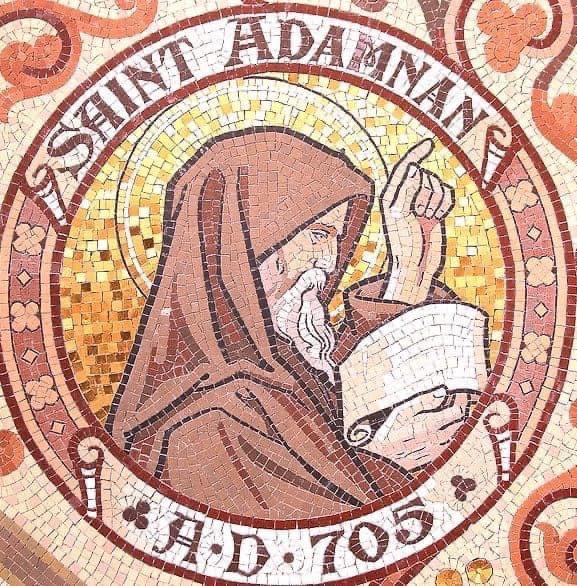
Today the church remembers a Celtic saint who, while kind of obscure, had an impact for generations to come: Saint Adamnan of Iona, Abbot, Law Writer, and Arranger of Calendars.
Saint Adamnan was born in the early 7th century in what is now County Donegal in Ireland, and was related to Saint Columba on his father’s side. He grew up in the Celtic expression of Christianity and was schooled far beyond most any Celt, average or noble, in his day.
Eventually, after entering the priesthood, ordination, and extensive education, he ended up at the famed Abbey of Iona, begun by his ancestor Columba himself. It was there that he eventually took over as Abbot and penned the most extensive work on Saint Columba, as well as the most in-depth work on the ancient Scots (the Picts) that we have today, The Life of Columba.
But that wasn’t all that he wrote.
He was very interested in justice and human rights, and proposed what came to be called, “The Rule of Adamnan,” essentially an argument that, in warring times, women and children should be spared, and that non-combatants should not be held prisoner. His “rule” sounds very similar to modern Geneva Convention rules of war.
In his role as Abbot, he traveled around what is now the British Isles, visiting different parishes as good Abbots do. In South Briton (Britain) he encountered a strict Roman adherence to custom and calendar, which chaffed a bit against his Celtic understanding of the faith. Nevertheless, he believed the church should be one, and while he was unwilling to give up much of his Celtic Christian practices, he argued that one thing the church should agree on was a common Easter festival.
See, the Roman expression of the faith celebrated Easter on 21 Nissan, but the Celtic expression had continued with the ancient way of celebrating Eoster, the “spring festival,” on 14 Nissan. Intermingled with the empty tomb they put their ancient symbols of spring and new life: eggs (often painted), hares, and sweet rolls (often a gift to the goddess of spring). These symbols were also seen in the spring festivals of many ancient peoples.
Those sweet rolls, by the way, became hot cross buns in the hands of the church…
So while the eggs, rabbits, and rolls could remain, St. Adamnan argued mightily that the Celtic Christian expression should adopt the same date for Easter that the Roman expression was using, further unifying the faith.
In time, his argument won out, and the festival date changed (though the Celtic traditions remain to this day!).
St. Adamnan is a reminder for me, and should be for all people, that compromise is not only possible, but often an important step in unity.
Unity does not mean uniformity, and we’ve forgotten that.


 Reluctant Xtian