“I just keep re-living my mistakes,” he said, face down.
“You mean, you keep making the same mistakes?” his friend asked.
“Not really,” he said. “I mean that I just can’t forget them.”
It was clearer now.
“Remember,” his friend said slowly, “that time you defied the odds and got that recognition for a job well done? It was just like, last year, right?”
He looked up. “Yes,” he said nodding.
“How about you replay that record. You haven’t heard it in a while.” And his friend sat next to him and together they remembered the things worth remembering.
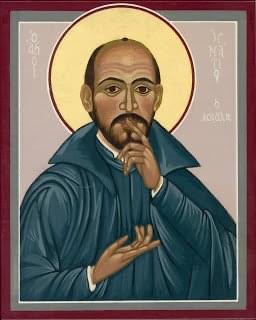
Today the church remembers a 15th Century monk who would form one of the most fiery Roman monastic orders: St. Ignatius of Loyola, Founder of the Jesuits (Society of Jesus).
St. Ignatius was born to a Basque family with money and prestige. Because of his high status, he had the privilege (if you want to call it that) of being a page in the court of Ferdinand and Isabella, where he spent his days drinking, enjoying lots of carnal pleasures, and really not giving a damn (in a bad way).
This life eventually landed him in some legal trouble. In order to reform his ways he did what so many young persons do to get a grip on life: he joined the military.
In 1521 St. Ignatius was injured in battle while fighting French forces at Pamplona. A cannon ball struck his knee, causing him to limp the rest of his life. While he lay in recovery, he read the life of Christ and hagiographies about the saints, and in those days of recovery he resolved to devote himself in service to the faith.
It’s worth noting that he also loved to read fiction and knight-centered fantasy tales…just to keep it real, ya know?
He took a year off (as only the wealthy can do), and decided to go on a pilgrimage to Jerusalem and enter University in Barcelona, and then eventually in Paris.
He graduated from University at the age of forty-three, proving you’re never too old to get some schooling under your belt. He gathered around him nine companions and took a trip to Rome, calling themselves the Society of Jesus. They offered their services to Pope Paul III in whatever fashion the Bishop of Rome desired.
All ten were ordained into the priesthood, and the Pope Paul III in time approved the Society of Jesus (the Jesuits as they’re commonly known) who organized themselves in the only way Ignatius knew how: military style, with Ignatius as the first Superior General.
Ignatius died July 31st, 1556, having established Jesuit orders throughout Europe, and sending missionaries to Asia, Africa, and the Americas. The Jesuits became known for their self-discipline, adherence to moderation, and frankly a “take no crap” way of being in the world.
The Jesuits today produce some of the most interesting personalities seen in the popular church. Some are militant social justice warriors, with hearts and minds set on bettering humanity, standing up for the poor, and bucking the patriarchy in order to do so. In other cases, some Jesuits strictly toe the doctrinal line, giving no room for error (they were staunchly against the Reformation). How these two types of personalities (and the many that fall between these two poles) find themselves in the same order might cause you to be puzzled…and rightly so. It’s a paradox.
Yet, in this paradoxical way, Saint Ignatius created an order that mirrored his own human existence: having tasted excesses and the strong arm of the law, he had compassion for those who suffer, all the while feeling the need to have safety-rails on his life in order to know how to “stay on track.”
Saint Ignatius is a reminder for me, and should be for the whole church, that it’s never too late to start a movement. Also: when you find yourself within a movement, you might be standing next to someone who joined for a completely different reason…and you have to become OK with that on some level, Beloved.
-historical bits from Pfatteicher’s New Book of Festivals and Commemorations
Today the church remembers a 19th Century saint who found his holy quest utilizing bills more than belfries: Saint William Wilberforce, Renewer of Society and Abolitionist.
Saint Wilberforce was born into wealth and privilege, and to his credit he leveraged these two rolls of the dice for the betterment of humanity. He was extremely devout, and desired to be a priest, but was convinced that Parliament held more sway than the pulpit.
He entered politics, and for forty-five years he fought within the House of Commons for the abolition of the slave trade. In 1798 he began speaking, campaigning, creating flyers and petitions and bills, tirelessly annoying Parliament with his insistence that moral humans and an ethical society could not coexist with slavery.
In 1806 Wilberforce managed to get a bill passed that prohibited slavery in all the British colonies, but his efforts were not done because while slavery was prohibited in the colonies, it still existed elsewhere throughout the British Empire.
Arguing, calling people to gain their moral backbone, backroom dealing, and appealing to their better angels, Wilberforce and his allies finally, in July of 1833, passed a bill that freed all slaves throughout the empire.
He died three days later.
In the early days of his movement Wilberforce was noted to say, “Let the consequences be what they would…I from this time determined that I would never rest until I had effected (slavery’s) abolition!”
Saint Wilberforce is a reminder for me, and should be for the whole church, that sometimes one person with moral backbone can move an empire.
It’s happened before.
-historical bits from Pfatteicher’s New Book of Festivals & Commemorations as well as Claiborne and Wilson-Hartgrove’s Common Prayer: A Liturgy for Ordinary Radicals
-icon written by Sir Thomas Lawrence and hangs in the National Portrait Gallery, London, United Kingdom
In the heat of waning July days, the ancient Celts would ready themselves for the August festivals and the beginning of the harvest.
They would take these final days to spend intentional time resonating with the world around them, relaxing in the earth and seeking out sacred spots to bless and in which to be blessed.
You might say this ancient practice is a precursor to our ideas of “vacation” these days. Summer rest is not something we invented, Beloved, but inherited through the long echoes of phenomenological rhythms that pulse throughout the looping threads of time.
Celtic author Mara Freeman notes three ways to honor the earth in these last July days that fall on the cusp of transition.
First, you can give thanks. Find a quiet spot in nature, breath deeply, listen carefully, and be grateful for what is around you. She notes that “a sacred site does not have to be famous or located in a distant country. It can also be a quiet, secret place you have found in the woods or, if you live in the city, a favorite old tree in a local park.” (from Kindling the Celtic Spirit)
Secondly, do some clean up. Whether it is in your backyard, along a well-hiked stream, your local park, or even just bush pruning around the house, caring for nature is an act of sacrifice to the very Earth who will, in the coming months, sacrifice fruit for us. Pruning, by the way, is necessary for many plants, and should be done with the plant in mind, and should not primarily be about how your yard looks from the street.
Finally, take a pilgrimage. Journey to a place where the Earth has been damaged or is in danger of being defiled, calling attention to it. Whether it is the pipeline in the Dakotas, over-fishing off the coasts, or even unwelcome infringement on a natural prairie in your little pocket of creation, walking there, seeing what is happening with your own eyes, and calling attention to it is an act of power and grace. Or, as one theologian puts it, “an actively mobilized process of bearing witness to woundedness and to the mysterious possibilities of the sacred.”
In these acts, the whole Earth becomes an altar upon which our attention, our love, and our gratitude is sacrificed. These acts have rippled throughout the cosmos from our ancient parents until today.
Today the church remembers a quintessential Lutheran theologian who took seriously Luther’s quip that “singing is praying twice,”: Saint Johann Sebastian Bach, Theologian, Composer, and Musician.
Saint Johann was born in Thuringia in the late 17th Century to a family of musicians. By the age of eighteen he was already a valued composer excelling on many instruments. He started his formal musical career as the organist of New Church at Arnstadt and the parish of St. Blasius in Muhlhausen where he married his wife Maria.
In 1708 he was offered the post as court organist and chamber musician to the Duke of Weimar, and this is where he would gain international fame and began composing chiefly for the organ. In 1714 he became in concertmaster, and held a number of other prominent positions in subsequent years, growing in fame, stature, and ability.
In 1720 his wife Maria died, and in 1721 he would marry Anna Magdalena Wulcken, a famous singer who served as his muse for a number of his most famous pieces.
From 1723 until his death he was the cantor of St. Thomas School and director of music at both St. Thomas and St. Nicholas in Leipzig while also lecturing a the University there. Were you to wander into St. Thomas or St. Nicholas in these days you would have heard most of his inspired compositions for the first time; his music was primarily meant to be played within the local congregation and the worshiping assembly.
Saint Johann saw his calling not primarily to music, but to the Divine inspirer of all sound. He was deeply spiritual, devoutly religious, and his faithfulness produced nearly two hundred cantatas for every Sunday and multiple offerings for High Holy Days.
B Minor Mass, the St. Matthew Passion (first performed at St. Thomas Church on Good Friday in 1729), and Concerto for Two Violins (my favorite) still ring throughout churches, concert halls, and iPhones around the world today.
Bach was the parent of twenty (yes…twenty) children between his two marriages. At his death he was given the title, “The Fifth Evangelist” by Archbishop Nathan Soderblom (see July 12th for his saint day). On the 200th anniversary of his death (1950), his body was moved from the churchyard of St. John’s to the site where he did most of his work, St. Thomas in Leipzig. Many flock to see the site still today.
St. Johann is a reminder for me, and should be for the whole church, that the arts have long been the primary medium of the faith. We must encourage young artists to take up the craft of music, composition, poetry, and choral direction, and we must pay them well for their wonderful work.
They are, after all, primary ministers in this world.
-historical bits gleaned from Pfatteicher’s New Book of Festivals & Commemorations
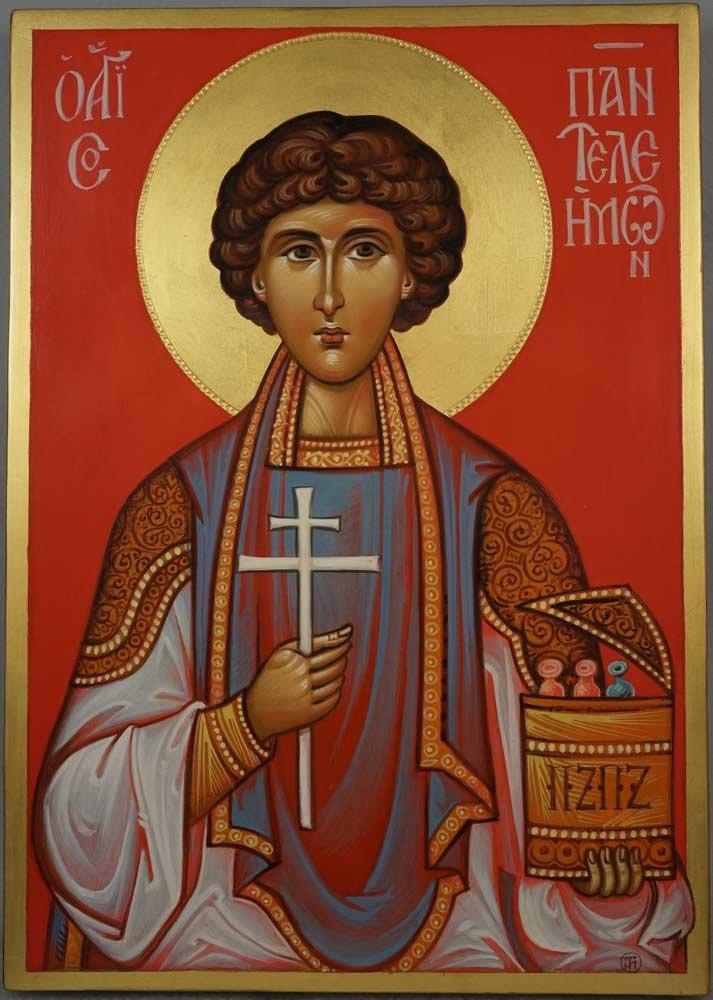
Today the church remembers one of the very early Christians of the faith: Saint Pantaleon, Physician, Martyr, and Emancipator.
Saint Pantaleon was supposedly born to a wealthy well-connected father, and was instructed in the faith by his mother Eubula. She died early in his life, however, and he went off to medical school letting his faith practices fall by the wayside.
A familiar story if there ever was one, right?! How many go off to university and seek out other distractions? Every parent is totally resonating with this story now…
So, Pantaleon is in medical school studying under the renowned early physician Euphrosinos. His acumen in the healing arts got him the enviable position as personal physician to Emperor Galerius.
It was Saint Hermolaus who came back alongside Saint Pantaleon and further taught him in the faith, telling him of the healing stories of Jesus which tantalized this physician’s imagination. He began to practice the faith again.
When his father died (who also became a Christian) the vast wealth of the family was given to St. Pantaleon who promptly freed all of the slaves, distributed the money to the poor, and became known as a wonderful humanitarian in the city.
All of this doing good, and his high position, caused his colleagues to become envious. When Emperor Diocletian came to power, Saint Pantaleon was exposed as a Christian and was beheaded (many a lore arose around his martyrdom, including the idea that the wild beasts were turned on him but only gave him cuddles because he was such a nice guy!).
He died in the year 305 AD.
Saint Pantaleon is a reminder for me, and should be for the whole church, that just saying “Jesus Christ is my Lord and Savior” without doing justice, loving mercy, and walking humbly is weak sauce indeed.
And much of popular Christianity is totally weak sauce.
-historical bits taken from common source materials
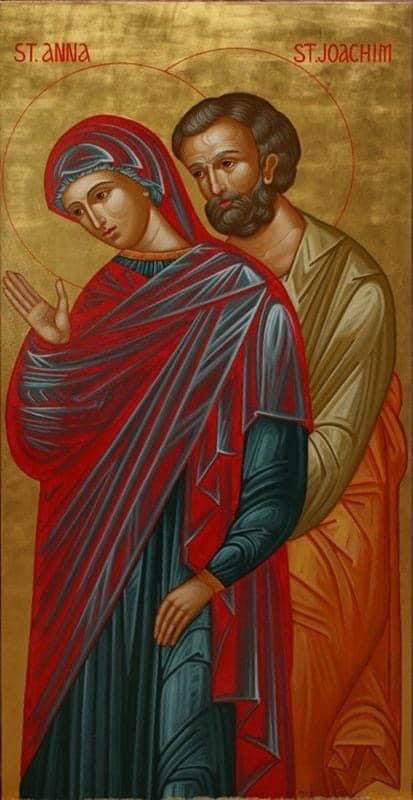
Today the church remembers two saints who we aren’t even sure existed, yet nevertheless hold an important (if figurative) place in the canon of Christianity: Saint Anne and Saint Joachim, Parents of Mary, the Mother of Our Lord.
Mirroring Abram and Sarai, Hannah, and Elizabeth and Zechariah, the lore on Anne and Joachim is that they reached an old age childless. Miraculously one day, Saint Anne was with child, and following in their faith ancestor’s footsteps, they raised the young girl (named Mary) in the temple to be taught by the priests.
Spoiler alert: this Mary would miraculously conceive Jesus and, well, you know the story.
We learn much of this from a second century apocryphal gospel of dubious authorship known as the Protoevangelium of James.
Nevertheless, the ancient world loved a good story, and this one fit the bill. The cult of Saint Anne grew and spread and really rooted itself in the mid 6th Century when Justinian I in Constantinople built the first church dedicated to her. When the details of these two saints became fleshed out and the immaculate conception of Mary (December 8th) was formalized, there was no looking back: Saint Anne would be assumed real, and would be really loved by many Christians.
In fact, our own Blessed Martin Luther loved Saint Anne so much, it was to her that he prayed when he felt his life was in trouble, promising her that, should he live, he’d become a monk.
In other words: the Reformation may never had happened had Saint Anne not been on Luther’s mind (though, perhaps he would have prayed to some other saint…who knows?).
Saint Joachim, like his son-in-law Joseph, takes the back seat in the lore. In fact, nothing else is really said about him other than he and Anne were together, he was old, and he had no children before Mary.
Saint Anne and Saint Joachim are important, though, because it just hammers home how much we love and adore lineage and tradition and long for meaning beyond meaning.
I mean, what are humans but meaning-making mortals?
-info gleaned from Pfatteicher’s New Book of Festivals & Commemorations
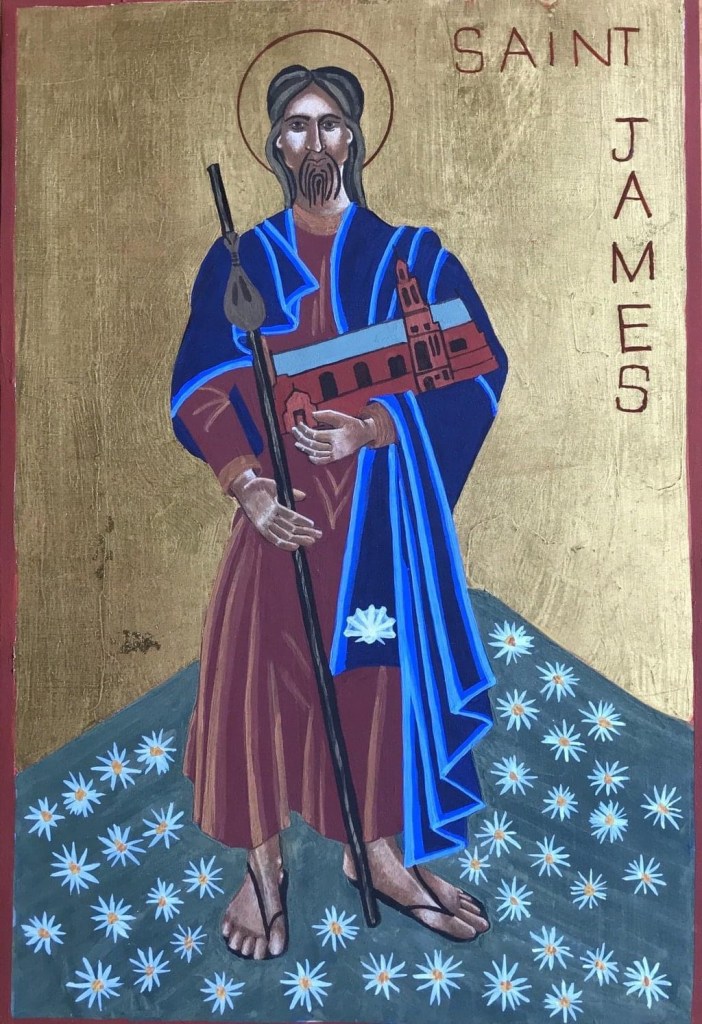
Today the church remembers one of the first called to follow Jesus: St. James the Great, Son of Thunder and Martyr.
Saint James the Great (he was called that because he was older than his brother John) was born in Galilee and worked as a fisherman. Jesus nicknamed James and his brother John, “Boanerges” or “Sons of Thunder,” probably as a nod to their quick tempers and flashpoint spirits.
Saint James was reportedly in the inner circle that Jesus had, the C-suite if you will (though I bet Mary Magdalene was also in there, just conveniently left off the record). He witnessed Jesus raising people from the dead, curing the sick, and being transfigured on the mountain.
He also fell asleep at the Garden of Gethsemane while Jesus was praying and fled when the soldiers came.
Saint James played an active part in the early church post-resurrection, and has the sad distinction of being the only Apostle to have his martyrdom recorded in the Biblical Canon (Acts 12:2) as he was beheaded by Herod Agrippa I in the year 43 (or maybe 44).
Though most all strains of Christianity honor Saint James the Great, no one can agree on a date. The Orthodox Churches give him a nod on April 30th, and the Coptic Churches venerate him on April 12th. The Western Church decided on July 25th probably because his relics were officially buried on this day in 816 AD at the Church of Saintiago de Compostella.
Saint James the Great is a patron saint of travelers, and you can walk his famous “pilgrim way,” the Camino de Santiago. A winding trail of pilgrim roads through Spain, Portugal, and France, the Camino ends at the relics of this beloved and revered Apostle, but best to warm up the hiking boots before you tackle it…it’s not easy.
Saint James the Great is often symbolized by a shell, a nod to his fishing background. Legend has it that eating an oyster on this day will keep you from being poor (though it’s not really oyster season, so be careful!).
Saint James the Great is a reminder for me, and should be for the whole church, that sometimes we get remembered for things that really don’t have much to do with us, and that’s ok. There is no good reason for Saint James the Great to be the patron saint of pilgrimages, and yet, here we are remembering him for it.
I mean, I guess in many ways it’s totally fine, right? He was a pilgrim in this weary world, like all of us, making his way.
-historical bits from Pfatteicher’s New Book of Festivals & Commemorations
-icon is “The Daisy Hill Saint James the Greater, ” written by Glenys Latham specifically for The Church of Saint James Daisy Hill in Bolton, United Kingdom
Today the church honors another saint who doesn’t get a lot of attention, but deserves it, St. Birgitta of Sweden.
Birgitta was born into a family of status. Her father was the chief judge in the province of Upland, Sweden in the 14th Century. As a child she began having dreams and visions of Jesus and Mary, which started her mystical journey.
Due to her proximity to the powerful in Sweden, she was appointed the lady-in-waiting to the queen of Sweden, Blanche of Namur. There she became known for having fantastical visions, and for being a staunch opponent of underhanded behavior from the nobles of the land.
She was not known for keeping her opinion to herself.
After her son died too young, she went on a pilgrimage, walking the Santiago de Compostella in Spain, accompanied by her husband. On the trip back, her husband (his name was Ulf…a great name) became seriously ill, and he died just a few years later, never fully recovering.
After the death of both her young son and her husband, Birgitta’s life became more akin to the prophets as her visions and dreams intensified. She devoted her time to helping the poor and oppressed, the underclass in Sweden, and later also in Rome.
She openly criticized the kings and popes and tried to make peace between warring factions of the church and the world.
Acting on one of her visions, in 1351 she founded the Order of the Holy Savior, also known as the Birgittines, centered on a monestary in Vadstena, Sweden.
The order was mixed-gender, comprised of both monks and nuns, but governed by an abbess.
In 1371 Birgitta embarked on one final journey, this time to see the Holy Land. The trip was cut short by a shipwreck and the death of one of her other children who went with her. She died in Rome, and her body was returned to Vadstena, where it is still buried.
Today her legacy lives on in the Society of St. Birgitta, a community of both clergy and laity within the Church of Sweden who follow a modified Rule of life inspired by her memory. Her dreams and visions are recorded in the book “Revelations” which is still read by mystics today.
Birgitta is a reminder for me of the power that putting our dreams into action can have, and that we are called to speak with conviction when the powers of the world conspire against the weak.
-historical notes gleaned from Pfatteicher’s “New Book of Festivals & Commemorations”
Today the church honors the “apostle to the Apostles,” St. Mary of Magdala, more commonly called Mary Magdalene.
Mary’s role in the stories of Jesus varies, depending on the account being referenced. In Luke she was one of those healed by Jesus during his ministry (apparently 7 demons plagued her). Some traditions have identified her with the “woman of the city” who anointed Jesus’ feet when he reclined in the Pharisees’s home, though there is no scriptural basis for this.
In the Gnostic Gospel of Philip, Mary is the one whom Jesus “loved more than the other disciples,” causing 2000 years of speculation over whether or not they were intimate or just in the “friend zone.”
It’s worth noting that the ancient church was known to type-cast in order to provide biased analysis, especially when it came to marginalized communities. The ever-virginal Mary, Mother of Jesus needed a yang to her yin, and so the perpetually penitent prostitute label was assigned to Mary Magdalene. These two mirrored Mary’s would stand for different paths in life for many a young Christian, and unfortunately these typologies have caused terrible, perhaps irreparable, harm to many of the faith.
This unfair, and unfounded moniker of prostitute doesn’t describe Mary Magdalene, but does describe us: we love such labels, especially ones that accuse and belittle.
I think Mary Magdalene should rather be thought of as “ever-faithful” instead of perpetually penitent. It was she who stuck by Jesus on his hardest day when everyone else fled. And it is she who, in the shadows of the early morning, rose to anoint his body, faithful to the end.
Or maybe we should call her “the first pastor,” because it is she who first told the disciples that Jesus had risen, originally proclaiming that good news formally, with the authority of one who had been visited uniquely by Jesus with the message.
Some recent scholarship suggests that “Mary of Magdala” is less a name assigning her to a place, and rather a formal title, with “Magdala” as a descriptor of what she was to the first church: “the tower.” Of this is true, “St. Mary the Tower” gets equal billing with “St. Peter the Rock,” making her a beacon of strength and wisdom.
I quite like that.
If this understanding has been erased or lost to the insecurity of patriarchy, it makes recapturing and re-membering it even more necessary.
Mary Magdalene is a reminder for me, and should be for the church, of two things.
First: histories written by men will feature men and end up denigrating women in some way, either by omission or by commission. This has been true, is presently true, and without a real “come to Jesus” around re-imagining masculinity and the intentional introduction of female voices in the mix, will unfortunately be true in an unchecked future.
Second: a woman was the first pastor. Every pastoral call committee should be reminded of this before looking at any paperwork.
-biographical notes taken from Pfatteicher’s “New Book of Festivals & Commemorations,” opinion portions are solely mine and don’t represent Pfatteicher






 Reluctant Xtian