Exceptionalism

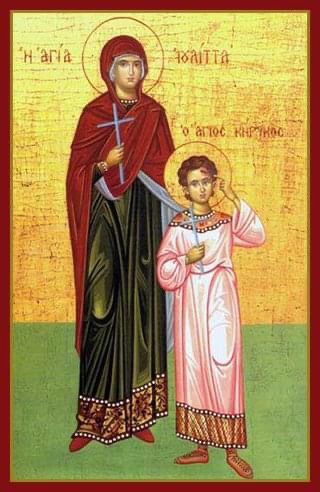
Today many parts of the church remember a duo of 4th Century saints, a mother and son: Saint Cyricus and Saint Julitta, Family of Fortitude.

Saint Julitta was of noble birth, living in Asia Minor. During the persecution of Christians during Diocletian, she is said to have fled to Tarsus with her young son, Cyricus. To avoid detection, she hid her noble status, and tried to pass as a typical citizen, but having been widowed early on in her life, had little protection in the eyes of the law. As she fled, Saint Julitta was captured by the governor of Tarsus, along with her child, and tortured and interrogated until she admitted she was a follower of The Way. Her son was said to have called for his mother even as she was being hurt by the system that sought their demise.

Legend has it that St. Cyricus, when grabbed by the murderous governor, scratched his face and screamed. They both were reportedly martyred for the faith, victims of state-sanctioned violence against the vulnerable.

So, here’s the thing Beloved: I make note of these two saints of the faith, obscure as they are, because I believe we are still witnesses to state-sanctioned violence against the vulnerable and the weak.

Saint Cyricus is a patron saint of children, one we need to lift up in these days where schools are still shot up. Saint Julitta is the patron saint of single mothers and, unfortunately, is the unwitting saint of mothers whose children are victims of state-sanctioned violence.

Black and Brown citizens are gunned down shopping for their daily bread, just last year. Babies were killed learning their ABC’s, just months ago. And lest we think this happens occasionally: gun violence happens every day in this country.

Every day.

A unique occurrence here in America. Perhaps this is “American exceptionalism” at it’s most raw.

And it’s not like other nations do not have mental health crises. They do. What’s the difference?

Access to assault weapons.

Saint Julitta and Saint Cyricus are reminders for me, and should be for the whole church, that the state is absolutely willing to put up with violence, especially at the expense of the weakest amongst us.

But the church? The church cannot be willing to put up with it…and neither should the larger citizenry.

Let those with ears to hear, hear.

-historical bits gleaned from publicly available sources and from Judika’s Daily Magic.

-icon written in the traditional Greek Orthodox style

Rooting and Grounding

Today the church remembers a recent spiritual hero, Saint Evelyn Underhill, teacher of mysticism within the church.

Born in England and taught at King’s College in London, she was already a promising writer when she underwent a spiritual conversion. Initially drawn to Roman Catholicism, she eventually was unable to make the Catechumenate oath due to the church’s rejection of modernism.

Instead, she turned to the mystics, of all denominations, for spiritual guidance.

She devoted her time to compiling and anthologizing the writings and lives of saints and mystics, resulting in her tome Mysticism (1911). She then came under the influence of Baron Friedrich von Hugel, a spiritual director who led her to her own mystical experiences. This led to her second major work, Concerning the Inner Life, which incorporated the the life of the saints with her own reflections, ponderings, and insights.

She eventually joined the Anglican church, and led retreats for spiritual seekers. After her death various letters of hers were published, indicating that she cared for her retreat attendees long past their individual retreats.

A lovely quote she’s known for is, “A certain wise Prioress said, ‘Most books on religion have thousands of words–we need only one word, GOD–and that surrounded not by many words but by silence.'”

Saint Underhill is a reminder for the church, and for me, that the spiritual quest need not be found in one doctrine or under one umbrella but a seeker, in the end, should at least anchor themselves to one as a way of rooting and grounding. That rooting and grounding doesn’t prohibit you from exploring, but rather keeps you solid as you spiritually stretch.

-historical notes from Pfatteicher’s “New Book of Festivals & Commemorations”

-icon written by Schleckicons.com

The Saints of Pulse

Though not an official saint day, I would lobby hard for it to become one.

Today the church (should) honor the 49 pulses stopped too soon in the Pulse Nightclub shooting, an act that was both domestic terrorism and hate crime wrapped into one bloody night.

In the days following I remember giving blood, and upon entering the waiting room, finding a number of young adults in tears, waiting. A young woman walked up to the attendant, asking, “How old do you have to be to give? If I bring my mom in, can she sign for me? She’ll give too.”

So much blood. On the dance floor. On the hands of a country that refuses to adequately deal with the scourge of gun violence. In vials filled to help the 53 victims wounded in the act.

And especially now when it seems to be increasingly dangerous for LGBTQIA+ folks due to hateful legislation being passed around the country targeting their representation, their stories, their families, and their dignity, we need to hear the call of the Saints of Pulse and act. We must not remain silent.

Pride month is a month of celebration; yes. But even more so it is a protest against the powers and principalities that seek to harm the splendid diversity of humanity through intimidation, violence, and laws that target rather than protect.

The Saints of Pulse remind the church, and all of us, that until we tackle both the hate of the heart and the lack of regulations that allow people to wantonly act on that rage in mass murder, we’re not done.

We’re not done.

The One Who Taught Paul

Today is one of my favorite feast days because an early apostle, who doesn’t get a lot of play, gets a nod from the church.

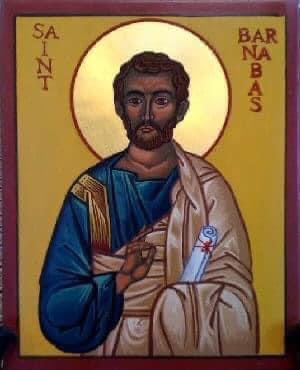
Today the church honors St. Barnabas, a Jewish-Christian from the Diaspora. His name means, “child of encouragement,” probably because he was such a dynamite preacher.

He has long been thought to be one of the seventy that Jesus sent out in Luke 10, and he was a staunch defender of Paul in the courts of the early church, believing that Paul had indeed had a conversion.

His early work was in Antioch, where the church was thriving, and he asked Paul to assist him there…yes, you read that correctly, Paul assisted Barnabas in his early career. Eventually Paul would take the lead, but he learned how to lead from Barnabas. This little tidbit has been lost in history due to Paul’s enormous influence and ego, but it’s worth remembering.

In the early church arguments over the inclusion of Gentiles, Barnabas sided mostly with Paul, calling for Gentiles to be accepted into the fold. Barnabas eventually took John Mark under his tutelage, leaving Paul to travel with Silas, and as Barnabas headed toward Cyprus, we lose track of him in the fog of history.

Lore states that Barnabas was stoned in Cyprus around the year 60.

The Epistle of Barnabas, supposedly written by the apostle, was widely used in the early church and almost made the canon, and some think Barnabas is the author of Hebrews (I don’t buy this).

Barnabas is a reminder for the church, and for all of us, to look just behind the shining stars to see who made them shine. He was Paul’s mentor and defender in Paul’s early days, and like every good teacher, encouraged Paul to outshine him one day (for better or for worse).

-historical bits gleaned from Pfatteicher’s “New Book of Festivals & Commemorations”

On Syrian Christianity

Today the Church honors a Deacon, hymnwriter, poet, and foundational theologian, 4th Century Ephrem of Edessa.

Syrian Christianity is one of the most ancient strains of the faith. Lore has it that Thaddeus of Edessa was one of the seventy sent out by Jesus (Luke 10), and he planted the seeds for Orthodox Christianity in the region. We have no proof of this, of course, and it may be the case that Thaddeus himself is entirely fictional, a pragmatic hagiography used to explain the origins of such an important branch of Christianity.

Whether or not this is true, though, Syrian Christianity was started early, and Ephrem was born a Christian in the early 300’s, and was a student of James, Bishop of Nisibis.

From there he became head of a successful theological school at Edessa, and began writing biblical commentaries, essays on dogma, biographies, historical records, homilies, and early Christian hymns that have remained a part of the Syrian Orthodox liturgy.

Syrians refer to Ephrem as “the harp of the Holy Spirit.”

Ephrem is a reminder to the whole church that Diaconal leaders have, since the early formation of the faith, influenced and guided the faithful all over the world.

Indeed, through our Deacons (and in many traditions, Deaconesses), the church continues to have many “harps of the Holy Spirit.”

-historical notes gleaned from Pfatteicher’s “New Book of Festivals & Commemorations”

Rebuker of Monsters

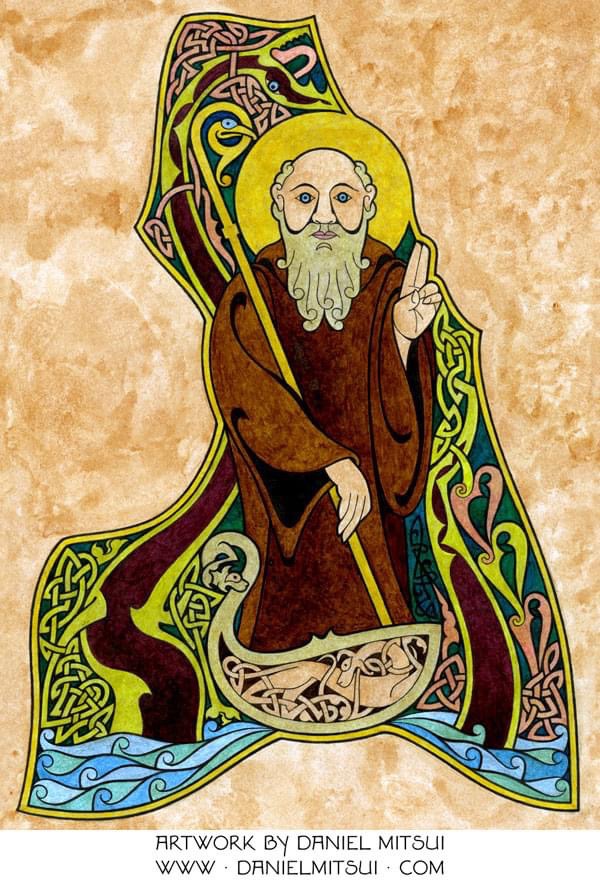
Because two Irish saints are commemorated on June 9th, I’d lobby one of their feasts be transposed to today as this good Abbot of Iona kept the lamp of learning and love alive in the toughest of times: Saint Columba, Rebuker of Monsters and Community Organizer.

Those with a Gaelic tongue would call him “Colum Cille,” or “Dove of the Church,” but you may call him Columba. He was born into a royal Irish dynasty (yes, there are such a thing) in the early 600’s, educated at the finest monasteries of the day, and eventually ordained a deacon and a priest for the people of the Emerald Isle.

At the ripe old age of 42 he left Ireland with twelve fellow travelers (you know, that old chestnut) to establish a community on Iona off the coast of Scotland. This little outpost would become the center for Irish missionaries serving the Scotch-Irish (those Irish who had settled in Scotland) and the Picts (the original Scots), as well as those living in Northumbria.

Saint Columba lived at Iona for more than thirty years, preaching and teaching both on the island and on the mainland.

One fun story about Saint Columba is that he took on the Loch Ness monster face-to-face after it had killed a young Scot. Saint Columba said, “Whoa, buddy!” and made the sign of the cross in front of it, calming it before it attacked another. The monster became docile and has never since attacked another human. This miracle was said to have converted King Brude, leader of the Picts, bringing many Scottish to the faith.

A powerful preacher with an imposing personality, Saint Columba was a force to be reckoned with and his footprints dot the literal landscape as well as the figurative landscape of the faith. He died on June 9th at the age of 77 (according to the Venerable Bede) and was buried on Iona (though his bones have since been moved to Kells).

Iona still remains a contemplative pilgrim destination for so many today, a sacred, thin space. In thin places there is very little separating you from God…Iona is considered one of the thinnest.

Saint Columba is a reminder for me, and should be for the whole church that sometimes we find thin places.

And sometimes we create them, by God.

Let those with ears to hear, hear.

-historical bits gleaned from Pfatteicher’s New Book of Festivals & Commemorations

-icon written by Daniel Mitsui

On the Oceans

Today is World Oceans Day, a day to honor the great incubator of life, the first amniotic fluid of creation: The Seas.

The ancient Celts held the sea in high reverence. Like anything worth powerful, the sea provided for the people and was also dangerous. It was a road to distant lands as well as a graveyard, a reminder that the wilds of creation are to be respected and not taken for granted.

With our modern minds we may imagine that the seas of this world are ours for dominating and using as we please, but with every strengthening hurricane and with every new exploration into the deepest parts of our oceans we are reminded that the oceans still have a temper and a hold a temptation for adventure.

Let us not abuse it nor forget it.

I’ve stood at the base of huge mountains, and I’ve flown over quite a bit of amazing land, and yet it is still the ocean’s siren song that enlivens the most awe in me.

Green and brackish, blue and calm, full of terrors and wonders and teeming with living things yet undiscovered, the oceans of our round rocket ship spinning in this universe are a reminder for me that, even though we may flex our mortal muscles, stronger forces exist and must be honored and respected.

If you’re one who endears themselves to such rituals, the ancients used to thank the Mer-people on in these mid-summer months. Mer-folk were known to protect as well as correct humans in their courses and, while I certainly don’t believe in such a thing, I understand how the ancients would.

After-all, with so many mysteries beneath the waves, why wouldn’t someone imagine that there might be a whole undiscovered universe of inhabitants who gazed up at the blue sky like we gaze at the briny blue depths, a reflection of what we know…just a little different, you know?

Regardless of what you believe, I hope we can all agree on one thing: the mother of all life, the Oceans, the Seas, deserves not only our thanks and awe, but also our protection.

Sacred Lands

On this day the church remembers the eloquent orator and 19th Century unifier: Chief Seattle, Wager of Peace.

Saint Noah Sealth (translated as “Seattle”) was born in the late 1700’s in the lush North West with the lullaby of the Puget Sound coaxing him to sleep at night. He first saw a European when Captain George Vancouver brought a gun ship to town carrying many products from far off places. Saint Seattle’s fascination with these new people grew and grew.

In the 1830’s Saint Seattle adopted the Roman Catholic faith even while retaining many of the ways of the indigenous faith. He learned to get along well with both other indigenous tribes and the European invaders, and encouraged everyone to wage peace and not war. In early 1855 he signed a treaty at Point Elliott in the heart of settlement now known as Seattle, a city that bears his name, ensuring that the Duwamish Confederacy, an alliance of local indigenous tribes, would retain land in the area even as the Europeans continued to take and take and take.

Governor Isaac Stevens of the newly created Washington Territory spoke to the residents of this new settlement, and Saint Seattle then also gave a speech, captivating the audience and living on into history. A Dr. Henry Smith was taking notes and reconstructed the speech, and it is notable that Saint Seattle refused to speak the pidgin English or Chinook that Governor Stevens asked him to use, and instead went with his mother Duwamish tongue.

Even as the treaty was being struck, Saint Seattle reminded the gathered of deep and sacred truth,

“Every part of this soil is sacred in the estimation of my people. Every hillside, every valley, every plain and grove, has bee hallowed by some sad or happy event in days long vanished. Even the rocks which seem to be dumb and dead as they swelter in the sun along with the silent shore, thrill with memories of stirring events connected with the lives of my people, and the very dust upon which you now stand responds more lovingly to their footsteps than to yours, because it is rich with the blood of our ancestors, and our bare feet are conscious of the sympathetic touch.

Our departed braves, our fond mothers, glad, happy-hearted maidens, and even our babies who lived here and rejoiced here for a brief season, will love these somber solitudes and at eventide they greet the shadowing returning spirit.

When the last of my people have perished…the shores will swarm with the invisible dead of my tribe…for the dead are not powerless.

Dead, did I say?

There is no death, only a change of worlds.”

Even when you wage peace you can refuse to be bullied.

Saint Seattle died on this day in 1866. It is said that though many wanted to name the city Seattle after this giant of history, the dear saint did not like the idea and asked that they choose another name. A city is for all the people, not just one.

Saint Seattle is a reminder for me, and should be for the whole church, that the land on which we tread is for all people, not just one…which should make us reimagine how we might use all the land we trod on, and the buildings we “own,” and the space we take up.

-historical bits from Pfatteicher’s New Book of Festivals & Commemorations

-art by Tolga Ertem, “Chief Seattle.”

The Mighty Oak

For the ancient Celts, June was the month where they honored the mighty oak tree. In June this towering tree reaches its zenith in beauty, and was a reminder for the Celts that doing two things at once in this life is necessary: we must plant deep roots while also reaching for the highest heights.

Their ancient priests, Druids, were colloquially known as “oak knowers,” believing that of all of the trees, the oak tree was the wisest. The Celtic word for oak was Duir (again, also where they got the word Druid), which meant “endure” and “truth.”

The oak tree, brightened by the Oak Moon, was both strong and enduring, like truth.

June is a month to deepen your roots and reach for those heights.

Living Up to a Name

Today the church remembers 8th Century Saint Boniface, Archbishop and Missionary.

Boniface was born with the name Wynfrith (love it!) in Devonshire England in the late 7th Century. When his father fell ill he was sent to a Benedictine school, and then monastery, where he was ordained. It was there that he wrote a Latin grammar book for scholastic use, and several poems.

When Wynfrith turned 40 he began his missionary work in Germany and the Netherlands. The anti-Christian sentiment in the area was strong, though, and he returned back to his native England, eventually succeeding his abbot at Nursling. He didn’t last long in that position, though, and resigned to petition Pope Gregory II for a missionary assignment.

Pope Gregory II approved it, and gave him the name Boniface, which means “to do good.”

He returned to what is now modern day Germany and, after trial and error, finally succeeded in establishing a monastery in Hesse.

With such success, the Bishop of Rome consecrated him bishop for the German frontier, even though there wasn’t a fixed diocese there. To show bravery, Boniface cut down the sacred oak tree of Thor, and though many expected Thor to strike him down with lightening or illness, Boniface remained perfectly healthy. Because of this, many were converted. Out of the wood of that tree he built a chapel in honor of St. Peter.

Pope Gregory III (popular name) elevated Boniface to archbishop in 732, and was eventually given the see of Mainz as his jurisdiction after the bishop of Mainz, Gewiliob (love it!), admitted to killing his father’s murderer.

At sunrise on June 5, 754, at Dokkum, Boniface, while reading the Gospel to a group of neophytes on Pentecost, was attacked by a pagan mob and killed on the job. His remains, and the Gospel book he was reading from at his death, can still be seen at Fulda.

Boniface is a mixed bag for me. He was obviously dedicated and zealous for the faith. But in his spiritual zeal he committed religious tyranny against those he was sent to serve. To take a sacred object, Thor’s tree, and create another sacred object of a different creed, St. Peter’s church, is religious violence.

That kind of violence totally goes against not only my own code of inter-faith work, but also that of my church.

Yet I do admire his willingness to serve in uncharted territory, and his willingness to leave a comfortable job (being the abbot of a monastery is no small thing!) to enter the unknown. That takes courage…I just wish he’d had a little more wisdom with it.

Or, maybe this is what I mean to say: I wish he’d lived up to his name, “Boniface,” and did more good than he did.

-historical notes taken from Pfatteicher’s “New Book on Festivals and Commemorations”