Secret Reformer

Today the church remembers a slew of 16th Century artists: Durer, Cranach the Elder, Grunewald, and Michelangelo. Though one could go in-depth on all of them, I’m going to focus this year on the one who is (probably) least well-known, and yet so influential: St. Matthias Grunewald, Artist and Secret Reformer.

We don’t know much about St. Grunewald. His name is even a fabrication, thought up by a 17th Century biographer for the enigmatic artist. His original surname was Gothardt, and he often added his spouses surname (Neithardt) to his signatures.

He spent most of his life in the upper Rhine area, and most of his professional career was under the patronage of the Bishop of Mainz and then Albrecht of Brandenburg. His artistic bent was (like most of his contemporaries) religious in nature, and he found the crucifixion and the resurrection as particularly curious events for visual exploration.

Though he was under the patronage of Rome, Grunewald was a professed admirer and supporter of the Reformation movement sweeping through the world of his day.

Many may not be familiar with his name today, but his works are worth checking out. I find them grotesquely fascinating; not as playful as Cranach’s and not as Gothic as Durer, but more mystical (perhaps) like an older Dali.

You might also want to check out the Grunewald Guild in Washington State, a community dedicated to careful artistic exploration. A number of colleagues spent time there in college and/or seminary, stretching their artistic muscles (or forming them from scratch): https://grunewaldguild.com/about-the-guild/

Finally, because finding a painting or an icon of St. Grunewald has proven unsuccessful, below is his depiction of the Resurrection. I thought it appropriate as we head toward Easter.

St. Grunewald is a reminder for me, and should be for the whole church, that art has always held hands with religion. The church was one of the first incubators for stunning creativity…and could be today, by God, if they keep dogma from squashing invention.

-historical bits from Pfatteicher’s New Book of Festivals & Commemorations

-opinions mine
Real Leadership

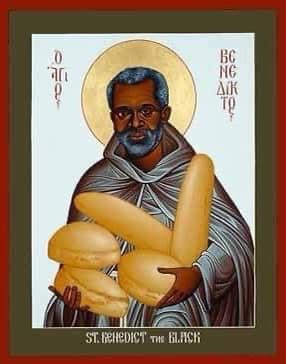
Today the church remembers a 16th Century saint who deserves more nods than he typically receives: St. Benedict the African, Friar, Friend of the Blue Collar, and Champion of Humility.

note: St. Benedict shares a feast day with St. Martin Luther King, Jr. on April 4th but, because it is shared, is usually transposed to the 5th to stand alone

St. Benedict the African was born in 1526 in Messina, Italy as the son of slaves who were converted to Christianity. He was under forced servitude until he was eighteen and, once granted his freedom, made his living as a day laborer. Though he made little money at his work, he shared most of his wages with those who made less than him, and he devoted much of his off time to caring for the sick and infirm.

His race and status in Italy made him the focus of much ridicule and scorn, but his reputation for handling the derision with fortitude and undeserved grace spread. He attracted the attention of Jerome Lanzi, a devotee of St. Francis of Assisi, and St. Benedict was encouraged to join Lanzi’s group of hermits, living a life of piety.

Lanzi died not long afterward, and St. Benedict reluctantly took the helm of the lay order, leading his fellow hermits as they served those who had no one to help them. When Pope Pius IV directed all informal monastic groups to identify with established orders, St. Benedict linked the hermitage with the Franciscans, and he was assigned to serve in the kitchen.

Doing his duties with careful attention and pride, St. Benedict found small ways to enliven the lives of his fellow brothers, and he shunned the lime-light. St. Benedict, throughout his life, wanted to embody the meek way.

In 1578 this brother without formal education (he was unable to read) was appointed as guardian of his Friary. Every account notes that he was the ideal superior: quick witted, theologically profound, gentle, and attuned to the sacredness of life. He often chose to travel in humble ways, at night or with his face covered, not wanting too much attention for his work. He had the scriptures memorized, and he was known for teaching the teachers in many ways.

Toward the end of his life, St. Benedict asked to be removed from his position as guardian of the Friary, and wanted to be reassigned to the kitchen. He died in 1589, and is enshrined still today as a saint worth emulating.

St. Benedict the African is a reminder for me, and should be for the whole church, that education, family, and status are poor indicators of leadership in many ways. Resumes are ego documents that don’t reflect the spiritual sensibilities of an applicant.

-historical bits from Pfatteicher’s New Book of Festivals & Commemorations

The Movement Maker

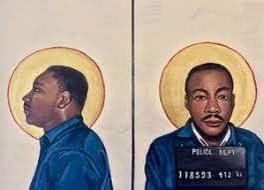
Today the church remembers a martyr and visionary, Saint Martin Luther King, Jr., Dreamer of Dreams and Movement Maker.

Born in Atlanta, Georgia in 1929, Saint Martin was a brilliant young scholar who could have studied anything, literally anything, and chose the ministry as his life’s pursuit. At Crozer Theological Seminary he studied Gandhi’s philosophy of non-violence, and was greatly moved and impacted by the thought that social change could happen through determination and will, not force.

He received his Ph.D from Boston University in 1955, and started his ministry at Dexter Avenue Baptist Church in Montgomery, Alabama. From there he organized his first social action: a challenge to the racial segregation of public busses, a continuation of the defiance of Rosa Parks and her refusal to give up her seat, and her dignity, to white privilege.

Within a year, due to the organizing efforts of the Montgomery Improvement Association, the busses were desegregated. But not before Saint King’s home was bombed and family was threatened.

In 1960 Saint Martin brought his family to Atlanta where he became co-pastor of Ebenezer Baptist Church, sharing the pulpit with his father. In October of that year he was arrested for protesting the segregation of a lunch counter in Atlanta, and in spring of 1963 he was once again arrested in a campaign to end similar segregation in Birmingham, Alabama. The movement withstood dog attacks, fire hoses, police brutality, political sabotage, and a deafening quiet from “respectable religious circles.”

It was from this vantage that he assumed the mantle of the Apostle Paul and wrote from prison what I believe to be his seminal work, Letter from Birmingham Jail, a piece of inspired literature that should be read in communities of faith every year alongside Corinthians, Thessalonians, and Colossians.

Quietism has no place in the church.

On August 28th, 1963 two hundred thousand people marched on Washington in support of The Civil Rights act. It was here that Saint Martin joined Saint Joseph of Egypt and Saint Joseph of Nazareth, all dreamers, telling of his dream that all people will be judged by the content of their character, and not the color of their skin.

In 1964 he was awarded the Nobel Prize for Peace.

King went on to speak out against the war in Vietnam, and took on the case of the poor and the working class in America.

In 1968 he traveled to Tennessee to support striking sanitation workers and, on this day that year, was shot dead by a sniper outside his motel balcony.

Saint Martin’s birthday is honored every year in America, but the church reserves the right to commemorate his feast day alongside the other great martyrs of the church: on the day of his death. We do this not to be morbid or to glorify death, but to rightly honor that often speaking truth to power has consequences.

And yet, speak we must.

Saint Martin Luther King, Jr is a reminder for me, and should be for all people, that non-violent resistance has been so threatening to the powers of the world that they would use violence to snuff it out. And yet the movement continues…you cannot stop a movement based in love and justice.

It lives.

Let those with ears to hear, hear.

-historical bits from Pfatteicher’s New Book of Festivals & Commemorations

-icon written by Kelly Latimore

On Housecleaning

For the Christian Celts, the Monday (and sometimes Tuesday and Wednesday) of Holy Week was dedicated to cleaning the house and the home (with Holy Thursday dedicated for cleaning the chapel).

After months of inside smoke from the hearth dusting everything with soot, and with the spots above and around the well-used candles getting dingy and oily, Spring cleaning served both practical and spiritual purposes. Spring was a time of renewal, and so it made sense to renew the home from the dinge of winter.

But, as importantly, Spring cleaning mirrored the inward housecleaning of the Lenten days. With Easter almost upon them. the last few corners of the soul were tended, swept, and exposed to the light for purification.

There You Go Again…

“I feel pretty good,” he said. “But I know something will go wrong. The good never lasts…”

“Why didn’t you just stop with the first thought?” she asked. “With your second thought you cut the good off at the knees. Just be present in the good for a while. No need to jump to a future of bad.”

“Why do I always do that?!” he asked.

“There you go again,” she said, “going to a past where you remind yourself that you make the same mistake over and over again. Just be present. You feel good.”

“But…” he started.

“But you feel good,” she cut him off. “Just sit in that for a while.”

His eyes relaxed. He smirked. He felt good.

All Glory…

Bishop Theodulph of Orleans penned the hymn my heart is singing on this Palm Sunday morning, “All Glory, Laud, and Honor.”

It truly is one of my favorites, made more sacred by the fact that we really only sing it once a year.

He is said to have written it from his prison tower, thrown there by King Louis the Debonair, son of Charlemagne.

The story goes that the Bishop wrote this hymn and, in the year 821 as the Emperor passed by on Palm Sunday heading to Mass at the cathedral, he sang it loudly over the passing procession from his stone entombment. The emperor, taken with the song, released the good Bishop.

Truly the rocks themselves will shout for justice.

-painting by Polly Castor