Abolitionist, Author, and Activist

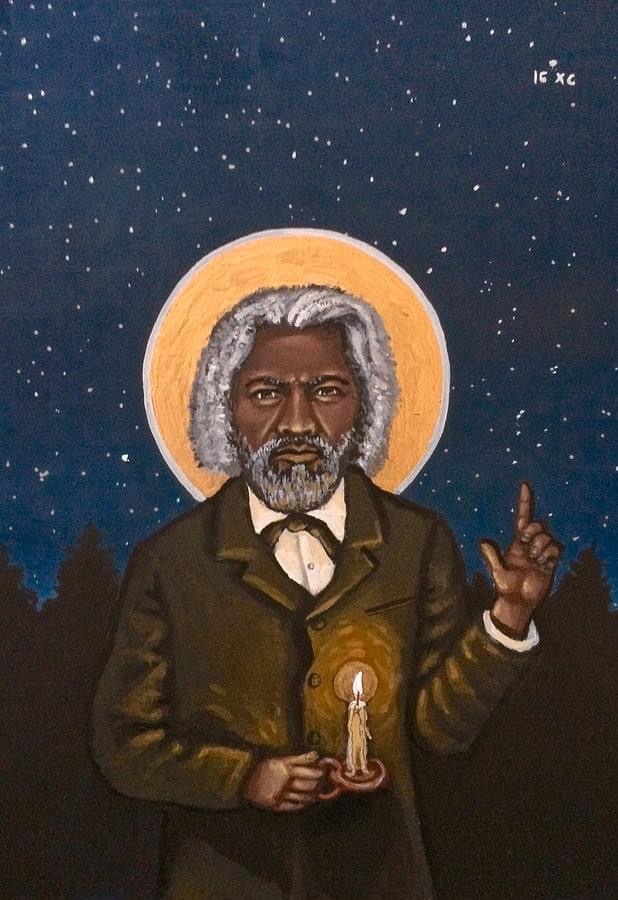
Today the church rightly remembers an icon of the rights of humanity: Saint Frederick Douglass, Abolitionist, Author, and Activist.

Saint Frederick was born into slavery in Maryland, a state many people forget was actually part of the historic South. His mother died when he was a young boy, and he was raised by his grandparents. It was rumored that his birth father was the plantation owner, though Saint Frederick himself never truly knew. He also barely knew his mother, as the barbaric practice of separating children from parents was common practice on plantations across the states where slavery was legal.

He was extremely bright and savvy, he learned to read and write by bartering food for lessons from neighborhood children. He went on, then, to teach other slaves to read using the Bible and the Sunday School hour as the classroom.

He escaped from slavery by pretending to be a sailor, aided by a uniform given him by his love, Anna Murray, and successfully hopped a train that aided him in getting to the free commonwealth of Pennsylvania. From there he went to New York City, sending for Anna Murray to meet him there, eventually marrying her in 1838. The couple eventually settled in Massachusetts and Douglass became a licensed preacher.

A fantastic orator and writer, Saint Frederick would spend his days making connections with other stakeholders in the area, and writing for the “Liberator” magazine. He attended protests and organized boycotts of local transportation (he refused to sit in segregated areas), lobbying for the equal treatment of African-Descent citizens as well as women.

As his fame grew, especially after the publication of his autobiography, he traveled to the British Isles as both a touring opportunity as well as a safe-guard against his former owners hearing about him and trying to take him back. For two years he toured the isles, even meeting with Thomas Clarkson, the famous British abolitionist who had persuaded Parliament to outlaw slavery.

This meeting gave him infinite hope that the same could be true of America, an America that he lamented “didn’t recognize him as even a man.”

Saint Frederick returned to the states and began publishing his first magazine, “North Star,” writing against slavery and butting heads with politicians and leaders who suggested anything other than total freedom for slaves, and he lobbied hard for school desegregation.

By the time the Civil War was underway, the famous St. Frederick met with President Lincoln to discuss a future free from slavery. He argued that willing men of all races should be allowed to fight for the Union, and post-war was disappointed that President Lincoln didn’t have the decency to publicly advocated for suffrage for free Black citizens who had so faithfully defended the Union.

During Reconstruction Douglass worked hard through political and social avenues to ensure the newly-granted rights of Black citizens were respected. He supported the election of President Grant, and became the first Black citizen to be nominated on the Vice Presidential ticket of the Equal Rights Party (though he didn’t even know he had been nominated).

That year his house burned down. Arson is suspected. But he continued on his speaking circuit, writing and lobbying for equal rights.

President Hayes appointed Douglass as the Marshal of the District of Columbia, the first person of color so named.

In 1881 he published his seminal work, The Life and Times of Frederick Douglass, and in 1888 received a vote for the Presidential nomination at the Republican National Convention.

On February 20th, 1895 Saint Frederick, having attended a meeting of the National Council of Women, returned home and suffered a massive heart-attack. He was 77 years old. Thousands attended his funeral out of respect to his legacy of fighting for equality.

Saint Frederick is an inspiration and an icon. He worked with anyone as long as they were trying to “do good,” and this fact got him much criticism from radicals who thought no one should ever work with someone of a differing ideology, ever. But St. Frederick was fond of saying, “I would unite with anybody to do right, and with nobody to do wrong.”

Saint Frederick is a reminder for me, and should be for the whole church, of many things, but primarily it is simply this: laws that are unjust are worth disobeying.

Let those with ears to hear, hear.

-history gleaned from Claiborne and Wilson-Hartgrove’s Common Prayer: A Liturgy for Ordinary Radicals as well as public source material

-icon written by Kelly Latimore

Where Was the Church?

Today the church remembers and mourns Executive Order 9066.

By executive order of President Roosevelt, Japanese Americans, two-thirds of whom were United States Citizens, were forced into internment camps on this day, February 19th, in 1942.

It is estimated that, at the time of the attack on Pearl Harbor, 112,000 of the 127,000 Japanese American residents lived on the West Coast. Of those American residents, around 80,000 of them were second and third generation citizens, never having spent any time in Japan.

Forced from their homes, schools, and places of business, anyone with Japanese heritage (in California they exacted it to 1/16th of Japanese lineage) were placed in regional concentration camps. What was trumpeted as a “security measure” in case any of them were sympathetic to Japan, was actually legalized racism. Such measures were not taken for German or Italian residents in the United States, many more of whom were not legalized citizens (though a small number of people of German and Italian heritage were also forced into these camps on the West Coast).

By this order all people of Japanese heritage were forced to leave Alaska, as well as many areas of California, Oregon, Arizona, and Washington State.

In 1944 a legal challenge to 9066 came to a close, and though its constitutionality was upheld on technicalities (another instance where the small print delayed justice, and it didn’t even opine on the concentration camps themselves), it was affirmed by the court that “loyal citizens cannot be detained.”

The day before the results of this legal ruling would be made public, 9066 was rescinded, an implicit admission of purposeful wrongdoing in my book.

In 1980 Japanese Americans lobbied forcefully to have Executive Order 9066 investigated. President Carter initiated the investigation and in 1983 the commission reported that little evidence of disloyalty was found in the Japanese-American community of the day, and that the internment process was blatant racism. In 1988 President Reagan signed the Civil Liberties Act of 1988 and officially apologized on behalf of the United States government, authorizing monetary settlements for everyone still alive who had been held in a camp.

In other words: the US government gave reparations. It’s not unprecedented…

The larger question for me, though, is: where was the church?

Why wasn’t the church lobbying hard to have these fellow sisters and brothers released?

Additional studies have shown that religious prejudice also played a part in the justification for these internment camps. In a largely “Christian America,” these often Buddhist, Taoist, and Shinto practicing Japanese residents were seen with much more suspicion (which is probably why the German and Italian residents, also largely thought to be “Christian,” were not rounded up).

The church failed to protect a vulnerable population. The church held hands with the politics of the day in ignoring at best, and aiding at worst, the abuse of other humans.

Today we remember, mourn, and are honest about this failure.

This commemoration is a reminder for me, and should be for the whole church, that when religion holds hands with politics we end up on the wrong side of history.

-historical bits gleaned from Clairborne and Wilson-Hartgrove’s Common Prayer: A Liturgy for Ordinary Radicals as well as common source news

-for more information on how religion played a part in this stretch of history, visit: https://religionandpolitics.org/2019/07/23/first-they-came-for-the-buddhists-faith-citizenship-and-the-internment-camps/

-art by Norman Takeuchi with his piece, “Interior Revisited,” stated that “Interior and ‘internment’ are synonymous for many of Japanese-American lineage,” because they moved people from the coast to “the interior” of the United States for these camps.

Now and Not-Yetness

Today the church remembers the reformer and cranky theologian, Martin Luther. He’d wince at being called a saint, but welcomed the title of “baptized.”

Luther was as imperfect as he was ingenious. As the most prolific and public author of his day, his opinions on matters mundane (a homemade remedy for skin rashes) to mighty (Freedom of a Christian) are well-documented and well known by all students of history. He wrote beautiful theological treatises and stirring hymnody. He was a pioneer for women and children in his day.

Yet, he was a person of his era in many ways, and lamentably was unable to rightfully wrestle with his own prejudices, especially toward those of the Jewish faith.

His anti-Semitic writings have been totally and fully condemned by the Lutheran church.

With both his flaws and his fortitude he embodies one of his central theological discoveries: that we are all both sinner and saint, simultaneously. We are both perfectly imperfect, and perfectly loved by a God who has a tender spot for broken things.

One of his more poetic thoughts about the “now-and-not-yetness” of our human existence:

“This life therefore is not righteousness, but growth in righteousness,
not health, but healing,
not being but becoming,
not rest but exercise.
We are not yet what we shall be, but we are growing toward it,
the process is not yet finished,
but it is going on,
this is not the end, but it is the road.“

On Thresholds with My Sons

“Our lives are full of thresholds: moving through the rise and fall of each day, the rhythm of the week, the seasons, the veil between this world and the other, between the status quo and our own deepening and unfolding journey. Thresholds require that we be vulnerable, that we acknowledge that we simply do not know what is to come, that we surrender to something much bigger and more meaningful, even as it calls us away from familiar patterns and habits that have become much loved.”–Christina Paintner

The Issue with Saint Valentine

Question from a reader:

Why doesn’t the church honor St. Valentine on Valentine’s Day?

Answer:

Nothing historically verifiable at all is known about St. Valentine other than someone with that name was buried in Rome on February 14th. Legends grew, of course, including legends of a gruesome death (kind of an ancient “tongue-wagging” tactic for a church that liked drama), but none of it is thought to be true. In 1969 the Roman church removed him from the calendar of saints for “lack of evidence for existence.”

It is thought, though, that the emergence of this day as a romantic holiday was a way that the church overshadowed a Roman festival, Lupercalia, held on February 15th.

Lupercalia was the celebration of the wolf that rescued the legendary founders of Rome, Romulus and Remus, and nursed and raised them (“Luper” from the Latin root “lupus” for “wolf”). For this reason the celebration was associated with child-birth and fertility, making the Church’s institution of Saint Valentine’s Day in 496 a natural Christianization of the holiday (though it became known more for love than fertility in the end).

Lupercalia honored the wild energies of creation intended for romance and reproduction. Valentine’s Day was a more modest variation of that theme…something the church could stomach.

Btw: Ever notice that the heart icons commonly used look nothing like an anatomical heart? The shape of that icon (all over everything Valentine’s Day) is thought to have been an artistic representation of voluptuous buttocks, the epitome of beauty in Roman times.

A competing thought is that the icon is derived from the fig leaves used as modesty covers in Pagan statuary.

Whatever the origin, though, it’s been used for a very long time and, despite it’s now common place and mild application, was pretty risque!

Blessed Valentine’s Day.

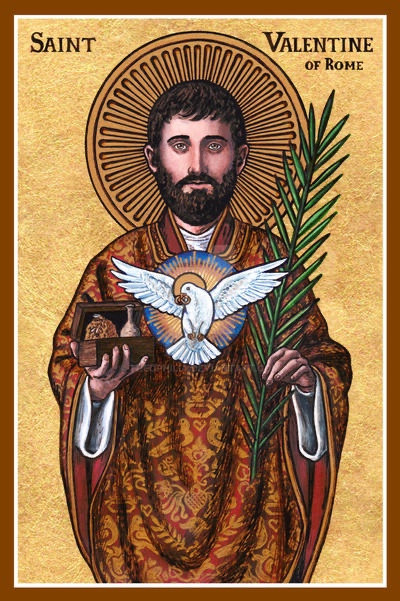
-icon written by Theophilia

Better Than St. Valentine

Today the world honors St. Valentine, but the church kind of shrugs toward that saint, and instead dedicates the day to two Greek biological brothers: St. Cyril and St. Methodius, both 9th Century missionaries to the Slavs.

Cyril, in an effort to translate the Gospels and the liturgy into the Slavonic language, created a whole new alphabet. Modern Russian is based on this Cyrillic alphabet.

After Cyril’s death, Methodius took up the missionary mantle and continued the work. Cyril and Methodius met great opposition within the church for their novel way of using the common vernacular to spread the Gospel. Their followers likewise faced oppression, and found themselves scattered…which actually helped the language, and the mission, spread throughout Eastern Europe.

The Slavic tradition in Lutheranism is still very strong, with a whole non-geographical Synod (Slovak-Zion Synod) representing the tradition in the ELCA yet today.

The brothers believed in a deeply contextual approach to engagement with those they were living with, even deconstructing and reconstructing their own systems (alphabet and liturgy) in order to communicate with clarity. They were transformed in the process, even as they transformed the information, and are still deeply revered in Slovak, Czech, Croat, Serb, and Bulgar traditions.

Those with ears let them hear.

-historical bits adapted from Pfatteicher’s _New Book of Festivals and Commemorations

Patron Saint of Seers

Today the church remembers an obscure First Century Christian mentioned in the Acts of the Apostles, but never really known otherwise: Saint Agabus, Prophet and Patron Saint of Seers.

According to Biblical tradition, Saint Agabus was one of the seventy disciples sent out in Luke 10. This unnamed group of seventy is kind of a “catch-all” for the early church, and many First Century Christians who were of note are said to have been in this number.

Where he first appears by name, though, is in the Acts of the Apostles, Luke’s sequel which, like many sequels in the world, added new characters and new adventures. According to Acts 11 he was one of the prophets with the Apostles at the Pentecost, and traveled from Jerusalem to Antioch where he predicted a severe famine in the area.

Then again in Acts 21 he met Paul on his missionary journey in the year 58 AD. There he stopped Paul in his tracks and, having said to have received a vision, took Paul’s belt from his waist, bound his own hands and feet, and in dramatic fashion said, “This is how you will end up if you continue on to Jerusalem.”

Those who know the Bible well will recognize that this sort of dramatic reenactment mirrors the dramatic prophecies of the Hebrew Testament seers (think Jeremiah, Amos, and Ezekiel). The symmetry is not on accident.

Anyway, Paul would not be deterred and, sure enough, would end up bound in Jerusalem.

Lore has it that Agabus was eventually martyred in Antioch for his prophetic voice and on February 13th is commemorated by many in the church, especially those who follow a prophetic/seer tradition.

Saint Agabus is a reminder for me, and should be for the whole church, that prophets don’t really tell the future, they tell the truth. It just so happens that when you tell the truth about a situation, the outcome is highly predictable.

-historical information from Daily Magic by Judika Illes and public sources

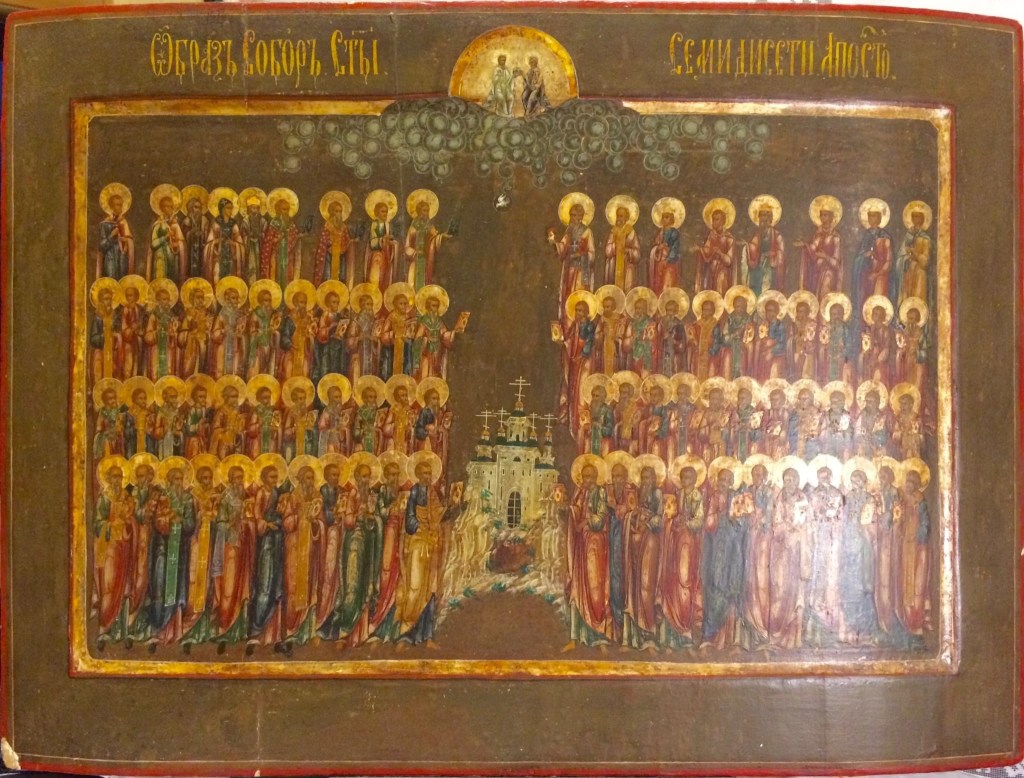
-icon is of the 70 Apostles by Antonio Caldeo because, while Saint Agabus gets his own commemoration day, it appears that he prefers to only be in group shots

Patron Saint of Murderers

Today the church honors a 4th Century saint who is more story than history, and yet that story is interesting and has lasted the ages: Saint Julian the Hospitaller, Patron Saint of Traveling Musicians, Innkeepers, Hunters, and yes, Murderers.

Saint Julian’s life is not verifiable at all, but as the story goes his parents were informed that ancient magicians put a curse on him the day he was born, and he was destined to kill his parents.

It’s a good opener, right?

Saint Julian’s father wanted to be rid of him, but his mother wouldn’t hear of it. She raised him and, when he was ten years old, told him of the prophetic curse upon him. An alternative twist said that while he was out hunting on his tenth birthday a white stag informed him of this terrible fate (which, honestly, is a better plotline if you ask me).

In either case, however he found out, Saint Julian swore that he’d never do such a thing and went on a pilgrimage, staying with whomever would share room on their floor with him. Growing in age on the road, he got as far a Galicia and found a wealthy widow who stole his heart.

Now, as happenstance has it, his parents went on a journey and also found themselves in Galicia some years later. Tired from their journey, they found a home and asked for lodging. The young woman let them in, noting that her husband, Julian, was out hunting and would be back that night. Overjoyed that they had found their long-lost son, the couple stayed the night.

Julian, arriving late from hunting, found two heads in the bed that was his and, in a fearful rage, slaughtered the occupants.

It was his parents (cue ominous music).

From that moment on Saint Julian swore that he would dedicate his life to charitable works, trying to repay the terrible debt he had incurred upon humanity. They went on another pilgrimage together, this time to Rome, and continued to travel until they came to a large river. There they created a hospice center for those with incurable diseases, and Saint Julian was said to help them, “cross the river.”

That language, of course, is purposeful. In Christian the story “crossing the river” is a way to note that you’re walking people through death to life everlasting.

Despite being more robust lore than real, Saint Julian remains an interesting character to me. Of greatest note, at least in my estimation, is the idea that even those who have done the worst in life can lead a meaningful existence in time.

Saint Julian is a reminder for me, and should be for he whole church, that even the worst in us can be redeemed, by God.

-information gleaned from Daily Magic by Judika Illes and public sources.

-painting by Franz Marc depicting Saint Julian on a hunt

Dare to Dare

Today the church remembers an often overshadowed 5th Century saint who dared to dare: Saint Scholastica, Monastic and Patron Saint of Overlooked Twin Sisters.

Saint Scholastica is the twin sister of Saint Benedict, born to noble Romans around the year 480 CE. Her mother died in childbirth, and Saint Scholastica was known, literally from her birth, to be both a blessing from the Divine and wholeheartedly dedicated to the Divine.

Her brother noted this often. He was in awe of his sister. So often we find this when one sibling overshadows the other: the one with the long shadow greatly admires the other one.

When Saint Benedict left to enter the ministry, Saint Scholastica stayed with the family home and business, tending to the practical needs of the moment. Yet, her heart called her to a monastic life, and she eventually heeded that call.

Saint Scholastica founded a community of sisters about five miles from her brother’s hermitage. Following the Benedictine rule of life, they gathered around prayer, contemplation, and service. She visited her brother once a year, meeting in a half-way house between the two communities, discussing spiritual matters and praying together.

On February 10th in 543 Saint Scholastica breathed her last. That night, long before he had heard of his sister’s passing, Saint Benedict had a vision where his sister’s soul, in the form of a dove, visited him and flew into the heavens.

Perhaps there is something to that idea that twins are connected in special ways, no?

The details of most of Saint Scholastica’s life are lost to memory, blotted out by the eclipse of her brother. Yet we know a few important things: Saint Benedict revered her, respected her, listened to her, and sought her spiritual guidance.

That’s a pretty good endorsement if you ask me.

Saint Scholastica is a reminder for me, and should be for the whole church, that often the brightest sun is hiding a wise planet in another orbit. The pastors with the most prestigious pulpits aren’t always the stars they appear to be. Indeed: the best sermons on any given Sunday are preached to fewer than fifty people, in my opinion.

Let those with ears to hear, hear.

-historical bits gleaned from public access information

-icon written by Theophilia at DeviantArt