“You thumbed grit into my furrowed brow, marking me with the sign of mortality, the dust of last year’s palms. The cross you traced seared, smudged skin, and I recalled other ashes etched into my heart by those who loved too little or not at all.” -Elizabeth-Anne Vanek
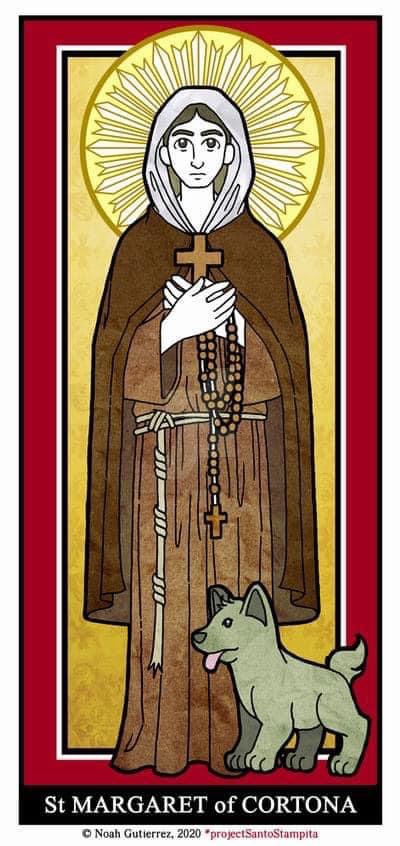
Today the church remembers a relatively obscure 13th Century saint, St. Margaret of Cortona, Mother and Friend of Those Who Self-Harm.
St. Margaret lived an unconventional life in many ways, at least for one who is considered a saint of the church…which makes her so relatable. Her father was a Tuscan farmer and her mother died while she was quite young. In the hustle and bustle of all her siblings, Margaret was neglected and largely forgotten, which caused her to run off early in life with a local man and have his child out of wedlock.
Though her child was this man’s, she was not his wife, and remained his mistress for nine years. One day the man’s dog came bounding toward her without her lover, and following the canine, she found him murdered under a nearby tree with no explanation.
With her young son, St. Margaret attempted to be reconciled to her father, but he rejected her and his grandson. Having no where else to go, she turned to the Friars Minor of Cortona to take sanctuary.
She was so tormented by her life which she assumed was a failure, that she tried to harm herself a number of times. Our past can be difficult to carry, especially when we feel like we are rejected by those we most love. The systems we find ourselves in can trap us in cycles of pain; this is most certainly true.
The kind Friars she found herself with, though, would not let her hurt herself. Gently and honestly they walked with her, and because she knew intimately the pain of rejection, she made a wonderful nurse in their sick ward, and spent her days tending those others refused to touch.
She eventually joined the Third Order of St. Francis, and her son became a Franciscan as well. She deepened her spiritual practices, and was granted permission by the church to dedicate herself to the care of the outcast, the poor, and the sick as her life’s work. She gathered her small group of followers and eventually became known as “The Poor Ones,” standing in solidarity with those who felt rejected and hurt in life.
She died on this day in 1297.
St. Margaret of Cortona is a reminder for me, and should be for the whole church, that sometimes people harm themselves not because they are selfish, but because they feel unseen, forgotten, and guilt-laden by a world that does a poor job at teaching us to transform pain rather than transmit it.
-historical bits gleaned from public source material
Today the church holds a somber fast traditionally known as Ash Wednesday which dates back to the 11th Century.
In a number of places in the Hebrew scriptures ashes were associated with penance and remorse. The books of Jonah, Amos, and Daniel all note the practice of heaping ashes upon your head as a outward display of how guilt and penitence feel inside.
As the church year begins to ponder the death of the Christ in anticipation for resurrection, a more introspective, prayerful, and yes, honest tone is kept. Ash Wednesday is the start of that long road to Calvary.
While some might consider the practice to be sad or even scary (after all, who likes considering their mortality?!), the wise mystics of all faiths remind us that we must ever keep death before our eyes if we are to truly live.
You cannot outrun mortality, Beloved.
You cannot out-diet, out-exercise, out-supplement, out-buy, or out-smart the quiet, pervasive truth that all creation is indeed, dust at our core (beautiful stardust, to be exact), and we will all one day return to that dust.
There is no out.
And yet, as is true with all paradox, there is a certain amount of freedom that comes with embracing this hard truth. Being Wonder Woman and Superman for too long weighs on us all, and we’re really not meant to fly anyway.
We’re meant to walk, which means we stumble like all walking beings do from time to time. The reality of our imperfection is, too, a gift of grace.



 Reluctant Xtian