
Even after all this time
The Sun never says to the Earth
“You owe me”
And look what happens
With that kind of love
It lights up the whole sky
-Hafiz
Happy Valentines Day

Even after all this time
The Sun never says to the Earth
“You owe me”
And look what happens
With that kind of love
It lights up the whole sky
-Hafiz
Happy Valentines Day
Question from a reader:
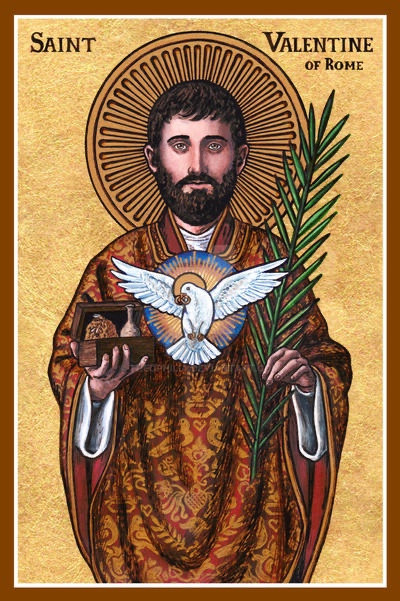
Why doesn’t the church honor St. Valentine on Valentine’s Day?
Answer:
Nothing historically verifiable at all is known about St. Valentine other than someone with that name was buried in Rome on February 14th. Legends grew, of course, including legends of a gruesome death (kind of an ancient “tongue-wagging” tactic for a church that liked drama), but none of it is thought to be true. In 1969 the Roman church removed him from the calendar of saints for “lack of evidence for existence.”
It is thought, though, that the emergence of this day as a romantic holiday was a way that the church overshadowed a Roman festival, Lupercalia, held on February 15th.
Lupercalia was the celebration of the wolf that rescued the legendary founders of Rome, Romulus and Remus, and nursed and raised them (“Luper” from the Latin root “lupus” for “wolf”). For this reason the celebration was associated with child-birth and fertility, making the Church’s institution of Saint Valentine’s Day in 496 a natural Christianization of the holiday (though it became known more for love than fertility in the end).
Lupercalia honored the wild energies of creation intended for romance and reproduction. Valentine’s Day was a more modest variation of that theme…something the church could stomach.
Btw: Ever notice that the heart icons commonly used look nothing like an anatomical heart? The shape of that icon (all over everything Valentine’s Day) is thought to have been an artistic representation of voluptuous buttocks, the epitome of beauty in Roman times.
A competing thought is that the icon is derived from the fig leaves used as modesty covers in Pagan statuary.
Whatever the origin, though, it’s been used for a very long time and, despite it’s now common place and mild application, was pretty risque!
Blessed Valentine’s Day.
-icon written by Theophilia

Today the world honors St. Valentine, but the church kind of shrugs toward that saint, and instead dedicates the day to two Greek biological brothers: St. Cyril and St. Methodius, both 9th Century missionaries to the Slavs.
Cyril, in an effort to translate the Gospels and the liturgy into the Slavonic language, created a whole new alphabet. Modern Russian is based on this Cyrillic alphabet.
After Cyril’s death, Methodius took up the missionary mantle and continued the work. Cyril and Methodius met great opposition within the church for their novel way of using the common vernacular to spread the Gospel. Their followers likewise faced oppression, and found themselves scattered…which actually helped the language, and the mission, spread throughout Eastern Europe.
The Slavic tradition in Lutheranism is still very strong, with a whole non-geographical Synod (Slovak-Zion Synod) representing the tradition in the ELCA yet today.
The brothers believed in a deeply contextual approach to engagement with those they were living with, even deconstructing and reconstructing their own systems (alphabet and liturgy) in order to communicate with clarity. They were transformed in the process, even as they transformed the information, and are still deeply revered in Slovak, Czech, Croat, Serb, and Bulgar traditions.
Those with ears let them hear.
-historical bits adapted from Pfatteicher’s _New Book of Festivals and Commemorations
 Reluctant Xtian