Today the church honors Oskar Schindler, Dissident and Defender of Humanity.
Schindler was born in Czechia in 1908. In 1939 he joined the Nazi party, where he benefited from the Nationalist movement by being given government contracts and favors for his loyalty.
When Nazi Germany invaded Poland, Schindler took over two manufacturing companies in Krakow and made enormous profit off of cheap labor: Jews from the ghetto.
But then Schindler saw something that shook him and stirred his moral compass: he saw Jews being deported to killing camps. Despite the significant monetary loss and danger, Oskar transferred his Jewish workers from his factory to safer locations. Under the guise of a loyalist and business man, Oskar Schindler moved a number of Jews to his native land of Czechoslovakia, and this became his life’s priority.
Using the factory as cover for his work, Schindler created an internal system for moving Jewish people young and old to safe locations outside of occupied lands. In fact, there is a story that a train of nearly 1,000 Jewish people was inadvertently sent to Auschwitz rather than Czechoslovakia, and Schindler offered the Nazis diamonds and gold in exchange for the souls on board.
Schindler would ultimately save 1200 Jewish lives from the death camps, and today over seven thousand descendants of those he saved are living throughout the world. He was not perfect by any means, and had many personal flaws, but when he saw the inhumanity around him he defied his party, his government, and risked his life to save the suffering.
Schindler is a reminder to me, and should be for the whole church (and world), that the law is not always moral.
In fact, sometimes what is moral calls our legal system to account for itself on the stage of the world.
We must wrestle with our conscience when lives are being bruised and broken in the streets, and we must always side with those being bruised.
Always.
Let those with ears to hear, hear.
-historical notes taken from Claiborne and Wilson-Hartgrove’s Common Prayer: A Liturgy for Ordinary Radicals
Today I would propose that the church honor two 4th Century saints who loved one another and died together: Saint Sergius and Saint Bacchus, Soldiers, Martyrs, and LGTBQ Icons.
Some calendars honor Saint Sergius and Saint Bacchus on October 7th, but because the Lutheran Church honors St. Muhlenburg on that day, I would offer that today, a day when no particular saint is lifted up, would be a great day to remember these two trailblazers.
Sts. Sergius and Bacchus were young nobles and high ranking legionnaires in the Roman army under Galerius. They were secretly Christian, and when this was exposed, they were arrested and told to make a sacrifice to Jupiter.
When Sts. Sergius and Bacchus refused, they were tortured.
It is reported that Sts. Sergius and Bacchus had pledged themselves to one another in love, and that in that same breath they pledged themselves to Christ, claiming that in their union they had also become one with Christ.
This oathtaking sounds very much like vows.
In the medieval era this oath was considered an act of “brotherly love,” but that moniker over their devotion to one another falls flat when compared to the sincerity of their words.
Sts. Sergius and Bacchus died at the hands of their torturers. It is reported that Bacchus died first and appeared in a vision to Sergius, saying, “My crown of justice is for you, and yours for me.” It’s interesting to note that “crowning ceremonies” were one of the ways same-gendered couples were formally joined in union in ancient Rome.
They are a reminder for me, and should be for the whole church, that LGBTQ Christians are not only not recent, but have always been, from the very beginning of the movement.
Let those with ears to hear, hear.
-icon written by Br. Robert Lenz and was first displayed at the Chicago Pride Parade in 1994
-historical bits gathered from memory and a number of sites
Today the church honors the person considered to be the founder of the Lutheran Church in America, Henry Melchior Muhlenberg, Missionary to United States.
Born in the early 18th Century, Henry was the seventh of nine children raised in Hannover, Germany. He started his professional life as a school master after graduating from studying at Gottingen and Halle, but soon felt a different stirring.
The Lutheran presence in America was scattered and disorganized. Three disparate congregations in Pennsylvania (Philadelphia, New Hanover, and New Providence) sent a joint delegation to London and Halle in search of a pastor who would unite the Lutherans together in the colonies.
Muhlenberg was chosen and sent in 1742. On his way he spent some time in London to learn about America, and while there adopted a new clerical garment that would be used by Lutherans in the colonies.
Henry arrived in Fall of 1742 and gained the trust of both the German-speaking and Swedish-speaking clergy…no small feat! Muhlenberg struggled mightily to unite the many churches that were so ethnic-specific. He traveled incessantly, wrote constantly, preached in German, Dutch, in English, and became known for his powerful voice.
He established the first Lutheran synod in America, the Ministerium of Pennsylvania, in August of 1748. The delegates met together and ratified a modern liturgy that remained the only authorized American Lutheran liturgy for forty years, and is still sometimes revived for use to this day and can be found in all the Lutheran hymnals up through the Lutheran Book of Worship (1978). Muhlenberg had a dream of “one church, one book,” and he didn’t mean the Bible…that was already done…he meant a liturgy book.
Lutherans in this frontier land struggled with authority issues as it moved from a state-supported church in Europe to congregational-led communities in the colonies. Muhlenberg worked mightily with churches on both stewardship and education, two practices that could use a little reviving today. He even wrote a model congregational constitution, never needed in Europe, that helped to organize the disorganized faithful.
Muhlenberg was in favor of a distinct church in America, noting that local practices must hold hands with local customs. Despite this belief, he was quite pietistic, and had a low tolerance for chicanery or shenanigans from clergy or laity.
Muhlenberg and his children were leaders in American public life as well. His son John Peter dramatically left the parish to serve in the Revolution, becoming a brigadier general under George Washington. Another son, Frederick (also a pastor), became a member of the Continental Congress and the first Speaker of the House of Representatives…much to his father’s disappointment. Muhlenberg believed he would have made a much better pastor and should have remained in the parish.
Another son, Henry Ernst was both a pastor and the president of Franklin College where he excelled as an administrator and a botanist.
Where did he find the time?
And Muhlenberg’s great grandson? He became an Episcopal priest who is honored on April 8th. Maybe that’s why Lutherans and Episcopalians in America love one another so much…
Henry Melchior Muhlenberg died in Pennsylvania on October 7th, 1787. You’ll find his remains under a monument where, inscribed in Latin, is this simple phrase, “Who and what he was future ages will know without a stone.”
Muhlenberg is a reminder for me, and for the church, that sometimes you can get a different calling in life (he and all of his children and a couple of vocations under the belts), and that listening carefully to that still, small voice can enable one to do much for the world.
-historical pieces from Pfatteicher’s _New Book of Festivals & Commemorations
Today the church remembers a 20th Century saint, Saint Fannie Lou Hamer: Civil Rights Activist, Reformer, and Firebrand.
Fannie Lou was born the daughter of sharecroppers in rural Mississippi in 1917.
The Mississippi Delta was not a kind place for a poor, black woman to be born and raised, but the wetlands of the South didn’t know who they were contending with in Fannie Lou Hamer. She left school at the age of 12 to work the fields, and in 1944 had married and was a plantation timekeeper on the estate of a Mr. B.D. Marlowe. She was appointed the timekeeper of the plantation because she was the only worker who could read and write.
In 1961 St. Fannie Lou was forced to have a hysterectomy while undergoing surgery to remove a uterine tumor..
Yes, you read that correctly, she was forced to have the hysterectomy. The tumor could safely be removed without the removal of the uterus, but it was a common practice in the day to forcibly sterilize black women as a way that the powers of the world kept the black population in check. This was such a wide-spread practice that it became known as the “Mississippi appendectomy.”
This was in 1961. Some of you reading this will have memories of that year. And some wonder why we have to say Black Lives Matter…
Unable to have biological children, the Hamers adopted two daughters, and St. Fannie quickly got involved in the Civil Rights movement around voting rights. She became a leader in the Student Non-Violent Coordinating Committee (SNCC), and led 17 volunteers in registering at the Indianola Mississippi Courthouse.
There they were given a literacy test and, because some could “not pass it” they were denied the right to vote. On their way home the bus they rode on was stopped by law enforcement, and each individual was fined $100 because, and I quote, “the bus was too yellow.”
After successfully registering to vote in 1963, St. Fannie and some other black women were jailed for sitting in a “whites only” restaurant at a bus station in Charleston, South Carolina. They were severely beaten, and Fannie Lou would sustain injuries there that stayed with her the rest of her life.
Yet, she persisted.
In 1964 she founded the Mississippi Freedom Democratic Party that fought the local Democratic party of the South who was trying to suppress black votes. She went to the Democratic National Convention that year, demanding they be recognized as a legitimate party. She gave a roaring speech while there, and to prevent it from being aired live, President Johnson gave his own speech at the same time. But St. Fannie Lou would have the last laugh, as her speech was aired later to wide acclaim and party shame. She spoke eloquently about continued racial discrimination in the South, and called for action.
By 1968 she was a member of Mississippi’s first integrated party delegation. Her voice was heard, by God.
She went on to found the Freedom Summer and the National Women’s Political Caucus. She became one of the first black women to speak before Congress, protesting the rigged 1964 Congressional election in Mississippi. She lobbied for aid for poor black farmers in the south and launched the Freedom Farm Cooperative to allow poor black farmers to buy land together.
After years of travel and activism, St. Fannie died in 1977 of breast cancer.
She is a reminder for me, and should be for the church, that it was not so long ago where all of the above madness was taking place, and it is not too far gone to slip back into prejudicial habits.
Indeed, many have never left, but just been under the radar.
It is also a very real reminder for me that not all heroes wear capes.
Today the church honors not only important saints, but an important tradition and order of service within the church: the Deaconess tradition.
Frederike, Theodor, and Karolina Fliedner are honored today, October 5th, as Renewers of Society for re-imagining the Deaconess order, a movement of the church that continues today in Deacons and Deaconesses throughout the world.
In the early church, the ancient order of Deaconesses were utilized to care for the sick, for needy women, to instruct women for the catechumenate, and to assist in the baptism of women. We find this all documented in the 3rd and 4th Century texts, the “Didascalia” and the “Apostolic Constitutions.”
When adult baptisms became rare, the role of Deaconesses declined in popularity and importance, and by the 7th Century the female diaconate nearly died out.
Until the Moravians got a hold of it.
In the early 1800’s Theodor Fliedner, a newly ordained pastor in the Lutheran church, made a tour of Holland and England to raise money for the church. There he encountered Moravian Deaconesses engaged in Christian service. The Moravian movement had revived the role in the mid 1700’s.
Inspired by their work, Fliedner went back to Kaiserswerth (where he had his little parish), and started conducting services at the prison in neighboring Dusseldorf, the first Lutheran ministry of its kind. His prison ministry grew and spread throughout the Rhineland and Westphalia, and even into the Netherlands, England, and Scotland. He eventually opened the Magdalen home for released women prisoners, and then a nursery school in Dusseldorf.
Pastor Fliedner, inspired by all this movement, decided to reinvigorate the role of Deaconess within the church, and opened a hospital and Deaconess-training institute in Kaiserwerth, a largely Catholic city. In 1836 it was officially opened, and Ms. Gertrude Reichardt, the daughter of a physician, became the first Deaconess trained there. Frederike Fliedner. Pastor Fliedner’s spouse, became the first Mother Superior of the house, and almost immediately Deaconesses were deployed to serve in the city hospital at Eberfeld.
Frederike Fliedner was wise and wonderful. She practiced simplicity, frugality, and charity toward all, and instilled these virtues in her Deaconess charges. Unfortunately, Frederike would die in 1842, leaving a large absence in the institution.
Pastor Fliedner married Karolina Bertheau about a year after Frederike’s death. Karolina had been the director of a hospital in Hamburg, and quickly proved herself to be a talented Mother Superior, following in Frederike’s footsteps.
Karolina came to be known as Mother Fliedner, and led the Deaconesses in their work for forty years, about half of which were after Pastor Fliedner’s death.
In 1849, at the invitation of William Passavant, Pastor Fliedner brought four deaconesses to Pittsburgh to staff the Infirmary that Passavant had established there. Motherhouses soon began to be founded all over the world, from the Middle East (Jerusalem, Smyrna, and Constantinople), to Paris, Strasbourg, Dresden, and Berlin.
At the time of Fliedner’s death there were 30 Motherhouses around the world and over 1600 Deaconesses, from Pittsburgh to Jerusalem.
By the late 20th Century there were over 35,000 Deaconesses on every continent and in every province where Lutheranism has a presence.
Eventually a Motherhouse was begun in Philadelphia in 1884, with the support of John Lankenau (fun fact: Lankenau is still the name of a dormitory at Valparaiso University). This was the first Motherhouse in the United States.
Today Deaconesses and Deacons from this tradition serve as pastors, teachers, doctors, youth directors, non-profit managers, and in professions of all kinds. Deaconesses and Deacons serve where and how they are called. It has always been so, and remains so.
The Fliedner’s are a reminder for me, and hopefully for the whole church, that we must raise up leaders to serve in all ways, not just in the pastorate.
-historical pieces painstakingly sifted from Pfatteicher’s New Book of Festivals & Commemorations -love and devotion for Deaconesses and Deacons everywhere by me
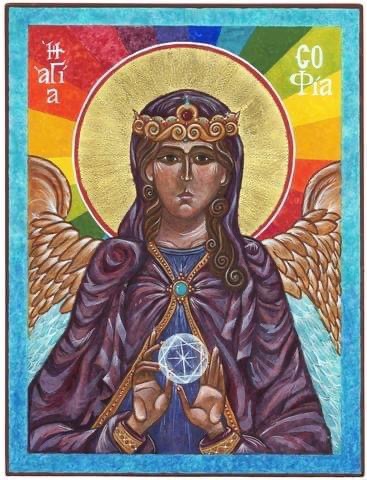
Today the church also honors something that defies explanation, other than to say “it is”: Sophia, or Holy Wisdom.
In the Hebrew scriptures Wisdom is spoken of using feminine pronouns, sometimes colloquially called “Lady Wisdom.” In the texts she attends the throne of the Divine, whispering in the Divine ear. Or, in other places, is the Divine breath breathed forth over creation.
Divine Wisdom has been called many names by humanity over the centuries. In Celtic Christianity she’s identified with the Wild Goose, flying where it makes gut-sense to go in the rhythm of the seasons, loud and untamable.
I quite like that description.
October 5th is a day to honor scholars, sages, and wise persons. Most everyone has the potential to grow old, but not everyone who grows old grows wise. And certainly some who never reach old age are wise already!
Wisdom is pursued and painstakingly won in life through observation, meditation, and experience that is analyzed. Every stumble and blessing can be, must be, a teacher.
Sophia, Lady Wisdom, Divine Insight…however you want to say it…is a reminder for me, and should be for the whole church, that though we age, becoming wise takes effort.
Let those with ears to hear, hear.
-notes about Sophia by me, though attention to the saint day was brought by Judika Illes in her work Daily Magic
Today the church honors a saint who could arguably be the most well-known saint outside of those directly associated with Jesus, St. Francis of Assisi, Friar and Renewer of the Church.
In the late 12th Century, Giovanni Bernadone was born into wealth. He was called Fracesco as a child because his father regularly traveled to France and admired the French. The name stuck. Fracesco, or “Francis,” was not a popular name back then, but has since become popular due primarily to this saint.
St. Francis wanted to be a knight, and even enlisted early and participated in some skirmishes. He was captured, came down with a serious fever, and was returned home. In his illness he had time to think and reflect, and as he recovered he came in regular contact with the poor and the destitute. These experiences of self-examination and proximity to the “least of these” encouraged in him a change of heart. This slow conversion process culminated in a vision in the church of St. Damian where he heard God say to him, “Francis, go and repair my house which is falling into ruin.”
Francis took this literally, and sold a good sum of his father’s goods to repair St. Damian…which caused his father to disinherit him. Pro-tip: an easy way to lose your future fortune is to give it away before it’s yours.
Having no family now, he decided to “wed Lady poverty,” took off his clothes on St. Matthias’ Day (February 24th…perhaps the only good thing Matthias is known for is encouraging Francis from his grave, over 1,000 years later, to take on the vow of poverty), wrapped a peasant’s smock and a rope belt around himself, and began his mission.
This became the Franciscan uniform.
Soon he had many followers who also took up poverty as a calling, and they tried their best to live out the Sermon on the Mount. They took on a simple joyfulness, a comradery with one another, an appreciation for creation, and a wry sense of humor.
No, seriously, humor is part of the order…Franciscans are funny. I think you’d have to be to take on such extreme vows!
St. Francis never became a priest, though he loved the Church and the clergy. Some of his followers got oral permission from Pope Innocent III to formally establish the order, dedicating themselves to poverty, chastity, and obedience.
Franciscans went far and wide with their embodied obedience to the simple life and preaching. Francis himself tried to convert the Sultan of Egypt at one time, but was unsuccessful. A little-known fact about St. Francis is that he literally had a “martyrdom complex,” and as he walked through the armies of the Fifth Crusade he prayed he might be struck down and killed, fulfilling the dream of dying for the faith.
Not one for clerical work, St. Francis easily gave up the administration of the order, finding it too far removed from the simple life he wanted to live. He quickly left the administration to others as the order grew, and stayed on the streets of the world, claiming that his monastery was the whole world itself.
Fun fact: St. Francis was the first to set up a manger scene at Christmastide. He reconstructed the nativity story from Luke in a little cave in Greccio, Italy, and since then we’ve been doing it in our homes and in churches. The manger scene you have packed in your attic was made popular by St. Francis.
As his health and strength waned, St. Francis became more and more a mystic. He is even reported to have experienced the stigmata in his last years. He died on October 4th in 1226 singing Psalm 142 with his last breath.
The Franciscan order remains strong and resolute in the world.
Oh, and that love for animals he’s so well-known for? That comes from a genuine respect for creation that St. Francis had, and for the fact that sometimes he’d be found preaching to the birds. In his mystical visions he recounts a oneness with all creation, which is why we take this day to bless our animal companions, acknowledging our kinship with them and our shared joy in a shared life with them.
St. Francis is a reminder to me, and to the whole church, that sometimes less is more.
Less domination, more companionship with creation.
For the ancient Celts, October signaled the end of their Autumn and opened the door for the shadowed half of the Celtic year.
Samhain (which literally means “summer has ended”) marks the final feast day of the season, and the convergence of the shadows and the weather inclined the Celts to believe that spirits were able to walk among the living causing mischief, curses, and sometimes blessings.
Practically it meant bringing in the cattle and the sheep down from the summer hillside and into the byre and the stable, now full of the harvested hay brought in throughout August and September.
It was also the time to slaughter the animals and prep them to last as far through winter as possible with salts, cold storage, cottaging, and drying.
The very last bits of barley, wheat, turnips, and apples were picked from the now naked fields, because come November the faeries would start breathing on all the fruit, frosting them and making them inedible.
While the sun still glowed it was also time to get the wood and peat stacked and ready for use. No one wanted to chop and gather in the frigid days coming.
This was a joyous month for the Celts, as the whole family was regularly gathered in the house and the barn: baking, salting, prepping, and preserving, envisioning the coming winter feasts and the cozy days ahead.
The summer sun now became the warm, dim room, and the noisy insects would be replaced with long talks and stories from family and visiting friends.





 Reluctant Xtian