A Whirlwind of Creativity

Today the Church celebrates one of our moveable, and most confounding, Feast Days: The Feast of the Holy Trinity.

Here’s the thing about the Holy Trinity: it is a mystery to be held, not a problem to be solved…so we should stop trying to solve it, already.

At its best this doctrine, and this Feast Day (which has been celebrated on this Sunday after Pentecost since at least the 10th Century), honors the ineffable nature of the Divine. Using ancient numerology and a mystic mindset, it acknowledges that some things are unknowable, always spinning, and that this can be comforting for a humanity that longs to peg everything down.

A God who cannot be pegged down is endlessly possible.

At its worst this doctrine has become a (primarily masculine) box that explains in ways that don’t make any sense who God is and how Jesus and God are related, and then throws in a bird (or are they all the same and not related at all? See what happens when you think about it too much?!).

The Trinity is a Divine whirlwind of creativity and love.

The Trinity is a thought that is foundational to all other thoughts.

The Trinity is mother of all, the stream in which time is caught up, the hovering mist that covers existence.

And it is also none of this.

The Holy Trinity is a reminder for me, and should be for the whole church, that any effort to peg the Divine down is a fool’s errand (thank God).

-Icon is Crow Trinity written by Fr. John Giuliani

So Much Blood…

Though not an official saint day, I would lobby hard for it to become one.

Today the church (should) honor the 49 pulses stopped too soon in the Pulse Nightclub shooting, an act that was both domestic terrorism and hate crime wrapped into one bloody night.

In the days following I remember giving blood, and upon entering the waiting room, finding a number of young adults in tears, waiting. A young woman walked up to the attendant, asking, “How old do you have to be to give? If I bring my mom in, can she sign for me? She’ll give too.”

So much blood. On the dance floor. On the hands of a country that refuses to adequately deal with the scourge of gun violence. In vials filled to help the 53 victims wounded in the act.

The Saints of Pulse remind the church, and all of us, that until we tackle both the hate of the heart and the lack of regulations that allow people to wantonly act on that rage in mass murder, we’re not done.

We’re not done.

Paul Assisted Him

Today is one of my favorite feast days because an early apostle, who doesn’t get a lot of play, gets a nod from the church.

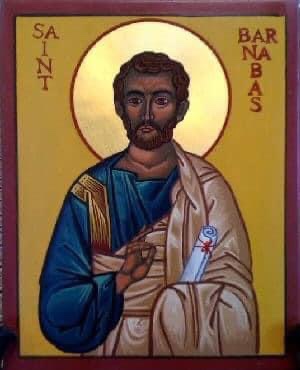
Today the church honors St. Barnabas, a Jewish-Christian from the Diaspora. His name means, “child of encouragement,” probably because he was such a dynamite preacher.

He has long been thought to be one of the seventy that Jesus sent out in Luke 10, and he was a staunch defender of Paul in the courts of the early church, believing that Paul had indeed had a conversion.

His early work was in Antioch, where the church was thriving, and he asked Paul to assist him there…yes, you read that correctly, Paul assisted Barnabas in his early career. Eventually Paul would take the lead, but he learned how to lead from Barnabas. This little tidbit has been lost in history due to Paul’s enormous influence and ego, but it’s worth remembering.

In the early church arguments over the inclusion of Gentiles, Barnabas sided mostly with Paul, calling for Gentiles to be accepted into the fold. Barnabas eventually took John Mark under his tutelage, leaving Paul to travel with Silas, and as Barnabas headed toward Cyprus, we lose track of him in the fog of history.

Lore states that Barnabas was stoned in Cyprus around the year 60.

The Epistle of Barnabas, supposedly written by the apostle, was widely used in the early church and almost made the canon, and some think Barnabas is the author of Hebrews (I don’t buy this).

Barnabas is a reminder for the church, and for all of us, to look just behind the shining stars to see who made them shine. He was Paul’s mentor and defender in Paul’s early days, and like every good teacher, encouraged Paul to outshine him one day (for better or for worse).

-historical bits gleaned from Pfatteicher’s “New Book of Festivals & Commemorations”

Harps of the Holy Spirit

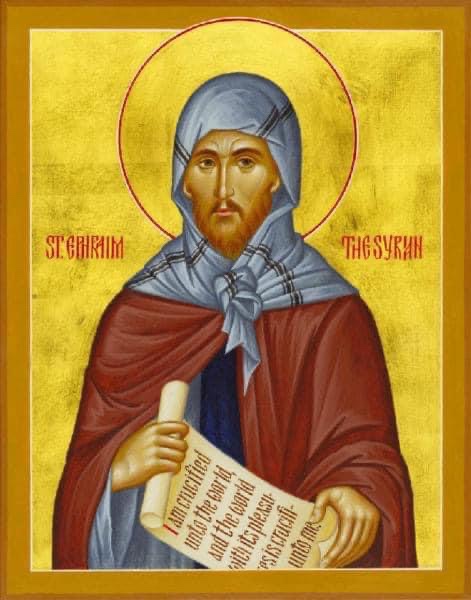
Today the Church honors a Deacon, hymnwriter, poet, and foundational theologian, 4th Century Ephrem of Edessa.

Syrian Christianity is one of the most ancient strains of the faith. Lore has it that Thaddeus of Edessa was one of the seventy sent out by Jesus (Luke 10), and he planted the seeds for Orthodox Christianity in the region. We have no proof of this, of course, and it may be the case that Thaddeus himself is entirely fictional, a pragmatic hagiography used to explain the origins of such an important branch of Christianity.

Whether or not this is true, though, Syrian Christianity was started early, and Ephrem was born a Christian in the early 300’s, and was a student of James, Bishop of Nisibis.

From there he became head of a successful theological school at Edessa, and began writing biblical commentaries, essays on dogma, biographies, historical records, homilies, and early Christian hymns that have remained a part of the Syrian Orthodox liturgy.

Syrians refer to Ephrem as “the harp of the Holy Spirit.”

Ephrem is a reminder to the whole church that Diaconal leaders have, since the early formation of the faith, influenced and guided the faithful all over the world.

Indeed, through our Deacons (and in many traditions, Deaconesses), the church continues to have many “harps of the Holy Spirit.”

-historical notes gleaned from Pfatteicher’s “New Book of Festivals & Commemorations”

Every Nook and Cranny

Today is also one of the church’s moveable feast days, and used to be the second-most honored feast day, only second to Easter: Pentecost, Fire Hazard and Freedom-Giver.

Pentecost highlights the “shy person of the Trinity,” the Holy Spirit. She is unleashed upon the disciples as they are scared and huddled in an upper room, unsure of what to do.

At this same moment it just so happened that people from all the known world were gathered in Jerusalem for a festival…and the symbolism here should not be overlooked.

The Holy Spirit will infuse the world.

The disciples are described as appearing as if they had “flames on their heads.” It’s kind of akin to that time Moses was descending from Sinai and his “face was shining,” or that burning bush moment earlier in Exodus where the flame didn’t consume the shrub. The idea here is that they were glowing with Divine power and wisdom, and it doesn’t consume them, but rather sets them free.

And in this moment, which is a Divine reversal of the Tower of Babel story in Genesis, everyone understands that God is for them in their own language and context, everyone thoughout the known world gathered there.

Pentecost is not a story of God empowering a few to give to the many what they don’t already have, but a story of God unleashing herself upon humanity so that Divine wisdom and saving grace is seen and known in every nook and cranny of creation.

Which should, I think, make us more open to the experiences and ideas of others, especially because they glow with what the Celts called “the spark of Divine life,” just like those disciples glowed that day.

Pentecost is a reminder to me, and should be for the whole church, that Divine grace and wisdom shows up everywhere, like new wine surprising us at every sip.

-commentary my own

-icon written by Jim Whalen

Zeal is Not Wisdom

Today the church remembers 8th Century Saint Boniface, Archbishop and Missionary.

Boniface was born with the name Wynfrith (love it!) in Devonshire England in the late 7th Century. When his father fell ill he was sent to a Benedictine school, and then monastery, where he was ordained. It was there that he wrote a Latin grammar book for scholastic use, and several poems.

When Wynfrith turned 40 he began his missionary work in Germany and the Netherlands. The anti-Christian sentiment in the area was strong, though, and he returned back to his native England, eventually succeeding his abbot at Nursling. He didn’t last long in that position, though, and resigned to petition Pope Gregory II for a missionary assignment.

Pope Gregory II approved it, and gave him the name Boniface, which means “to do good.”

He returned to what is now modern day Germany and, after trial and error, finally succeeded in establishing a monastery in Hesse.

With such success, the Bishop of Rome consecrated him bishop for the German frontier, even though there wasn’t a fixed diocese there. To show bravery, Boniface cut down the sacred oak tree of Thor, and though many expected Thor to strike him down with lightening or illness, Boniface remained perfectly healthy. Because of this, many were converted. Out of the wood of that tree he built a chapel in honor of St. Peter.

Pope Gregory III (popular name) elevated Boniface to archbishop in 732, and was eventually given the see of Mainz as his jurisdiction after the bishop of Mainz, Gewiliob (love it!), admitted to killing his father’s murderer.

At sunrise on June 5, 754, at Dokkum, Boniface, while reading the Gospel to a group of neophytes on Pentecost, was attacked by a pagan mob and killed on the job. His remains, and the Gospel book he was reading from at his death, can still be seen at Fulda.

Boniface is a mixed bag for me. He was obviously dedicated and zealous for the faith. But in his spiritual zeal he committed religious tyranny against those he was sent to serve. To take a sacred object, Thor’s tree, and create another sacred object of a different creed, St. Peter’s church, is religious violence.

That kind of violence totally goes against not only my own code of inter-faith work, but also that of my church.

Yet I do admire his willingness to serve in uncharted territory, and his willingness to leave a comfortable job (being the abbot of a monastery is no small thing!) to enter the unknown. That takes courage…I just wish he’d had a little more wisdom with it.

Or, maybe this is what I mean to say: I wish he’d lived up to his name, “Boniface,” and did more good than he did.

-historical notes taken from Pfatteicher’s “New Book on Festivals and Commemorations”

Huge Overhaul

On this day the church remembers Saint Angelo Roncalli, better known as Pope John XXIII.

Born in 1881 to a family of thirteen children in rural northern Italy, Roncalli entered the seminary at the age of 12 and was heavily influenced by the progressive leaders of the Italian social movement.

He was finally ordained in 1904 and served in World War I in the medical and chaplaincy corps while serving in the bishop’s office at Bergamo. During his time in the bishop’s office, he learned social action and gained experience serving the working class.

In 1921 he was called to Rome to serve as the director of the Society for the Propagation of the Faith. He was consecrated archbishop in 1925 and made apostolic representative to Bulgaria, and then Turkey and Greece in subsequent years.

During his time in the East he built bridges toward Orthodox Christianity, and when World War II broke out, Roncalli was instrumental in passing secretive and sensitive information back to Rome to help Jews fleeing the Nazi regime.

In 1958, at the age of 77, he was elected pope and chose the name John. Everyone expected him to be a buffer between Pope Pius XII and whomever came next, holding down the fort in his old age.

But Pope John XXIII wasn’t having any of that. Building off of his early days working with the poor and his service in the military, he orchestrated an ecclesial overhaul on a massive scale, diversifying the college of cardinals, revising the code of canon law, and calling the Second Vatican Council to shake up the church.

Pope John XXIII’s ultimate goal, it appears, was the re-unification of the church, and (arguably) more than any Bishop of Rome before or since, visited hospitals, prisons, and schools regularly. He was known for, as the folk band Spanky and Our Gang would say, “Giving a damn.”

Today Pope John XXIII is a reminder to me, and to the church, that we can never discount the present moment, regardless of appearances, as being ripe and ready for change.

In many ways he didn’t bother building off of the past, but let some unhelpful and useless ways of operating die on the vine, planting in new soil for a new and changing world. Not everything can be redeemed, Beloved. Sometimes you must start fresh.

And the things that can be redeemed?

Sometimes they need more than refurbishment…they need a huge overhaul.

Huge.

-historical portions gleaned from Pfatteicher’s “New Book of Festivals and Commemorations”

Nothing the King Could Do…

Today the church remembers a horrible 19th Century massacre as it honors St. Charles Lwanga and the Martyrs of Uganda.

In the late 1870’s Christian missionaries came to Uganda, both Catholic and Protestant, to plant churches and spread the Gospel.

Full disclosure: I have very mixed feelings about missionary work, especially the kind that was practiced in that time and place (and still practiced in many corners of Christianity). The accompaniment model I can support, and do support. I do not support the “I have something you need/white savior” model, which is far too often the model still used.

But I digress.

Regardless of how they came to the faith, these thirty-two martyrs were offered up as a “burnt offering” at Namugongo, many of them pages in the court of King Mwanga of Buganda. Many of the men were actually just boys, no more than thirteen years old. Their crime?

They refused to renounce the faith.

Charles Lwanga was seen as their leader, and encouraged them to stand fast to their convictions.

After this massacre, the killings continued as persecution spread throughout the land as King Mwanga attempted to exterminate Christianity. Unfortunately for the king, the stories about these brave martyrs emboldened others to not only stand firm in their faith, but even led some to adopt the faith because they were so inspired.

The conviction of these martyrs helped other Ugandans to understand that Christianity was/is truly African, and not a white religion…which totally makes sense because Christianity started with a man of color (even though much of the church keeps trying to pretend that’s not true).

Led by the example of these martyrs, Christianity started to spread like wildfire throughout Uganda. There was nothing the king could do.

The Martyrs of Uganda, led by Saint Lwanga, are a reminder for me, and should be for the whole church, that sometimes your life and how you live it is the best testimony.

-historical bits from Pfatteicher’s New Book of Festivals & Commemorations

-commentary mine

-icon of Saint Charles Lwanga written by Fr. Kevin Estabrook

Martyrs…More Martyrs…

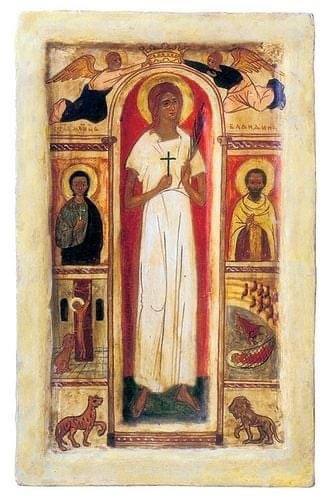
Today the church honors a martyr of the faith, Blandina who, along with her companions, was killed at Lyons.

She, and those with her, were beaten by the majority population who felt they were deviants. They were unduly tortured, and thrown in prison. The Bishop Pothinus, at 90 years old, died in prison after being beaten with the group.

If the prisoners would not give up their faith, the Roman citizens in the lot were to be beheaded at the command of Marcus Aurelius. The rest would be used for sport in the amphitheater, killed by wild beasts as crowds cheered and jeered, as if at a rally with the local politicians leading the chants.

Blandina and her companions were brought up on trumped up charges, including indecent acts. Blandina, when asked to confess to these acts, is reported to have simply said, “I am a Christian, and we do nothing vile.”

Reportedly there were 48 martyrs, of all ages and all walks of life. The church historian Eusebius said of them, “They offered up to God a single wreath, but it was woven of diverse colors and flowers of all kinds.”

Blandina is a reminder for me today of just how long our human systems of injustice have been operating. It reminds me of what trumped up charges and group-think can do to people.

The martyrdom of Blandina and her companions is a witness to me, and to the church, that a diverse group of people can stand together in the face of opposition and that, when push comes to shove, no nationality can save us in the end…after all, the Roman citizens were beheaded…and only God is in the saving business.

The wreath of humanity, precious to the Divine, is woven of diverse colors and flowers of all kind…and we must stand as one, by God.

-historical notes taken from Pfatteicher’s “New Book of Festivals & Commemorations”

All Apologies…

Today the church remembers one of its most influential early thinkers: St. Justin, Martyr, Apologist, and Philosopher.

As the early church began to expand and grow, the Second Century proved to be a difficult time period for those trying to be honest about following the faith in a world hostile to non-conformity.

St. Justin, probably the most influential public Christian figure of his day, was born to pagan Greek parents in Samaria around the year 100 A.D. He sought out the best thinkers of the time in his honest pursuit of philosophy and to understand religion, and while studying in Ephesus stumbled upon the stories of Christian martyrs. He was amazed that people would die for their faith, noting that “no one believes in Socrates to the point of dying for what he taught…” (though, truthfully, the Inquisition would turn this notion on its head, right?).

As the story goes, he came upon an elder Christian by the seashore who explained to him the prophets of the Hebrew Scriptures, and then and there he decided to become a Christian.

St. Justin taught the faith in Ephesus for a while, and eventually made his way to Rome where he made two famous defenses of Christianity: once to emperor Antoninus Pius, and once to the assembled Roman Senate.

He became embroiled in a series of debates with the Cynic philosopher Crescens, and though St. Justin provided honest and tight philosophical defenses, it went…well…predictably for him.

When push came to shove, St. Justin refused to make burnt sacrifices to the emperor, and for that he and some of his students were killed.

His Apologies still remains a sound defense of the faith and an early glimpse at what ancient Christians believed and practiced. St. Justin was also keen to make sure that Christianity didn’t ignore the Hebrew Scriptures (which some strains are wont to do), and kept the faith rooted in the prophecies of old.

Most importantly (at least, for me), St. Justin didn’t see Christianity as a foil for Platonism or as incompatible with deep philosophy. Rather, he saw it as both complementary and, in some ways, a culmination of the life of the mind.

St. Justin a reminder to me, and should be for the whole church, that the faith doesn’t mean a rejection of the life of the mind.

-historical bits from Pfatteicher’s _New Book of Festivals & Commemorations)

-Icon written by the saints at Legacy Icons (legacyicons.com)