Stalwart of Stonewall

Today, on Trans Visibility Day here in the states, I would lobby hard for the church to remember the stalwart of Stonewall, St. Marsha P. Johnson, Activist and Trailblazer.

Born with the name Malcolm Michaels Jr in Elizabeth, New Jersey, Marsha lived her early years in a town with little acceptance for those who identified as LGBTQ. She remained closeted, was the victim of bullying and sexual harassment through school, and mercifully graduated and headed for New York City to live and work at the age of 17.

In her early days in New York she came out of the closet, and took on the persona Black Marsha, which eventually morphed into Marsha P. Johnson (the “Johnson” taken from Howard Johnson Motels and the “P” standing for “pay it no mind” in reference to questions about her gender). In the 60’s and 70’s Marsha used many labels to identify herself, often utilizing the term “transvestite,” an attempt to reclaim the moniker from contemptuous slurring. But many queer studies experts agree that, had the term been accepted and more widely used, Marsha would have identified herself as transsexual (mostly indicated by her preferred pronouns she/her…this is why pronouns matter).

Though St. Johnson was often portrayed as a drag queen, she described herself as “low drag” because she couldn’t afford the fancy clothes and makeup that professional queens utilized. She was just being herself…it was not an act or a performance. In her dress and personality she embodied the intersection of the masculine and feminine, inviting an analysis of assumptions and stereotypes.

Johnson was one of the first drag queens to cross the Stonewall threshold when they first began to allow drag queens to enter without interruption (it had primarily been a gay men’s bar). We often forget (and may our children always ask “why?!” when this bit of history is unveiled), but homosexual activity, cross-dressing, and same-sex pda was illegal in many states in the USA, even in 1969.

Right. We forget that. And in the age of “Don’t Say Gay” bills in Florida, it appears we’re trying to actively move back that way…

On June 28th, 1969 Stonewall Inn was raided by New York City police, and many were arrested sparking an uprising that lasted for days. The gay rights movement surged in the days following, with Marsha P Johnson on the front lines, pushing back against police brutality, claiming, “I got my civil rights!”

Marsha joined the Gay Liberation front, and in coordination with other movements across the United States, helped to push both public opinion and political legislation to include protections of sexual minority rights in courtrooms and classrooms.

Toward the end of her life St. Marsha, living with HIV herself, took care of her good friend dying of AIDS during the AIDS pandemic. She became a vocal advocate for better care and conversation of AIDS victims, and sat at the bedside of many who were dying of the disease as a comforter.

Despite not being accepted in many religious circles, Saint Marsha was a practicing Catholic, often praying and lighting candles for those she loved. She felt that Christ unified all living people, across the spectrums and diverse personhoods in which we live.

Tragically, directly following a Pride Parade in 1992, Saint Marsha P Johnson was found dead in the Hudson River under mysterious circumstances. Her legacy of love and activism and self-acceptance lives on in a movement that will not be stopped.

Saint Marsha P Johnson is a reminder for me, and should be for the whole church, that loving yourself is holy, by God.

-historical bits from publicly available sources

-icon written by Kelly Latimore

A Voice from the Margins to the Monarchy

Today the church remembers prophet-farmer who spoke from the margins for the margins: St. Amos of Judah, Critic of the Monarchy and Firebrand Defender of the Poor.

St. Amos was active between 8th century BC, and is considered one of the twelve minor prophets in the Hebrew Scriptures (Hosea, Joel, Jonah…they round out the rest). The book of Amos is attributed to him, and though he was from the Southern Kingdom (Judah), he preached in the Northern Kingdom (Israel).

Having felt the call of the Divine upon his heart from the rural outskirts of the kingdom (and of society), Amos is a farmer-turned-prophet who pointed the monarchy toward the margins and asked, “Do you see who you are neglecting?! You claim to be working on behalf of God, but the growing wealth and opportunity gap between the elites and the working poor exposes your talk as just lies!”

Seriously, that’s the gist of his argument.

He said, “I am not a prophet, nor the son of a prophet!”(Amos 7:14) are his attempts to get the elites to listen to him. In essence he said, “I’m not doing this for show, y’all! This is real life.”

He warned that not watching out for the welfare of the weakest would lead to the Northern Kingdom’s fall. And, well, the Northern Kingdom fell in time…

As the wealthy continued to amass lands that did not belong to them, and on which they did not work, Amos reminded the circles of power that their goal was to honor God by protecting and elevating the laborer, not to get the “best deal” and take advantage of them.

Justice. Egalitarianism. A preference for the poor and the margins. This was the cry of the prophet Amos.

At his core Amos sought to do something that, throughout history, has been the hardest thing to do: convert the wealthy and the comfortable.

The feast day for this Biblical prophet varies depending on tradition. The Armenian and Orthodox calendars place the day in the summer months (June 15th or July 31st), while the Roman branch waits until March 31st.

Today, though, is an excellent day to honor the firebrand of a saint as March 28th often lands in the season of Lent, a season where we attune our spiritual hearts toward repentance.

St. Amos is a reminder for me, and should be for the whole church, that in times of prosperity conversion is still necessary…and often it has little to do with “giving your heart to Jesus,” but rather offering up your life and gifts for the sake of your neighbor.

Let those with ears to hear, hear.

-historical bits gleaned from publicly accessed information, the Harper Collins Study Bible, and Claiborne and Hartgrove’s _Common Prayer: A Liturgy for Ordinary Radicals_

-icon is a Russian Orthodox depiction of the prophet making their appeal.

Theotokos

Today the church celebrates the Feast of the Annunciation, honoring the moment when the angel Gabriel visits young Mary to announce that she is highly favored by God and will carry the Christ into the world (naming Mary the “Theotokos” or “God-bearer”).

My favorite thought associated with this feast day is offered by Sojourner Truth, 19th Century prophet and activist.

She says:

“That man say we can’t have as much rights as a man ’cause Christ wasn’t a woman. Where did your Christ come from? From God and a woman.

Man had nothing to do with it…”

Be Saved Alongside the Poor

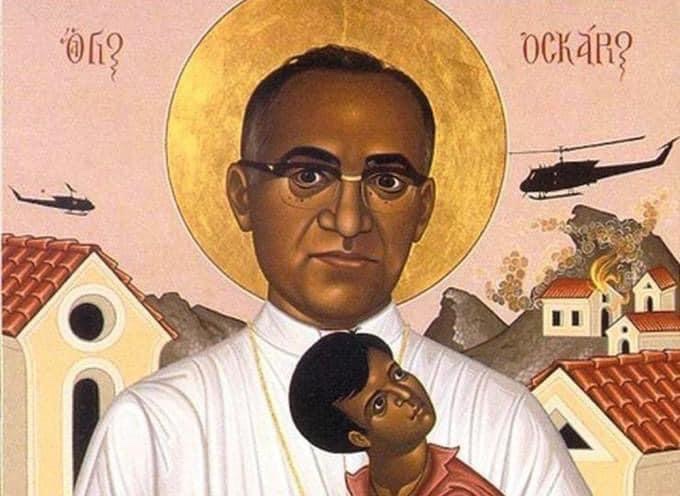
Today the church remembers Bishop Oscar Romero of San Salvador.

Bishop Romero was born in the mountains of El Salvador, and was originally trained in the arts of carpentry. At a young age he entered seminary, and eventually completed his schooling in Rome.

He served as a parish priest in El Salvador, and then as the rector of the seminary in San Salvador. He was consecrated bishop in 1970, and then Archbishop of San Salvador in 1977.

He is remembered for being a defender of the poor and the underclass, especially in the conflicts in El Salvador. He used his status as bishop, and then Archbishop, to call the powers to account for their greed and atrocities.

But we forget that he wasn’t always so vocal. He was timid at the start of his bishopric, worried that speaking out too forcefully would be too divisive, even if it was the just thing to do.

A peace brought about by silence, though, is no peace at all…and he eventually felt the weight of this deep truth.

During Mass on the 24th of March in 1980, Archbishop Romero was shot through the heart just as he was elevating the host, killed for his work for justice on behalf of the poor and oppressed.

“The church’s good name,” he once wrote, “is not a matter of being on good terms with the powerful. The church’s good name is a matter of knowing that the poor regard the church as their own, of knowing that the church’s life on earth is to call on all, on the rich as well, to be converted and be saved alongside the poor, for they are the only ones called blessed.”

(excerpt from The Violence of Love, by Romero)

-biographical information from Pfatteicher’s New Book of Festivals and Commemorations

The Illuminator

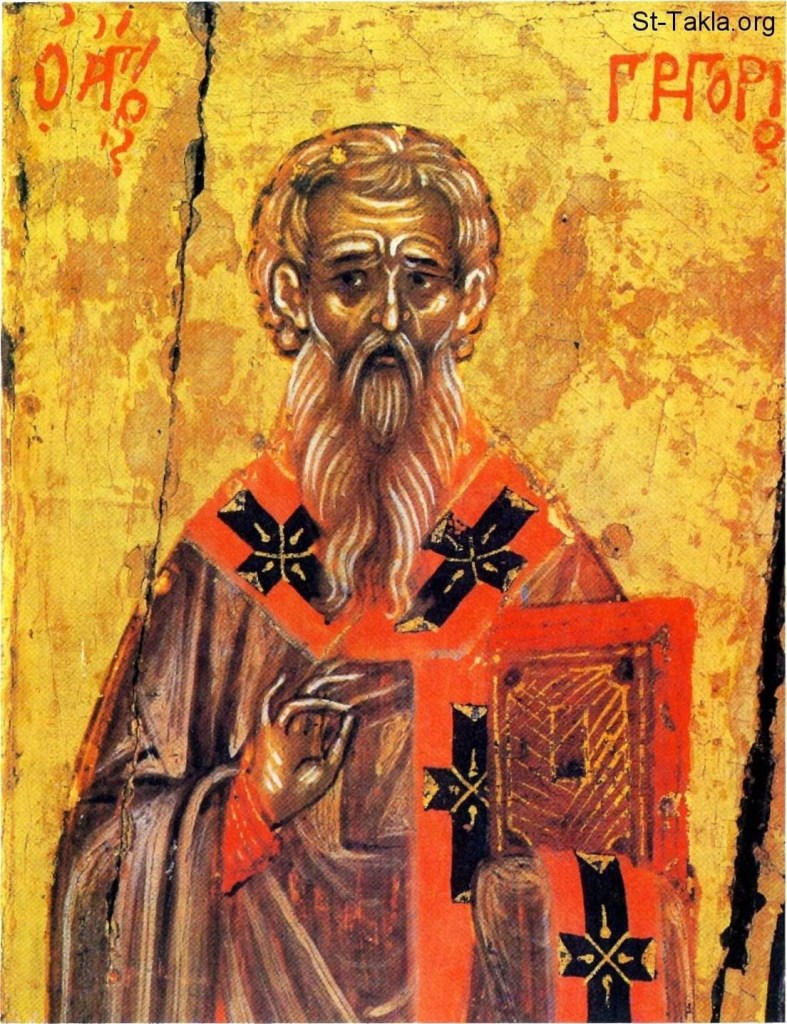
Today the church remembers an obscure (to Westerners) Armenian saint with a cool name: Gregory the Illuminator, Bishop of Armenia and Trailblazer.

We don’t know much that is verifiable about St. Gregory’s early years. Lore and legend have crept up around his historical life that he is a giant standing upon the stories others tell of him.

Nevertheless, we know he was born around the mid-3rd Century, and was baptized as a child while in hiding (perhaps his father was the assassin of the Persian King Khrosrov I?), and a married St. Gregory returns to Armenia in the late 3rd Century and converted King Tiridates III to Christianity.

Around the year 300 St. Gregory was consecrated Bishop of Armenia, and under his leadership Armenia was the first country to officially adopt Christianity as the national religion, paving the way (for better or for worse) for Constantine to do the same.

The Armenian Church continues to have a strong Christian presence, and is a companion to the Anglican Communion (though not officially part of it).

St. Gregory is called “The Illuminator” because he sought to bring Gospel light to Armenia. Toward the end of his life he appointed his son Aristages to be chief Bishop in his place, and lived out his remaining years in holy solitude.

St. Gregory the Illuminator is a reminder for me, and can be for the whole church, that a good and righteous life can be eaked out of tragic beginnings. The sins of the parents need not trickle down to the children. Though his father (probably) was a murderer, he went on to shape a whole nation for good.

-historical bits from Pfatteicher’s New Book of Festivals & Commemorations

Step-Father of Jesus

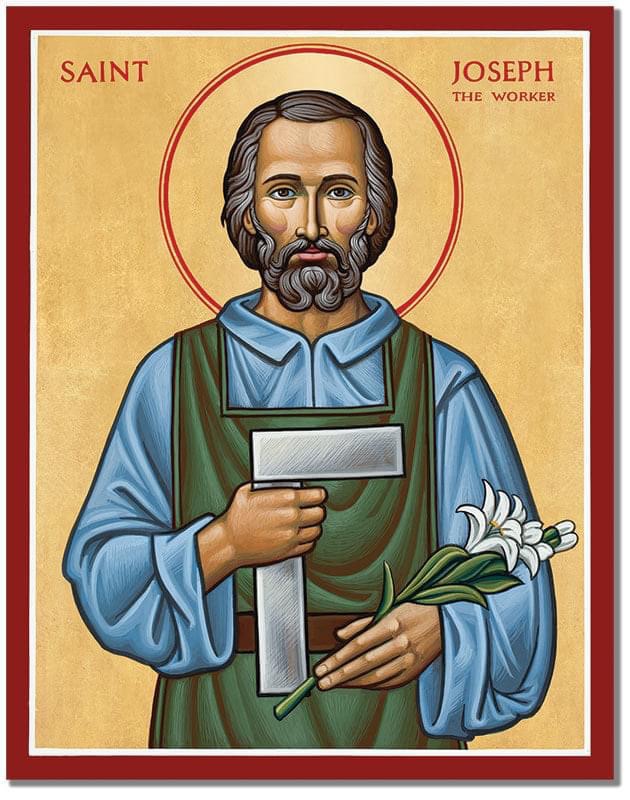
Today the church remembers a saint that everyone knows, but no one knows much about: St. Joseph, Step-Father of Jesus and Companion of St. Mary.

St. Joseph is only mentioned in three of the four Gospels (Mark doesn’t seem to know about him, or doesn’t think he’s important enough to mention), but because the Christmas tales are so popular in our age, St. Joseph is part of that other holy Trinity: Jesus, Joseph, and Mary.

Matthew and Luke don’t even really agree on the genealogy of Jesus, but both trace Joseph through that singing Psalmist David, making a direct connection between Jesus and the House of David. Matthew indicates that St. Joseph was originally a resident of Bethlehem who made his home in Nazareth (which is how he met Mary for Matthew), but Luke says that Joseph was a longtime resident of Nazareth, and only went to Bethlehem for the census.

St. Joseph, like Jesus in the Gospel of Mark, seems to be a person without a known home, which I kind of like, because it means that St. Joseph could be anyone…like you, or me, and entrusted with the Christ-child for the sake of the world.

Scriptures say that he was a carpenter (though the Greek word used is kind of obscure and could mean anything from “artisan” to “rock mason”…I like to think he was an artist). The Gospels portray him as a fair individual, and a devout follower of Judaism who sought wisdom and understanding.

Because the Gospel accounts don’t mention him again, it is thought that he had died by the time Jesus is crucified. This is entirely plausible as marriages in the ancient world were often unequal in age, and wives typically outlived their spouses (hence why “widows and orphans” is noted so often in the scriptures). That all being said, nothing in the scriptures notes he was older, so why do we assume he might be?

I’m glad you asked…

There’s a fun (and fake) 2nd Century Gospel attributed to James the Less, a disciple of Jesus, that makes that claim. And in the 5th Century we find a History of Joseph the Carpenter that claims he was 89 (!) when he was a widower, and married Mary when he was 91 (!). That’s a stretch for a number of reasons, not the least of which is that hardly anyone in the ancient world lived that long.

The first commemorations to St. Joseph are recorded in the 8th Century from Northern France that calls him the artful “Spouse of Mary.” I prefer to think of him as the “Step-Father of Jesus” not only because the Gospels functionally portray him that way, but also because it gives a holy nod to the blended families that bless this world.

St. Joseph is a reminder for me, and should be for the whole church, that everyone is called to be a step-father to the Divine Love Letter in this world.

We are all Josephs, no matter where we’re from.

-historical bits gleaned from Pfatteicher’s New Book of Festivals & Commemorations

How Palm Sunday (Probably) Came to Be

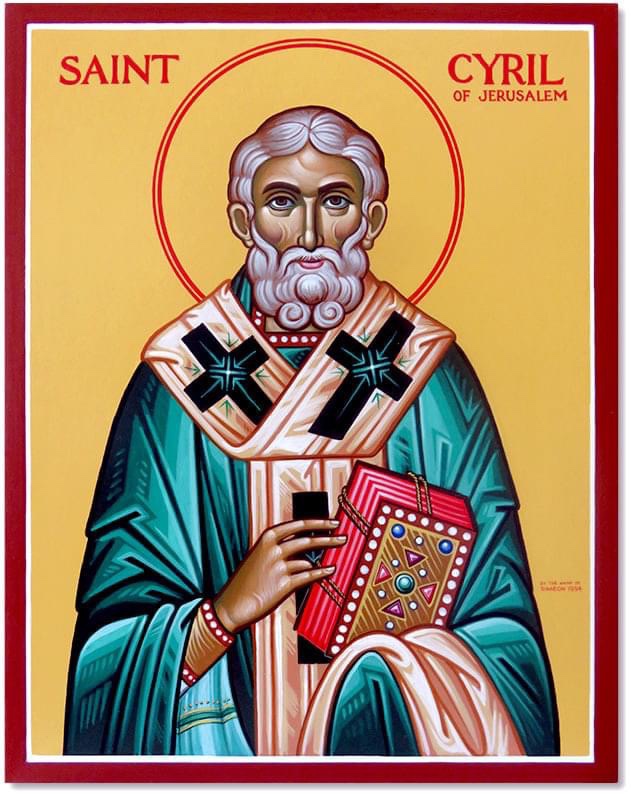
Today the church remembers the church father who, in all likelihood, instituted the feast days of Palm Sunday and the observance of Holy Week: St. Cyril, Bishop of Jerusalem and First (unofficial) Sunday School Teacher of the Church.

St. Cyril was born in Jerusalem sometime around the early 4th Century. At a young age he was ordained a priest and, despite his youth, was entrusted with catechizing those preparing for baptism. This work was traditionally reserved only for the Bishop, but Cyril’s skill in teaching and relaying the doctrine of the church was impeccable.

The catechesis that St. Cyril created, known as the Catechetical Lectures are the clearest surviving notes that we have on the catechetical process of the early church for the Rite of Initiation which leads to the Rite of Holy Baptism (at least for adults…for children the process is reversed).

Cyril became Bishop of Jerusalem around the year 349, and remained in that holy seat until his death on this day in 386. Yet, during his bishopric he led in exile more than a few times, as that early church fought over doctrine and dogma (seems like a pattern, no?).

St. Cyril was Bishop over the Holy Land, the site of holy pilgrimage for many early Christians, especially around Easter. It is quite likely that St. Cyril, in all of his catechetical acumen, instituted the Feast of Palm Sunday and the events of Holy Week as a way to teach Christians about the Passion of the Christ. In many ways you can thank St. Cyril for what are, I believe, the best parts of Christian ritual.

St. Cyril is a reminder for me, and can be for the whole church, that rites and rituals are not “hoops we jump through,” but formative experiences that create a rhythm in our being that can be supremely meaningful in the right hands.

-historical bits from Pfatteicher’s New Book of Festivals & Commemorations

Expert Snake Removal

Today the church remembers St. Patrick, the 5th Century missionary to Ireland.

He was not religious as a child, and as an early teen was seized by Irish raiders and sold as a slave in Ireland. In his bondage and loneliness, he began to pray every day.

He eventually managed to escape in his late teens and returned to Roman-Britain, now spiritual and convinced that he was called to serve the Irish people not as a slave, but as a shepherd.

He studied for the priesthood, and became Bishop of Ireland in the 430’s.

Lore is legion for this Irish saint, and he became known for standing up for the Irish, even against the will and decrees of his native Roman-British. He was known for leading a vigorous and historic life. He died in 461 in County Down.

St. Patrick is a testament to how, when we fall in love with a people, we also fall in line with them against the powers of the world that threaten them. He was an ally for the abused Irish, and is now one of their patron saints.

Friend of Those with Depression

Today the church remembers the yang to St. Vincent de Paul’s yin: St. Louise de Marillac, Patron Saint of Social Workers and Friend of Those With Depression.

Born in France at the tail end of the 16th Century, Louise encountered many challenges in life. She was born out of wedlock to a mother she would never know and a father who died when she was twelve. Despite the early hardships, she had received an exemplary education, and her uncle was part of the Queen’s Court, which gave her allies in high places…that is until the civil unrest of the time forced his untimely demise.

When her father died, St. Louise went to live with a kindly spinster in town her taught her herbal medicine (Louise was perpetually sick), and from a young age she felt the call to cloistered life.

Unfortunately, cloistered life did not feel the same about her. She was denied entry as a Capuchin, and had to pivot to a plan B for her life. Her family encouraged her to get married, and she stumbled upon Antoine, an ambitious young man whom she would, in time, grow to sort of love.

From their union one child was born, Michel, whom she loved dearly.

But in these days St. Louise still felt much inner turmoil. She had wanted to follow a life of devotion to God, and yet here she was with a husband and child. She felt like she had abandoned her call in life which, along with the failing health of her husband, led her into a deep depression.

Yet, like so many in life, she lived with the depression, tending her ailing husband and doting on her son. I think we would all be surprised to know the number of functioning people living with depression, doing what they must for those they love, even as their insides feel empty…

One day in prayer, St. Louise felt an overwhelming sense of calm. She realized that she must stay with her husband, though she felt a strong call to the cloister still, and should she outlive him, she would refuse to marry and than accept her vows. In this same clarity of purpose, she also said she felt a Divine assurance that a new spiritual director would enter her life.

Soon after she met St. Vincent de Paul, and that, as they say, is that.

Despite her excellent care, Antoine died in 1625. As a widow with a son and without income, she moved into a more modest home, and lobbied for St. Vincent to become her confessor. He eventually agreed, though he was already very busy giving his life away to the sick and infirm in France.

Over the next few years, under St. Vincent’s spiritual care, St. Louise came to see her life attain more balance. She joined St. Vincent in his care for the needy and sick in France, and found both joy and success in the work. At the age of forty-two she went on retreat and received a new vision for her life: she must lean into her vows and start the Daughters of Charity.

Part of the vision was a realization that social class and stigma prevented the upper class from aiding the lower class. Yeah, sure, they sent meals and provided some minor medical care, but the tension between the classes remained and made everyone hesitant to give, and to receive, care.

Plus, St. Louise realized the aristocracy didn’t like the work of caring for the needy…and they were kind of lousy at it, honestly.

So, St. Louise set up a system of care that leaned upon the aristocracy to raise funds, but left the practical hands-on work to a group of sisters who not only identified with those they were caring for, but were trusted by them, too. These women who would come to care for the sick and infirm were usually from rural areas of France, and their unique upbringing made them supremely capable of the task in a way that elite city-dwellers were not.

St. Louise organized these women into formational homes, teaching them practical care and spirituality. Being savvy with governmental regulations, St. Louise began organizing her work to have centralized places of care throughout the city where the medical and social needs of the poor could be handled. She enlisted the help of doctors, nurses, and politicians to have sites set up in hotels, hospitals, prisons, the battle field, and eventually orphanages and mental institutions.

In concert with those doctors and nurses, she created nimble teams of care-givers to provide comprehensive services to those in need.

She, in effect, created a modern-day social worker network.

At the age of 68, St. Louise breathed her last, having set up over 40 places of care throughout France.

St. Louise is a reminder for me, and should be for the whole church, that sometimes being in touch with the difficulties in your own life make you supremely qualified to walk with others through their own difficulties. And yet, it is often those people the church…like St. Louise…rejects at first.

Let those with ears to hear, hear.

O, the Lord is Good to Me

Today we remember a legendary (literally) character in Americana: Johnny Appleseed, Evangelist and Erstwhile Ecologist.

Born John Chapman in the late 18th Century, Johnny’s mother died at a young age leaving him and his infant sister in the care of their father, a Minuteman who fought at the Battle of Bunker Hill.

At the turn of the 19th Century a young adult Johnny shows up in Pennsylvania, tossing around apple and pear seeds like they’re confetti at a ticker-tape parade, espousing the philosophical and religious teachings of a certain Emanuel Swedenborg, a Swedish spiritual teacher.

Yeah. All you forgot about that, didn’t you?

Because he carried around these seeds and threw them everywhere, wanting to “provide shade for all travelers,” Chapman became known as Johnny Appleseed. But chiefly he was a religious fanatic (not in a bad way, just was), preaching the Swedeborgian philosophical beliefs as he went along. With a pack of apple seeds you also got a free religious pamphlet, as if to say, “Please, throw this away for me.”

As unusual as his journey was, his dress was just as odd for the times. Like a mirror of John the Baptizer, Johnny traveled barefoot with a broad-rimmed hat, to keep the sun out of his eyes. He traveled largely by horseback or canoe, and lived off of the extreme kindness of strangers who found a place for the young evangelist at their supper tables.

Though Johnny’s birthday falls in September (and some heretics honor him in that month), the sane Americana-lovers like myself prefer this March date because now is the time of planting.

Do yourself a favor and check out Swedeborgian churches. There are some still in the United States, though it’s a quickly-shrinking religion.

One final note, and this is worth remembering: though Johnny Appleseed dressed funny and espoused an unusual religious creed, most every legend or personal account of him notes his pure kindness.

Honestly: despite all our quirks, if we’re remembered just for that…that’s a pretty good life.

“Oh, the Lord is good to me, and so I thank the Lord,
for giving me the things I need: the sun, and the rain,
and the apple seed.
The Lord is good to me. Amen!”