Today the church uses its parched tongue to cry out, “O Radix Jesse!” or “O Root of Jesse!”
The ask here is that the dead stump of a family line, scourged and ravaged by one conquering after another, eating away at the Family Tree, somehow live again.
This dead-end of a year feels very stump-ish to me.
It’s also just true that while we may have eaten from the Tree of the Knowledge of Good and Evil, we have not learned its wisdom. That ancient tree is dead in our hands as we call what is evil, good, and what is good, evil.
On December 18th in Advent the church raises its voice to cry out, “O Adonai!” or “O Lord!”
This is, perhaps, the most honest prayer there is, Beloved. In times of trial and joy, “Oh God” or “My Lord” slips from our lips.
In the ancient context of Advent, this cry is both an invocation and a statement of political priorities. The Empire of old (and now?) would have you believe that power is Lord, that grievance is Lord, that Caesar is Lord.
In fact, all the ancient steles and decrees said just that: Caesar is Lord.
But the church, at its best, says that the Divine is Lord.
It’s a political statement. We’ve forgotten that…but we can remember. There is time.
-art is by Michael Adonai, an Eritrean painter, entitled “Back to Homeland.” You can imagine crying out “O Lord” when longing to return to your mother…
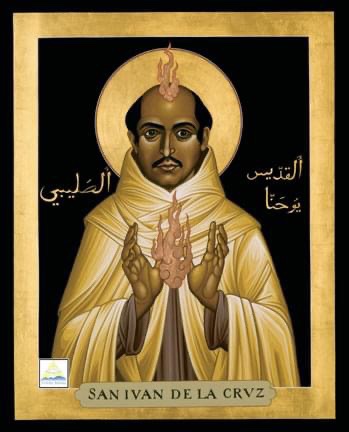
Today the church celebrates one of the great mystics of history, St. Juan de Yepes y Alvarez, but you know him better as St. John of the Cross, Renewer of the Church and Visionary.
St. Juan was born in Fontiveros Spain, the third son of a Jewish silk merchant. His father died shortly after he was born, and his family placed little Juan in an institution for the poor.
St. Juan was extremely short of stature, even for his day, but showed great skill in craftsmanship from early on, and apprenticed at many places. He enrolled in college and worked his way through school striving to become an exemplary monk.
He was entranced in the Order of the Blessed Virgin (Carmelites), and was ordained. Soon after met St. Teresa of Avila, his spiritual cousin. She had begun to implement her reforms of the Carmelite order, and St. John promised himself to these reforms, adopting the name St. John of the Cross to embody his minimalist and mystic piety.
St. Teresa eventually helped get St. John appointed as Confessor to the Convent of the Incarnation, where she was a sister.
St. Teresa’s reforms were causing division within the Carmelite Order, and some monastics came and seized St. John, imprisoned him in a six foot by ten foot cell, beat him, and attempted to force him to renounce the austere reforms.
St. John refused and after nine months was able to escape, fleeing to a safe monastery in southern Spain.
This is where he began writing down his mystical visions and dreams, having had them in the confinement of his prison cell. His deeply spiritual writings often took the form of poetry. Most notable are The Ascent of Mt. Carmel-the Dark Night, and Living Flame of Love (which is more song than pure poetry).
In 1591 the controversy over the austere reforms rose again, and St. John was banished further south in Spain. It was there that he caught a fever and, though he sought medical care, was poorly treated because the prior of the monastery didn’t want the burden of another monk.
He died uttering the Psalms, saying, “Into your hands, O Lord, I commend my Spirit.” He was deeply beloved by the people, though he was rejected by much of the Church at the time, and was immediately heralded as a Saint.
You may not be too familiar with St. John of the Cross, but you’re certainly familiar with art that is based off of his mystical visions. Salvador Dali’s unique painting of the crucifixion was based on one of St. John’s poems.
St. John of the Cross is a reminder to me, and should be for the whole church, that sometimes the most despised in our midst are the wisest.
Let those with ears to hear, hear.
-historical notes from Pfatteicher’s New Book of Festivals & Commemorations
Today the church, especially those of Scandinavian heritage, remembers a young saint and martyr who, in memory, has a taste for sweet rolls and coffee: Saint Lucy, The Light Bearer.
Having lived sometime at the end of the third century in Sicily, Saint Lucy was a victim of the Diocletian Persecution, a purging of Christians in Roman territories. She was said to have lived a good life who had a heart for the poor. Legend goes that her mother fell gravely ill when Lucy was a young maiden, and when she recovered St. Lucy gave all of her bridal dowry to the poor in thanksgiving to God. Her would-be suitor did not like this at all, and turned Lucy in to the authorities for being a secret Christian.
As punishment Lucy was forced to work in a brothel…though she refused to work at all, which frustrated her oppressors. They took her out to the village square and built a fire around her in order to scare her into submission, but she remained unafraid. She eventually died due to these intimidation tactics, and her legend grew in the Christian communities as a brave young woman who had no fear in the face of danger.
Saint Lucy is remembered as the patron saint of the working poor. Her name literally means “light,” which makes the intimidation tactics of her oppressors ironic.
In modern practice Saint Lucy’s memory made its way far north to Scandinavia where she is highly regarded, especially as her feast day is quite near the Solstice.
Saint Lucy, or as she is known in the North, “Sankta Lucia,” is remembered by the procession of a young girl in the house wearing white with a red sash (the sign of a martyr), her head adorned with a crown of candles, bringing breakfast and a blessing to each room. These candles stand for two important symbols in Saint Lucy’s story: both the light that was used to intimidate her, and they also symbolize her eyes (the candle of the body), which prayers to Saint Lucy are reported to protect. A traditional breakfast on this day are Lussekatter, or “cat’s eye rolls” made of saffron and currants.
Oh, and if your home doesn’t have a young girl to process, have no fear. Young boys often dress in red as St. Lucy’s attendants by the name of “Star Boys.” They, too, carry on the tradition with star wands, blessing each room.
It makes sense that in the Scandinavian North around the shortest days of the year the people would seek out signs that the light would never be extinguished. Saint Lucy is one of those ancient signs; an ancient memory that humans have long utilized to remind themselves that though shadows lengthen, the light never dies.
Though the Saint Lucy practices are fun and highly tied to heritage, it is too bad that she is not remembered better as the fierce young woman of lore.
Saint Lucy is a reminder for me, and should be for the whole church, that reminders of hope are necessary for humanity, and stories often provide those reminders.
The story of Lucy the Light Bearer, the fierce and unafraid young woman, is worth remembering.
On this day I often recite a poem by Edna St. Vincent Millay, especially as daylight is at a premium and we’re all overworking:
“My candle burns at both ends it will not last the night. But ah, my foes, and oh, my friends, it gives a lovely light.”
-historical pieces from Pfatteicher’s New Book of Festivals & Commemorations
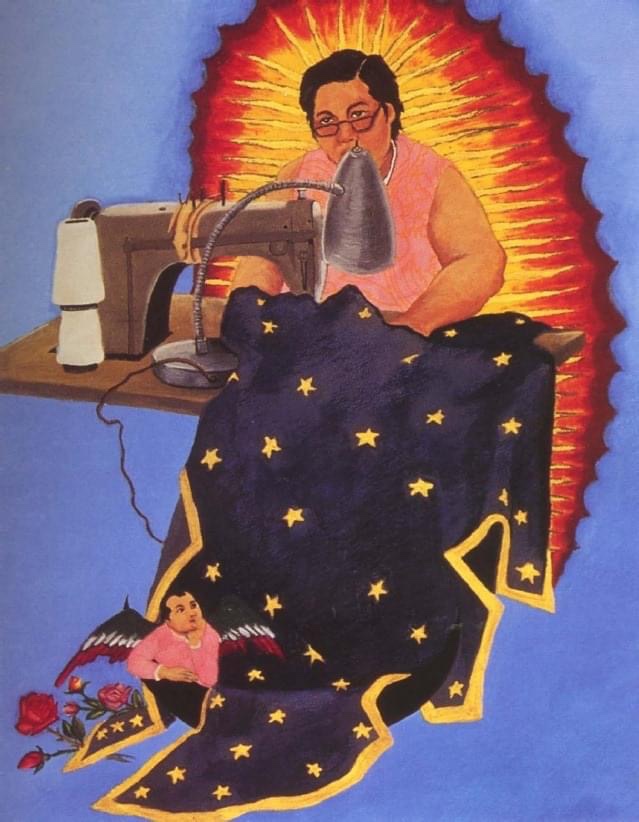
On December 12th many Christians honor Our Lady Guadalupe.
I am not Roman Catholic, nor Latinx, but I do not and cannot underestimate the powerful connection to the Divine that Our Lady of Guadalupe provides for Christians who check both of those boxes. Arturo Perez says it best:
“Guadalupe’s significance is both word and symbol. She provides the answers to the prayers of the faithful people: ‘God is with you!’ Her very appearance, as one of the poor, aligns her with them. Guadalupe’s proclamation can be seen as God’s option for the poor.”
These two depictions, by artist Yolanda Lopez, flow not only from her heritage, but also from her work as a Mujerista Theologian. I find them both engaging and inspiring and, though they’re not traditional icons for this important Feast Day, they moved me.
Today the church remembers a more contemporary saint of fascinating and enduring legacy (though you’ve probably never heard of him): Saint Lars Olsen Skrefsrud, Apostle of the Santals and Patron Saint of Second Chances.
Born in mid-19th Century Norway, Lars grew up in poverty and was not really ever formally educated. He studied largely at his local parish and, after being Confirmed, took on an apprenticeship to be a coppersmith.
But St. Lars had more ambition.
He couldn’t afford to pay for an education, and though he took to writing poetry, all of his poems were rejected for publication. He then set his sights on becoming a drummer in the military, but his contemporaries made fun of this idea. All of this compounded together drove Lars to take comfort in the bottle and, after drinking and coercion from those around him, he robbed a bank.
Once arrested, Lars refused to name any accomplices and was sent to prison at the age of nineteen.
In jail, Lars took up the scholarship he was denied in the outside world. He became a model prisoner, and was sent to the sick ward to tend to the ill. Though rejected by his family and friends, one young woman, Anna Onsum, visited him in prison.
Once released (and absolutely without one cent), St. Lars worked as a traveling laborer and made his way to Berlin to the front steps of the Gossner Missionary Society. There he explained his history and his desire to be a missionary. He adopted a monastic way of life and devoted himself to his studies.
In the fall of 1863, St. Lars headed for India. He worked to pay for his passage, and even slept on the deck of the ship. On board he worked alongside people from all over the world, and began to learn the languages of his companions. In 1864 he arrived in Calcutta and was joined by two fellow missionaries and Anna (and they soon married).
Without any aid from any church, the four took up the cause of the Santals, an oppressed tribe in northern India. St. Lars worked day and night to learn the Santali language and adopt their customs and way of living. They built a mission station there, “Ebenezer,” and while they went about their work St. Lars also went about creating a grammar book and dictionary in the Santali language, as well as textbooks, hymnals, and even a translation of Luther’s Catechism.
Most importantly, St. Lars and his companions defended the Santals physically and vocally against their oppressors, and lobbied the British government on their behalf. He aimed to assist them in raising their standard of living.
He said that his ultimate aim was an indigenous Santal church, noting, “We came to the Santals to bring Christianity, not take away their nationality.” In this he was an early adopter of the accompaniment method, rudimentary as it was, of mission work.
In 1873, after the death of his dear Anna, St. Lars took a return visit back to Europe and arrived to much acclaim. The Church of Norway at last ordained him.
At the age of sixty-nine, St. Lars had a massive stroke, but retained the use of his left hand. He continued to write and translate with his left hand until 1910 when he finally died. He was buried in the cemetery at Ebenezer.
The Santal Church continues on to this day, flourishing as a member of the Federation of Evangelical Lutheran Churches in India.
St. Lars is a reminder for me, and should be for the whole church, that accompaniment is the best model for cross-cultural engagement and that everyone deserves a second (and third!) chance.
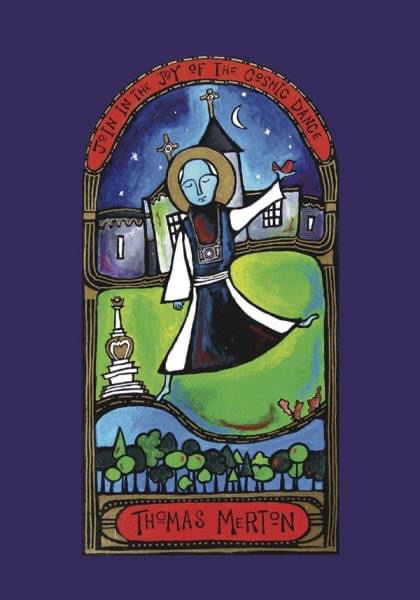
Today the church honors the contemporary Kentucky-dwelling theologian and poet: St. Thomas Merton, Mystic and Renewer of the Church.
Born in France (1915) to a New Zealand painter and American Quaker mother, the family came to America during World War I and settled with family in Queens, New York. His mother died of stomach cancer when he was just six years old and his father quickly fell in love with acclaimed novelist Evelyn Scott. Thomas never liked Scott, and at age eight chose to live with his mother’s family in Dougston, New York. Eventually his father came and moved the boys to France to live after the war (though the family traveled extensively throughout Europe in their youth, shaping Thomas in many ways).
In his early adulthood St. Thomas, like so many saints before him, had a wild streak. While at University in Cambridge, though, he became acquainted with great theological works through a few visiting professor-monks.
Early one morning in 1939, after a long night out at a jazz club, Merton told a few groggy friends over breakfast that he felt the call to become a priest. After fits and spurted attempts to join the Franciscan order, he was ultimately rejected from starting the process. He worked as an English professor at Saint Bonaventure University, believing that if he couldn’t be a friar, he would at least live with them. It was there that he began to practice a monastic way of life.
In 1941 Merton was invited to become an initiate at the Abbey of Gathsemeni in Bardstown, Kentucky, just as his brother was being sent off to war. It is here that Merton leaned into his writing and poetry, even dedicating a poem to his brother who died in World War II.
In 1949 Merton published what he considered to be his conversion story in the much acclaimed (and awesome!) The Seven Storey Mountain. In this work he introduced the greater world to the gifts he found in the monastic life. He continued to write and publish reflections, theological books, and poetry from a deeply mystical standpoint, moving many to explore their spirit and soul both within and without a formal religious tradition.
St. Thomas took up inter-religious experiences as part of his ministry and work, traveling to Asia to pray and study with Buddhist monks there. He saw the great “golden thread” running through the lives of the followers of the great religions, and though he always remained a dedicated and professed Roman Catholic, he sought to traverse religious boundaries, often in the name of world peace, which he fought hard for in his monastic life. In fact, many of his controversial political writings condemning war and militarism were censored by the Church for many years.
He is considered by many to be the one who ushered in a new, contemplative-activist monasticism.
In 1968 St. Thomas died mysteriously while on a speaking engagement in Thailand, but his writings and legacy live on in those mystics who still cling closely to his life and example.
St. Thomas is a reminder for me, and should be for the whole church, that not every religious leader and model wears a fancy clerical collar, and that contemplation and activism must hold hands in this world.
-historical pieces from Claiborne and Wilson-Hartgrove’s Common Prayer: A Liturgy for Ordinary Radicals and a life studying Merton.
-icon written by Marcy Hall at RabbitRoomArts (find her on Etsy)
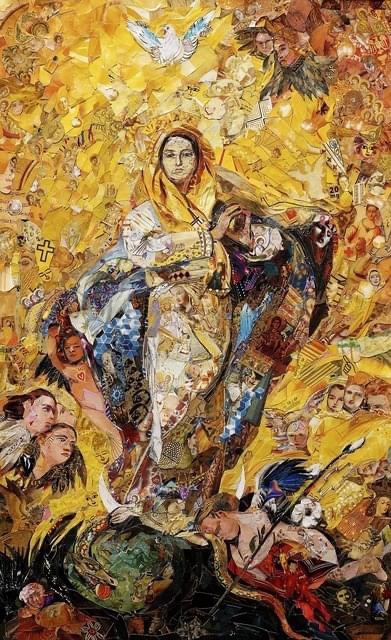
On December 8th many Christian sisters and brothers mark the Immaculate Conception, the day when lore says St. Anne was miraculously “great with child” in the form of Mary, the Mother of Jesus, said to be “born without original sin.”
It’s a relatively recent Feast Day in the festivals of the church, and while there are many traditions who not only don’t honor it, but really wonder why it’s necessary at all, in solidarity with those of different traditions, the theological importance is worth noting despite the biological impossibilities.
I don’t note it as a way to lend credence to its veracity, but more-so to highlight the often overlooked fact that women have played not just an important role in understanding the Divine, but an integral role.
Or, well, perhaps St. Sojourner Truth said it best::
“That man say we can’t have as much rights as a man ’cause Christ wasn’t a woman. Where did your Christ come from? From God and a woman. Man had nothing to do with it.”
I’ve seen people clutch their Bibles, but worship their checkbooks, counting and covering zero after zero. Retirement plans speak louder than God most days, right?
I’ve seen people clutch their scriptures, but bow to their partisan tract, carefully edited Twitter feed, their internet-assembled philosophic convictions shared in group emails people try to opt out of but can’t because “that’s just Uncle Bob,” and sure he’s xenophobic and racist, but he’s “from a different time” as if the past is an excuse for a prejudiced present.
I’ve watched people go straight from closing their New Testaments to complaining at the diner because the waiter has too many piercings, or balking at the short-staffed reality while in their back pocket their MAGA hat pads the seat of their unvaccinated butt, confused why more people aren’t at brunch in a pandemic.
Everyone has a holy writing that they live out. Some are emblazoned on hats.
I’ve seen people pray the prayers of the church but hold Marx as their true Messiah.
I’ve seen people walk from the Mosque, but all the while they have been calculating how much they’ll pocket next year with that big tax break.
I’ve seen people humbly exit the temple and enter the sacred Holy of Holies: the Jaguar dealer, where they haggle on saving more on a sleek purchase than most cars cost outright.
They say they trust in God’s grace, but throw an extra twenty in “just in case” because checkbooks are more tangible than forgiveness.
Everyone has a Holy Book, Holy Writings, words they hold at the center of their life and being.
And it’s often not the one they claim they follow.






 Reluctant Xtian