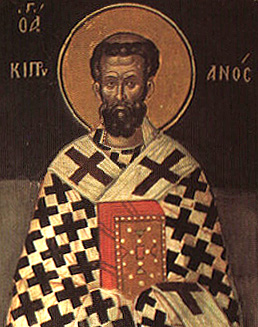
Today the church honors a Bishop who tended his flock during a plague, which makes him a bit relatable, no? Today is the feast day of Cyprian, 3rd Century Bishop and Martyr.
Hailing from Carthage in North Africa, Cyprian was a professor and lawyer by trade, only being baptized in his forty-sixth year of life. Amazingly, however, he was elected Bishop of Carthage only two years after ordination…hardly enough time to understand the ins and outs of parish ministry, me-thinks…but no one asked me.
Cyprian was a scholar and assumed the Bishopric when the church was rocked by schism and scandal. He used his office to gather the church together, seeing the office of Bishop as both encourager of the people and the anchor that holds disparate parts of the Body of Christ in communion with one another. When emperor Decius began persecuting Christians, Cyprian went into hiding, a move for which he was much criticized. He felt that he had to continue to lead his flock through the persecution, and so his survival was paramount. History has taken a more cynical view of this move.
Soon after the persecution a plague broke out in the empire, and the Christians took the popular blame for it. When persecutions again resumed under emperor Valerian, Cyprian willingly and peacefully was arrested on September 14th in the year 258. He died a martyr’s death two days later.
His arrest and appearance before the authorities is well documented, and even appears to have been a peaceful exchange…even though it led to his death. The charges?
He was accused of not bowing and acquiescing to the gods of the empire, of not siding with the powerful against the powerless, and not worshiping the emperors of the day. He spoke against their self-congratulatory ways of operating and their demands for prestige and accolades at the expense of the people they were supposed to serve. He plead guilty and died by the sword.
St. Cyprian asks us a question from his grave in these days:
Would we be found guilty or innocent?
-history gleaned from Pfatteicher’s _New Book of Festivals & Commemorations_
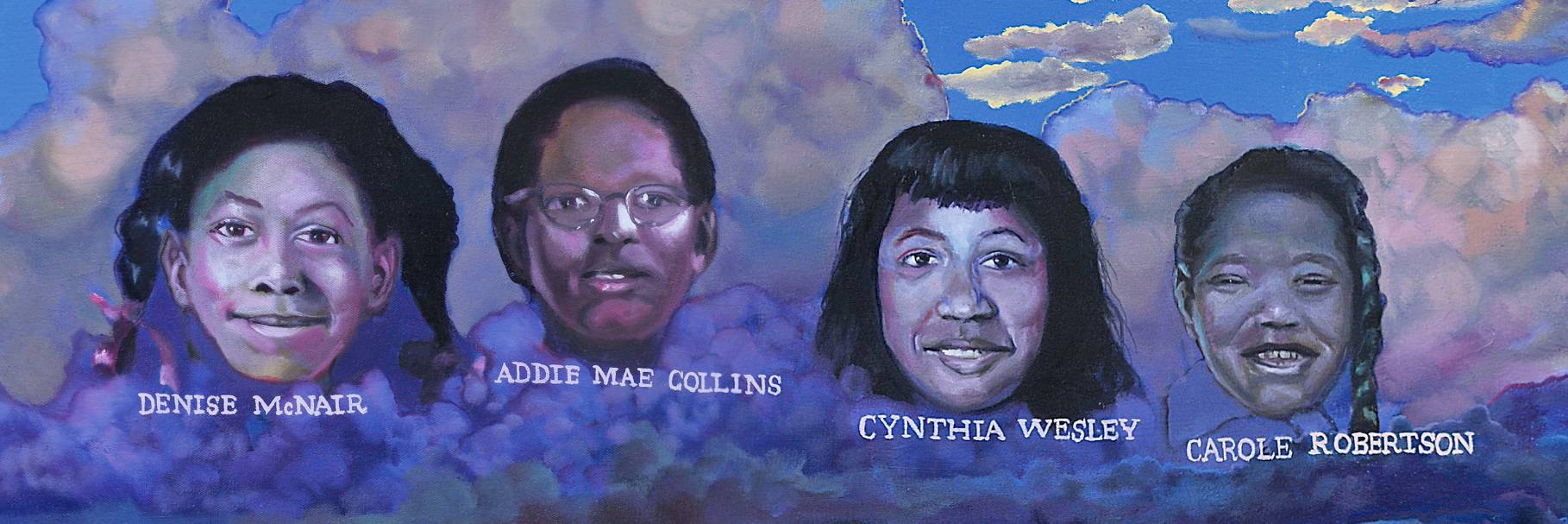
Today the church remembers with sadness and indignation a group of young saints martyred on the altar of racism and white supremacy: Saints Addie Mae Collins, Carole Robertson, Cynthia Wesley, and Denise McNair.
These young women, all under the age of fifteen, were killed when Robert Chambliss, Bobby Frank Cherry, Herman Cash, and Thomas Blanton stuck dynamite under the steps of Sixteenth Street Baptist Church in Birmingham, Alabama on this day in 1963. As Sunday School was beginning, the bomb went off and they were martyred while walking to learn about the Prince of Peace, himself a man of color.
In that blast, twenty others were injured.
The courts found Chambliss, Cherry, Cash, and Blanton not guilty of murder, but fined them $100 and gave them six months in jail because they illegally possessed dynamite, making a laughing stock of not only the legal system, but of every Alabama courthouse emblazoned with “In God We Trust.
“Ten years later, in 1973, the case was retried for this bombing, and they did eventually received a life sentence. Regardless, Saint Addie Mae, Saint Carole, Saint Cynthia, and Saint Denise would not get a second chance at life, no matter how many years pass.
The public funeral for these saints was attended by 8,000 mourners, but no public officials in Alabama thought fit to have their face seen there.
These young saints are a reminder for me, and should be for all humanity, that we are not so many years removed from this tragedy to take for granted that people are safe regardless of their race. Driving from Raleigh to Asheville this last weekend I had to pass by two Confederate battle flags the size of Buicks on route 40, lit up at night as a reminder for every driver on that stretch of land that bombs are liable to be found under every staircase when in the hands of racist, hateful people.
Indeed, sometimes it still feels like 1963.
-historical bits gleaned from Clairborne and Wilson-Hartgrove’s _Common Prayer: A Liturgy for Ordinary Radicals_
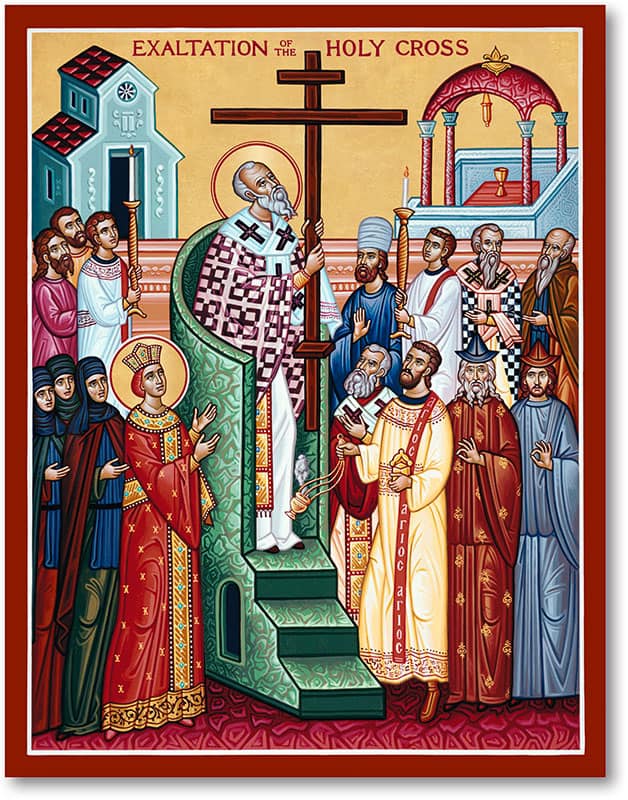
Today both the Eastern and Western Church gather together to honor one feast day known by many names but with one central focus: The Holy Cross of Christ, September 14th.
Sometimes called “The Exaltation of the Cross,” “The Triumph of the Cross,” or simply “Holy Cross Day,” this feast day honors a symbol not a saint…though, in fairness, all saints are symbols.
The particular perspective this feast day nods to is the one found most forcefully in the Gospel of John where the cross is seen both as human humiliation and the gate of Jesus’ glory. Early on the Church endeavored to reclaim the cross as a sign of God’s “alien work,” as our own Blessed Martin Luther called it, and today marks the reclamation on the calendar. Yet, as a symbol, the cross was rarely used in Christianity, as followers seemed to prefer the fish that you see on so many bumpers.
In the 4th Century, however, Constantine formalized the use of the cross as both a symbol of the faith and a symbol of victory…for better and for worse.
This feast day supposedly marks the day when emperor Constantine was building basilicas in Jerusalem, and upon excavating the site for one of them, “discovers” the cross of Christ. The cross was broken into pieces, and purported relics of it can be found from Iowa to Iona.
First celebrated in the 7th Century, this odd feast day continues to be popular, and even finds itself marking the names of several churches to this day. Just Google “Holy Cross” and you’ll find a slew of churches from across denominations, though Lutherans and Catholics seem particularly keen on the name, probably for very different reasons. Luther’s “theology of the cross” (which chaffs at much of what passes for Christian theology these days) remains central to the Lutheran lens on life, seeing the cross as both hinge and key to Divine work and salvation.
Many in the Protestant tradition prefer empty crosses as a sign of God’s victory over death. Many Orthodox and Roman adherents prefer a cross with a corpus, emphasizing the passion and sacrifice. Lutherans tend to split the difference, having images of either…we do love our “both/and,” don’t we?
Lore has it that Eve’s son Seth was barred entrance to the Garden of Eden, but that the angel guarding paradise gave Seth a seed from the tree of the Knowledge of Good and Evil. Seth goes and plants this seed where he buries his father, Adam, and it just so happens to be at Golgotha. The tree that grows from this seed is then used to hew out the cross on which Jesus died.
Yes…it’s a fanciful story, known as the Legend of the Rood. But even in this story we see the earnest hope for the cross embedded in the Christian narrative: that all things can be redeemed in time and used for good, by God.
A symbol of both suffering and self-giving love, of victory and violence, of heartbreak and hope, the cross continues to be at the center of the faith for many. Yet, there’s no need to seek out a relic to find a piece of it.
Dig around your past. Dig inside your heart. Excavate your inner temple and find those broken things in you which, somehow, continue to have and give you life, by God.
Find those times where you were shown grace upon grace and an undeserved second (and third and fourth) chance. Find those pieces of your soul that leap and resonate with the idea that everything, every thing, is in the redemption process somehow.
Do that searching, and I bet you’ll find a piece of that cross buried in there…
-historical parts from Pfatteicher’s _New Book of Festivals & Commemorations_
This past year I’ve been in the habit, on social media, of honoring the saints that the church remembers on particular days. Now, when I say “saint,” I’m using the Lutheran understanding of the word: one who deserves emulation and remembrance for their deeds and example for humanity. In other words, not all of these people I remember are canonized by Rome or the Orthodox community.
That all being said, it’s been suggested that I post these saintly salutations here as well, so I’m beginning that practice this Fall.
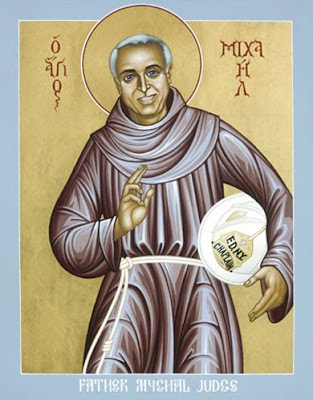
Because I was on vacation this last weekend, I’m posting a retroactive saint remembrance, a saint deserving to be held: Saint Mychal Judge, Saint of 9/11 and Chaplain of Engine Co/1 and Ladder Co/24.
Saint Mychal was not the first victim of the terrorist attacks on 9/11, but he was the first identified victim: “Victim 0001.” He served as New York City Fire Department’s chaplain. A Franciscan friar and priest, Saint Mychal was known for going above and beyond for the women and men he cared for. He often made hospital visits. He was at most every funeral.
And he went to fires, keeping his radio nearby, which is how he heard about the World Trade Center attacks.
While others fled the scene, Saint Mychal rushed toward it in his priestly garb, following the steps of his fellow fire fighters. He immediately started administering last rites to those who were critically wounded, and when he saw his company rush into the North Tower he ran toward it, too, despite the evacuation order.
Outside that North Tower he helped people escape and, while standing there praying, was killed by flying debris as the South Tower fell.
Saint Mychal was more than just NYFD’s chaplain, though, he was also a gay priest (out to his friends) who openly counseled those suffering from AIDs in the 1980’s, performed funerals for AIDs victims when other shunned them, who admitted quite honestly his struggles with alcohol, and who showed up to New York City’s first gay-inclusive Saint Patrick’s Day Parade in his friar’s garb, taking interviews for the media despite the Archbishop’s warning against it.
Saint Mychal is a reminder for me, and should be for the whole church, that the true work is to walk with the people, especially when their lives are on the line, even as the world falls down around them.
-historical bits taken from Illes’ _Daily Magic_
-icon written by Br. Robert Lentz and can be purchased at Trinityicons.com See lessEdit
It’s a Celtic phrase that refers to this ancient idea of a “soul friend,” someone who knows your insides even better than your outsides.
I love it. The phrase itself might be Gaelic, but it’s found in all cultures across time and history. It’s an idea of deep knowing and deep understanding.
As this pandemic has forced us all into a new reality which, inherently, means that we can’t “go back” to the old way we were prior to March 2020, some new sparks have flown and new seeds have been sewn, encouraging us all to discover what community might mean, now.
The Lutheran Church I’m a pastor in (ELCA) is exploring some new ways of doing the spiritual life. I was approached in early 2021 with an idea: what would a “digital-first” community look like that explored spirituality, worshiped primarily through a digital interface, and grew community without geographical restrictions?
I told them I had no idea what that would look like, but that we do see glimpses of it all over the place now.
After six months of study, exploration, meditation, and a good bit of hesitation, the green light has been given to formally explore this kind of community. A shout-out to my partner in this exploratory time: Matt Hansen, a seminarian who comes from the digital marketing world, was imaginative, integral, and will continue to play a part in this work.
We don’t know a lot about what it will look like, act like, or turn out to be in its final form, but my co-curator Jason Chesnut (you may know him from the Ankos Films and the Slate Project) and I know this much:
-it will be both theologically and socially progressive
-it will have an eye toward the medium we’re working with (aka: we’re not just video taping a church service)
-it will be diverse in every way it can be
-it will be exploratory in nature, but grounded in the best parts of our tradition
-it will be a place where Anam Cara, soul friendship, is cultivated because physical proximity will not always be possible.
We’re calling it Anam Cara Community, and it’s just now being formed and birthed. There will be many touchstones: web presence, video, short podcast (cause there are too many long ones out there), blogging (most likely here), social media, scripture studies, worship gatherings, perhaps even an in-person retreat when it’s safe. Our goal is to create opportunities and resources not only for folx curious about spirituality, but also for pastors who need ideas and inspiration. In this way, this community will be unique, formed by both professional church people, non-church people, and people who fall somewhere in-between.
But it will take time, patience, and discernment for it all to come together. New things take time. You’re invited to be a part of the walk an the Way.
All of the above touchstones will begin trickling out, with more fully-formed offerings coming in early 2022. Our goal is to have our initial digital-first worship gathering at the start of Lent of that year.
I’m reminded, Beloved, that the Apostle Paul and much of the early church were in community together largely through letters and shared stories. That was the “digital-first” medium of their day.
Which makes me think this is not only possible, but probably needed for this next phase of our communal life.
Pastors, in so far as they are pastors, are not medical doctors.
Pastors, in so far as they are pastors, are not nurses.
Pastors, in so far as…you get the picture, are not lab technicians, breathing specialists, or any other kind of medical aid.
But they are, I think, healthcare workers. And before you write this off (and few other claims I’ve made on social media have attracted ire like this particular one) let me explain…
Well, first, let me share a memory.
By his green scrubs I knew that he was a breathing specialist. At Northwestern Memorial Hospital in downtown Chicago, the green scrubs were reserved for the breathing specialists, the blue for the M.D.’s, the grey for the surgeons, and the purple for the Chaplains.
There was a code blue. At a code blue the right people all get a page: the attending doctor, the floor nurses, the specialists (should there be one), and the Chaplain.
They all gathered around the body, doing what they could to revive the patient and the breathing specialist turned to the Chaplain and said, “Get in here! We need you. You’re part of the team.”
Now, being part of “the team” doesn’t make you a medical professional, but it does, I think, make you a healthcare worker.
Now, let me explain a little bit more…
President Biden asked “local docs, ministers, and priests” to encourage people to wear masks in this pandemic. He did so because he knows that, in America at least, clergy still hold a particular kind of sway with their congregants.
Yes, it’s waning, but it’s there.
And, especially in a health crisis, that kind of sway brings with it an inherent responsibility to do a few things, in my view.
First: they cannot shy away from speaking openly and honestly about public health and the public good. Many faith communities have come to believe that speaking about masks and vaccines is speaking partisan politics, and that is just a flat out pile of horse shit (insert ivermectin joke here).
Pastors are called upon, by nature of their office, to speak about things that concern the public, their parishioners, and the common good, which is precisely why they were asked to encourage their people to wear masks. The common good is not partisan, Beloved. Hence why it’s called “common.”
Secondly: pastors must follow the best science available. They must. They must hold hands with science, especially in a health crisis like this one.
It is their responsibility to encourage people to do what the best scientists and medical experts are encouraging humanity to do. In a pandemic there is no time or space for fringe medical ideas. In a pandemic there is no excuse for, “Well, 1 out of 10 doctors think differently…” There’s always one crap doctor out there, one quack scientist, and yes one crappy pastor (maybe more, now that I think about it). There’ll always be that one.
But that one little guy? I don’t think you need to worry about that one little guy. Focus on the other nine.
Finally: it is precisely because pastors don’t think that they have this kind of responsibility that they remain so silent on these kinds of public health issues that have a real impact on the common good. But, think with me now, how many healing stories are there in the scriptures? How many stories involve communal health and wellness?
Hundreds, from Genesis to Revelation.
Jesus provided free health care! We’re used to talking about health from the pulpit when it comes from the scriptures, so why are we so silent when it comes from the newspaper?
The key to all of the above, though, is for pastors to stay honest about their role as a healthcare worker, and this is very important (and, I think, the confusion over this piece caused so much backlash when I presented this idea on social media):
Pastors are not trained to diagnose physical ailments and, in most cases, mental illness, either.
Pastors are not experts in medicine, and should not offer some sort of personal opinionfrom the pulpit and claim it has medical authority backing it up.
Pastors cannot look at a major health crisis and give their own advice on the topic, prescribing a course of action for their parishioners that differs from the best science available (this has been a disaster in this pandemic, and caused serious harm to both parishioners and the church at large).
We have an issue in this pandemic, I think, with pastors parading themselves as things they are not.
They cannot, in their pastoral role, encourage their parishioners to burn their masks as if they have the medical knowledge to make such a prescription, choose “faith over fear” and tell people to skip the vaccine, or take some sort of cocktail of horse de–wormer and prayer as some sort of prophylaxis. They are not medical professionals.
And, at the same time, they cannot claim to be agnostic on the subject, saying nothing at all when it comes to the health of their parishioners and the common good. They are not without responsibility and authority.
Pastors are, for better or for worse, healthcare workers in this society. And as such, they have a responsibility to speak openly about the best scientific advice available on the topic, not overstepping their role, but not sloughing it off, either.
Pastors are healthcare workers.
We need to make sure we’re taking on that role with humility, honesty, and the gravity it deserves.



 Reluctant Xtian